

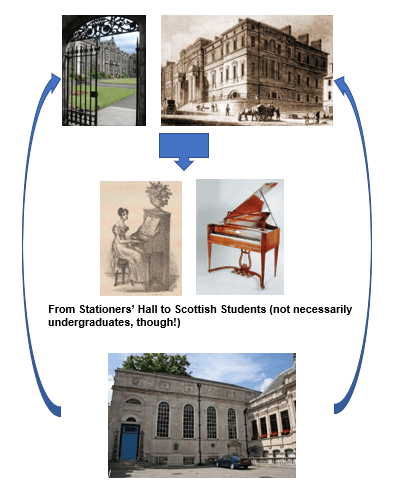
Although, as we’ve seen, some Georgian legal deposit libraries didn’t actually want to retain music – after all, it wasn’t yet a university subject – the pattern of retention was varied to say the least. The University of St Andrews kept quite a bit of music. Meanwhile, the University of Edinburgh retained some but certainly not all that was on offer. However, there’s one category of musical material that seems to have been deemed worth keeping, and that was pedagogical material. I had already noticed quite a bit of it at the University of St Andrews, and I did a bit of research into who borrowed what kind of material. Bear in mind that an ability to play the piano was quite desirable for the well-bred young Georgian miss. When I started looking at the Edinburgh collection more recently, I was interested to see that music teaching books were popular there, too. I wonder if the Edinburgh professors ever borrowed music for their daughters and friends in the same way the St Andrews chaps did?
I plan to see what I can identify on the Edinburgh spreadsheets, and see how it maps across with the St Andrews collections, just to see if there’s much overlap. It’ll be a bit hit-or-miss, but a quick survey will tell me if there is an interesting story to be uncovered. Coincidentally, I did once wonder if any students at my workplace might be interested in the history of piano pedagogy. Little did I realise that I might eventually be the one getting interested in much earlier material in a research capacity!
If I got interested in all of the pedagogical material published between 1780 and 1840, it would be a bit like Alice disappearing down a rabbit-hole, so I’m inclined to focus on one category in particular: the teaching of “thorough bass” (aka “figured bass”) and harmony – in other words, on theory, more than instrumental technique. And if I were to find a few observations about teaching music theory to girls and women, then that would be an added bonus, wouldn’t it? You wouldn’t expect the approach to be different, but it would be interesting to notice any remarks made specifically to them.
Here’s a thought, to start with. After his opening preface, Latour’s thorough bass tutor is heavy on musical examples and light on text, which is a little disappointing given my predeliction for paratext. Nonetheless, in that opening preface, we learn that he aimed to teach “what a young Lady ought to know, viz: to be able to accompany the Voice with propriety, to play from a figured Bass, and to compose her own Preludes, Variations, &c.” From this, we can tell that the “young Lady” was not expected merely to be a performer, but to compose (or improvise?) as well. And the pages of examples that follow provide a good introduction to generating variations – perhaps on popular songs, such as the many sets of variations on national and operatic airs that abounded in the early nineteenth century.
If one instructional treatise tells us this much, how much more might the others reveal?! 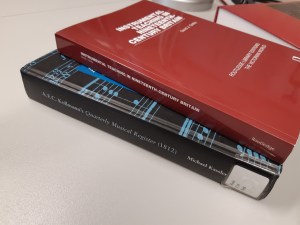 I have a new book that I need to start reading: David J Golby, Instrumental Teaching in Nineteenth-Century Britain (Routledge, 2016 ) – originally an Ashgate imprint, 2004.
 Karen McAulay, Musicologist
I found the same thing Karen and wrote quite a lot about text vs Pedagogy in practice in my thesis. During this turn of the century period there was a division between text-heavy treatises discussing the nuances of harmony and practice-based treatises intended for use with aa teacher. But there was a third type emerging that aimed to be a one-stop-shop without the need for a teacher. It would be great to bring together a comprehensive database of these publications and find out more about how, and where they were used and if the claims made in the treatise were made a reality. In Rauzzini’s case his ‘ideal’ wasn’t quite reached… Hmm… Maybe I should get round to that monograph. 🤔
LikeLiked by 1 person
Have you come across David J Golby, Instrumental Teaching in Nineteenth-Century Britain? It looks to be a combination of extensive commentary and bibliographical listing for INSTRUMENTAL treatises; maybe we need to see how it’s constructed, and see if the same has yet been done for vocal treatises – perhaps going back a bit into the late 18th century?
And yes – write the monograph!
LikeLiked by 1 person
Ah yes! I have (though it has been a while since I read his book and I remember it being quite ‘string’ heavy). The 18th century would be very interesting indeed especially vocal treatises. (I would say that though!) We should talk more next week.
LikeLike
Indeed! I have a new (embryonic) idea. Don’t know our chances, but it would be positively wrong not to investigate this one!
LikeLike