

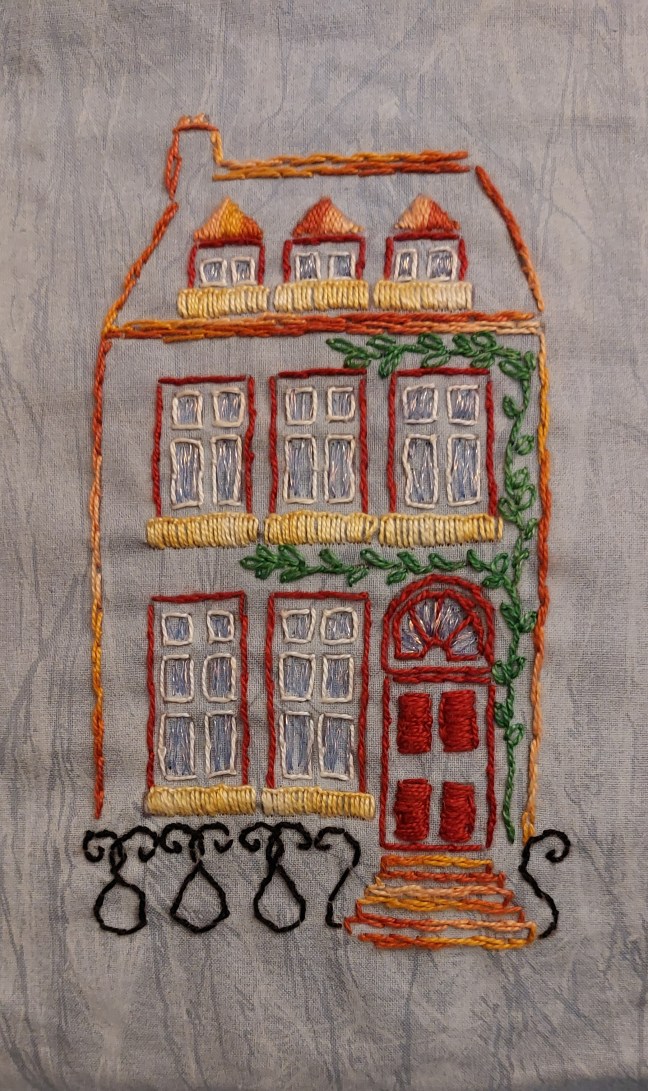
If you’ve visited this blog before, you’ll know I research various aspects of Scottish music history, not textile arts. However, when I take a break from research, I often take up needle and thread – it’s relaxing – and what I sew is quite often a reflection of what I’ve been researching. (I can explain the house at the top of this posting – just read on!)
I applied for an international opportunity to make something really big and research-related, a few months ago. I didn’t succeed, but I went on thinking about it. I’m not following it though, because I would have nowhere to display it if I did make it. Instead, I have scaled it down both literally and in terms of subject matter.
In place of a large wall-hanging representing my latest research in its entirety, I’m trying a new way of making a cloth book, and focusing on a couple of Thomas Nelson books I’ve encountered. I’m still thinking about educational music books published by Nelson in the second quarter of the twentieth century.
I’m using some iron-on embroidery transfers from my late mother’s collection (the kind where you iron-on a line drawn transfer, leaving an outline on the background fabric, then work over it), along with a few ideas of my own.
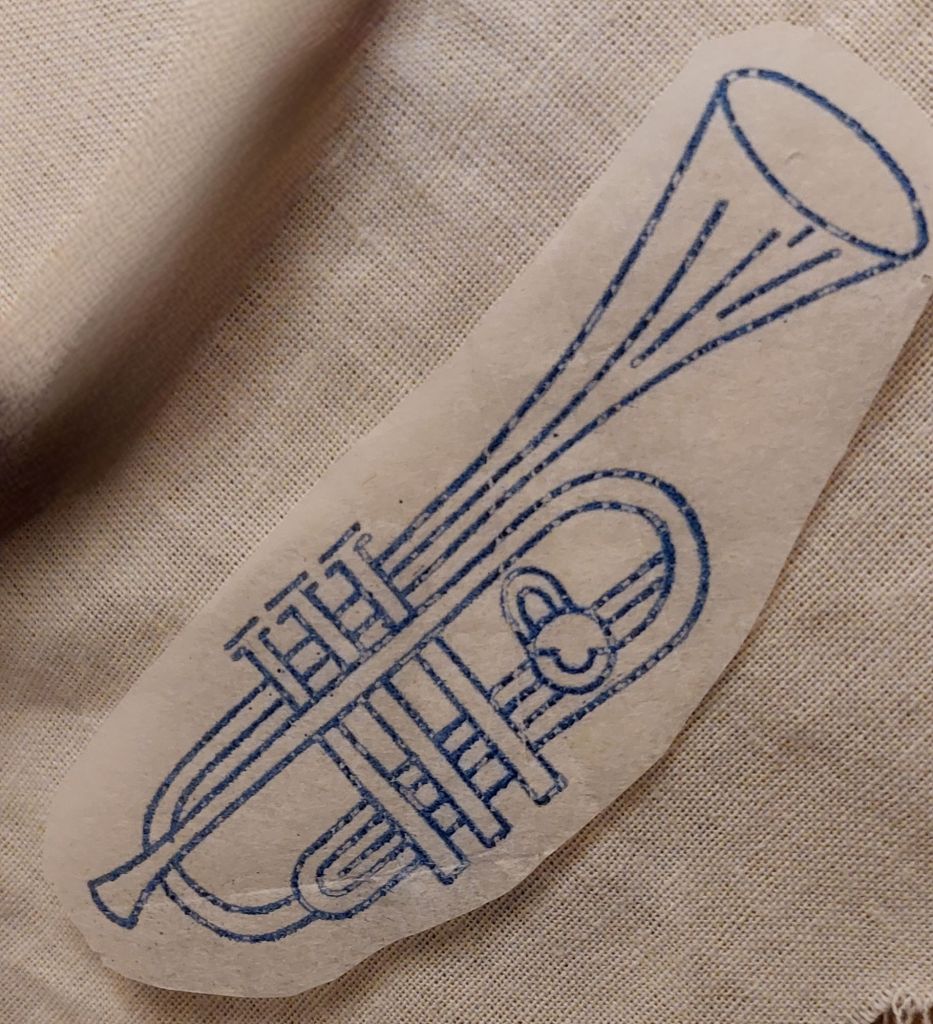
We have only just realised that Mum hoarded things – she was so tidy and methodical that they could be sorted away in that large house, and no-one knew. Why she kept quite so many embroidery transfers is a mystery. For needlework teaching purposes? She retired in 1991! Even I would never get through them, if I live another 30 years.

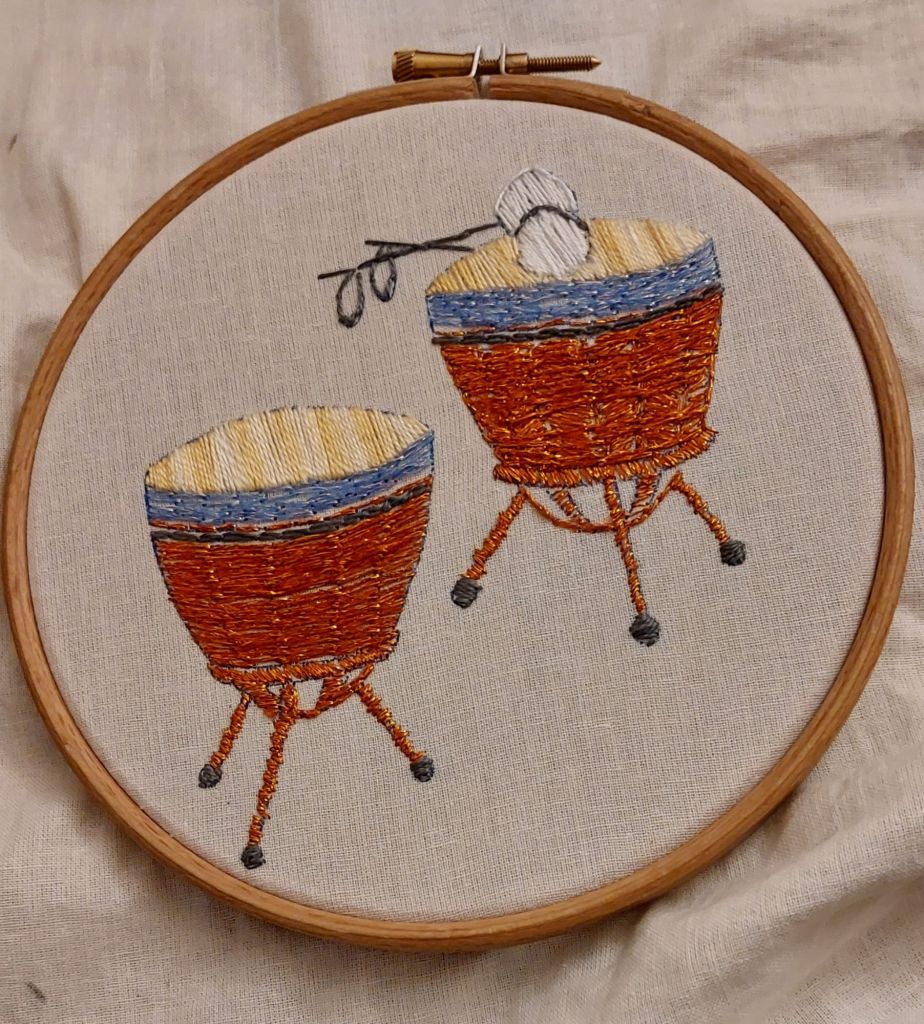
Anyway, with a bit of ingenuity, I’m finding musical motifs that might have been applicable in the 1930s to 1940s: Percussion bands. Brass bands. Wind bands. I’ve copied Thomas Nelson’s singing child motif, and the Nelson publisher motif from books I’ve bought on eBay, and no doubt I’ll use the vintage thistle transfers (Scottish symbols) that I acquired from the same source.
There’s a rather fanciful house from Mum’s stash, which I embroidered against a blue background reminiscent of heavy rain, last weekend – Storm Amy was with us, and I had stayed at home last Friday rather than going to Edinburgh. (A wise choice, as it transpired.) I need to end up with 20 cloth pages, so I might need to go through the stash again to see if I’ve missed anything, or start embroidering quotes that caught my eye. I’ve done one of those already.
‘Three Stars and a Wish?’ Forget it!
I have to keep reminding myself that this is something I’m doing for fun, as an amateur, whilst Mum was a professional. As an old-school teacher, she hadn’t encountered the ‘three stars and a wish’ principle, and if it wasn’t up to scratch, she told you. Straight. No gentle preamble about what you had done well. The ‘Spirit of Mum’ has more than once seen me unpick things because it was plainly ‘not my best’. And whilst my little rainy-day house is now finished (after some unpicking and reworking), I can’t guarantee that I won’t have another go, just to try to improve it. (Maybe representing a sunny day, next time?) It’s strange how one still feels the weight of parental expectations, and hears the criticism, even when they’re no longer around. This is probably the root of my perfectionism – but I’m working on it, honest!
The next problem, of course, is where to put my creations …?
From That, to This (the Original Idea)
It would have been a much larger art work!
Original Artistic plan for the work
I proposed to create a 2-dimensional hanging collage. Predominantly in black and greys, it would have depicted archival shelves and resources; silhouettes of editors; and in the foreground, children singing from the Nelson Scots Song Book,and a teacher at a piano. The song-books would reflect the original colours of the Nelson books. A furled blue and white Saltire flag would have occupied a lower corner of the collage. Further details, space permitting, might have included popular motifs: a Highland piper, a thistle, or a Highland dancer; a snatch of a song in music notation, and a few significant editorial words from correspondence.
Explanation
The narrative behind this collage would have demonstrated that even a set of small Scots song books had an ultimate audience or user in mind, deriving from decisions by compilers and editors, and created as part of their day-to-day work amongst other projects. The books’ contents show the compilers responding to a contemporary urge to educate and immerse young Scots in their traditional culture. Illustrations of resources would have hinted at the sheer quantity of paperwork behind the publications, and would have included stitched representations of bundles of paper, a document file and a correspondence book, whilst small, typically Scottish motifs would, if possible, have reflected (but not reproduced) the well-received line-drawn pictures commissioned for the separate pupils’ editions of the song books.
 Karen McAulay, Musicologist