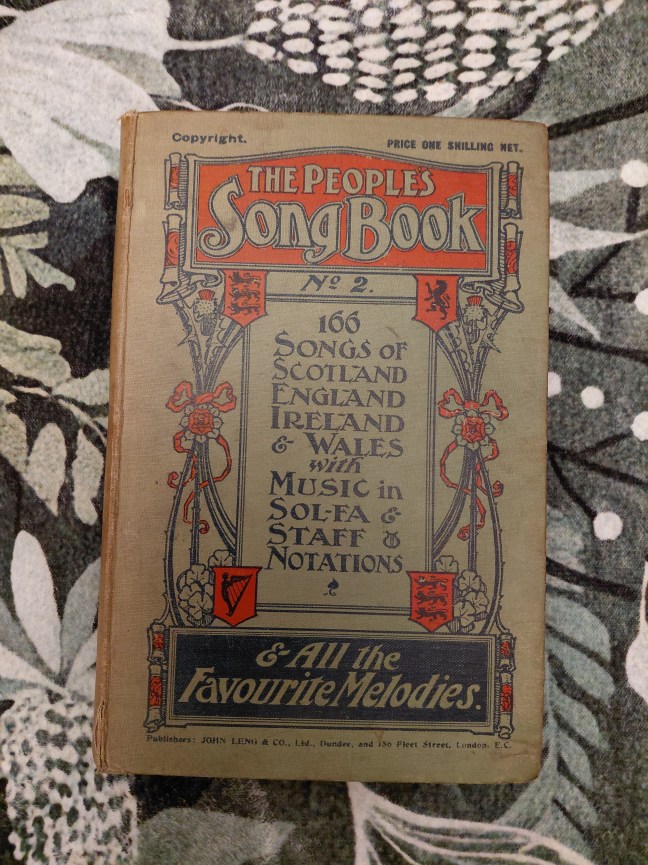
The People’s Song Book No.2 (published by John Leng)

It stands to reason. If I’m researching the John Leng Scots Song competitions, then I might also be interested in this firm’s publications. Not, of course, that there’s any direct link between Leng’s trust fund and the firm’s later publications.  They published general material, magazines and newspapers, and only a handful of music titles.  However, this means that what music they did publish would be of a kind suited to the mass market. 
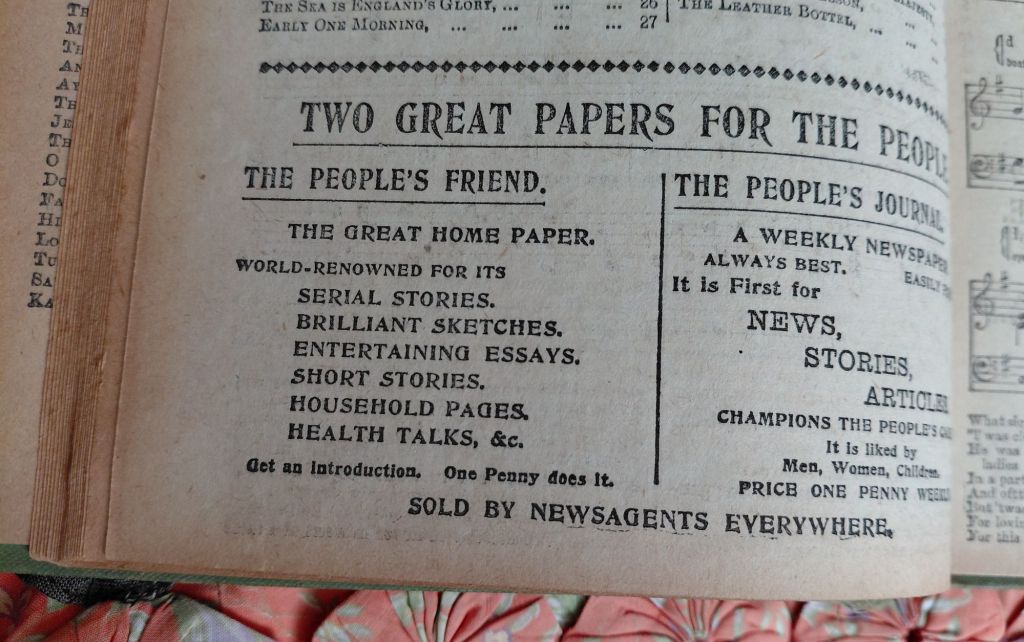
‘For the people’

Is it any surprise that, amongst the ‘Aunt Kate’s’ housekeeping and embroidery books, there might also be dance music and national songs? Which of course indicates their recognition of how popular national songs actually were.
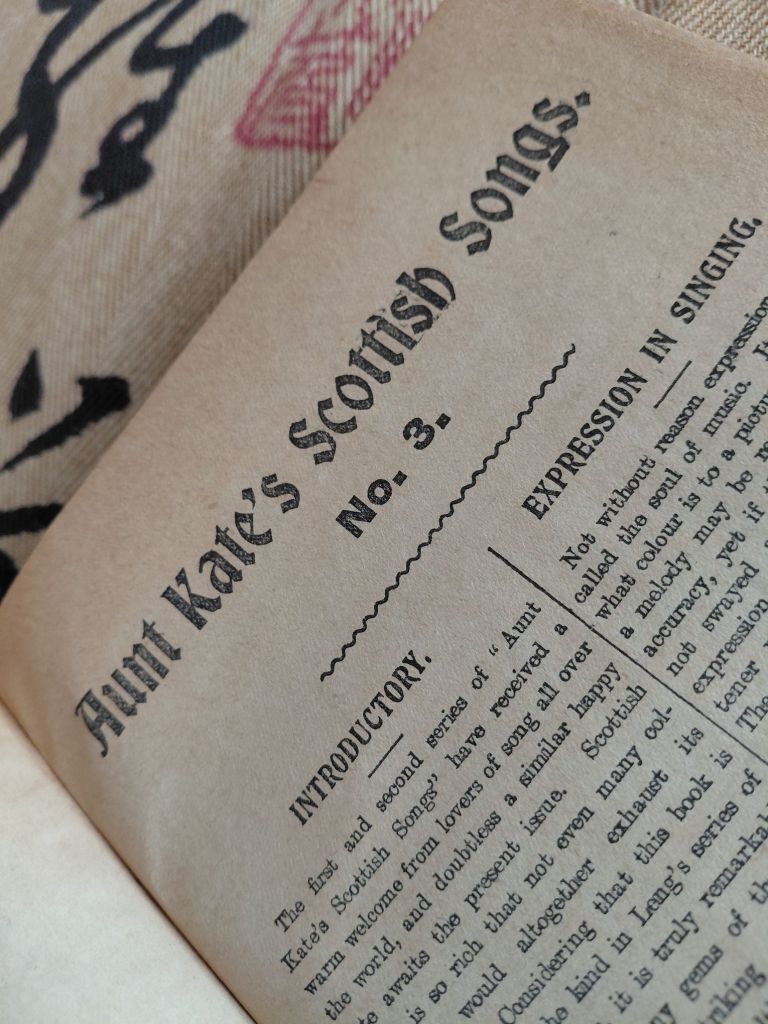
The mythical ‘Aunt Kate’ enjoyed a song!

This week, I bought the second volume of The People’s Song Book, published in 1915. It’s quite an attractive little book, containing 32 Scottish, 33 English, 35 Irish and 34 Welsh songs.

There’s also a section with 32 of the now distasteful genre of ‘minstrel’ songs at the back – blackface minstrelsy, not the homegrown wandering minstrel variety. They are described more insultingly than that, as was the unfortunate custom of that era.

Curiously, these are indicated as a third series of English songs, lower down the page.  (The second series appeared after the Scottish songs.  Remember, this was the second book, so the ‘first series’ of English songs is presumably there.)

Today, we recognise the English and American origins of the minstrelsy repertoire, but I doubt the compilers were hinting at that.  I have written at some length about such songs in my recent monograph – what’s in the present book is no different to those in the collections I’ve already examined.

Notwithstanding this – because we have to recognise that the book is a product of its age, whatever our more informed modern opinion – it would be a strange scholar that acquired book 2, but wasn’t curious about book 1, so I’m excited now to be repatriating the first volume from Virginia.  Perhaps some expat took it with them in their trunk, or had it sent to them as a keepsake?  And now it’s coming home – it feels appropriate.
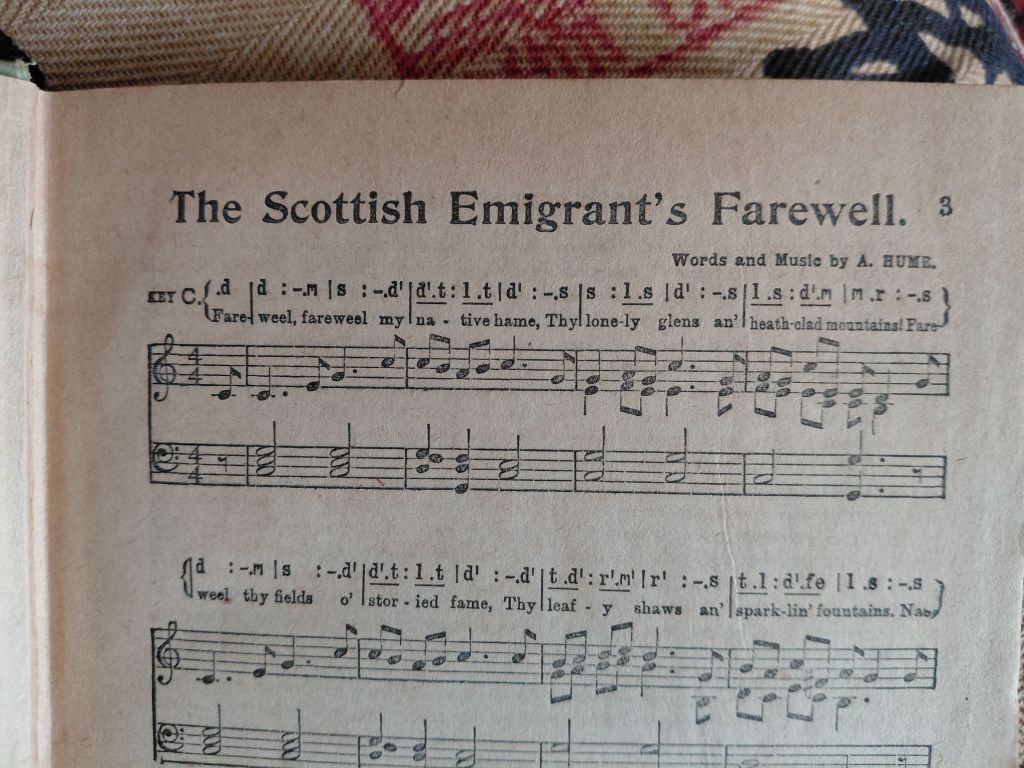
First song in the 2nd book – emigration!

The funny thing about Virginia  – on a completely unrelated note – is that, a quarter of a century ago, I attended a librarianship interview in Richmond. I didn’t succeed  – but I did start my doctoral studies at home in Glasgow, a year or two later.  None of what I’ve subsequently done, would have been done at all, if I’d become yet another emigrant like those of a century before.

And now a little national song book is making its way home to me.  I’ll be sure to make it welcome!

And More?

Book 1 may answer an intriguing question that arose yesterday. I’m impatient!

Yes, Librarians Sometimes Stamp Books … Always Have Done (a historical note)


Ask any librarian: the number of, “I guess you must stamp a lot of books” jokes are nearly as many as “How lovely to spend all your time reading …”.  They drive us insane!

However, when it comes to library history, book-stamps become almost interesting, because the use of one library property stamp or another may shed light on when a book came into the library.  So you begin to see where I’m coming from, when I say that I requested photographs of bindings and any stamps or ownership marks in the music and minstrelsy I’d traced at King’s Inns.

Unfortunately, whilst Edinburgh and St Andrews University Libraries stamped their textbooks if they were “From Stationers’ Hall”, this wasn’t always the case with music – certainly not in St Andrews, and apparently not generally in Edinburgh – and it turned out not to be the case at all in King’s Inns!

Unless a stamp actually SAYS that the book came from Stationers’ Hall, then its only use for book detectives is in the possibility of linking particular stamps with particular timespans.  In King’s Inns, a handful of books yielded three different stamps, but only one bore a date – 1955 – and that just means it was processed in some way at that time. It doesn’t tell us when the book came into the library.  Similarly, whilst I was looking for evidence of library bindings or provenance notes, there wasn’t really enough to go on.  And I say that because we don’t actually know if these items came by the Stationers’ Hall route, where unbound books were quite common, or by nineteenth century donation.

Crosby_5
Crosby – The Irish Musical Repository. Pictures all courtesy of King’s Inns Library.

What we do know, however, is that the majority of this little batch of King’s Inns minstrelsy, whether poetry or with music, was classed in the “Literary” section.  One can only conclude that these were for recreational use – I like the mental picture of a Georgian or Victorian lawyer sitting by his fireside with his feet up, and a copy of Motherwell’s Minstrelsy, Crosby’s The Irish Musical Repository (the spine title is just, “Crosby’s Irish Songs”, in what looks like a twentieth century binding) , Bunting’s A General Collection of the Ancient Music of Ireland, or Ritson’s A Select Collection of English Songs (2nd edition, 1813) on his lap.  Some are graced with charming engravings, whilst Clementi’s London edition of the Bunting collection has a particularly nice title-page.  This last title was held by almost every legal deposit library, so there’s more chance of that one being a legal deposit arrival, especially since one would have expected the original Irish edition to be a more likely holding than a later, English one. However, even in this case, we cannot say for sure that it arrived by this route.  Donations to the library were very common in the nineteenth and twentieth centuries.  At the end of the day, the minstrelsy material is probably more of interest as indicative of nineteenth-century readers’ leisure reading, than as evidence of traffic from Mr Greenhill and the network of London legal deposit agents!

My thanks to the time-consuming and painstaking work of staff at King’s Inns Libraries for taking these photographs for me.

Footnote: There was one pedagogical music item which seems to have been missing at least since the 1990s, but possibly a century or more longer: Charles Mason’s, The Rhythm, or, Times of Musical Compositions Explained and Reduced…  a skinny score, it could have fallen victim to any number of fates, but it means we couldn’t examine it for library stamps or indeed anything else!  Whether misshelved, bound in a bigger volume, or unreturned, let’s hope someone benefited from it first, and that one of the Dublin lawyers or their families gained a suitable understanding of musical rhythm and times!