

 In the past month, I’ve been to Edinburgh, Cambridge and Oxford in connection with the Claimed From Stationers’ Hall research network. I’ve chatted with Almut Boehme in the National Library of Scotland, Elizabeth Lawrence and Jenny Nex at the University of Edinburgh, Margaret Jones and Jill Whitelock in Cambridge, and Martin Holmes and Giles Bergel in Oxford. We’ve talked about how different libraries stored and curated their legal deposit collections, attitudes towards music and cataloguing, and the influence of the British Museum’s mid-nineteenth century cataloguing rules. Several libraries began by categorising their music as instrumental or vocal – so to anyone wondering why our library does it that way – well, we’re following the Library of Congress, and they seem to have followed the British Museum too!
As I’ve mentioned before, our Victorian forbears periodically attempted to impose order on the never-ending stream of music that just kept on flowing into their libraries.
Both in Cambridge and in Oxford, we looked at old bound books of legal deposit music,  and the lists of music – lists that came from Stationers’ Hall at regular intervals, and lists that were made of material as it was accessioned. Serendipity is a wonderful thing – Margaret looked out scores corresponding to material in the lists, and came up with a bound collection of various national songbooks – always a popular genre – not to mention an English opera that might have made no ripples in nearly two centuries, but certainly raised a few smiles in that meeting room in February 2018!
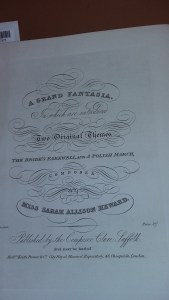 Meanwhile, Martin’s selection of scores included a composition by a young English woman whom I’d never heard of before – Sarah Allison Heward – and a network member in Germany has since unearthed a whole wealth of information about her and her musical family. Watch this space – there’s a blogpost coming up!
A tour of shelves at Cambridge University Library was enough to change the mental pictures in my mind from a general impression of scores gently drifting towards the various libraries, to a picture of a very, very large fountain – or an overflowing bathtub. You see, whereas the Scottish university libraries and Sion College lost their right to legal deposit books in 1836 – a very long time ago – the flood simply never stopped when it came to the national libraries, Oxford and Cambridge. For someone working in a conservatoire library – large enough on its own terms, but certainly tiny compared to the legal deposit giants – it’s quite overwhelming to see just how much music has actually been published. And then, to realise that it hasn’t all been catalogued online – a backlog of these proportions is a frightening thing to get one’s head around! I didn’t ask how many linear miles of bookshelves each library is responsible for – offsite storage and all – but they are certainly amazingly big institutions.
In Oxford, a large data-input exercise in the Philippines meant that most of the legal deposit music has now been listed online, but only by accepting that the catalogue data would be less clearly formatted, and more incomplete, than a modern cataloguer would consider acceptable.
My meeting with Giles, on the other hand, afforded me the opportunity to find out more about two projects using Stationers’ Hall data – one, a commercial database, and the other, a website that will go live in April this year. I also learned about optical recognition software being tasked with identifying different imprints of ballad texts and woodcuts – all fascinating stuff.
Our forthcoming research network meeting will bring together all the legal deposit library ‘descendants’ with a responsibility for the surviving sheet music. There might have been meetings or correspondence between groups of these libraries in Georgian times, but I think we can safely say that there has never before been a gathering quite like this before. We’ll be looking both backwards (at the history) and forwards (at documentation and access issues, not to mention big data considerations. It promises to be quite a day!
 Last week, I was on a research visit to the Universities of Cambridge and Oxford. I’ll blog about the visit on my next dedicated research day. However, in the interests of giving blog followers something new to look at, here’s the resource that Oxford scholar Giles Bergel is collaborating on, with the support of CREATe:-
 Karen McAulay, Musicologist