


My new eBay purchase arrived on Sunday afternoon: Letitia Higgin’s Hand Book of Embroidery, published by her employer (the Royal School of Art Embroidery) in 1880, and edited by the Vice President of the Society: Lady Marian Alford. It’s a modern reprint: the original is an appropriately antiquarian price.
The Society had been founded in 1872. Letitia (Lily) was a middle-class young woman needing to earn her own living, who, with two of her sisters, was employed by the Society. She was promoted to a senior position, and wrote this handbook not for absolute beginners, but for ladies who had learned the basics and needed to know more. The introduction explains that the book answers some of the most frequently asked questions. Brilliant, I thought. This could be just what I need. You know how I enjoy embroidery, even if I’m just a relative beginner.
A Daughter of Margaret Maclean-Clephane
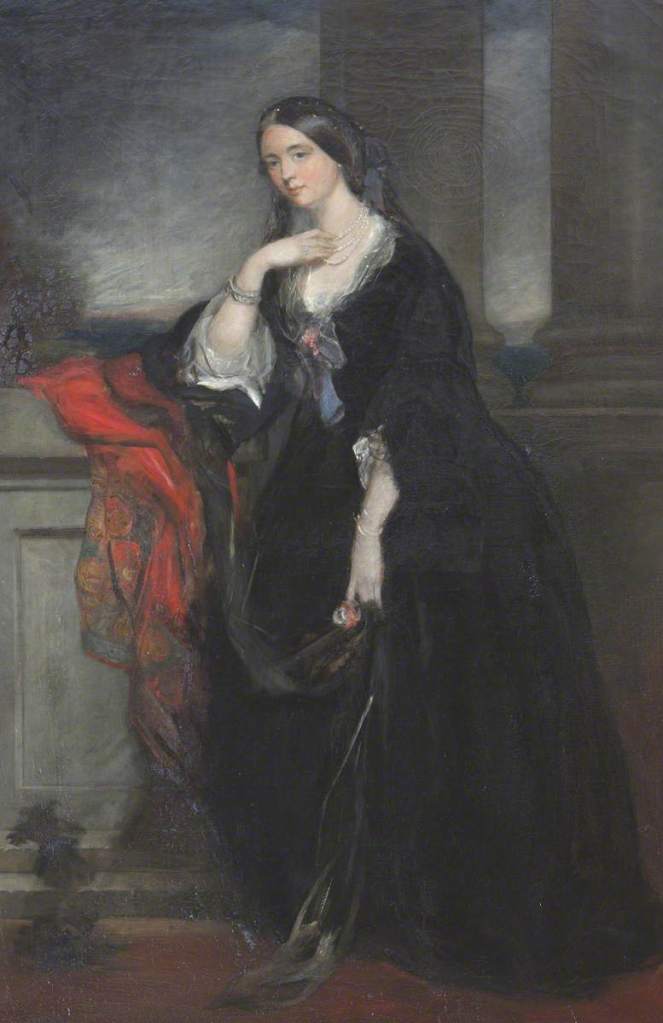
Enter Margaret Maclean Clephane’s elder daughter, Marian (Marianne)! The book’s editor was none other than a daughter of song-collector Margaret Maclean-Clephane. (Just for the record, Margaret’s married name was Lady Compton, and later Lady Northampton. That’s why her daughter was Lady Marian Margaret Compton.) Lady Marian’s musically gifted mother was also a poet. The family evidently had creativity in their genes. Marian’s aunt Anna was a song and folklore collector too; her other aunt was artistic; and now we find that Marian was a talented needlewoman.
A Copyright Dispute
The guide was so popular that the Society had hoped to produce a second edition, but a copyright dispute between author and editor meant that this didn’t happen.
I sat bolt upright. We ordinary folk shall never know what the dispute was. (I learnt this much from Wikipedia. See reading list below.) Maybe the Society has archival paperwork that tells more, but I really must not let myself get distracted at the moment!
Giving Credit where Credit’s due
From my vantage point as a 21st century author, it would be easy to feel outrage on Letitia Higgin’s behalf. Had she done all the work and written the whole book, only for Lady Marian Alford to sweep in and add her name to it? Realistically, having a titled name on it would probably have added gravitas and authority in 1880. My guess is that Letitia Higgin did most of the hard work, and Lady Marian put her own titled gloss on it, but I simply don’t know. We can’t jump to conclusions.
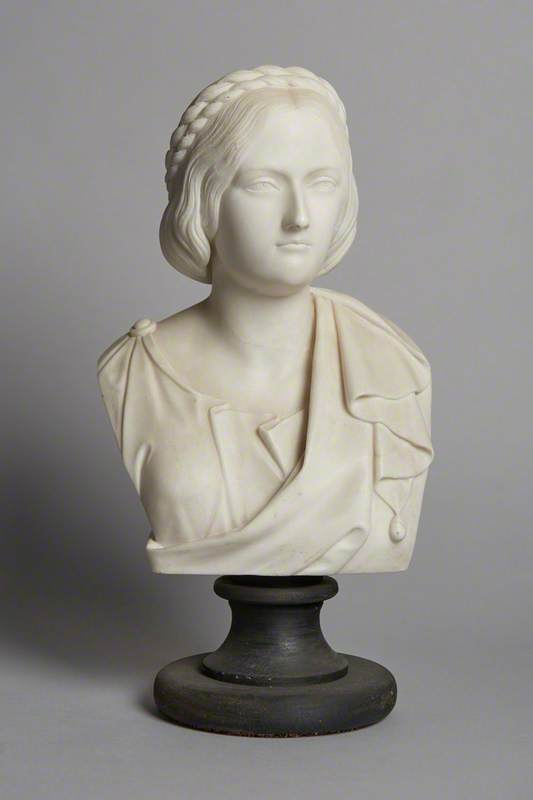
Ernesto Cali (b.1821)
National Trust, Belton House, again via Art.UK.
I do know that Miss Higgin also wrote magazine articles referring to the book, and Lady Marian also authored other works. Neither woman’s expertise is in question.
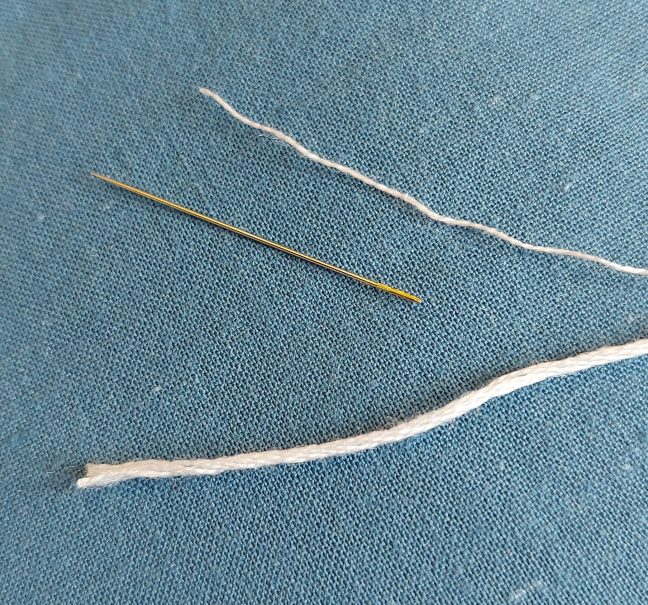
Anyway, I intended to use the book for the purpose of self-instruction, so I turned the page to find out about needles. It informed me I should use a size 5 needle for crewel work. To be honest, I don’t think I’m doing crewel work (with crewel yarn), but embroidery. With embroidery silk. I had imagined it would be similar, but I imagined wrong.
Five is Larger than Nine
Moreover, Miss Letitia Higgin and Lady Marian Alford didn’t think to tell me that size 5 needles are larger than size 9. I suspect I may have been using the right size for embroidery all along (without knowing a scooby about sizes and numbers), but now I reached for the tiniest size needle, and spent far longer than was reasonable, trying to thread one strand of thread into the eye of a needle that I couldn’t even see. Ughh! I blamed the eye (my own) that can’t even read with glasses. Eventually I used a needle threader. The thread broke. I did get dressmaking thread through the eye. And I bent the needle before getting the single strand of embroidery floss through the eye. The eye of the needle was ludicrously, but appropriately small for such a tiny wee needle.
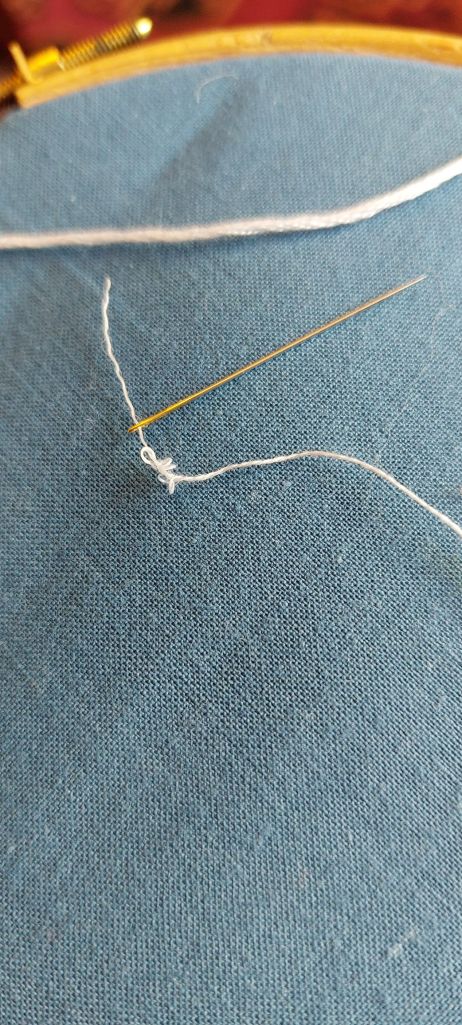


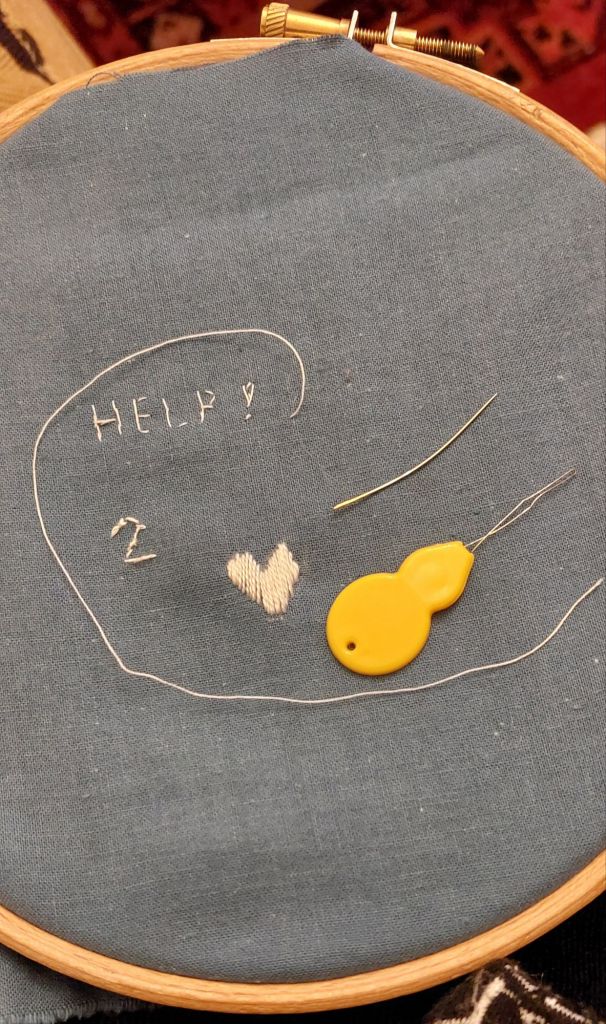
Temporarily giving up on Higgin and Alford, I turned to YouTube. Thankfully, Sarah Homfray has done a series of YouTube videos about embroidery, and that’s how I learned that 5 was actually larger than 9:-
‘Are you using the right sized needle? I show you how to pick the right one!’
https://youtube.com/watch?v=PtBGZn0yohU&si=LJomNgTXJTZ_hoMT
I shall eventually return to Miss Higgin and Lady Marian Alston. I’m sure they have useful knowledge to impart, quite apart from the insights into the pastime of embroidery in the late Victorian era. You could buy a marked canvas, which someone at the Royal School of Art Embroidery had prepared and even started off for you. That sounds helpful!
However, today? I’ve signed up to a local evening class. (Although I don’t know if I’ll ever be capable of marking out a canvas to make Higgin’s and Alford’s piano cloth design!)
READING LIST
- Alford, Marian, Needlework as Art (London: Sampson Low, Marston, Searle & Rivington, 1886.)
- Alford, Marian – other works of local history interest.
- Higgin, Letitia, ‘Art Needlework’, articles in The Art Amateur (1880) Vol.2 issues 5 and 6
- Higgin, Letitia, Hand Book of Embroidery, ed. Marianne Margaret Compton Alford (London: Published by Authority of the Royal School of Art Needlework, 1880)
- ‘Higgin, Letitia’ – Wikipedia entry
- Homfray, Sarah, ‘Are you using the right sized needle? I show you how to pick the right one!’ YouTube
- Hulse, Lynne, ‘Higgin, Letitia (Lily) , author and embroiderer’, in Oxford Dictionary of National Biography
- Northampton, Margaret Compton, marchioness of (d. 1830), Manuscript book of poems, dated 1808-1821, by Lady Compton (Lady Northampton), also transcription of poems, dated 1804-1840, by her sister Anna Jane Douglas Maclean Clephane.] National Trust Libraries – Note on Jisc Library Hub Discover:- ‘Poems stated to be by Lady Compton (as Lady Northampton was known 1815-1828) on pp. 1-47, and by Lady Northampton on pp.113-120; poems by Anna Jane Clephane on pp. 52-110 and 121 to end (many with monogram AJC).
- Royal School of Needlework. Our History
 Karen McAulay, Musicologist