

Back in January, I started thinking about the repurposing of tunes by Georgian composers – whether arrangements, piano variations or other interpretations. Rossini particularly came to mind, because his operatic airs were so very heavily used – but it wasn’t just Rossini’s rights that intrigued me – what about all the other instances of repurposed tunes? I blogged, and then I threw the question open to the Claimed From Stationers’ Hall network, and – as I’ve already posted – Paul Cooper of RegencyDances.org and German folklorist Jürgen Kloss enthusiastically joined in the discussion, sharing some useful links to articles and postings that I’ve since incorporated into the 5th edition of our bibliography.
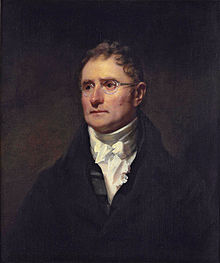
The conversation continued. Last week, Jürgen shared evidence that Scottish music publisher George Thomson became very concerned by the upstart Joseph Dale pirating piano music by Ignaz Pleyel that he, Thomson, had originally published. (I’ve used the Copac spelling of Pleyel’s forename here.)
German folklorist Jürgen’s thread was so intriguing that I offered to blog it in its entirety, and what follows is his input. I’d like to thank him for so graciously allowing me to reproduce his narrative on this blog.
Guest Blogpost by Jürgen Kloss

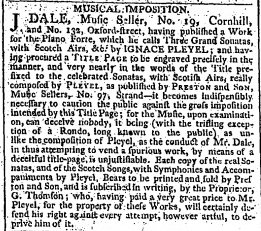
@juergenkloss (Jürgen Kloss) 12 Feb: Further to our early copyright discussions as to who “owns” the music?, I found this ad: “Musical Imposition”, in which George Thomson – editor and publisher of Scottish songs – warns against a “spurious” ed. of sonatas by Pleyel, publ. by J. Dale:-

Indeed, Thomson regarded Dale’s ed. (ad in OAPA, 12.3.1794) as an attack on his own investment: “G. Thomson, who, having paid a very great price to Mr. Pleyel, for the property of these Works, will certainly defend his right against every attempt, however artful, to deprive him of it.”
Of course Mr. Dale kept on publishing these works: Twelve Grand Sonatas for the Piano Forte or Harpsichord […] In Which are Introduced a Variety of Scotch Airs, Book 2 (1798) (this copy in the University of Iowa Digital Library):- http://digital.lib.uiowa.edu/cdm/compoundobject/collection/pleyel/id/8775 … And he claimed to have the original editions:-

Even several years later, in some editions of his Select Collection, Mr. Thomson still warned against the “wretched imitation” published by Dale.
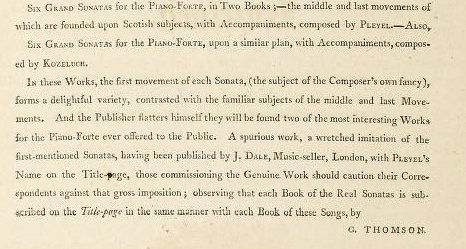
https://archive.org/details/selectcollection00pley/page/n9 …
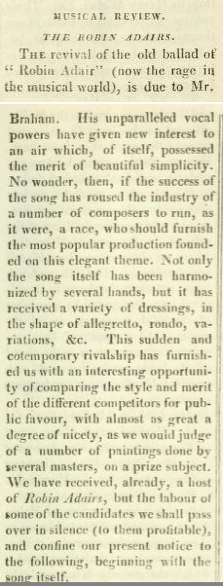 And here’s another disputed instance: that of “Robin Adair”. (See Jurgen’s blog of 2014, link below.) This old tune was revived in 1811. Composer William Reeve wrote a new arrangement and John Braham sang it with a new text. The new “Robin Adair” was a great hit… https://hummingadifferenttune.blogspot.com/2014/02/john-brahams-robin-adair-1811-original.html …
…and of course other publishers quickly offered their own editions. But Mr. Reeve sent letters to newspapers warning against “spurious” editions. This letter even appeared on the title-page of the sheet music, see below: https://archive.org/details/sheet-music-RobinAdair-Braham-London1812 …

Interestingly, composer J. Mazzinghi couldn’t resist publishing an answer to Mr. Reeve’s claims in his own edition of “Robin Adair”. He said it was a big success because of the tune and Braham’s performance (and Reeve had no rights to the song)! http://digitalcollections.baylor.edu/cdm/ref/collection/fa-spnc/id/8566 …

Of course: songs are money, especially popular hits like this one. Later it was claimed that “in one year, […] upwards of two hundred thousands copies” of the sheet music were sold. Therefore it is understandable that Reeve was a little bit nervous about competing editions:-

There is much fascinating detail to absorb in these stories that Jürgen has generously shared with us.
MAYBE YOU’D LIKE TO LEARN KNOW MORE?
Jürgen’s newspaper references are available via these electronic resources:-

Jürgen also traced a reference to a paper that Claire Nelson gave at the International Musicological Society’s 17th Congress in Leuven, in 2002. Here’s the abstract:-

The paper wasn’t published in its entirety that year – just the abstract, in the conference programme above – but the good news is that it became a chapter in Nelson’s doctoral thesis in 2003, when she completed her DMus at the Royal College of Music. The thesis can now be downloaded free of charge via the British Library’s EThOS service.
Nelson, Claire M., Creating a notion of ‘Britishness’ : the role of Scottish music in the negotiation of a common culture, with particular reference to the 18th century accompanied sonata (Royal College of Music, 2003, Access from EThOS:- https://ethos.bl.uk/OrderDetails.do?uin=uk.bl.ethos.489910
Go to page 240 of Nelson’s thesis to read more about George Thomson’s disgust at Joseph Dale’s shameful piracy. She quotes (and provides an English translation) from a letter that Thomson wrote to Pleyel in 1794:-
“Dale has done something most shameful and most offensive. He has published three sonatas with Scottish airs, exactly on the same plan as mine, and their title is engraved in the same way and almost in the same words, your name is given as the composer! His intention is evidently to deceive the public and without regard to my sonatas, pass a work supposedly of your composition, I have published an advert revealing the fraud, and hope that you have had no part in the work of Dale.”
Thesis footnote 102, translating the French original reproduced in Pincherle’s 1928 article, (Marc Pincherle, ‘L’Edition Musicale au dix-huitieme siecle: Une letter de Thomson a Ignace Pleyel’, Musique i (1928), pp.493-498), p.496.
Earlier Claimed From Stationers’ Hall Blogposts that you might enjoy:-
- What did Rossini think? (16 Jan 2019)
- Copyright Contradictions (5 Feb 2019), referencing Paul Cooper’s postings about dance music publishers’ copyright skirmishes)
And of course there’s much more to be found in the network Bibliography!
Of particular interest in this context are the articles by William Lockhart ( ‘Trial by Ear: Legal Attitudes to Keyboard Arrangement in Nineteenth-Century Britain’, Music & Letters, 93.2 (May) (2011), 191–221 https://www.jstor.org/stable/41684166 [accessed 31 January 2018]) and Charles Michael Carroll (‘Musical Borrowing: Grand Larceny or Great Art?’, College Music Symposium, 18.1 (1978), 11–18 https://www.jstor.org/stable/40373912 [accessed 12 January 2019]) – but seriously, there is a lot more to read if you’re keen to find out more! And of course, don’t forget that Jürgen Kloss and Paul Cooper have both written extensively on the subject – their blogposts are also listed in the bibliography, naturally.
(I must confess that I’m eager to download Pleyel’s Twelve Grand Sonatas – whatever the edition! – to see what they’re like, too!)
 Karen McAulay, Musicologist