

In historical musicological research, sometimes apparently inconsequential names assume disproportionate importance. This was the fate of Caleb Concord this week. Apparently a contributor to the Aberdeen Censor – a journal which only lasted 13 months from January 1824 to January 1825, Dominie (schoolmaster) Concord submitted his autobiography in four lengthy letters, and in one of them, he opined that the Marischal students should be more concerned about what had happened to the Stationers’ Hall music.
This raised more questions than answers. I went to read the journal at the National Library of Scotland. Concord appears several times in the journal, including a couple of letters to the editor, quite apart from his autobiographical contributions. The pieces are very tongue in cheek (viz, his wives’ names, their characterisation – and a flattened cat!). His name also appears in another contemporary Aberdonian book by someone else delighting in not one but two pseudonyms (a common enjoyment in the 1820s). But you won’t find Concord in genealogical or newspaper sources online, and I’ve been fortunate to have made contact with perhaps the only person who could immediately provide an identification. Behind the pseudonym lurked a very real person, but not the person I thought!
Concord claimed to be a good singer and piper, teacher not only in school but also of songs and psalmody on Thursday nights!, and a kirk session clerk. Last week, I conjectured that he could have been the schoolmaster of Footdee and session clerk of St Nicholas Parish, one William Smith, in the 1824 Aberdeen post office directory, maybe even a brother of the publisher, bookseller Lewis Smith. I was completely wrong! Iain Beavan has generously provided a positive identification, which we’ll divulge in due course. Whether ‘Concord’ was musical remains to be seen!
Now, one might ask whether his identity actually matters one iota?!
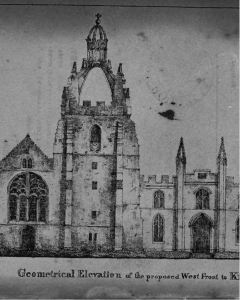
The most important thing about “Caleb Concord” is his observation about the Marischal students, and it’s intriguing because at that time, the Marischal students had virtually no access either to their own college library or to the library of King’s College Aberdeen – and it was King’s College that received the Stationers’ Hall legal deposit materials. Last year, Iain Beavan wrote a fascinating article, ‘Marischal College Library, Aberdeen, in the Nineteenth Century: an Overview’, in Library and Information History 31:4 (258-279). It is clear that students in the early to mid 19th century had a very raw deal as far as libraries were concerned, and the animosity between the two colleges extended for many decades on account of King’s College’s determination to keep hold of the legal deposit books.
What we do know, from Barry Cooper and Richard Turbet’s bibliographical work on the Aberdeen early music holdings, is that not much survives from before 1801, and some 4000 items survive from after this. Iain Beavan has found reference to the possibility that some of the Stationers’ Hall music might have been sold, and that’s a matter of some interest. Certainly, the debate was raging about legal deposit holdings in Aberdeen, and it is not surprising that the public debate should be referred to in a local journal.
 Karen McAulay, Musicologist