Dr Karen McAulay explores the history of Scottish music collecting, publishing and national identity from the 18th to 20th centuries. Research Fellow at Royal Conservatoire of Scotland, author of two Routledge monographs.
WordPress reminded me of a blog post I authored a few years ago. Since I’m still thinking both about folk songs and lady piano teachers …I thought I’d share it again. Who wrote the books? Who wrote the songs? Two important questions.
I was being a dutiful music librarian yesterday, when I looked up the Tonic Sol-Fa proponents John Curwen and his son J. Spencer Curwen, to see what of their output was in the Conservatoire library. My first shock was discovering that we had catalogued a couple of Mrs J. Spencer Curwen’s piano teaching books under […]
After attending last week’s Donne launch (when I found the opportunity to mention my earlier work in the Whittaker Library), I looked back at my 2023 open access article about increasing women composers’ representation in the Whittaker Library. Just in case you missed it in 2023, here it is again, ‘Representation of Women Composers in the Whittaker Library’. Enjoy! Let me know what you think.
I’m no longer a librarian, focusing solely on my musicological research, but I can still look back with pride on some of my more notable successes. This was definitely one of them.
I sat down in my home office alcove this morning, and realised that my desk actually tells you everything about me!
ORGANIST
the Billy Graham All-Scotland Crusade 1955 song book, open at ‘The Solid Rock’
Ancient laptop – used only for Allegro Finale Songwriter (I was transposing the song, and reducing it to three rather than four vocal parts)
Under my desk, a box containing new choir anthems …
MUSICOLOGY
CDs of an organ that had been inaugurated by the Athenaeum’s second Principal, Edward Emanuel Allan
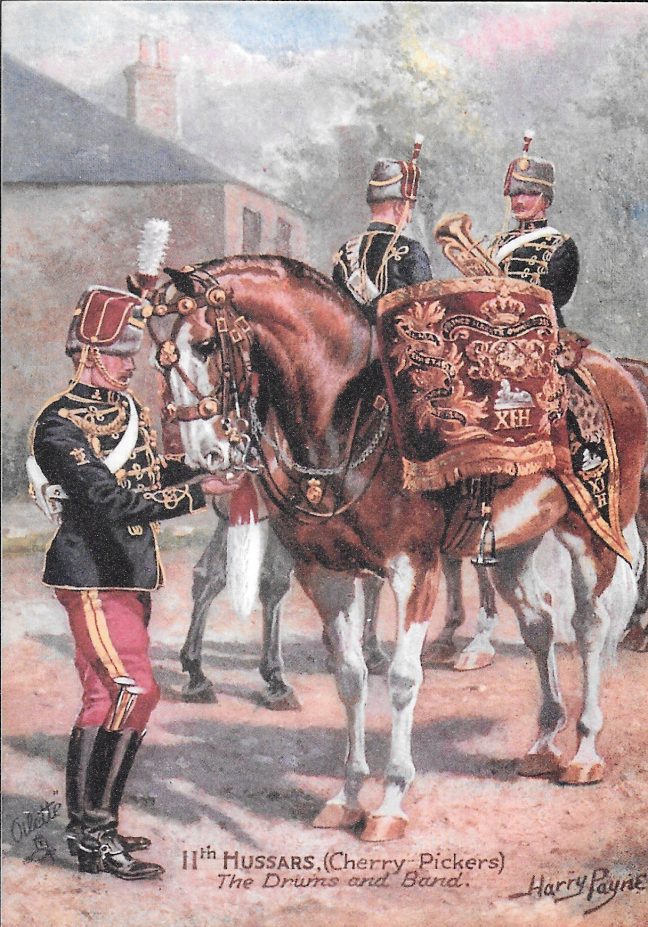
Picture of a Victorian 11th Hussars trumpeter
ANYTHING FABRIC-RELATED
Samples of fabric, most of which I won’t be ordering!
(I could add context, and explain that I’m a semi-retired researcher and a church organist!)
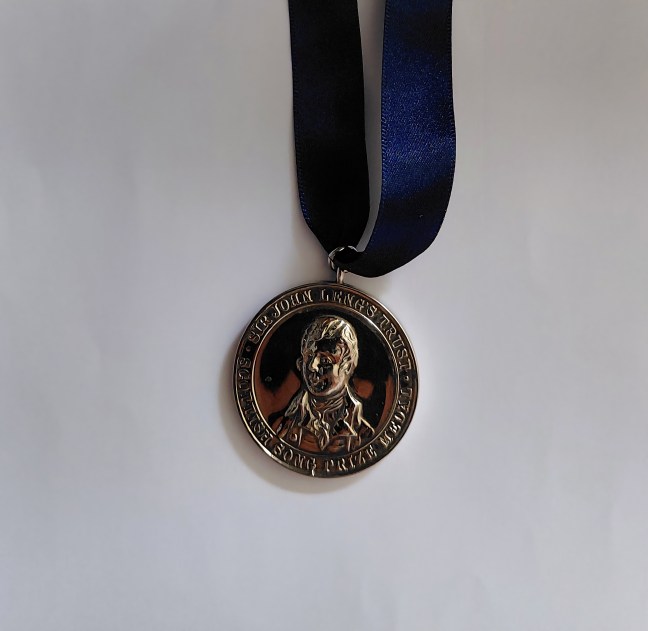
Right, the song book and old laptop are closed. I fix my eyes firmly on the Leng Silver Medal on my pinboard. That’s this morning’s focus! But I just can’t put away the 11th Hussars trumpeter – it’s the closest I’ll get to Trumpet-Major James Smith today!
On this day in 1899, the late publisher James S. Kerr’s daughter Maude took possibly the worst decision in her life – she married Benjamin Disraeli Wigton, Second Officer of SS Britannia.
Anchor Steam Liner Britannia between Glasgow and Bombay
A descendant hinted that they may have been distantly related. That was not the problem. (He also spent some time in an asylum in the West of Scotland, for which we can’t condemn him, obviously.) The bridegroom, with perhaps the most memorable Christian names I’ve ever encountered, went on to marry other ladies in Australia AND New Zealand. However, he was certainly more than a bigamist. It must have been comparatively easy to get away with, in those days. But with such a conspicuous name? Breathtaking audacity!
Maude [Maud] Speirs Kerr divorced him not long after her mother died, and went on to make herself a new life in America. Did she deliberately wait until Mary had died before taking this step? Who knows!
The Scotsman, 17 Oct 1910 – only one extra wife was mentioned here!
I’ve had a series of phone-calls from the in-house talent team at IQVIA today. This is apparently because I am looking for clinical manager roles. I can see one tiny problem. No, more than one!
AM I?
I’m semi-retired, and geographically tied to where I am. I can’t relocate. And whether or not I would take on more work is hardly the question, because I haven’t activated LinkedIn’s looking-for-work function. Quite apart from the elephant in the room – that job title.
They were Persistent!
I ignored the first call. Told the second and third that I hadn’t asked them to contact me. Finally, I asked the fourth caller – Amelia – why she thought I was suited for a role as clinical manager, and she said it was because of my LinkedIn profile.
Have I ever intimated that I have medical qualifications? I have not. I told Amelia very firmly to remove me from their database because I am utterly unqualified for a clinical manager role. (I’m not even entirely sure what a clinical manager does!)
However, if I get any more calls, I can’t promise that I won’t enjoy myself stringing them along and wasting a bit of their time. I’ll share my age and qualifications. I’ll tell them about my specialisms, and bring them up to date with my latest research. It’ll be most amusing – well, to me, at any rate.
After all, my insights into the history of Scottish music publishing might be exactly what is needed to cure someone’s duodenal ulcer …
WordPress has a habit of reminding me what I posted ‘on this day’ in previous years. Today’s reminder has been quite interesting!
2019
… seems a long time ago! I was in Killin, speaking at the Clan Gregor Weekend. Sir John Macgregor Murray was an interesting historical figure whom I’d encountered in passing during my doctoral research. A decade later, I’d been invited to give a research paper about him at the Sorbonne, and it turned out that Clan Gregor was also interested in my research, so I gave an after-dinner talk there, too.
The paper eventually became a peer-reviewed article in vol.13 no.1 (2026), pp.50-63 of the Folk Music Journal, ‘Sir John Macgregor Murray: Preserver of Highland Culture, Music and Song’.
2022
I gave a lightening paper at a HoPIN webinar. HoPIN is the History of the Printed Image Network, so my paper was probably rather unfamiliar territory for researchers more familiar with images than old sheet music.
2023
A Social History of Amateur Music-Making and Scottish National Identity: Scotland’s Printed Music, 1880-1951
I was revising my second monograph prior to submitting it to the publisher. And looking forward to taking up my Ketelbey Fellowship in the History Department at the University of St Andrews. (By the end of the fellowship, I’d be working on revisions to the book!)
2024
I had not long retired from librarianship, but now I identified as semi-retired. So for the research fellow part of me, it was full-steam-ahead on indexing the second monograph, and my ‘vacation’ was somewhat busy. I was also contemplating an emergency visit down to Norfolk – I can’t remember if I actually went that time, because there were several such crises, some resolving sooner than others.
2025
Again, my vacation was far from relaxing. I was back from a trip to Norfolk, and in Glasgow we were having a new bathroom fitted. Meanwhile, we knew that a family bereavement was very imminent. I got the sad news on the final day of the bathroom re-fit, with a houseful of plumbers and electricians around. The news and our domestic circumstances will always be combined in my memory!
2026
Down-time
It’s more like a vacation this year, I guess. It’s warm and sunny. The garden’s looking moderately tidy, and I’m not rushing to meet a deadline. If I feel unsettled and vaguely guilty for my laziness … well, maybe I’m just out of practice!
Anyway, I know I’ll be busy enough when my holidays come to an end.
Yesterday being Sunday – and Scotland isn’t out of the World Cup yet – I dug deep to find some more thematically appropriate music to play on the organ. I’m pleased to report that it IS possible to play, ‘Yes, Sir, I can Boogie’ in a sedate, dignified manner. Challenging, but possible. Likewise ‘Scotland The Brave’. After those, a calmer ‘The Rowan Tree’ and an organ setting of ‘Amazing Grace’ completed the World Cup set.
But AFTER the service … although I nominally stuck with a Scottish titled march, absolutely no-one would have known or recognised it. It was an indulgence of my research interests, I’m afraid! I played a piece of music by Edward E Harper. So … it was
composed by an Englishman,
who briefly lived in Scotland.
His tune was called a Scots March (it doesn’t sound Scottish) –
and it was in a collection published by Bayley and Ferguson, a Scottish publisher.
The composer himself had emigrated to Canada by this stage. I don’t know when he composed it.
It gets more complicated.
The copy I own was sold in AUSTRALIA,
and taken to California by a talented scientist at the start of his career.
I repatriated it through eBay, so today the not-exactly ‘Scots March’ was played by an Englishwoman in Scotland, not that far from where the English composer was once organist …
I have a problem now. Just supposing Scotland beats Brazil? I can find any number of traditional tunes, but what would I play as an outgoing voluntary?!
I was surprised, last night, to realise that I hadn’t blogged about William Moodie on this blog. The explanation turns out to be very simple: I blogged about him on Whittaker Live, the library blog that I ran for a couple of decades before I retired from the Whittaker Library at the Royal Conservatoire of Scotland. Click here to read all about him!
Why He Matters
He was a music teacher at Glasgow Normal School – the forerunner of Jordanhill Teacher Training College.
He did the first service of song for Wee Davie, a moral tale by a Glasgow minister, Revd. Norman McLeod – and this ‘service of song’ was Bayley & Ferguson’s first known music publication.
Services of song were often accompanied by magic lantern show. You could argue that this was early ‘audiovisual’ media – projected pictures to watch whilst a story was read and hymns or songs were sung.
I was chatting yesterday with someone who has had a lot of involvement with the Leng Medal Scots song competitions over the years. They shared with me a couple of lines of verse that summed up their own philosophy. When I looked it up to see who first wrote the words, I was gobsmacked to find it goes back to … 1588! The words are by courtesy of an old English composer, William Byrd, in his book of Psalmes, Sonets and Songs. [sic] Here are the lines of verse that were shared with me:-
Since singing is so good a thing, I wish all men would learne to sing.’
You might not agree with all Byrd’s reasons, but at least some of them still ring very true! Singing is good for you. It has mental, physical and social benefits.
In Dundee, Sir John Leng would surely have agreed wholeheartedly. With the added incentive of keeping the Scots song tradition alive!
I made this cloth book after I’d finished the ‘Claimed from Stationers Hall’ research project. Something was missing, though: it lacked explanatory captions. This week, I revised it and corrected my omission!