Top companies your searchers work at

Clip of the LinkedIn section listing the top companies my searches work at

Linked in won’t tell me much, without my paying for Premium membership, which I’m not going to do. Still they’ll tell me the top three companies my searchers work at. Frankly, I’m surprised by their names. I’m particularly surprised that IQVIA (a real company) has looked me up again, considering I have spoken to a real, live person – well, I assume she was real and live – to point out that I am absolutely not who they are looking for. So, why have they looked me up again? Didn’t they remove me from their list of hopefuls, as I rather strongly suggested?

This is Who I am Not

I am not, never have been, never will be a medic of any description. Do they really think that just because I have a PhD and am a post doctoral research fellow, I must therefore be a medical researcher?

I was not a straight-A-in-every-subject all-rounder: I have one narrowly-passed O-Level in Physical Chemistry. That’s is my sole scientific credential. The other ten O-Levels, and all subsequent qualifications, are non-scientific.

This is Who I am

I work in a Conservatoire! (To anyone in the USA, it would be called a conservatory.) I’m a musicologist, and my historical research crosses over into social history.

Anyway, to make things easier for them, I have improved my profile. Before tonight, perhaps it was a little ambiguous – to headhunters not familiar with what a Conservatoire is all about:-

Post Doctoral Research Fellow at Royal Conservatoire of Scotland. Athenaeum Award for Leng Medal Memories research project.

And now?

This is What I do

Post Doctoral Research Fellow at Royal Conservatoire of Scotland. Athenaeum Award for Leng Medal Memories research project into a Dundee Scots Song Competition ๐ŸŽต.

  • I haven’t said I’m ‘Open to’ work of any kind, because I’m semi-retired, live in Glasgow with an elderly spouse, and could only possibly entertain part-time research which did not entail relocation.
  • I don’t wish to Enhance my profile using AI.
  • I shall, however, Add a section to help clarify that medical research is really, truly not my forte! I’ve linked to my publications list, and featured the paper I’m giving at the Royal Academy of Music’s September conference, Women and Musical Histories, 1789-1914:- ‘The Trumpet Majorโ€™s ‘Poetess’ Widow; the Scottish Shipping Magnateโ€™s Daughter and the Retired Barrister: The Importance of Parental Support to Musically Gifted Girls in the Late Victorian and Edwardian Eras’.

Having written my conference paper and devised a PowerPoint, it’ll be back to transcribing oral history interviews on Thursday. The kind of thing you’d expect a musicologist/social historian to be doing, in fact!

And it Goes on

A week later – now we have pharmaceutical companies and animal health experts looking me up. What do I have to do …. ?!

Dawn-Break Research

I’ve got the weirdest of headaches.  My head and I got home from A&E at 5 am yesterday. (No explanation, but both serious potential diagnoses ruled out.)

Wristband off – I’m free!

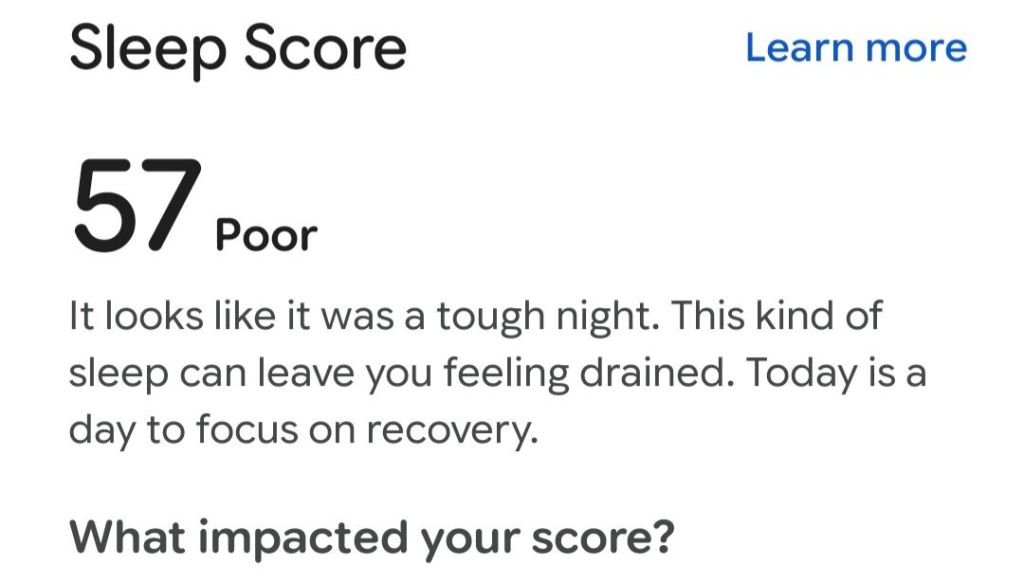
Even Google Health (aka Fitbit) was sorry for me:-

Thanks, Google Health!

Yesterday, weird headache or not – it’s not a foggy migraine, but a frequent, painful distraction – I was determined to make a start on my conference paper.  Miraculously, between twinges, I had suddenly hit upon a good way to begin it, and in desperation, I decided that some simple maths would enable me to make a start, even if I have to tidy it up later.

  • How long would I be speaking?
  • How many words a minute?
  • How many headings?

Armed with that framework, I got started, and actually made reasonable progress, considering how tired and uncomfortable I was. I completed several headings.

So, wouldn’t you think I’d have slept well last night?  I achieved nearly five hours – I suppose that was at least substantially better than the night before.

Morning insomnia is the most frustrating thing. It has afflicted me for years. But if getting back to sleep at 5.20 am is nearly impossible, then return to slumber with the weirdest of headaches is utterly impossible. I didn’t try: I sought medication, made a cup of tea and took it back to bed. But now I was awake, and I knew I wouldn’t sleep.

Duvet-Top Research (the Latest Trend?)

Combining Robert Louis Stevenson’s ‘Bed in Summer’ and ‘The Land of Counterpane’, out came my phone for some duvet-top research. (Thereโ€™s just one golden rule: do not touch any audio or video clips, for obvious reasons!) 

I’ve been looking into a Victorian-era London music publisher. What did he publish with a Celtic connection? Who published with him? Did they know each other? This gets intriguing. I can see today’s going to be a day of lists and charts.

Great Western Bridge, at Kelvinbridge

But not before the outing to a secondhand bookshop that I promised myself as a reward for yesterday’s efforts – because it looks as though the only way to find what I’m looking for, is to look in places that don’t have an online presence – just me, leafing through old music.

Just off Great Western Road…

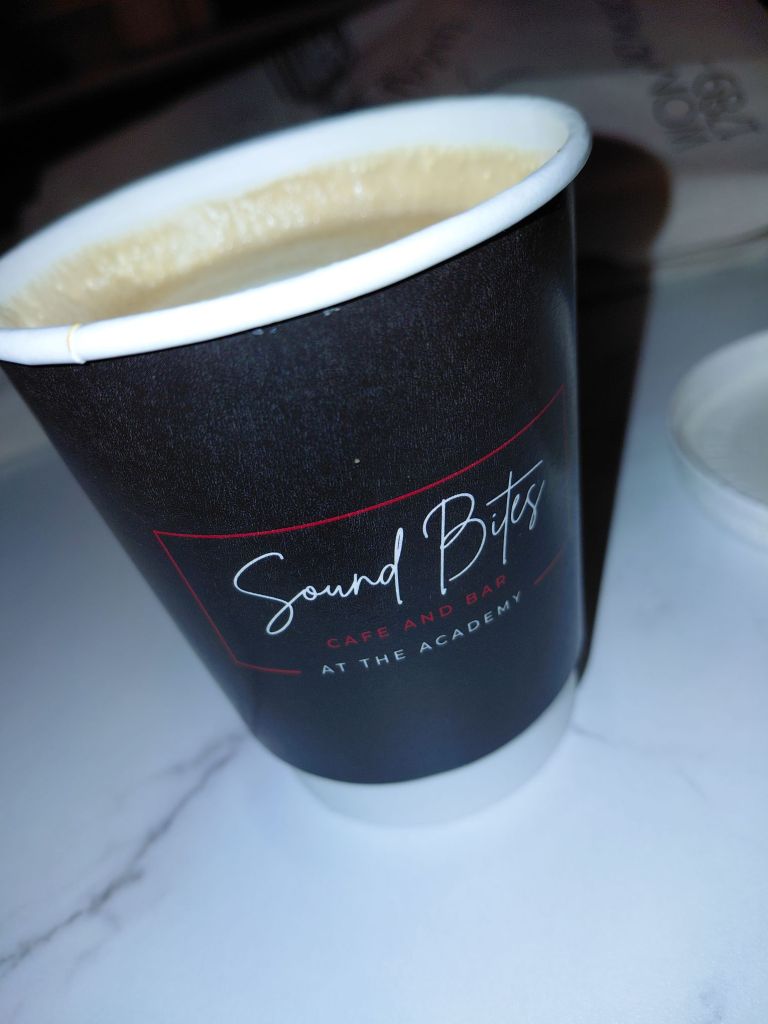
I’m sure to find a decent coffee-shop somewhere nearby!


(Later) The smell of fresh grass … but not a whiff of any interesting scores. Oh, well.

Cover image by madartzgraphics from Pixabay

Back to Work Now

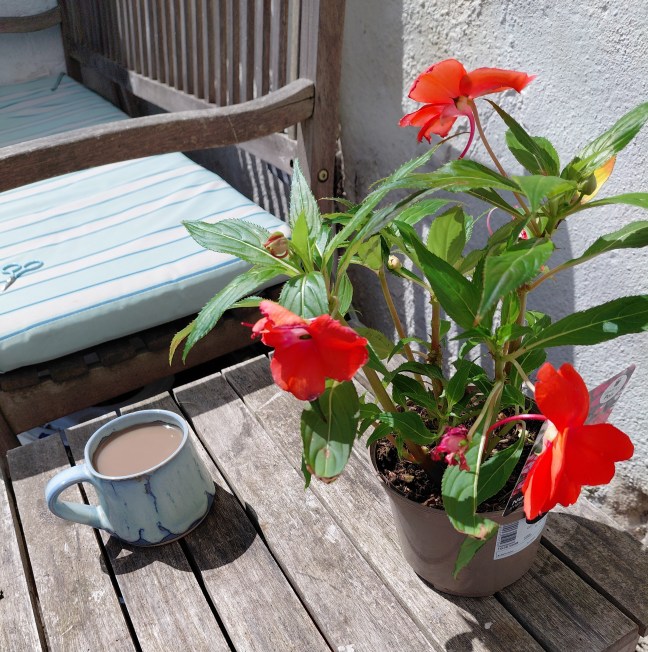
Busy Lizzie plant on garden table, with cup of coffee

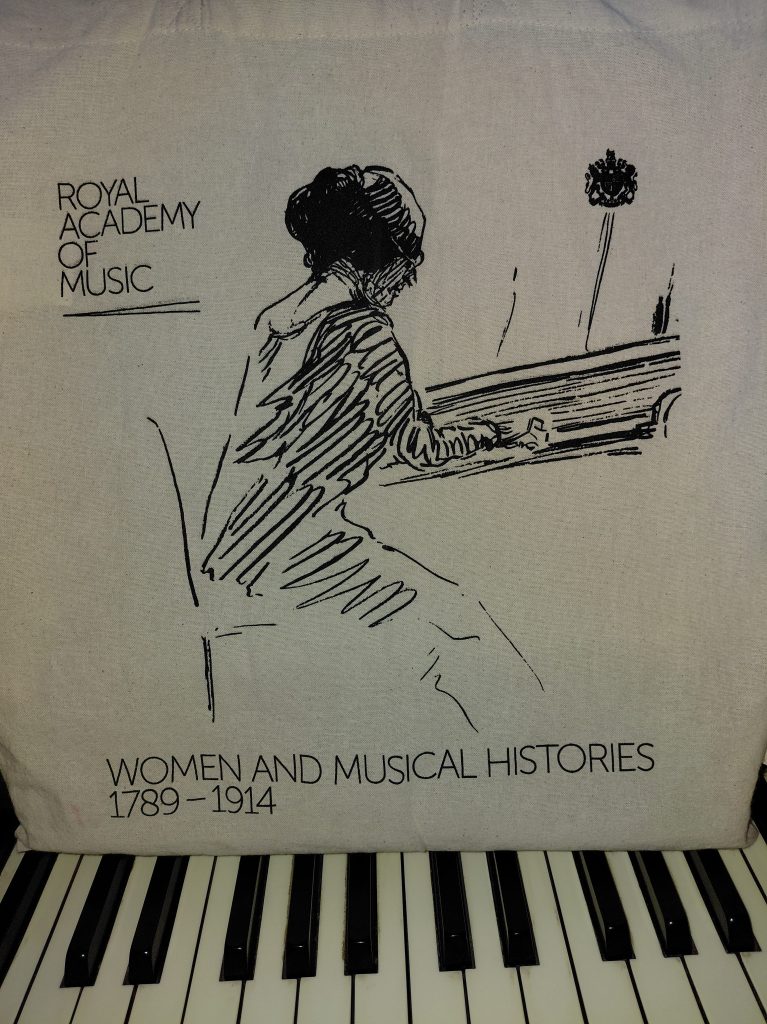
I’m back at work after a month’s vacation (I confess that I was rather lazy), and now I must get back both to my Dundee Leng Medal research, AND to writing a paper for a conference at London’s Royal Academy of Music: Women and Musical Histories, 1789-1914.

Recent Summers

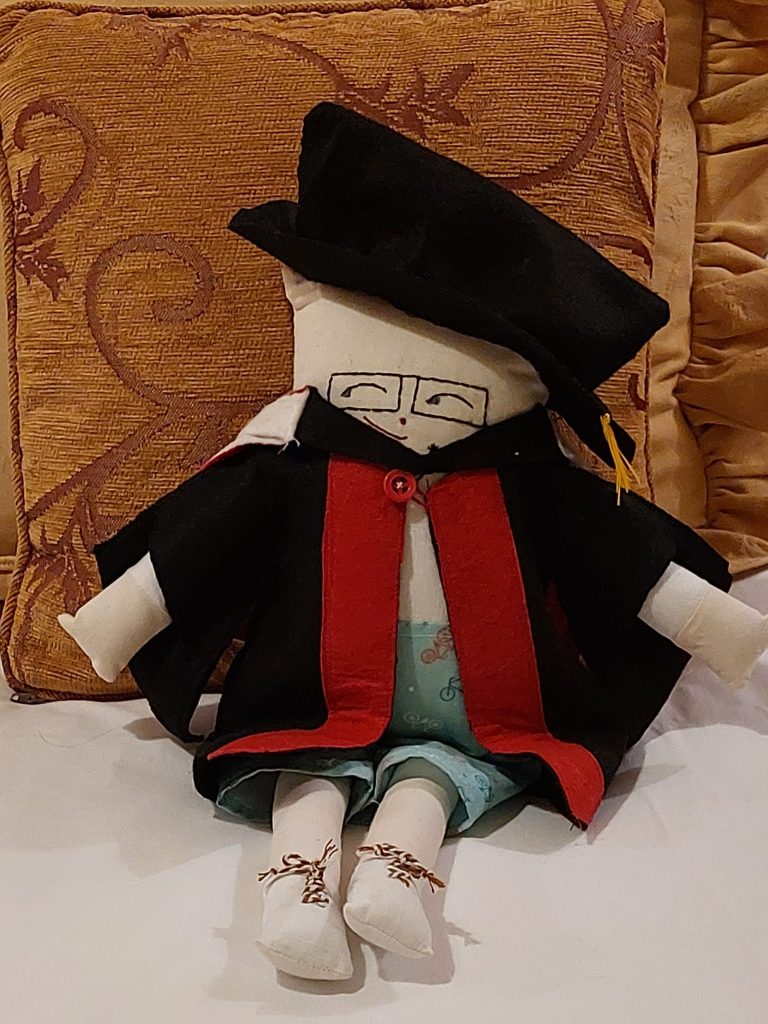
'Don', one of the IAML Cambridge Congress mascots, clad in academic robes

I’m reminded by this, my own blog, that I was attending the International Association of Music Libraries’ Congress in Cambridge, this time in 2023. I particularly enjoyed hearing the talks about early film music.ย 

I wasn’t speaking on that occasion.ย  No, my input was merely in various social media aspects: I was running the social media campaign for and during the event, and I’d created a trio of conference mascots – Cam, Bridge and Don – whom I employed in social media posts. (I don’t know what happened to the first two, but Don was given to a wee girl at church, and has enjoyed a comfortable retirement in a family setting.)

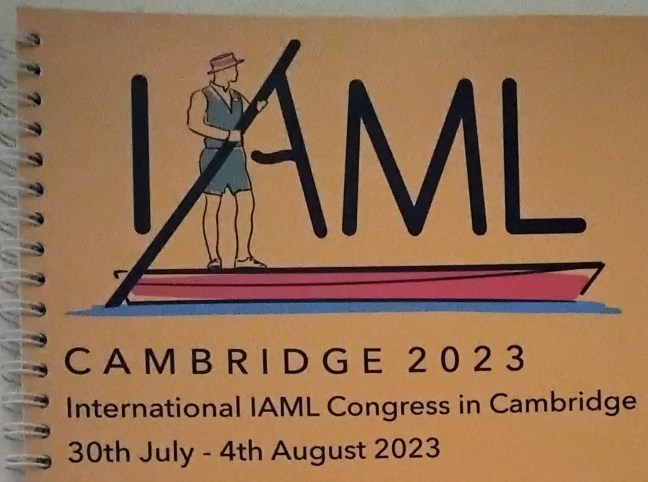
IAML Cambridge 2023 programme logo

I’d also come up with the IDEA behind the conference logo – a chap on a punt, incorporating the IAML abbreviation. Well, it was Cambridge! I hasten to add – I wasn’t the artist. The IAML Cambridge Congress feels like a long time and another lifetime ago!  I was already aspiring to a new part-time research existence, but envied another delegate who already had theirs’ lined up, being a tiny bit closer to retirement age than I!

And by this time in 2024? I’d retired from librarianship, but I was rather busy on final tweaks to my second monograph. And 2025 saw a rather unsettled summer, which we’ll gloss over.

Miss Marple – my Alter Ego?

Anyway, this year, I decided it would be a proper vacation, even if I didn’t spend it travelling or sunbathing. I achieved this moderately successfully. However, last weekend I decided I’d ease myself back by having another go at some detective work which had failed on all earlier attempts. My earlier research had focused on this individual’s daughter. Now it was the parent who intrigued me. But again, I drew a blank, after I don’t know how many hours. I cannot trace documented evidence of youthful musical activity by this individual, although I know that she was her daughter’s first singing teacher – and I have my own hunches about some of the books they might have used!

This is not to say that I found nothing. I know where the mother was born – no more than a couple of miles away from where I’m sitting today, in a large house that is no longer there.* It would be fair to say that the neighbourhood has gone down significantly since then! I know where she subsequently grew up (an even larger house in a very nice neighbourhood, again a couple of miles from where I’m sitting today, but on the other side of the M8 motorway). I know where her parents came from, too. And I traced her mother’s retiral from the family business. I even found a blogpost about a family grave in the Glasgow Necropolis.

However, the sad fact is that if a wealthy young woman was musical, but there’s no newspaper documentation of her ever performing publicly, then there really isn’t very much to go on. Try as I will, I can find no mention of her at school, or singing, being a soprano or a contralto, ‘contributing’ (a common word in Victorian reportage of musical events), or even venturing into playing the piano/pianoforte. Her older brother and sister took part in a fund-raising bazaar hosted by the local church, but there’s no mention of ‘my’ subject there either.

I have visions of myself standing dolefully outside the large house that’s still standing, or on the corner of the street where the other house stood, or even in Glasgow Necropolis, literally trying to communicate with ghosts past, in my efforts to intuit how much music occupied her childhood and adolescent years. It would make not a scrap of difference, though!

Ah, well. Back to more pressing topics. Perhaps I have to give up on my Miss Marple endeavours.


*By this evening, I had realised that my bus route to work actually passes the junction where Floraโ€™s mother was born. It’s a curious coincidence, to add to the vacant site a bit further along the route, where James S Kerr’s first music shop was located.  Who knew the no.23 bus had such  historical links?!

The Excitement of a Good Spreadsheet!

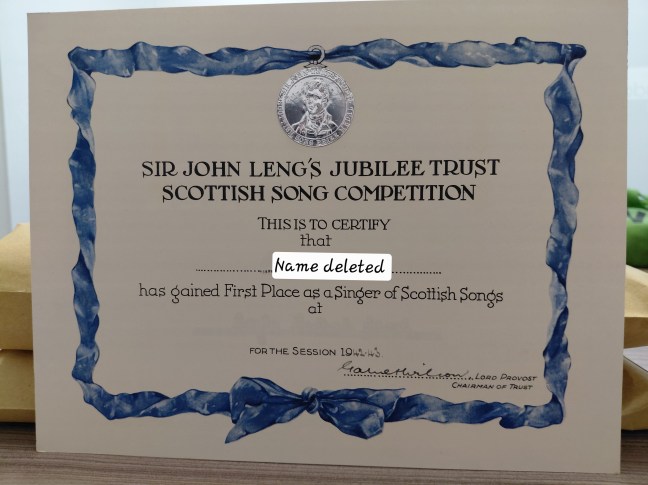
A Leng Medal Certificate

It’s fair enough to say that I find spreadsheets endlessly fascinating, although I don’t use them for number-crunching. However, they’re invaluable for comparing data. In fact, I discovered this before I even knew the word, ‘spreadsheet’, since I did some repertoire comparison for my Masters research degree on mediaeval English plainsong uses at the University of Exeter in 1979-80. It was a 60K-word Masters thesis – I’d intended to continue it to doctoral level, but decided instead to write it up as a Masters then changed subject for the PhD.  (And that became my first doctoral attempt, the one that never got finished.)

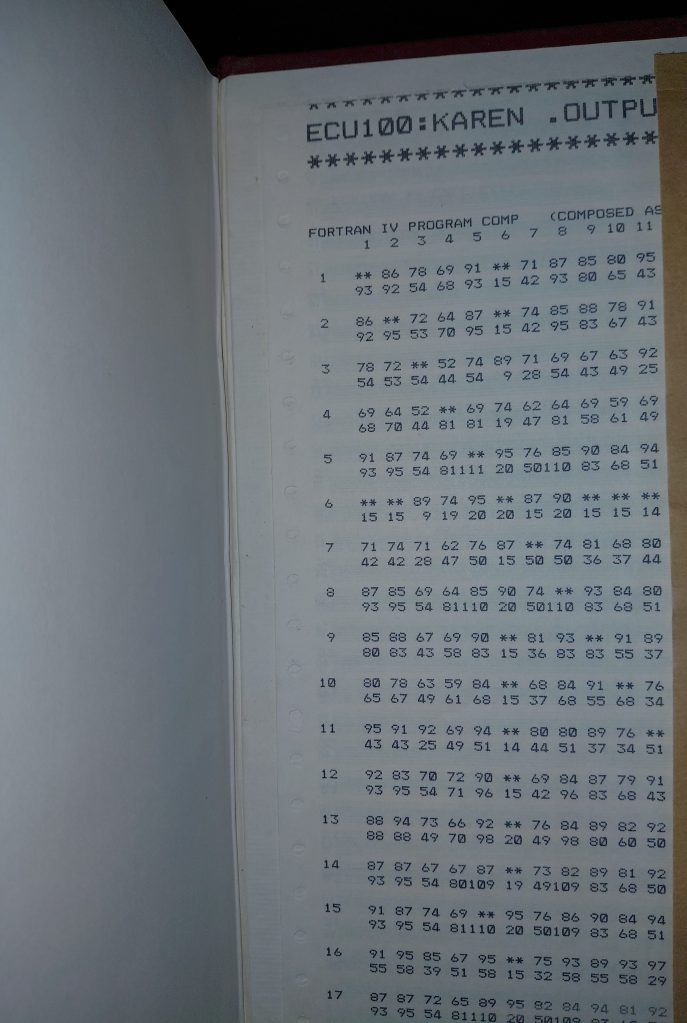
Page of Fortran data printout
Computer printout from my Masters thesis, 1980

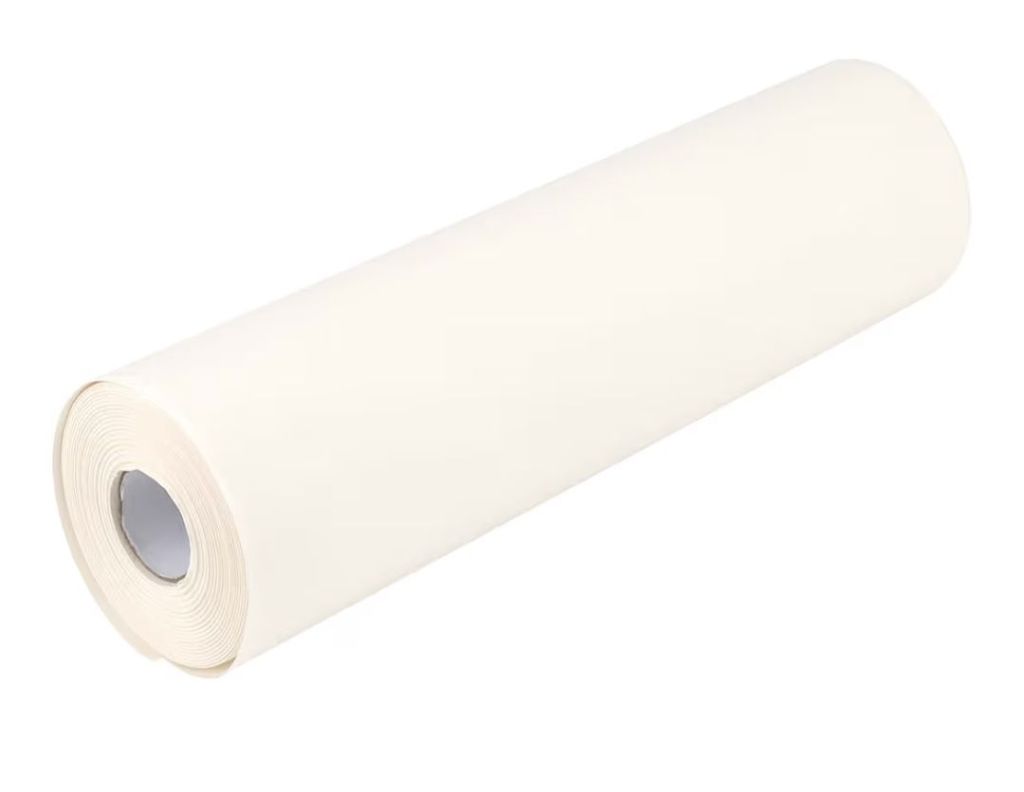
This was before the era of personal computers. My data was tabulated manually on a very long roll of kitchen shelf-lining paper, which opened out the full length of the Music departmental library in ‘Knightley’ on Streatham Drive. I compared post-Pentecostal Alleluias and sequences from various English liturgical manuscripts, along with pieces of plainsong from an Augustinian burial rite, now in Shrewsbury public school library. That’s nearly as much as you need to know about my Masters!

Just a Roll of Paper!

Computer Science? Yes, Indeed!

However, one other interesting fact is that I was the first music postgrad to involve the Computer Science department in my repertoire analysis. I filled in cards – or forms, can’t remember which – which were input by the computer scientists to arrive at statistics as to how much different categories of plainsong correlated in terms of repertoire, across different monastic orders and geographic locations.

If you were interested in that Master’s research, this is how you’d find it in Jisc Library Hub Discover; it hasn’t been digitized, to the best of my knowledge:-

  • Karen Elisabeth Manley, English mediaeval liturgies and their plainsong. Exeter, 1980.

The Magical Microsoft Excel

Since my second incarnation as a musicologist in the present century, I’m sure you can imagine how exciting it has been to be able to compare repertoires of Scottish song in a variety of different contexts. But this time I can save my spreadsheets safely – they’re much more portable and more readily manipulable.

In the context of my Leng Medal research, my ‘cup truly overfloweth’ this week, since I’ve seen lists of songs sung, enabling me to see how tastes have changed over the past sixty or so years. I’ve been comparing what was sung, against a few different song books available at particular times. Obviously, I can’t compare ALL the songs against ALL the song books that exist – I would surely go insane! Indeed, I couldn’t even capture ALL the data for every single year over that period – I simply didn’t have time. But carefully judged snapshots are certainly giving me food for thought. I’ve had endless fun today, producing charts and tables to examine the data in different ways.

The Most Popular Songs sung by Leng Gold Medal Finalists

Oh, did you think I was going to tell you which they were? Sorry, not at the moment – I need to keep specifics for when I write my research up later!  It’s certainly interesting, though.

I only picked nine different years for close examination.   Suffice to say, they have given me plenty of hard data to set my oral history interviews in context.

And not a roll of shelf-lining paper in sight nowadays!


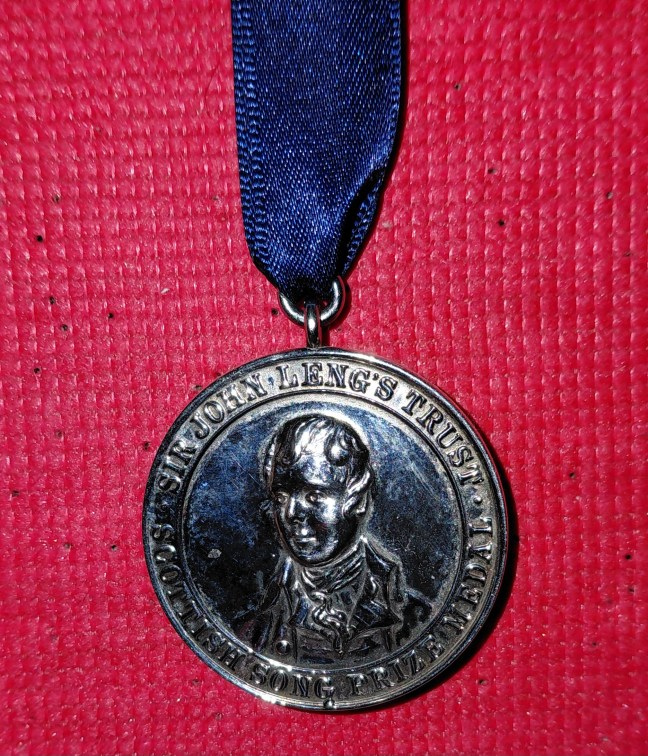
My Leng Medal Memories research is funded by an Athenaeum Award from the Royal Conservatoire of Scotland.

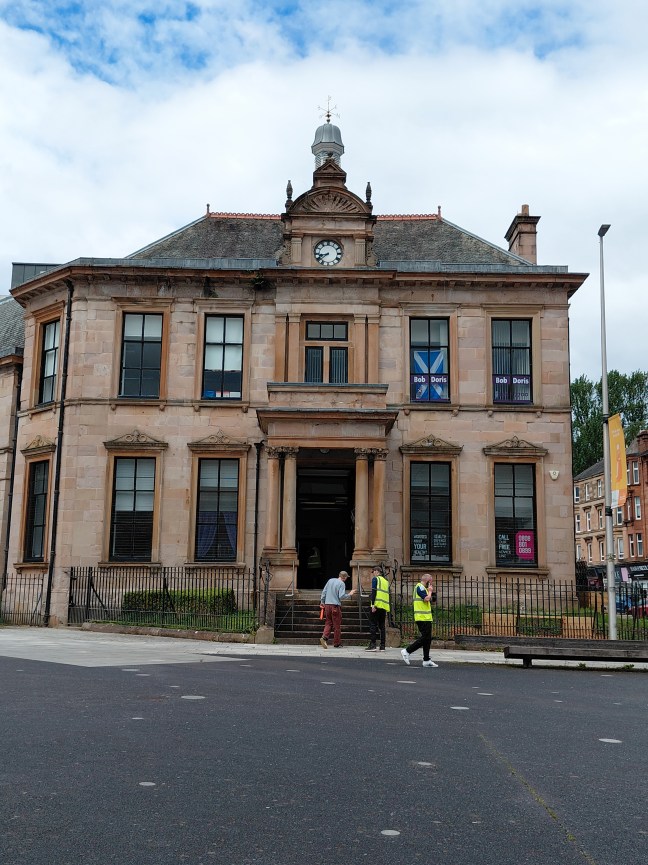
Saturday Outing to Maryhill Burgh Halls

Why This Matters

This is all about networking – and expanding one’s knowledge beyond the immediate focus of research, in order to understand the context in which the topic stands.


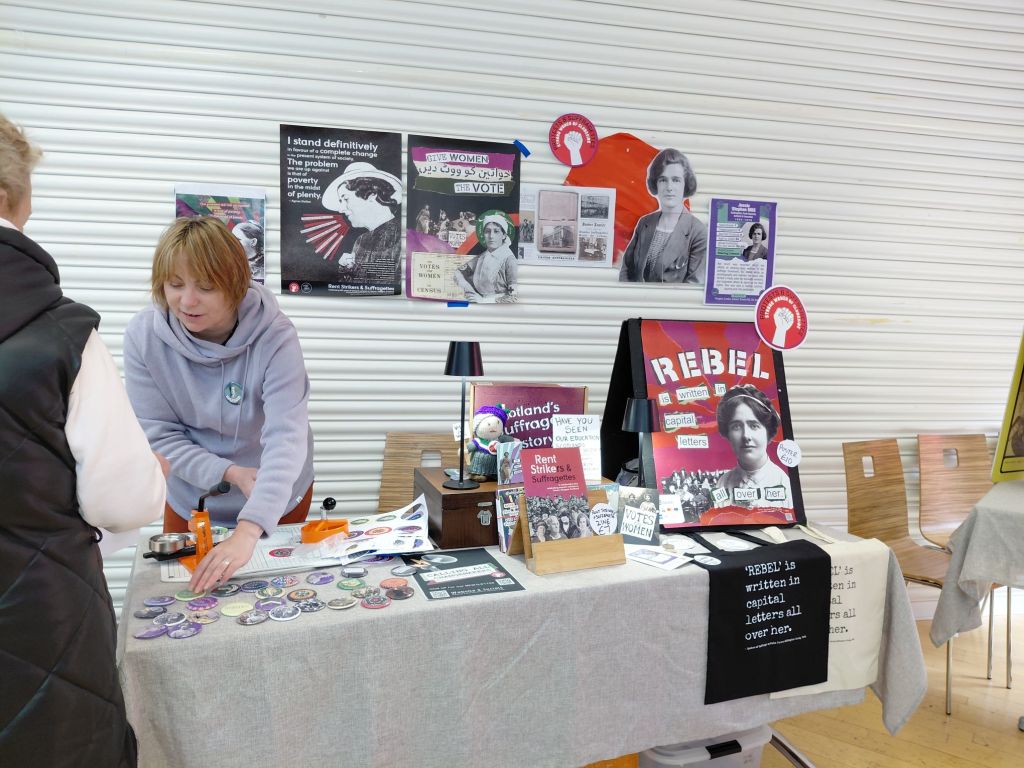
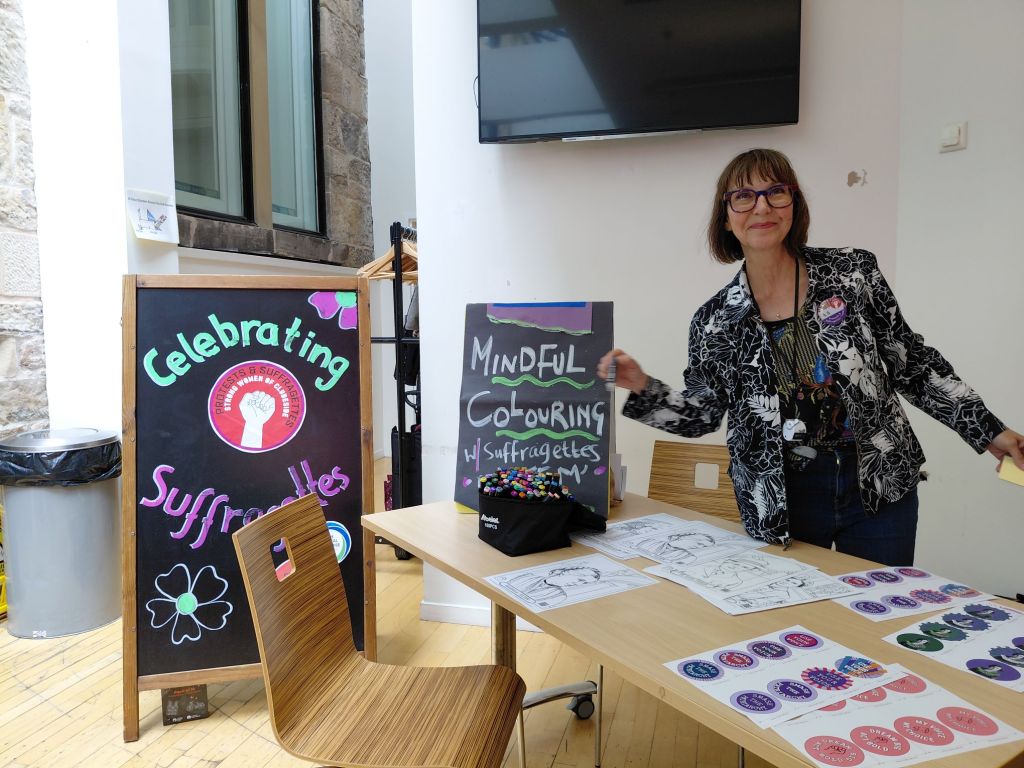
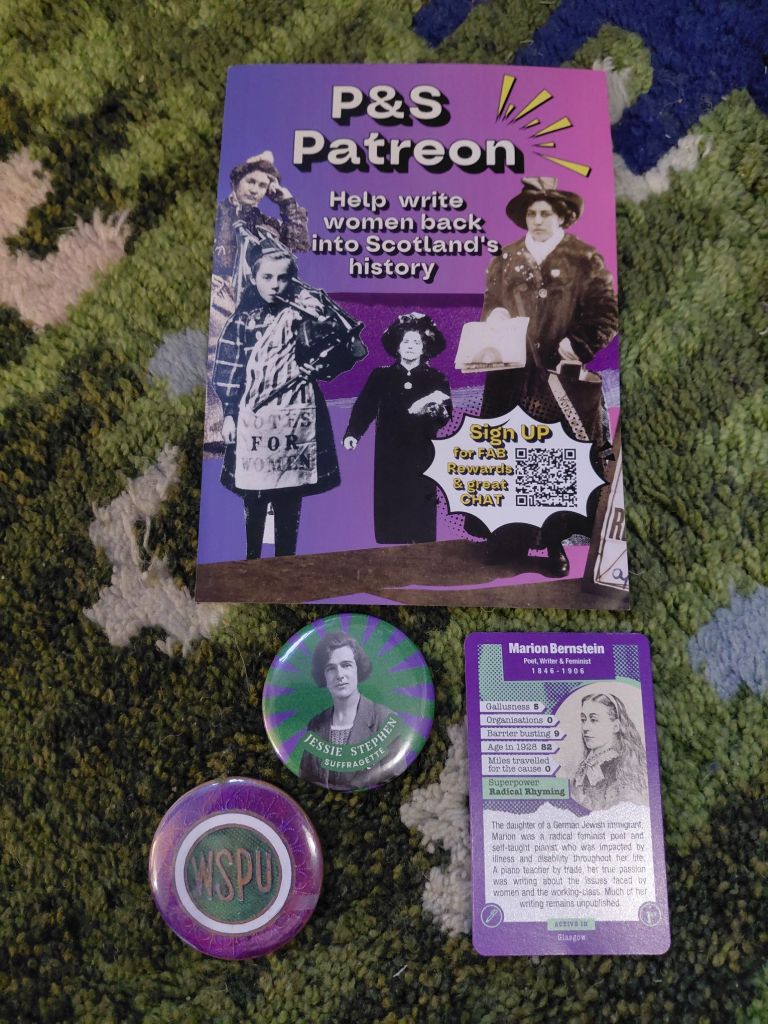
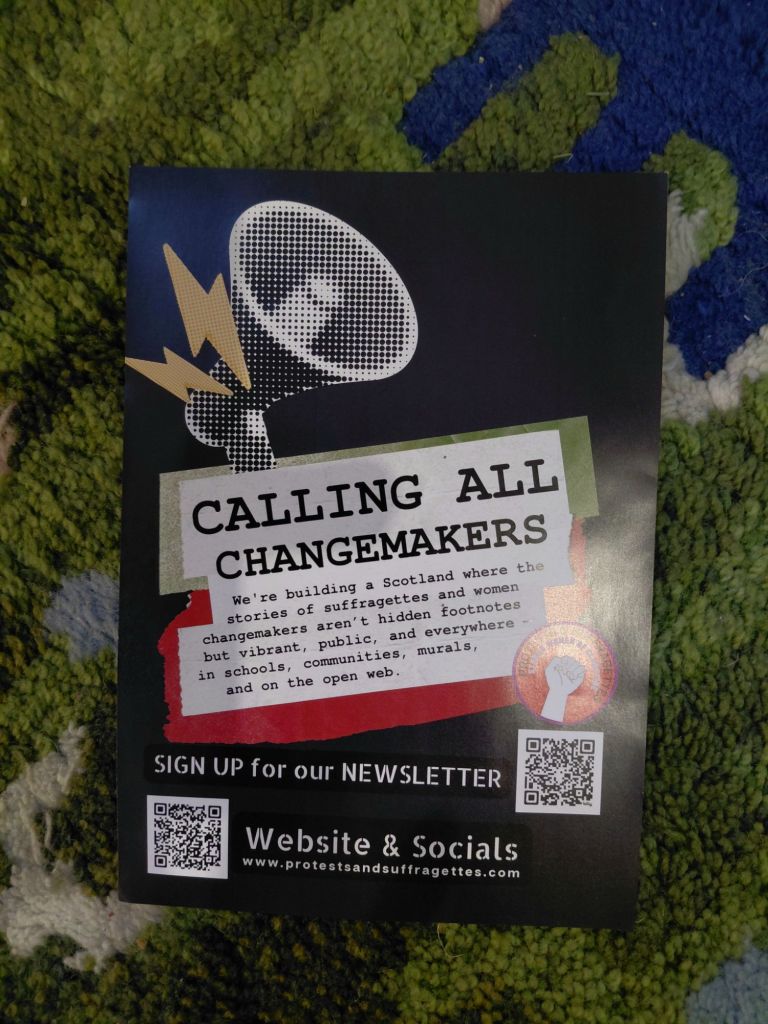
Yesterday, I headed north of the river, because there was a community event being held by Maryhill Burgh Halls Trust, and a group I’ve recently started following was manning a stall there – the Protests and Suffragettes social enterprise.

A creative project & new social enterprise led by a team of artists, activists, & local historians working to recover and re-voice the histories of women activists in Scotland.

My takeaways from the stall!

My interest stems from the work I’ve done researching late Victorian and early twentieth century Glasgow women involved in teaching, performing or publishing music. I’ve already published an extensive article in the RMA Research Chronicle, and I’m giving a conference paper later this year. I’d like to find out if two of ‘my’ ladies were actively involved in the early suffrage movement. My guess is that they may have been sympathisers, if not active in the cause. The older lady lived before the Suffragette movement as such, and I’m not expecting to find the younger of the two doing anything particularly audacious,  but it would be nice to find any trace of supporting the cause,  even just as a member of some organised group!  (I’ve already mentioned my trip to Glasgow Women’s Library on a similar mission a couple of weeks ago.)

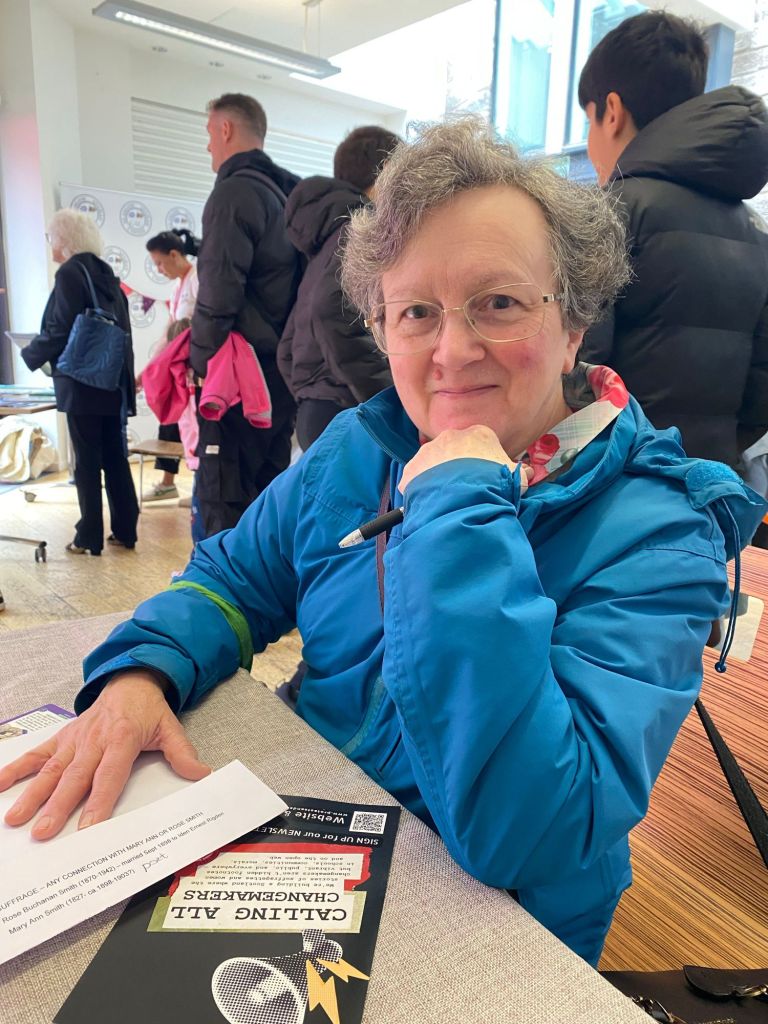
Anyway, I thought it would be altogether lovely if I introduced myself today, since we’ve already been in touch via social media. And it was lovely. I took the opportunity to outline what else I’m hoping to find out about this particular mother and daughter.

Caught chatting

Elevator Pitches

You’re always reading on LinkedIn about how you should have an elevator pitch just there on the tip of your tongue, so that your current project can be readily described to questioners who may not know very much about your work yet. As I travelled home, energised, after my outing, I reflected that actually, I need several elevator pitches, because I have two side projects as well as the main one!

Glasgow Women’s Careers in Music

One of my side projects, I’m currently exploring how different women’s backgrounds may have influenced the careers they pursued, in turn-of-the-century Glasgow.

The Glasgow Athenaeum School of Music

I’ve been exploring the careers of our first Principals, and contemplating the musical education that the institution offered in the first few decades. Another side project.

Publisher Thomas Nelson & Sons

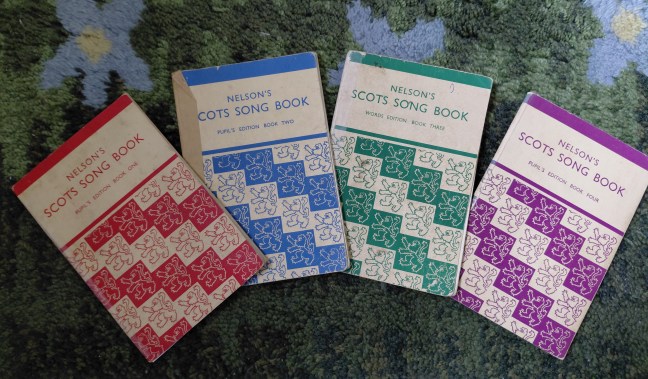
This is the big project. I’ve been looking at the kind of educational music materials published in the first half of the twentieth century, and reflecting on the use made of Nelson’s four Scots song books by pupils and teachers. After archival work on the Nelson correspondence, I’m now conducting an oral history of the Sir John Leng Trust’s Scots Song medal competitions in Dundee. The idea is that I’ll use all this for a third book. Watch this space!

Silver & Gold Leng Medal Memories, Update no.1

A classroom in Wandsworth, London, 1906 - the year that John Leng died

I’ve heard from many kind people who remember their involvement with the Leng Medal song competitions in Dundee, and now I’m starting to organise myself to speak to (or chat online, or email) everyone who has been in touch and expressed a willingness to share their memories with me.  If you’re one of those people, and you’ve expressed a preference to share your memories via one form of communication or another, I have noted this for future reference. You’ll be hearing from me soon! But if this blog post is the first you’ve heard of my research project, then you can find out more about it here, and you can get in touch with me here. It’s not too late!)

I hoped to hear from a lot of folk, and I certainly did!  So I’m contacting a few people at a time, to make it easier to organise my time.  If I can, I plan to focus on a decade or so at a time – though this idea may end up being rather loosely interpreted!

I’ve just started emailing people who indicated that they could chat online, inviting them to select a day and time.  I’ve allocated half an hour, so that we don’t feel rushed.  But if anyone fears their memories won’t take that long to share – there’s no need to worry – any anecdotes, however wee, will help fill out the story!

Microsoft Bookings

I very carefully set up my Microsoft Bookings page, and so far as I could tell, I did everything correctly. However, when I shared the link, I suspect I ticked a box that should not have been ticked. Anyway, I’ve unticked the box and shared the link again. I only confess this in case anyone received an email from me but couldn’t make the link work! I’ve re-sent the email and hopefully all is now well. Every day’s a school day, as they say.

‘Two notes’

One person has revealed that they sang two notes before the teacher told them to sit back down!

I think I may have mentioned before – I work part-time, so progress will be slow but steady! I’m very much looking forward to hearing more about this remarkably long-lived and successful competition!

Karen McAulay


Faded old sepia photo of solemn children (Edwardian?) in a classroom
The ghosts of children long, long past – provenance unknown

Confession: these photos are from my own ephemera collection. They have absolutely no connection with Dundee, but just serve as a reminder of the days when Sir John Leng’s competition was initiated. The photo at the top of this blog was taken in Wandsworth in 1906, the year of Leng’s death. These little tots probably weren’t being taught Scots songs by their elegant teacher. On the other hand, the children at the foot of this blog post look exactly the age that early Leng Prize competitors must have been! This postcard comes with no caption whatsoever.


Links


My Leng Medal Memories research is funded by an Athenaeum Award from the Royal Conservatoire of Scotland.

Shipment for a Semi-Retired Researcher

There’s no such thing as a typical semi-retired researcher! But my mail this week pretty much sums up my current preoccupations:  a tripod for the Zoom 5 Handy Recorder (research) and assorted double-ended knitting needles (semi-retirement sock project)! I now have all the tech I need, both for my oral history interviews, and for learning how to knit socks.

Researchwise, I’ve designated this week, The Last Week of Procrastination. I need toย  get started on my interviews – no more ‘I must just …’ prevarication. Florence Nightingale’s ‘invalid’ of last week is not technically an invalid this week; I do know how my various technical options work – why, I even have a wee tripod to help me look the part! – all that remains is to start scheduling. (This is proving easier said than done, but I’m working on it …)

Who’d have thought a tripod was such dangerous tech?!

Retirement-wise, though,  I’m not quite sure where the sock-knitting fixation came from. My feet feel the cold, true. And I need something else to do other than embroidery, at times when I find myself ‘relaxing’ in front of the TV. (Let’s just park those inverted commas for now.)

Sheer Bloody-Minded Determination

But I’ve been driving myself crazy with this knitting malarky! If only I had an amenable granny sitting beside me telling me what to do next. As it is, I’ve downloaded instructions off the internet, bought a couple of books, and sworn quite a bit  … I absolutely hate being beaten by a circular needle and a variable quantity of double-ended needles.  (Manipulating these is worse than trying to hold bagpipes.*)  I can’t admit defeat to a 4-ply woollen sock, for heaven’s sake.  I’m meant to be intelligent. As my late mother said about cookery, surely anyone who can read instructions can do this thing? 

If nothing else, it’s proof that I don’t give up easily.  In the grand scheme of things,  I made a second attempt at a PhD. On this micro level, I will work out how to knit socks.

I finally (at the fourth attempt) turned a heel, and arrived at something resembling a sock. If it’s on my foot, it’s a sock, right? Even if Kitchener Stitch is a form of torture, and the sock foot is really only just long enough.

The other one of the pair will be better. And quicker.  I’m getting there.  The BBC recently showcased research proving knitting to be good for one’s mental health.  Relaxing.  Well …

Okay, it’s a ‘neat’ fit!

*Postscript. I did give up on the bagpipes. Learning whilst completing the second PhD was really not a good idea!

Who is this Woman Researching the Dundee Leng Medal Competition? Introducing Dr Karen McAulay

If you’ve found a link to my brief questionnaire on Facebook, and wondered who I am and what I’m up to, then maybe I should introduce myself properly?

So … McAulay is my name, but as soon as you speak to me, you’ll realise I’m not Scottish.  I’m the only member of our household that isn’t! However, I’ve lived in Glasgow since 1988 – more than half my life. 

I do have a connection with Dundee through the Friends of Wighton – I’m Honorary Librarian of the Friends of Wighton, who promote the Wighton Collection in the Central Library. It’s a very old, historical collection of Scottish music publications, and I’m just available in an advisory capacity – I’m not in any way employed by the city of Dundee. I do enjoy this connection with Dundee, though. I have often consulted the old music books since before I even started my PhD, so I appreciate their significance. I’ve written about them, and about Andrew Wighton, who was their original collector.

Since I started my career in a public library – in South Shields on Tyneside, as a music librarian – I rather like having this loosely continued connection with public libraries, too.

I do have another link with Dundee, through my writing.ย ย  I’ve written both fiction and non-fiction, and the fiction was for D. C. Thomson’s The People’s Friend, during my earlier years in Glasgow.ย  But since getting started on my research, I’ve only really written about music and social history (and occasionally, libraries!).


I’m a research fellow at the Royal Conservatoire of Scotland in Glasgow. For most of my career, I was a music librarian at the Conservatoire, but I did a mid-career doctorate at the University of Glasgow, and a few years after getting my PhD, I started being seconded to the Conservatoire’s research department – basically, I split my time between the library and a research desk elsewhere.

Nowadays, I’m just doing the research part of my role – I retired from the library.

My research has always been into Scottish printed music of one kind or another – songs, fiddle music, old music in libraries, publishers who published Scottish music or Scottish publishers who published music.

My most recent research has been into Thomas Nelsonโ€™s, the Edinburgh publishers.  They published a set of four Scots Song books for school use, and one of the editors was in charge of music in Dundee schools – so not surprisingly, these books were used a fair bit! Anyway, that’s how I got interested in the Leng Scots Song prizes.  I’m keen to know what competitors remember of their experiences, and if they continued singing Scottish songs later in life.

I’ve had a great response so far. I’ll start having chats with people soon.  But if you would still like to get in touch, it’s not too late. Please just visit this link!

https://tinyurl.com/LengMemories

Athenaeum Award Research Project: Silver and Gold Leng Medal Memories

Microsoft Forms icon. Cartoon person sitting holding a notebook or tablet.

This research is being funded by an Athenaeum Award from the Royal Conservatoire of Scotland.

I Met Her, Take my Word for it

‘You’ll be home for lunch’, He said. It was halfway between a query and a command. ‘You have four hours …’ (Actually, that came down to three, once I got to the library. Two, allowing for a coffee and my return journey … )

The Authoress

Nonetheless, I held in my hands the two very poetry books that the author (‘authoress’, in those days) had donated to the city library service back in 1881, not that long after they moved from Lanark to Glasgow.  I’ll never know if she handed them in personally, but I think it’s reasonable to assume that she handled those copies at some point. 

I can’t show you them.  (I signed a library form, which said that I couldn’t share my photos on the internet.) But you can picture two small volumes, one dark green and one purple, a little over six inches tall, with gold-edged leaves, and a little gold-embossed lyre on the front cover of each. Slightly different in design, but very similar.

A bit like this unrelated, non-library book

These books are by the mother of one of the women I wrote about in my recent RMA Research Chronicle article.*  Only one has been digitized, but I wanted to see them both. I was enchanted to find she had written a poem about ‘my’ heroine, Rose, when Rose was just a small child.  It was worth the trip for that in itself.  Not that it really added any hard facts to her biography, but still a lovely thing to find.

Anyway, there we were.  Me, Mary Ann’s books, and a poem about wee Rose (amongst lots more poetry – I’m not writing here about everything I found!) – so yes, I think I can safely say I came as close as is possible to ‘meeting’ Mary Ann today. But as I said, you’ll just have to take my word for it.

I handed the books back – it was a bit of a wrench, but hey, that’s what happens in a library – and the curtains of time softly closed behind me, leaving Mary Ann in 1881, and myself here in 2026.  I may be back – she and I could have more to talk about!

Book Image by Ruslan Sikunov from Pixabay

Clock Image by StockSnap from Pixabay


* Article, ‘Women Pursuing Musical Careers: Finding Opportunities in Late 19th- and Early 20th-Century Scottish Music Publishing Circles’, Royal Musical Association Research Chronicle , Volume 56, April 2025 [this date is correct], pp. 97 – 118