Since beginning this research into Dundee’s Leng Medal competitions, I’ve posted updates from time to time. Seven of them, to be precise! If you’d like to read more, I’ve put all the links on a special page dedicated to this project:-


Dr Karen McAulay explores the history of Scottish music collecting, publishing and national identity from the 18th to 20th centuries. Research Fellow at Royal Conservatoire of Scotland, author of two Routledge monographs.
Since beginning this research into Dundee’s Leng Medal competitions, I’ve posted updates from time to time. Seven of them, to be precise! If you’d like to read more, I’ve put all the links on a special page dedicated to this project:-
To recap – I have done oral history interviews with a number of people who participated in Dundee’s Leng Medal competitions for Scots song singing – mostly as children, but a few teachers have also talked with me. I’ve checked the transcriptions of 25 out of the total 27 interviews, and I also have a few emailed responses too. If you’re one of the people I’ve interviewed or emailed, then can I offer a big thank you, right now, because I now have lots and lots of information and memories. I really am very grateful. I couldn’t have done this without you. You’ve shared your memories, you’ve made me smile, and some of you have even sung to me. Who could ask for more generosity of spirit than that?
So, what’s next?
And I have more than one string to my bow. I’m also still researching …
After my talk at the recent Royal Academy of Music conference, Women and Musical Histories, 1789-1914, I have continued researching Rose Smith’s life. I’ve already found out more, and tomorrow I’m off to consult an archive where I hope some of my still outstanding questions might be answered. I foresee a [second, more focused] research trip to Rose’s birthplace in the near future, before our Scottish days get short and wintry!
I’d also like to organise another event! But I really must focus on getting the Dundee research written up and celebrated before I get consumed by this other research thread.
It’s a good thing I’m semi-retired, really! If I was still cataloguing jazz CDs in the library, I certainly wouldn’t have time to plan research expeditions without taking annual leave.

After a couple of months of online and a few in-person interviews, I’m at the stage now where I’m going through all my recorded interviews and transcriptions, reminding myself of highlights and key details.
This one just leapt out at me:-
‘The one thing I do remember is all the crowd standing up, after I had sung – and cheering and clapping and stuff, and that was the beginning of it, you know.’
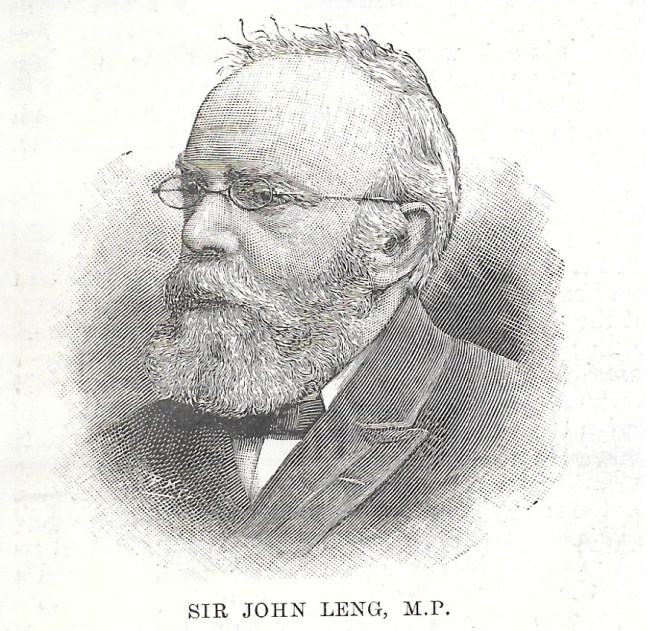
Isn’t that glorious? I’m sure the Sir John Leng Trust will be delighted to read such heartwarming witness to Sir John’s inspired endowment. (I’ll keep the rest of that particular interview for later – I want to leave plenty of material for what I shall be writing in due course. I have a lot of data to draw upon.)
I aim to bring the interviewing to an end by the end of June; after that, I have some annual leave booked, and then I need to start writing! An article or two, a book chapter – and maybe organise a wee event or two.
This has turned out to be absolutely the most enjoyable, affirming piece of research. I’ve decided I love oral history, and conducting interviews is nowhere near as scary as I thought it might be!
(Incidentally – although my interviewing will mostly finish by the end of June, if anyone was literally bursting to share their own Leng Medal memories with me after that, then do get in touch. Even if an interview wasn’t feasible, I still might be able to draw upon memories shared by email.)
My Leng Medal Memories research is funded by an Athenaeum Award from the Royal Conservatoire of Scotland.
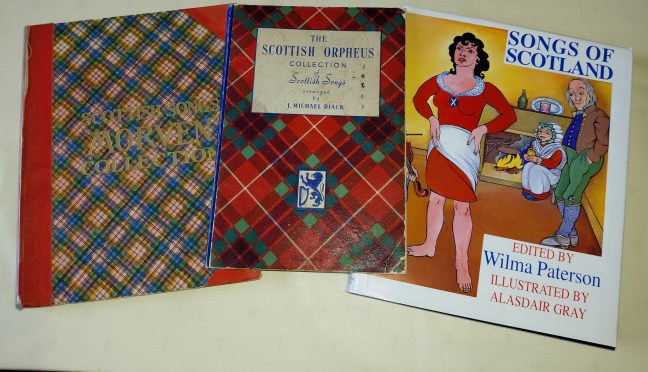
Just a quick post today – I realised that I do actually possess all three of the Scottish song books that have been awarded to Leng Gold medallists over the years. They make a pleasing display!
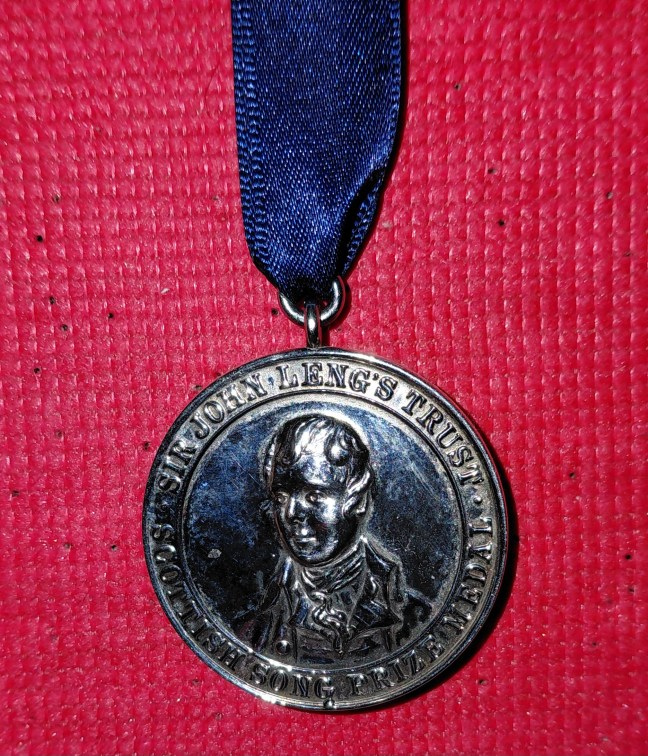
Mozart Allan’s Morven was awarded for many years. First published in 1890, it lived on for an incredibly long time, and is still valued by those who own it. I have spoken with winners a little younger than myself, who still have their copy of this book. (I have a hunch that Mozart Allan’s sister Euphemia may have had a hand in this publication. (See my recent RMA Research Chronicle article for more on this!*)
The next book prize was a Paterson book, J. Michael Diack’s Scottish Orpheus Collection, which actually goes back to 1922. (There had in fact been an earlier edition, resulting in Diack’s book being called the New Scottish Orpheus in some imprints.)
And lastly came Royal Scottish Academy of Music graduate Wilma Paterson and artist/author Alasdair Gray’s collaboration, their lavish Songs of Scotland (Mainstream Publishing, 1996), which is certainly amongst the most artistically pleasing modern collections that I’ve seen. Early winners of this one got a signed copy.
I’ve just made a new ‘Leng Medal Memories‘ page for this website – do take a look.
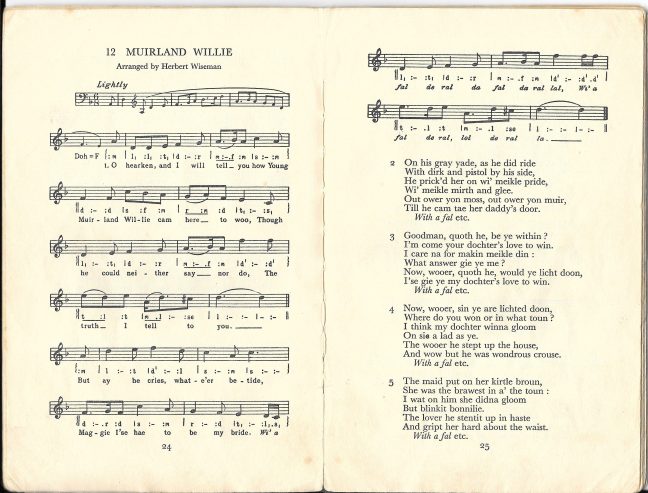
This isn’t really a scholarly post – just a reflection.
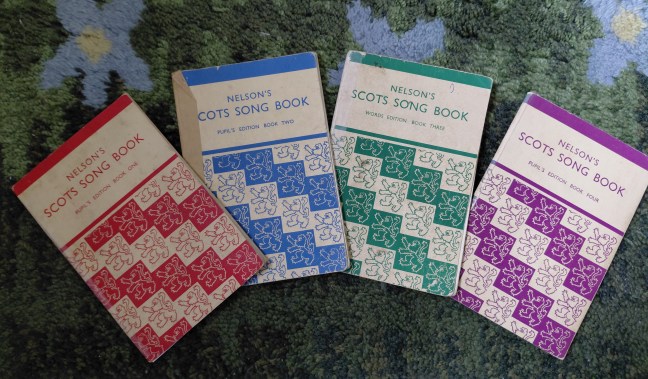
One of my informants remembers singing ‘Muirland Willie’ as their Silver Medal entry, and I was chuffed to find it in my Nelson’s Scots Song Book, Book 3 (‘words edition’). And yes, the ‘words edition’ does contain the melody line as well – just not the piano part.
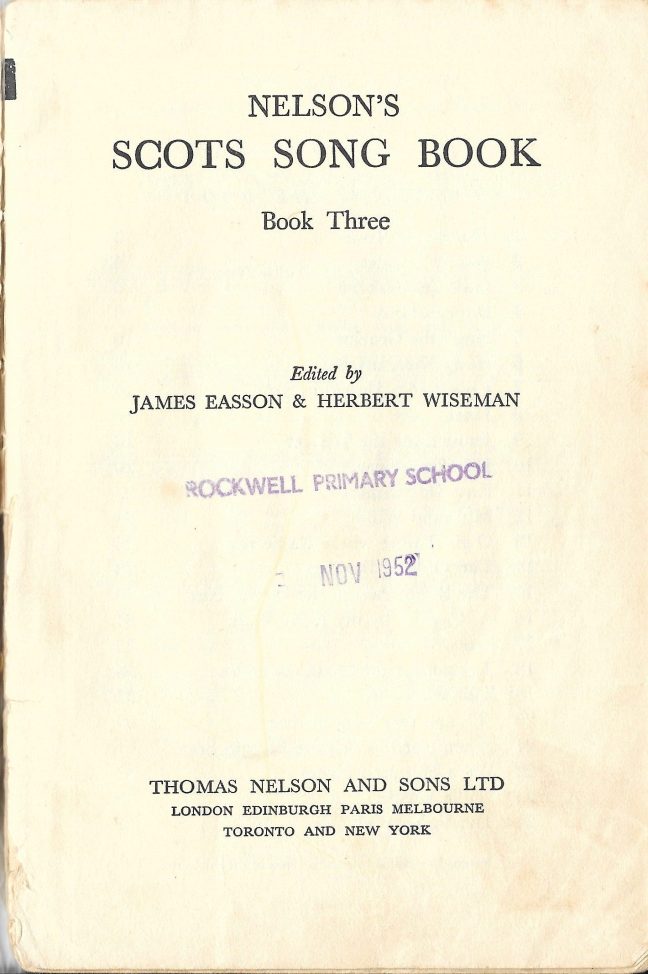
The book had reached me third hand – or was it fourth? How many hands has it passed through since someone stamped ‘Rockwell Primary School, November 1952’ on the title page? This tells me it was bought by a Dundee school the year it was first published. It must have lived in a class collection for some years, at some point ending up in a private home, and finally being sold to a friend of a friend, who generously got it on my behalf.
It’s a little bit battered, so it obviously got well-used. One page bears a carefully drawn treble clef – pretty accurate but not yet fluent – someone had been learning how to write music, evidently! Meanwhile, the back inside cover has a scrawled ‘THE END’! Was there a sigh of relief, or was it just an irresistibly blank page demanding to be scrawled on?
I wonder how many Leng medal competitors used this copy? If books could talk, this one would surely recall feelings not only of excitement, enjoyment and pride, but also occasionally fear, nerves and perhaps embarrassment – all emotions that my interviewees have shared with me.
It would remember teachers who are still remembered half a century later; not to mention head teachers and deputy heads whose own musicality ensured that they gave music its proper place in the schools that they led.
The principal teacher of music at that time […] was a redoubtable lady and she made sure everybody knew everything …1
But I’d better put my little book away and get back to my interview transcriptions now!
It’s time for another update on the research that the Royal Conservatoire of Scotland has awarded me an Athenaeum Award to conduct.
By the end of tomorrow I’ll have interviewed some 25 or so Leng medallists who were awarded their silver and gold medals between the 1960s and 1990s. They went to a wide range of schools, though one or two schools have featured more than once. And they sang a wide range of songs. Some were nervous, some excited. Some knew they could sing – others were surprised to win – and all were overjoyed to be winners. I’ve been shown a lot of medals, proudly kept through the decades.
Interestingly, social media has been very helpful in augmenting my research findings. On Facebook, I’ve found folk in groups like Dundee Pals enjoy answering quick questions, and their answers are often highly informative. When I asked how many people had three or more family members with medals, the number of replies was quite remarkable!
It wasn’t until last weekend when I conducted a face-to-face interview in Dundee, that someone mentioned ‘the Scottish cringe’. I guessed what that meant, and when it was explained to me, it was rather as I had guessed. It refers to the inferiority complex that many in Scotland have, having grown up in a Scotland that felt it was always subordinate to England, and looked down on by many politicians south of the border. I did look up where the phrase originated, but I only made a hasty search, so I’ll hold my tongue until I am sure of my facts. An article in Glasgow University Magazine last year provides useful context:-
Didi Marina Salonia, Death to “Scottish Cringe” (28 April 2025)
In the context of my research into the Leng medal competitions, it occasionally led to pupils being encouraged to sing their songs in a refined, sanitised kind of accent – not exactly English, but certainly toned-down Scots. I’m sensing that this happened more amongst older medallists, and hopefully children now are encouraged to use their own natural accent – as they’d speak – rather than trying to put on something uncomfortably clipped and unnatural. Again, Facebook has been very helpful here – 38 comments in reply to my question! I’m bowled over.
“I was talking to a friend about the Leng medals yesterday and an interesting thing came up. Who was encouraged to sing their Scots song in their natural everyday accent? Did anyone get told to sing it ‘nicely’ in a posh concert-platform accent?!”
For the rest of this month, I’ll be going through my recordings and transcriptions, looking for interesting threads and making sure I have tabulated schools, songs and the names of long-remembered teachers! I’m also going to look at some archival material, which excites me considerably. Hopefully I could find further evidence of Mr Easson (and perhaps Mr Wiseman), the compilers of the Nelson Scots Song Books, around the time the books were published – and introduced into Dundee schools.
I am taking annual leave in July. (If I don’t, I lose it, and that would never do.)
I won’t be capable of NOT blogging for a whole month, apart from which I do like to think that if someone comes back here after a couple of weeks away, there will always be something new for them to find. What it will be, I cannot yet say! (Additionally, as you’ll have noticed, I have a couple of research side-interests, so who knows what my month’s vacation might lead me to, if I feel the urge to investigate sudden bright ideas?)
Image: Head of a Boy Singing, by Merson (Creative Commons)
My Leng Medal Memories research is funded by an Athenaeum Award from the Royal Conservatoire of Scotland.
After some years researching the history of printed Scottish music and Scottish music publishing, I’m currently using oral history (talking to people about their memories) to find out what they recall about Dundee’s Leng Medal Scots Song Competitions. Did participation lead to a lifetime of music and song? Or stage fright?! What do people remember?
I began the Athenaeum Award funded project a couple of months ago. I posted the first update a month ago. It feels like time I posted another one, so here goes!
You’d be surprised how many people remember their music teachers. You’d also be surprised how many people have kept their Leng medals! For gold medal winners, Mozart Allan’s Morven Scottish song book was a prize for a number of years, certainly into the 1970s. From the late 1990s, the prize changed to Wilma Paterson and Alasdair Gray’s lavish Songs of Scotland, published in 1996.
Are there any gold medallists out there from the 1980s or 1990s? What was your prize book? Have you still got it?
What I find so enjoyable about this project, is how uplifting these conversations are! Participants talk with such enthusiasm and affection about singing in school – not just in the Leng Medal competitions – and about other musical activities that enriched their childhood. Sir John Leng would be astonished at the impact his endowment has had. I wish he could be a fly on the wall!
I haven’t nearly finished my interviews yet – as a part-time researcher, I’m just slowly and steadily making progress. Indeed, I’m heading to Dundee tomorrow for some face-to-face meetings. And then on Thursday, I’ll see about sending out some more meeting invites.
(If today’s posting is the first you’ve heard of my research project, then you can find out more about it here, and you can get in touch with me here. It’s not too late!)
My Leng Medal Memories research is funded by an Athenaeum Award from the Royal Conservatoire of Scotland.
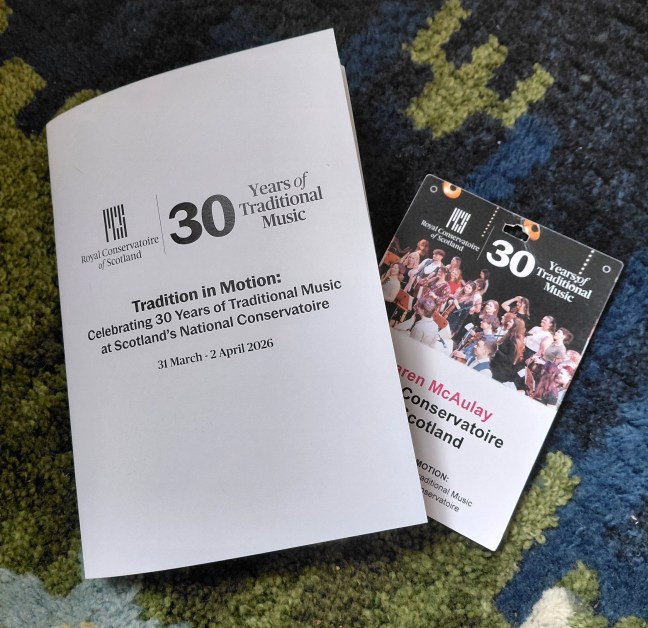
I started my Leng Medal Memories interviews this week. What a pleasurable experience this is turning out to be! Two of my interviewees still have their silver medals, fifty-odd years later. I subsequently asked the Facebook group, Dundee Pals, and found that lots more people there still have their medals, too. It just goes to show how significant winning the medals actually was to the school pupils who took part.
Anyway, I thought I’d re-share the link to my questionnaire about Dundee Leng Medal memories, in case anyone finds this post and would like to participate in my research project:- https://tinyurl.com/LengMemories
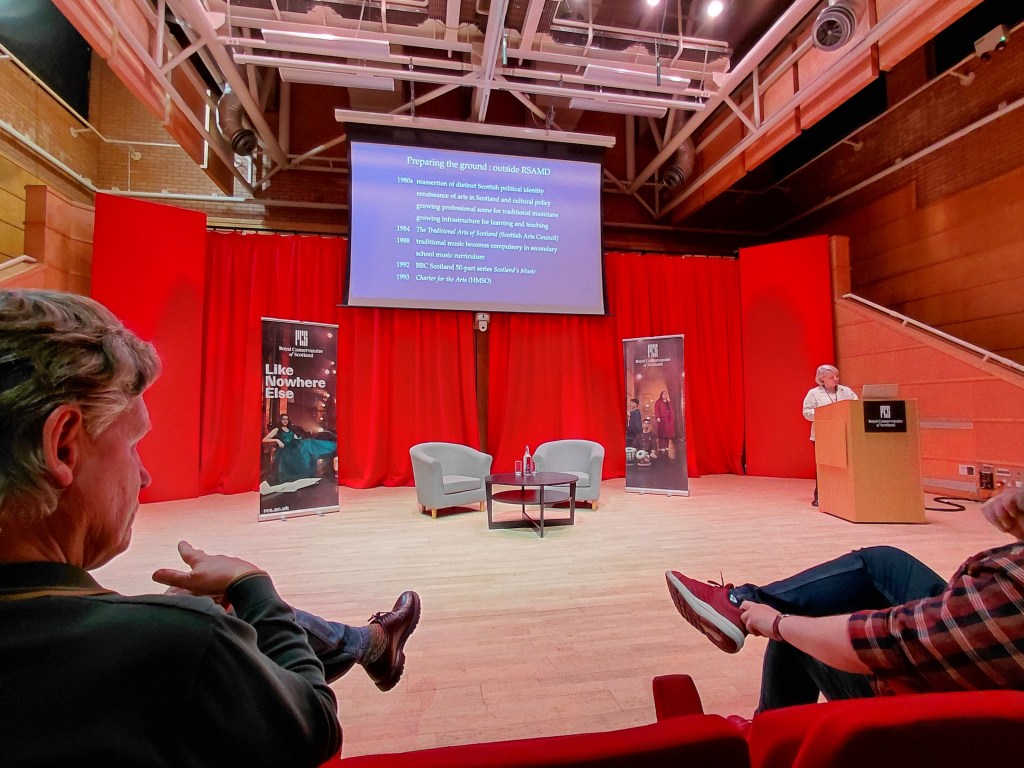
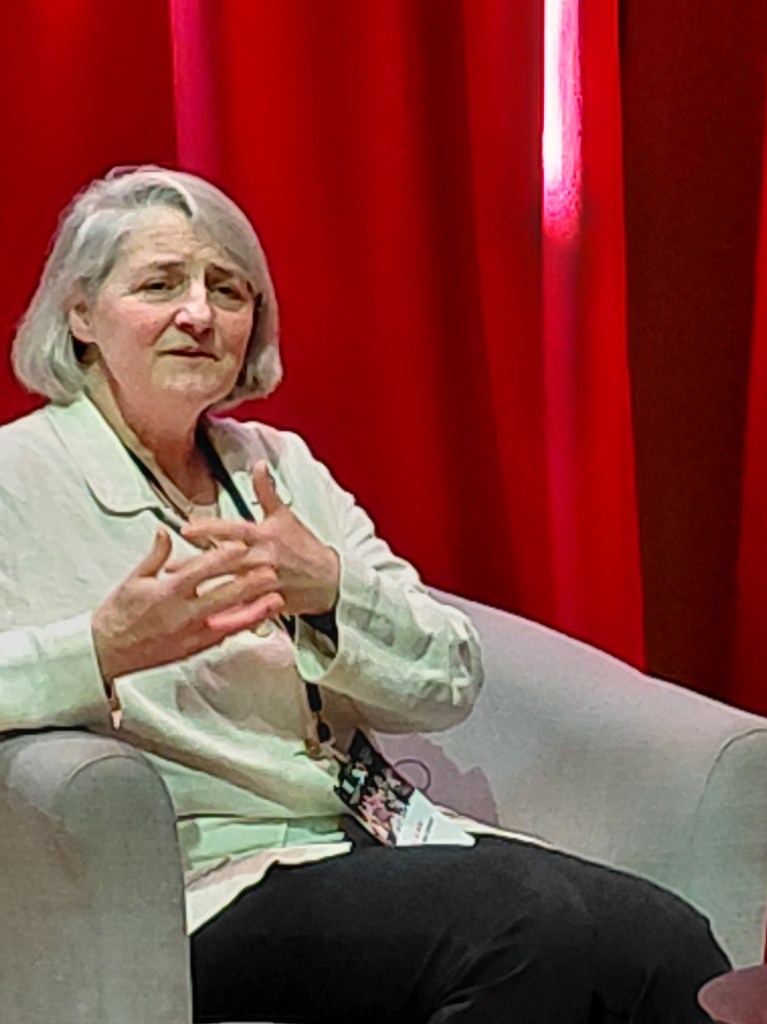
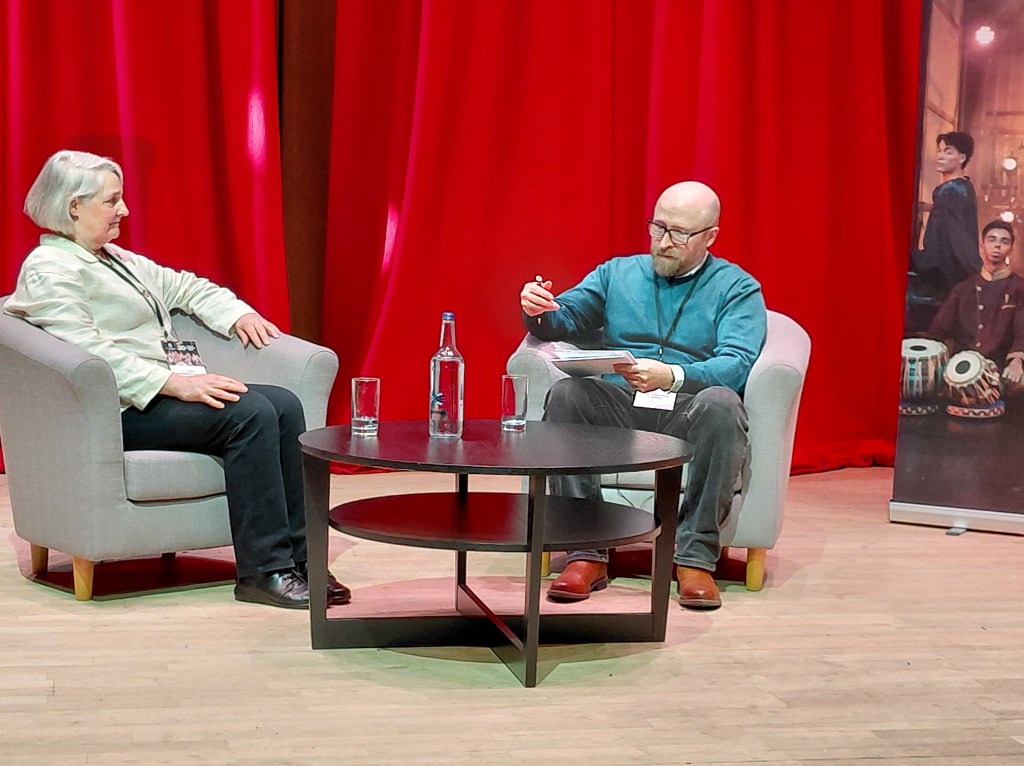
On a different note, yesterday (Tuesday) saw me as a delegate attending the first day of an Royal Conservatoire of Scotland conference, which was celebrating thirty years of traditional music at RCS. The keynote speaker was Dr Jo Miller, one of the co-founders of the Scottish Music degree. As she spoke, her slides showing the chronology of those early years, I realised that when I arrived at what was then RSAMD in 1988, this was just as trad music teaching was getting off the ground.
In 1988, I had no idea that I’d end up recommencing my doctoral studies fifteen years later – little did I know! – forsaking mediaeval polyphony to focus on Scottish songs. My choice of subject was very much influenced by the thought that I’d at least be studying something that might be useful and relevant to students on that course. It took me a little bit longer before I realised that what I was researching counted as ancient history – certainly relevant background, but a very different kind of Scottish song to what today’s contemporary musicians really want to focus on! The songs – their tunes and authors – are still important. But the harpsichord, and subsequently the piano arrangements that I was looking at, represented the soundscape of another world entirely. By contrast, yesterday I heard a paper about sounding Scottish in modern harp-playing; another about the use of traditional Scottish music in videogames; and a third talking about Robert Burns and Hamish Henderson. So many different aspects of Scottish traditional music!
No more interviews or meetings for me this week, but next week I’ll resume my researches. Meanwhile, I need to create another ‘Microsoft Forms’ online form. To think that when I was first a doctoral researcher, I took typing lessons so that I wouldn’t be dependent on paying a typist – as I had done for my Masters dissertation.
By the time I finished my second attempt at a PhD, we had email and PCs. Social media and all the extra Microsoft offerings were still in the future.
And now – I couldn’t even do this present research without Teams, Bookings and Forms. Times change!
I’ve heard from many kind people who remember their involvement with the Leng Medal song competitions in Dundee, and now I’m starting to organise myself to speak to (or chat online, or email) everyone who has been in touch and expressed a willingness to share their memories with me. If you’re one of those people, and you’ve expressed a preference to share your memories via one form of communication or another, I have noted this for future reference. You’ll be hearing from me soon! But if this blog post is the first you’ve heard of my research project, then you can find out more about it here, and you can get in touch with me here. It’s not too late!)
I hoped to hear from a lot of folk, and I certainly did! So I’m contacting a few people at a time, to make it easier to organise my time. If I can, I plan to focus on a decade or so at a time – though this idea may end up being rather loosely interpreted!
I’ve just started emailing people who indicated that they could chat online, inviting them to select a day and time. I’ve allocated half an hour, so that we don’t feel rushed. But if anyone fears their memories won’t take that long to share – there’s no need to worry – any anecdotes, however wee, will help fill out the story!
I very carefully set up my Microsoft Bookings page, and so far as I could tell, I did everything correctly. However, when I shared the link, I suspect I ticked a box that should not have been ticked. Anyway, I’ve unticked the box and shared the link again. I only confess this in case anyone received an email from me but couldn’t make the link work! I’ve re-sent the email and hopefully all is now well. Every day’s a school day, as they say.
‘Two notes’
One person has revealed that they sang two notes before the teacher told them to sit back down!
I think I may have mentioned before – I work part-time, so progress will be slow but steady! I’m very much looking forward to hearing more about this remarkably long-lived and successful competition!
Karen McAulay
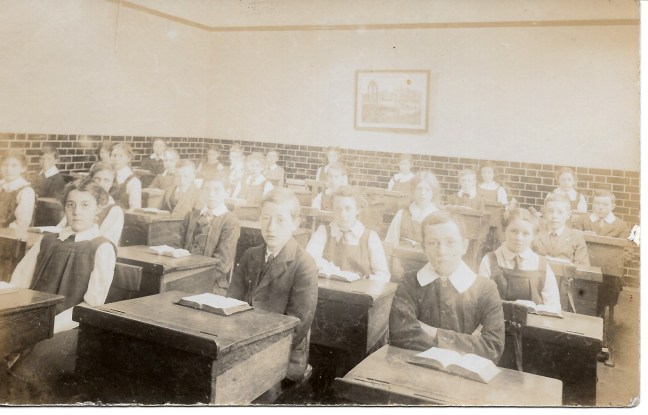
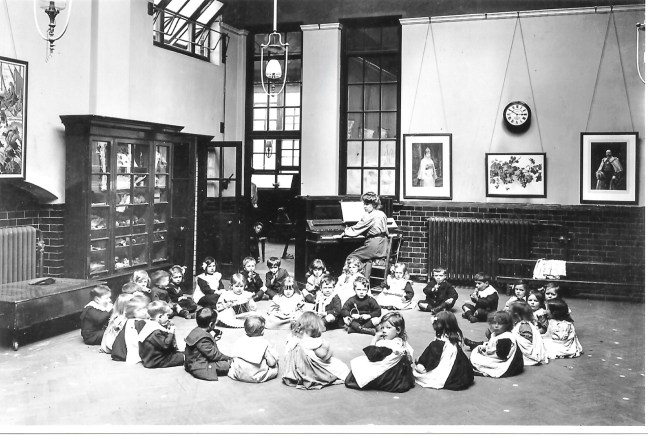
Confession: these photos are from my own ephemera collection. They have absolutely no connection with Dundee, but just serve as a reminder of the days when Sir John Leng’s competition was initiated. The photo at the top of this blog was taken in Wandsworth in 1906, the year of Leng’s death. These little tots probably weren’t being taught Scots songs by their elegant teacher. On the other hand, the children at the foot of this blog post look exactly the age that early Leng Prize competitors must have been! This postcard comes with no caption whatsoever.
My Leng Medal Memories research is funded by an Athenaeum Award from the Royal Conservatoire of Scotland.
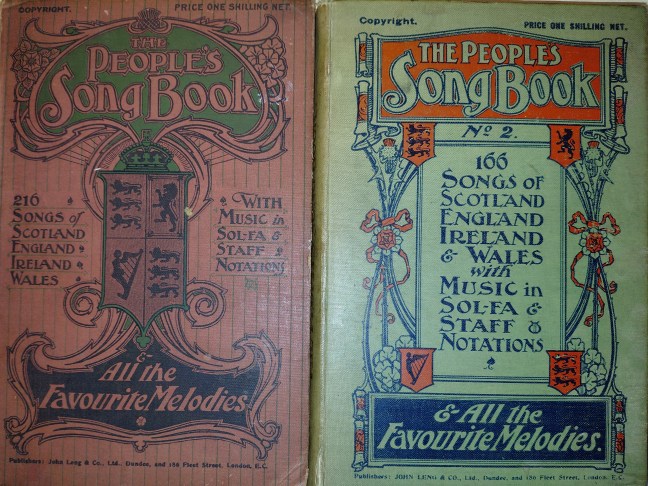
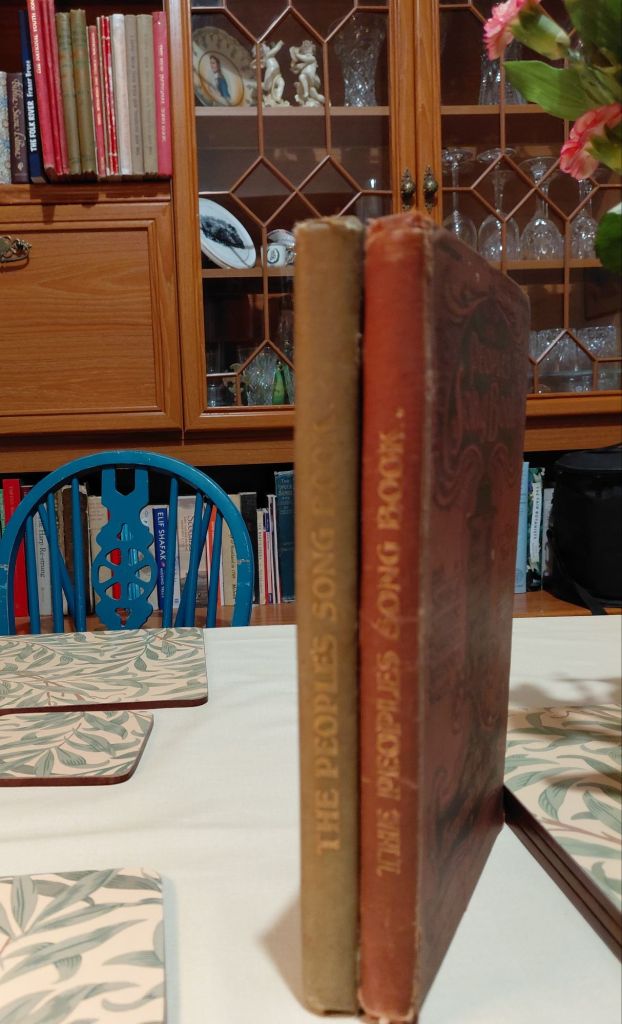
Book 1 of The People’s Song Book (1905) finally reached me, yesterday. Repatriated back to the UK from Virginia, it was beautifully packaged and looks, outwardly, in good condition for its age. Inside is the most fragile paper I have ever encountered. And I’m not kidding! I have done some repairs with library-standard transparent Filmoplast, but the pages tear if one so much as lifts them too quickly to turn over, so I doubt I’ll be using it on the piano much.
Nonetheless, I have pretty much answered my own question: John Leng & Co’s The People’s Friend Students’ Song Book of 1939 derived half of its songs from Book 1 of their earlier The People’s Song Book, and half from Book 2 (1915). Both books, with Tonic Sol-Fa above the staff notation, were compiled by Nimmo Christie (1855-1920), a Dundee music teacher and music critic. For many years he wrote for the Dundee Advertiser, the first Dundee newspaper that John Leng edited. Christie’s sister was a journalist on the same paper.
Christie actually compiled several song books of this type. His name doesn’t appear inside either of The People’s Song Book volumes, but there’s sufficient evidence in contemporary Dundee newspapers. I’m completely convinced. Since he also conducted the Leng Medal concerts – and other school concerts – for a few years, there’s a pleasing tangential overlap with my Leng Scottish Song research, too.
Now, if the later People’s Friend Students’ Song Book derives from the two earlier collections, is there any more to say? Well, yes.
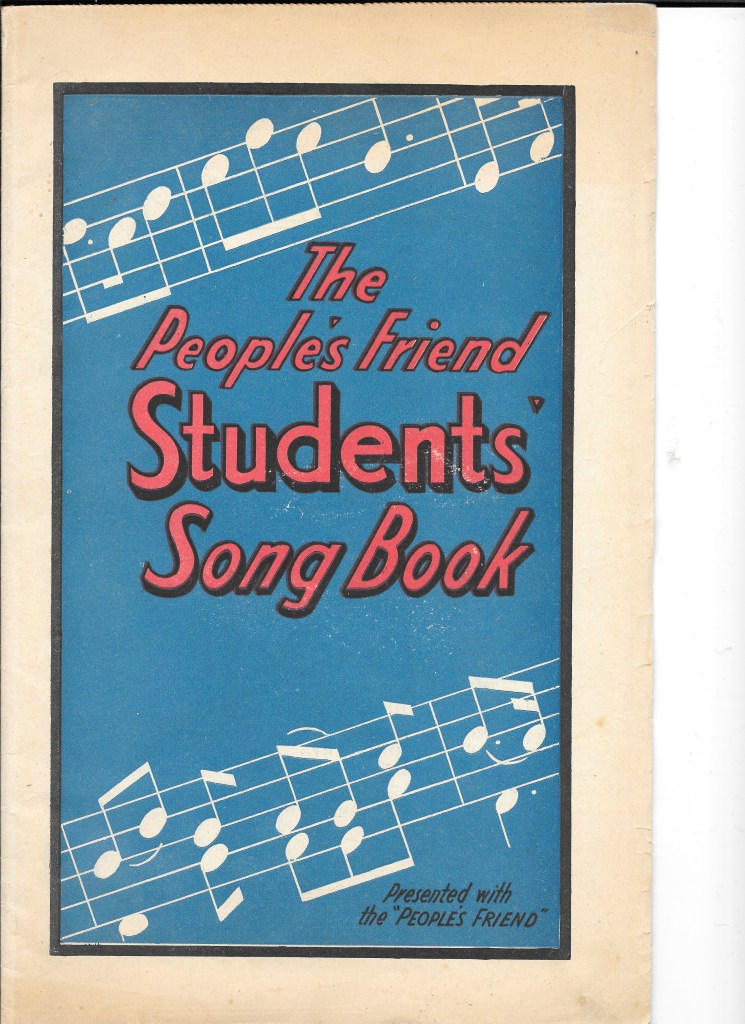
There is one extra song which is in neither earlier book. Back and forth I went, looking through the section indices and the music itself. But ‘A-Roving’ (also known as ‘At Number Three Old England Square’) is categorically not there. An early appearance of this song was in the Canadian Camp Fire Choruses of 1887, ‘Presented to Members of the Canadian Expeditionary Forces With the Compliments of The Compilation Committee of the University of Toronto Song Book’. Oxford University Press reprinted it in 1916.
The song is also in Bayley & Ferguson’s Scottish Students Song Book – but although it’s the same tune, the piano arrangement is different, so it wasn’t just lifted.
Which begs the question, why did John Leng & Co. insert the song into their later publication? I suspect it may simply have been the choice of a well-known song that would fill a blank page. I cannot find any reason why this particular song was included, and certainly no link to the by-now long-deceased Nimmo Christie.
No matter. Community singing and family sing-songs were for many years a popular form of amusement for folk in many walks of life. Evidently, students were no different. It says something for the repertoire that it was still considered worth reproduction in this free supplement in The People’s Friend, a quarter of a century later.
You may also like to read my blog post of 8 March, The People’s Song Book No.2

