Dr Karen McAulay explores the history of Scottish music collecting, publishing and national identity from the 18th to 20th centuries. Research Fellow at Royal Conservatoire of Scotland, author of two Routledge monographs.
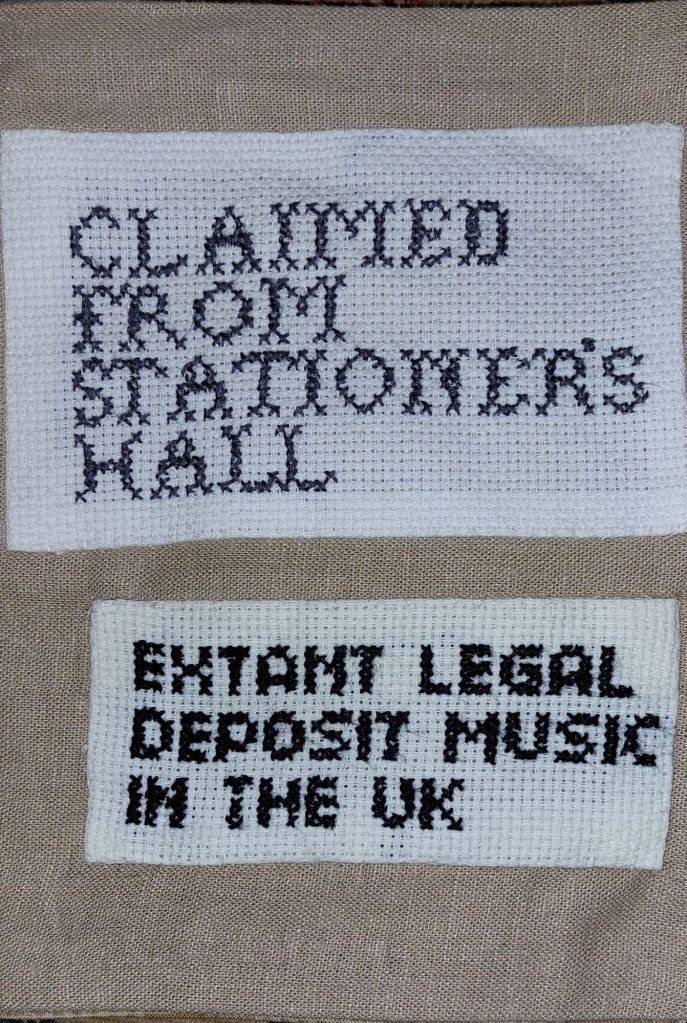
A few years ago, I was awarded a research grant to set up a network which I called ‘Claimed from Stationers’ Hall’, looking at historical legal deposit of music in British copyright libraries.
My research has moved on since then, but the bibliography that I built up may be useful to other people researching legal deposit. There are items of general interest, before the references to music copyright as such. It’s all on a page of this blog. People don’t always realise there are other pages, so I thought it was worth sharing the link again:-
Claimed from Stationers Hall Bibliography: Literature on Music Copyright:-
I came to Edinburgh to see a poetry collection. I’ve seen the book before, but this was a copy presented by the ‘poetess’ [poet] to a friend, whom I’d discovered was a Glasgow publisher. And the catalogue mentioned additional papers associated with the book. Now, wouldn’t that intrigue any scholar?
Wild Goose-Chase
But yesterday, I learned that there weren’t as many papers as the catalogue hinted. They’ve somehow gone missing. Disappointed, I came anyway, to see what remained. Which turned out to be, not a lot. However, what little there was, was informative – in a negative kind of way.
Jump Not To Conclusions!
Not My “Mr Right”!
At the end of the day, there’s a moral to this story! It doesn’t really matter much about the missing papers, because the friend was NOT the Glasgow publisher (about whom I’d learned a lot, on the train to Edinburgh) …. Even when a name looks distinctive and appropriate, it is wise to maintain a healthy element of scepticism.
No, this was another gent with the same name. A highly-esteemed Wishaw bone-setter. Yes, you read that right.
I’ll never know whether the poet consulted him about a child’s injury, or her own ‘rheumatics’. But I can be fairly sure it wasn’t for advice about publishing poetry!
I reread a few poems, had a coffee, and came home again.
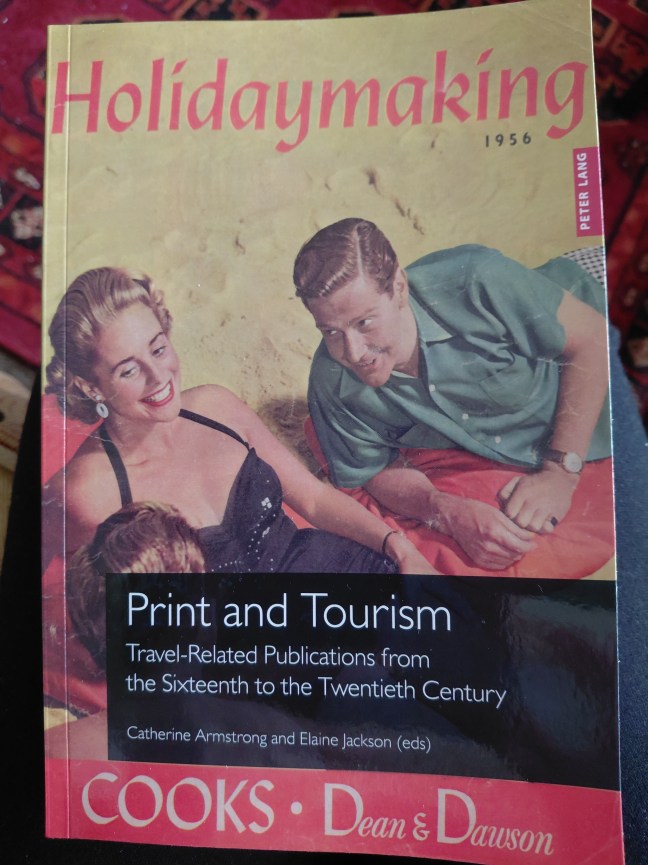
Yes, I’m on holiday! So I’ll keep this brief, but I have to share this: the postie has just delivered my author’s copy of Print and Tourism: Travel-Related Publications from the Sixteenth to the Twentieth Century / ed. Catherine Armstrong and Elaine Jackson.
My contribution is Chapter 8, The Glories of Scotland in Picture and Song: Jumping on the Festival of Britain Bandwagon (pp.187 – 205). It enabled me to write more about this Mozart Allan publication than I was able to justify in last year’s monograph about Scottish music publishers. I’m very happy indeed to have this chapter in Vol.7 of the Printing History and Culture series.
This isn’t really a scholarly post – just a reflection.
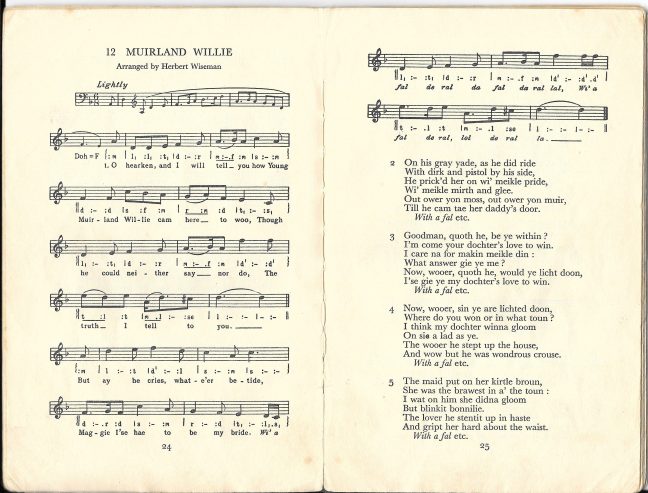
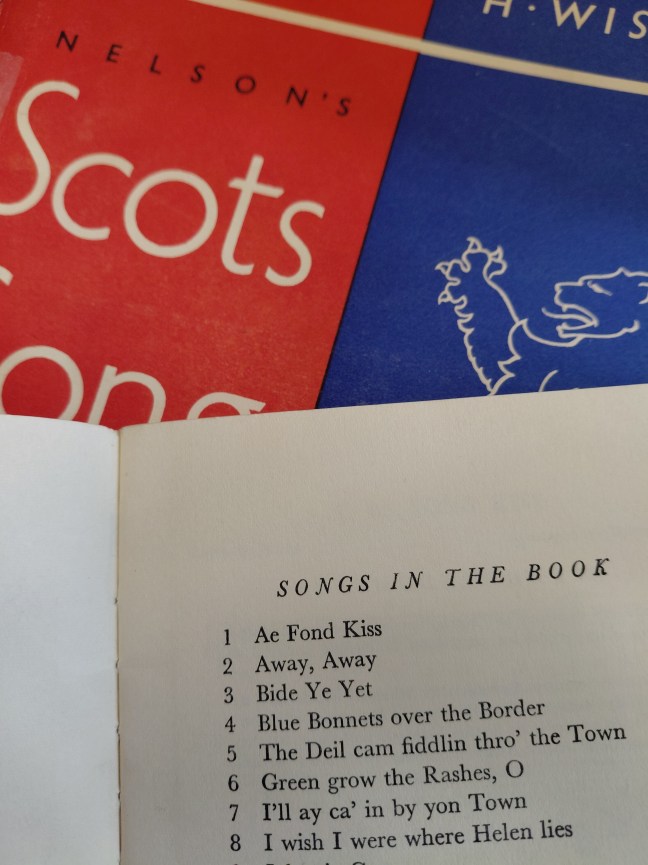
One of my informants remembers singing ‘Muirland Willie’ as their Silver Medal entry, and I was chuffed to find it in my Nelson’s Scots Song Book, Book 3 (‘words edition’). And yes, the ‘words edition’ does contain the melody line as well – just not the piano part.
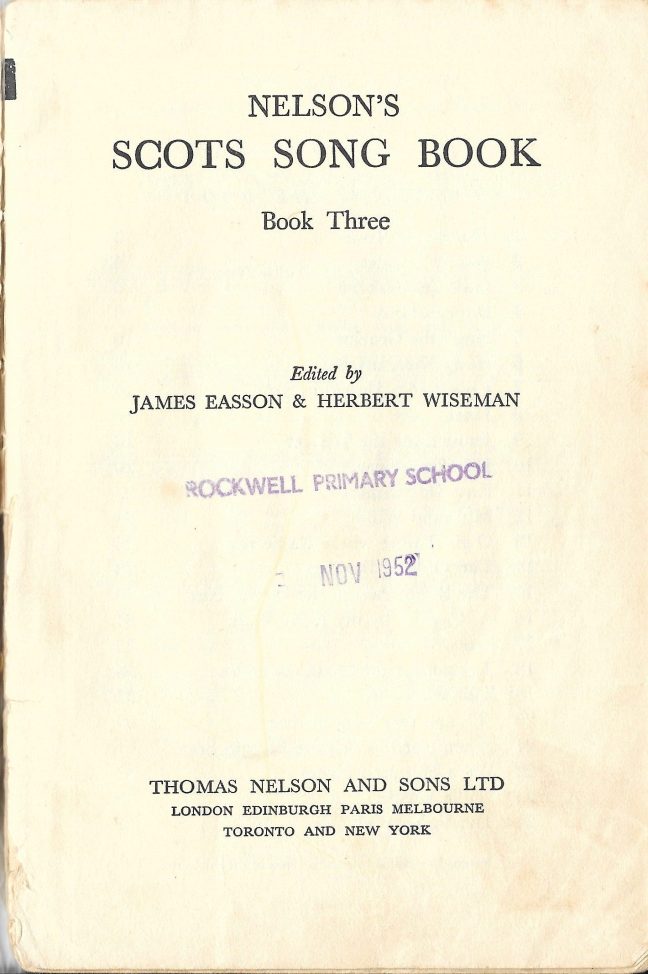
Title page, Book 3 (pupil’s edition)
The book had reached me third hand – or was it fourth? How many hands has it passed through since someone stamped ‘Rockwell Primary School, November 1952’ on the title page? This tells me it was bought by a Dundee school the year it was first published. It must have lived in a class collection for some years, at some point ending up in a private home, and finally being sold to a friend of a friend, who generously got it on my behalf.
It’s a little bit battered, so it obviously got well-used. One page bears a carefully drawn treble clef – pretty accurate but not yet fluent – someone had been learning how to write music, evidently! Meanwhile, the back inside cover has a scrawled ‘THE END’! Was there a sigh of relief, or was it just an irresistibly blank page demanding to be scrawled on?
If Books Could Talk
I wonder how many Leng medal competitors used this copy? If books could talk, this one would surely recall feelings not only of excitement, enjoyment and pride, but also occasionally fear, nerves and perhaps embarrassment – all emotions that my interviewees have shared with me.
It would remember teachers who are still remembered half a century later; not to mention head teachers and deputy heads whose own musicality ensured that they gave music its proper place in the schools that they led.
The principal teacher of music at that time […] was a redoubtable lady and she made sure everybody knew everything …1
But I’d better put my little book away and get back to my interview transcriptions now!
Secondary school pupil commenting on Leng medal singing classes ↩︎
At some point, I’ll be making a list of the songs that juvenile Leng Scots Song Medal competitors recall singing as their competition entries. It’ll be interesting to compare them against the lists I’ve compiled in connection with a number of Scottish song books. Some kids (a few) chose a song that was entirely their own selection. Most seem to have been offered and taught a short selection of songs, from which they then made their choice.
What goes into a published song book like the four Nelson’s Scots Song Books, though? It was a combination of the compilers’ choice and, occasionally, printer’s practicality.
73 Years Ago …
On this day, 4 June 1953, the then editor of the fourth song book had received the initial proofs from Aird and Coghill the printer, and wrote to James Easson (the Dundonian Music Supervisor collaborating with Herbert Wiseman), to say that they needed two more songs to fill five more pages. Pure practicality! Moreover, the editor was leaving for a new job soon, and was keen to get the publication as far advanced as possible before they left.
Reading the correspondence, it looks as though, in response, Easson supplied ‘Ae fond kiss’ (which ended up occupying three pages) and ‘Maggie Lauder’.
Job done? No. The printers said that ‘Maggie Lauder’ had been supplied incomplete. Moreover, another song, ‘As I came over the Cairney Mount’ was too short. Neither ‘Maggie’ nor ‘Cairney Mount’ appeared in the finished publication. It looks as though an abbreviated ‘I wish I were where Helen Lies’ (occupying one page) was supplied instead. (Three and one do not equal five, but it’s of no consequence now!) But it all goes to show how much to-ing and fro-ing took place before a book is published in its final form.
And has either song even been used as a medallist’s performed entry? I don’t know. I haven’t interviewed that many people! But I’ll be going through my transcripts, so who knows?
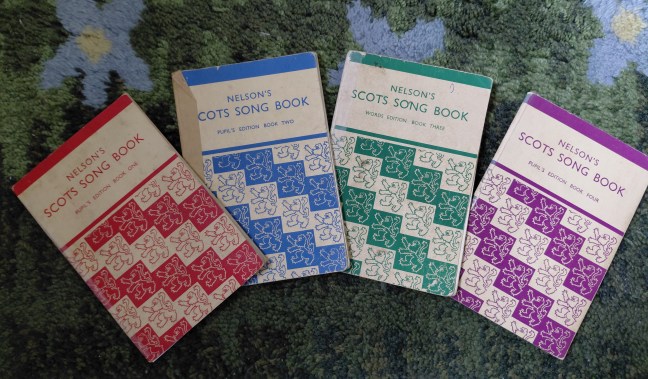
Thanks to the kindness of a friend of a friend, I received books 3 and 4 of the Nelson’s Scots Song Book through the post today. Well, what else could I do but take a photo of them?! I’ve longed for ages to have the complete set, and now I do.
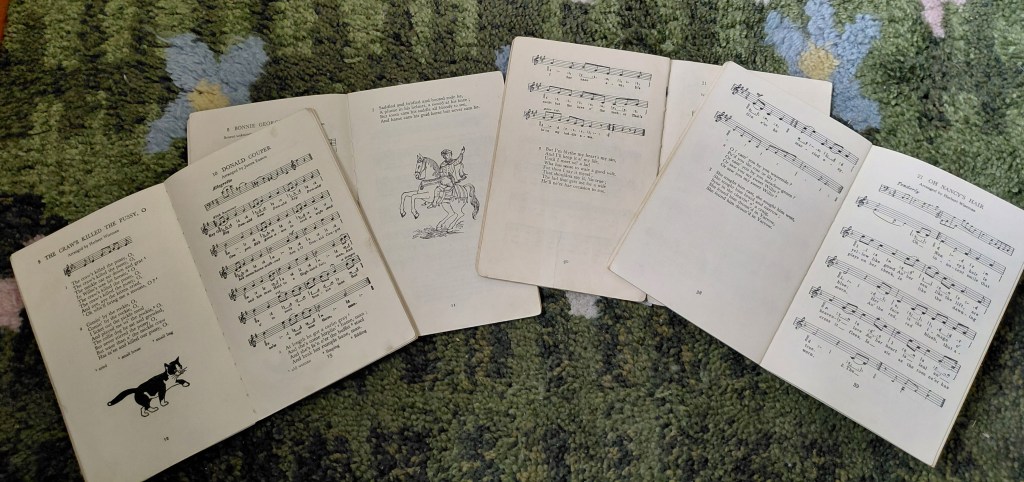
I have already learned something new. The first two books had little black-and-white line drawings wherever there was a blank bit of page, and apparently the pupils loved these. And then …
I think there was a bit of cost-cutting going on! But I don’t recall any correspondence with the editors James Easson and Herbert Wiseman to advise them of this. I’ll need to go back through my notes!
Suddenly – the pictures stopped!
Book 1 – published 1948; reprinted until at least 1960.
Book 2 – 1950; reprinted until at least 1964.
Book 3 – 1952. I don’t currently know if it was reprinted!
Book 4 – January 1955; reprinted at least in 1956. (The teacher’s book came out in 1954)
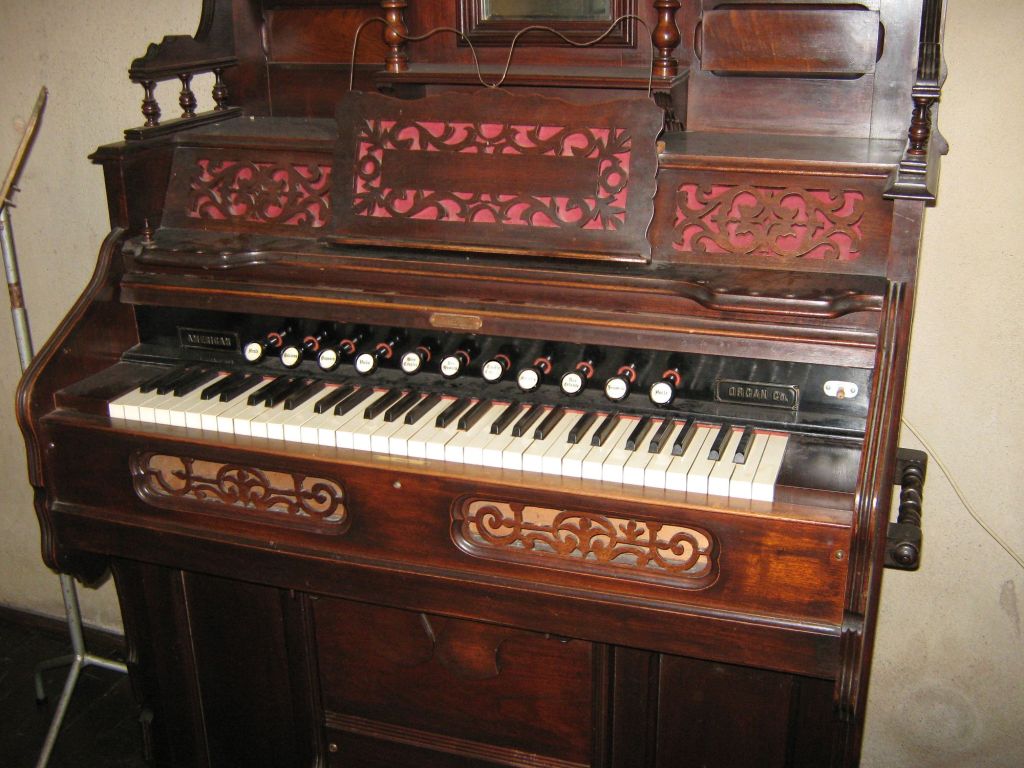
Dr Edward Emanuel Harper has a lot to answer for. As I mentioned in my podcast, I was awaiting a book of American organ/ harmonium pieces, published in 1926, which included a number of pieces by Harper. It’s quite a small book, and arrived from California – in a huge box – yesterday. (An American organ is an instrument very much like a harmonium – a keyboard instrument powered by wind, often for domestic use. My own Welsh grandfather had one.)
American organ (Wikimedia)
As I suspected, they’re short, easy pieces. Amongst the 51 pieces are thirteen by Harper, along with pieces by eight other composers, some of whom would still have been living, and some dead. (Nine pieces were by an American woman of English parentage. That’s not part of today’s story – but kudos to Bayley & Ferguson for including her. All the other composers were men.)
However, even if the pieces in this book – the second book in a series of six – are predictably straightforward, I shall still play them over, just out of curiosity. There’s not a great deal to say about them, after observing that Harper liked chromaticism in the slower pieces, but he also contributed some more diatonic march-like items – and a ‘Scots Coronation March’ which is remarkably un-Scottish.
Notwithstanding the simplicity of the contents, the book itself had more surprises for me. And I fell down a rabbit-hole, as I investigated.
Transcontinental
I’ve written about Scottish music publications having been distributed across the diaspora, but this usually entails one transcontinental trip from the UK, whether commercially, as a gift or by a migrating owner. This copy has travelled thousands more miles than that!
Here we have a book from a Glasgow/London publisher, including pieces by Harper (now in Canada) and the Anglo-American lady, and a German composer who had died some sixty-odd years earlier. It was first published a hundred years ago. Obviously, I’ve no idea whether it was a new copy, ie still in print, when the late owner apparently acquired it in the 1950s (bear with me, I can explain how I think it was then), or if they were given it by someone else, and subsequently wrote their own name on it. The book was ‘printed in Great Britain’ (so I guess that probably means it was NOT printed by Aird and Coghill in Glasgow) – but it was sold to a previous owner, by a firm in Adelaide, Australia – Cawthornes Ltd.
How, I wondered, had the book got from Adelaide to California?
There are Doctors and Doctors …
The late owner’s name is on my copy. It was a distinctive name – so I looked it up, out of curiosity. In deference to their memory, I won’t name them, but the details proved really quite easy to find out, so it feels okay to share the barest outline of my discoveries.
The book had clearly belonged to someone in Adelaide. I can pinpoint the 1950s because the Australian owner gained their undergraduate and Masters degrees in Adelaide, having travelled thousands of miles across Australia to get there. They married there – indeed, their father conducted the ceremony. (This versatile pastor had also played the organ on an evangelical mission to a first nation community in his younger days.)
The newly-weds moved from Adelaide to California to further the career of the named individual on my American organ compilation – who became an eminent scientist. I do know, from the eBay vendor, that the book was one of a number of church-related music publications being disposed of. Although I don’t know for certain if the owner of the book was an organist, their name was on it. I like to think they played it. Does it matter? No, not really!
Of course, the singular, distinctive life-history of one single copy has no bearing whatsoever upon Edward Emanuel Harper, who was in his sixties in Canada by the time the book was published, and was long deceased by the time the book’s owner was a student in Adelaide.
The whole story is just a series of unrelated happenings during the course of its life. It just amuses me to think that an Anglo-Scottish book including short organ pieces by our second Glasgow Athenaeum School of Music Principal – a Doctor of Music – ended up being sold to an Australian scientist at the start of their career, remaining in their music collection as they gained their PhD in one American state and grew in stature and reputation in another – they were not the kind of medical doctor that we think of when we talk of hospital doctors, but certainly working very closely alongside them . I wonder if and when they last played this music?
Home Again
It would have left Britain between 1926 and around 1958, went to Australia and then the USA, but now, finally, it is back in Glasgow, flown back to the home town of the former Bayley & Ferguson, where it’s being pored over by another musical doctor – this time a PhD rather than a Mus.Doc.
That’s quite a life-story for a humble little book of Church Voluntaries!
‘You’ll be home for lunch’, He said. It was halfway between a query and a command. ‘You have four hours …’ (Actually, that came down to three, once I got to the library. Two, allowing for a coffee and my return journey … )
The Authoress
Nonetheless, I held in my hands the two very poetry books that the author (‘authoress’, in those days) had donated to the city library service back in 1881, not that long after they moved from Lanark to Glasgow. I’ll never know if she handed them in personally, but I think it’s reasonable to assume that she handled those copies at some point.
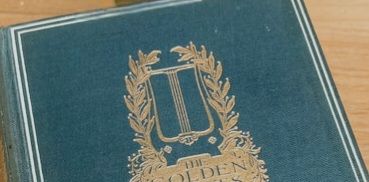
I can’t show you them. (I signed a library form, which said that I couldn’t share my photos on the internet.) But you can picture two small volumes, one dark green and one purple, a little over six inches tall, with gold-edged leaves, and a little gold-embossed lyre on the front cover of each. Slightly different in design, but very similar.
A bit like this unrelated, non-library book
These books are by the mother of one of the women I wrote about in my recent RMA Research Chronicle article.* Only one has been digitized, but I wanted to see them both. I was enchanted to find she had written a poem about ‘my’ heroine, Rose, when Rose was just a small child. It was worth the trip for that in itself. Not that it really added any hard facts to her biography, but still a lovely thing to find.
Anyway, there we were. Me, Mary Ann’s books, and a poem about wee Rose (amongst lots more poetry – I’m not writing here about everything I found!) – so yes, I think I can safely say I came as close as is possible to ‘meeting’ Mary Ann today. But as I said, you’ll just have to take my word for it.
I handed the books back – it was a bit of a wrench, but hey, that’s what happens in a library – and the curtains of time softly closed behind me, leaving Mary Ann in 1881, and myself here in 2026. I may be back – she and I could have more to talk about!
On Wednesday, I was more than happy to attend as an advisory board member for the first board meeting of the University of Sussex’s PromiscuousPrint research project. The website explains what it’s all about:-
A research project about what UK copyright libraries left out in the nineteenth century. Funded by the European Research Council. Hosted by the Sussex Digital Humanities Lab. Led by Dr Hannah Field.
Dr Field is the principal investigator of PromPrint; she is an associate professor in Victorian literature at the University of Sussex. She’s joined by doctoral researcher, Tiffany Murphy, also at the University of Sussex, and two Digital Humanities scholars, Dr Nicolas Seymour-Smith and Dr Milan Terlunen (also at Sussex).
It’s rather nice to have the opportunity to think about copyright libraries again. My own Claimed from Stationers Hall network feels quite a while ago now! (Remember?)
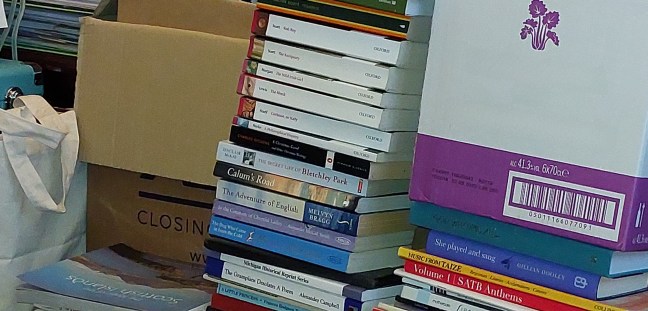
I forgot to add .. the decorating delays are apparently our fault for having so much stuff. It’s my books and music in the dining room that the painter’s alluding to. (He has no idea about Himself’s collection, many of which were originally secretly delivered to his workplace so that I wouldn’t see them, and are now scattered in various parts of the house.)
Last November, one of the electricians also innocently asked why I had so many books. I answered lamely, ‘Well, so I could write these two.’ Which didn’t seem terribly convincing to me, but seemed to satisfy him!
Scholar
Former librarian
Organist
Writes books about music books …
I don’t feel guilty about the books, but I really must reduce the collection before my family have to clear the house once I’m gone! Some are going on eBay, others to the charity shop.