Dr Karen McAulay explores the history of Scottish music collecting, publishing and national identity from the 18th to 20th centuries. Research Fellow at Royal Conservatoire of Scotland, author of two Routledge monographs.
Yesterday, I highlighted the 85th anniversary of the Blitz that destroyed Paternoster Row on Sunday 29th December 1940 – and with it, Thomas Nelson’s London premises.
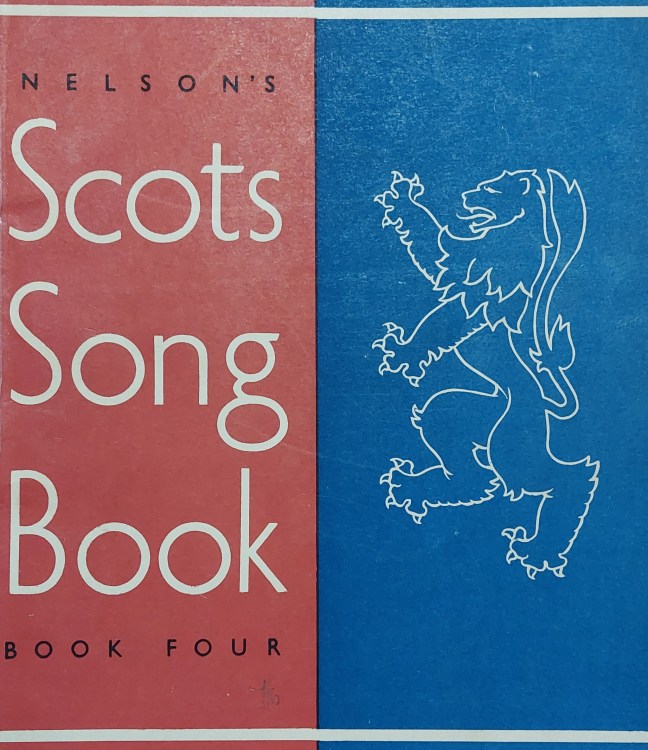
Today, 30th December, we leap forward to 1954. The Second World War had ended nine years earlier. The country was picking itself up again, and James Easson and Herbert Wiseman had published four books of Scottish songs in the series, ‘Nelson’s Scots Song Book, primarily for school use. I’ve done a lot of research into this series, during my Heritage Collections visiting Fellowship at IASH in the University of Edinburgh, so I’m sure you’ll understand that I won’t be saying much about it today – all will be revealed in due course! However, I can reveal that Easson seems to have written a letter to his editor on 30th December 1954, with the expectation of compiling a fifth book. The letter is no longer extant, but the carbon copy of their reply survives.
‘All good things must come to an end’, as the saying goes. And an IASH Postdoctoral Research Fellowship is a thoroughly good thing. I handed back my keys with sadness today, but I have had a great year. (The Fellowship was technically six months, but I was graciously permitted to hang around, retaining the use of my office for the rest of the year, which was wonderful, and enabled me to continue data-gathering in the Library’s Heritage Collections.)
19th meets 20th century Looking back …Last glance from bus stop St Patrick’s Square
If you are looking for a next step after your PhD, or if like me, you’re making a change of direction – or need a spell concentrating on a particular research question in the Humanities – do consider applying.
I devoted my time to examining the archives of the Edinburgh publishers, Thomas Nelson. I initially entitled my project, ‘From National Songs to Nursery Rhymes, and Discussion Books to Dance Bands: investigating Thomas Nelson’s Musical Middle Ground’, but the nursery rhymes turned out to be poems, and weren’t what I had in mind! The rest? Yes, I researched them.
I found quite a bit of correspondence between Thomas Nelson’s editors, authors and compilers, which was gratifying. I was able to trace material in journals that I would not have had access to, had I not been in Edinburgh; there’s the excellent University Library collection of actual and digital resources, and the National Library of Scotland just down the road.
I have deferred commencing any significant written work until I had explored all the potentially relevant materials in the files. I believe I’ve now reached that point. As a result of conducting this research, I have ideas for extending my research in new directions, and I’m contemplating writing another book, so I need not only to explore potential audiences, but also to start working on a book proposal
However, I have also applied for and recently won an Athenaeum Award from the Royal Conservatoire of Scotland to enable me to conduct an oral history project. This work, to be conducted in 2026, will hopefully enable me to write a final chapter for my proposed monograph. (I’ll be blogging about this before too long, but there are things I need to do first, before I spill the beans!)
I have benefited from being part of a research community, hearing other scholars’ papers and discussing our research; and attending researcher development sessions. I was able to focus on my new direction as a researcher – important, after so many years as an ‘alt-ac’ researcher working in professional services. In this regard, I have also been in a position to submit some other unrelated work for publication, and I spoke at a conference at the University of Surrey in June, all of which gives me a sense that my research is gathering momentum.
Today, my last day, I took a cake to the University Library’s Heritage Collections; went to IASH’s Christmas lunch; and mulled over aspects of my ethical approval submission for my next project. (Oh, and drank quite a bit of coffee!)
Thank you so very much for a great year, IASH!
IASH (Institute for Advanced Studies in the Humanities)
It’s not as though I’m unaccustomed to what I’ve been doing in odd moments for the past few days. Over the years, I’ve opened dozens, indeed hundreds of old song books and other music publications, trying to read their prefaces, annotations and harmonic arrangements as though I were a contemporary musician rather than a 21st century musicologist. Looking at music educational materials is likewise not new to me.
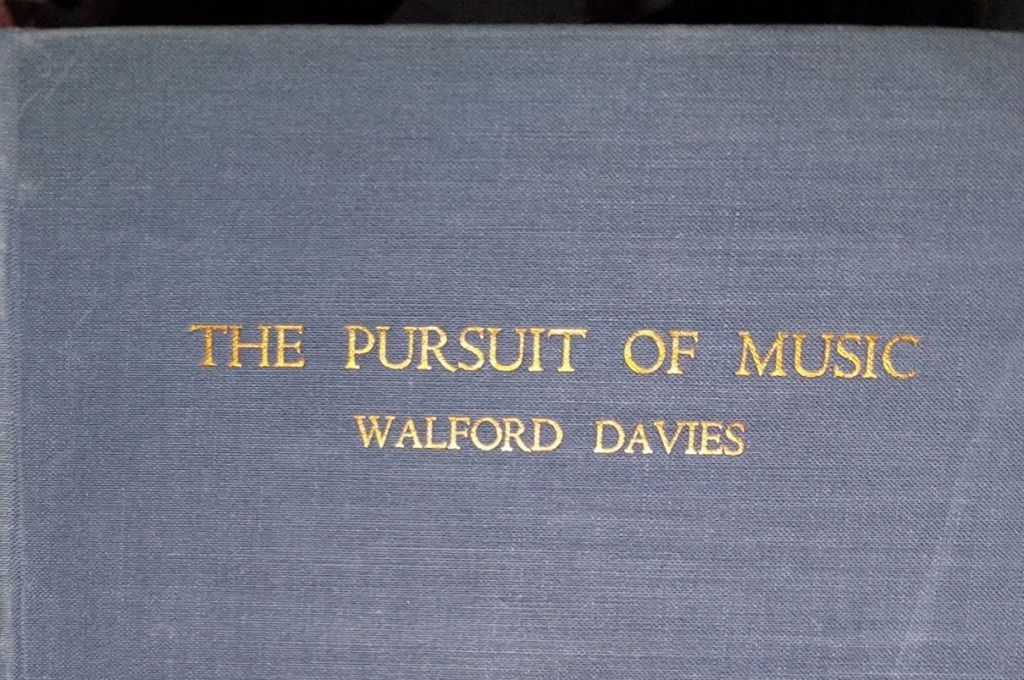
Enter Dr Walford Davies and his The Pursuit of Music
He was the first music professor at the University of Aberystwyth, but he was also hugely popular in the 1920s-30s through his broadcasting work – fully exploiting the new technology of wireless and gramophone for educational purposes, and to share his love of music with the ordinary layman wishing to know more about all they could now listen to. This book was written after he’d mostly, but not entirely retired.
It wasn’t exactly what I expected! If I thought he would write about what made the Pastoral Symphony pastoral, or Die Moldau describe a river’s journey, I rapidly had to change my expectations.
His audience was apparently not just the average layperson, but also young people in their late teens, not long out of school. If the reader didn’t play the piano, they were urged to get a friend to play the examples for them. (Considering the book is over 400 pages, you can imagine how long they’d be – erm – captive!)
Dedication
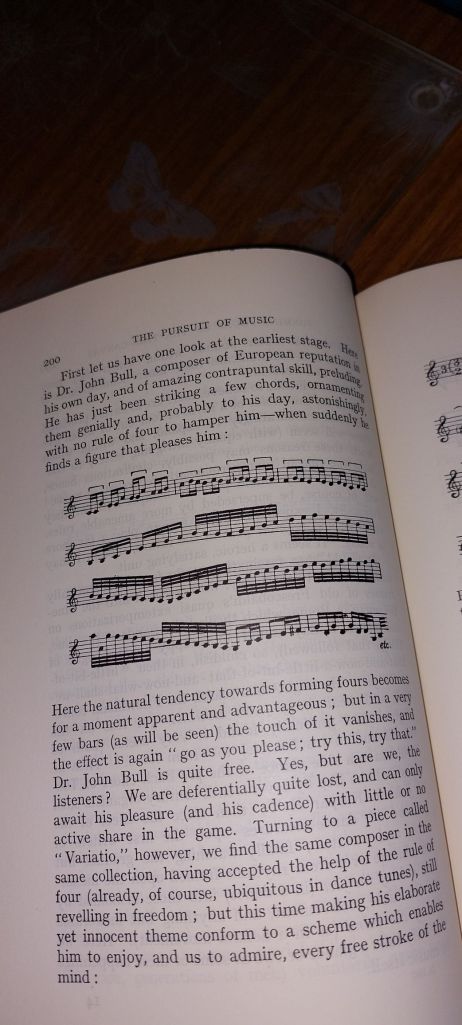
Examples for your friendly pianist to play!
And this was aesthetics, 90 years ago. I struggled to get into the mindset of a layperson wanting to know what music (classical, in the main) was ‘about’, without knowing what a chord was, or realising that music occupies time more than space. Would I have benefited from that knowledge? Would being told in general terms what the harmonic series was, have helped me appreciate the movements of a string quartet? Or Holst’s The Planets?
It wasn’t about musical styles over the years. I didn’t read it cover to cover, but neither did it appear to explain musical form and structure as I would have expected.
Davies’ biographer, H. C. Colles, did comment that it was a mystifying book, and suffered from the fact that the author’s strengths were in friendly and persuasive spoken, not written communication.
I’ve only heard snatches of his spoken commentary, so I can’t really say. Apart from which, Colles made an observation about Davies’ written style. Colles was a contemporary authority who knew Davies personally – and he may have been picking his own words carefully, so as not to cause offence. My own disquiet is more a matter of content: was it what his avowed audience needed, to start ‘understanding music’?
I think I have been mystified enough.
I wonder what the Nelson editors made of this book by one of the great names of their age? They published it, and I think regarded him as a catch, but what did they actually think?!
And did the layperson, assuming they got through the 400+ pages, lay it down with a contented sigh, feeling that now they understood music?
It would be remiss of me not to point out that Routledge’s Black Friday sale makes the e-book version of my book very affordable! (Maybe someone might even buy you it for Christmas?).
Those preferring to read a hard copy might point out to their library that there’s no time like the present…
(Do I live in the 1950s these days?!) I’ve been tracing a woman who briefly worked for publisher Thomas Nelson in Edinburgh in the mid-1950s. Yesterday, I found a memo from her to one of the managing directors. Instructed to throw a book away if she couldn’t find a use for it, she promptly did find a use for it, giving it to the library of the Glasgow training college where she had previously worked.
I admired her honesty in telling him, because there was probably no need to report back on what happened to a book that was clearly regarded as inconsequential. It came from the Toronto branch of Nelson’s, and was about important Canadian educationalists; I can see why it might not have been much use in the Edinburgh office. (She had, in fact, travelled back from Montreal at the age of 16 – I have no idea how long she’d been there – so maybe he knew this, and thought she’d be interested in this combination of a country she’d visited, as well as a topic she knew well.)
Nonetheless, she did tell him, and reported that not only did the college librarian thank her, but her former boss at the college had commented that it was a title she’d actually been looking for. My interest was piqued, and I checked Jisc Library Hub Discover. Sure enough, the college has since been absorbed into a university, but the university library still has that book – the only copy in the UK. It has survived 72 years and at least one library relocation. I wondered if it had subsequently been borrowed by that senior training college lecturer – the one who had been looking for it?
Apparently not! The book has no trace of ever having been borrowed. Let’s hope she at least sat and read it in the library!
In the late 1920s, Thomas Nelson’s were just starting to work with the music specialist who would turn out to be very helpful to them over the next couple of decades. As I mentioned, I’ve been trying to find the very first letter that passed between them. Moreover, the Nelson’s editor had told his line-manager at the outset (in the mid-1920s) that he hoped this individual would be helping with ‘the large music book’. Now, this is delightfully vague, isn’t it? Nelson’s wouldn’t be publishing anything that I’d call ‘large’ in the way of printed music for several years.
And Another Music Man!
On Friday, I stumbled across editorial correspondence from 1929 about revising an earlierbook about music – one useful to individual students, possibly beyond school age – but not a school classroom text-book. When I get my hands on it, I expect to find that it’s a fairly standard Nelson printed book size. If this was ‘the large book’ (Possibility A), then it was only ‘large’ by comparison with slimmer materials intended for the classroom. Moreover, our music man was NOT the person who ended up revising it. His first contribution was something slimmer, and more classroom-based. But this book does perhaps better fit the timescale of a publication being projected in the late 20s.
It’s so easy to imagine up a sequence of events, with what is really insufficient evidence. After all, there could be another projected ‘large book’ (Possibility B) that never actually happened!
My working theory for Possibility A, is currently that even if they approached the first guy to revise a book, then for whatever reason, he wasn’t ultimately offered or didn’t fancy the commission. The chap who did do it was certainly a good choice, in any event – a knowledgeable scholar rather than a gifted practitioner and pedagogue.
There’s nothing for it – I must continue leafing through early correspondence in search of that initial letter! But I’ve also ordered a copy of the book that the scholar revised. After all, it’s another Nelson music publication. I need to know about it, too, whether it’s the ‘large’ book or otherwise.
This afternoon, I gave a talk about my archival research, to the Friends of Edinburgh University Library – where I received the strongest indication that people love talking about their memories of school music lessons!
I had great fun introducing the long-forgotten editors at Thomas Nelson – including a lady who went on to work at the University Library after finishing her PhD – and, of course, the people who compiled the Scots Song Books. (They wanted to compile a fifth – I bet you didn’t know that! But Nelson’s didn’t …)
Main picture – tulips outside the University Library
On Friday afternoon, a tiny germ of a thought struck me. It was about a book to which I had previously given no thought whatsoever. It is unrelated to Scottish song, or even Scottish culture. It was published by a Scottish publisher.
100, 245, 260 …
(Forgive the little library codes! I haven’t forgotten where I came from.)
But I can’t see a title without wondering about the author, so I idly looked them up on my journey home from Edinburgh.
Well!
Here we have someone who …
Had LRAM piano and was a Dalcroze graduate
Trained primary school teachers in eurythmics
Gave classes for kids in a city studio
Helped choose music for the Royal Scottish Country Dance Society
Once or twice arranged music for same (but was never apparently on any committees – you can spend hours looking at RSCDS digital archives, and I have!)
Did I trace their birth and death dates, where they grew up, and where their parents married? Yes, I’m afraid I did!
MT? Definitely.
(Another clue for my former colleagues!)
All this falls into the scholarly equivalent of ‘pretty but pointless’, on the face of it, since it has nothing to do with a Scottish song book series for schools. But the book itself might have a tangential link to my present research – more anon – and gives me food for thought in another direction.
I have just talked myself into another eBay purchase …
From the 56 or so files I’ve examined up to now, the Thomas Nelson archives generally save copies of the letters that went out from the offices – but not the incoming replies. They reveal one side of a conversation.
So today, I was able to read letters to James Easson and Herbert Wiseman about the third and fourth Scots Song Books, but I couldn’t see how they reacted or responded. I need to look at the finished books again, but I may not necessarily be able to determine if they took on board the impeccably polite and respectful points raised about the texts they had used. I haven’t got the annotated proofs that were sent to Easson, or his reply.
As you will see from the enclosed, there are certain discrepancies, mostly small ones, between your text and the text as given in the various authorities.
I wonder if he had anticipated the lengths to which his new editor would go – visiting libraries and consulting authoritative editions – to ensure the texts were accurate?! Lengths, I might add, which are entirely consistent with what I’ve learned about the editor!
What is clear, though, is that these books were very carefully compiled, and just as painstakingly edited.
I am very anxious to get these points settled now before the MS goes for setting.
I still have a number of files to examine – and until I see them, I won’t know which departments they are from. I wonder when I’ll catch up with the meticulous editor again?!
Thomas Nelson’s four-book set was for classroom use. Offering a mixture of history and theory (music-reading and tune-building), it even suggested pupils might plan a folk music concert.
In this exciting, modern world, children were reminded that their parents’ music lessons consisted only of singing, whereas now they might also learn instruments like the recorder, and perhaps collect interesting clippings from the Radio Times. (It sounds like another world, doesn’t it?)
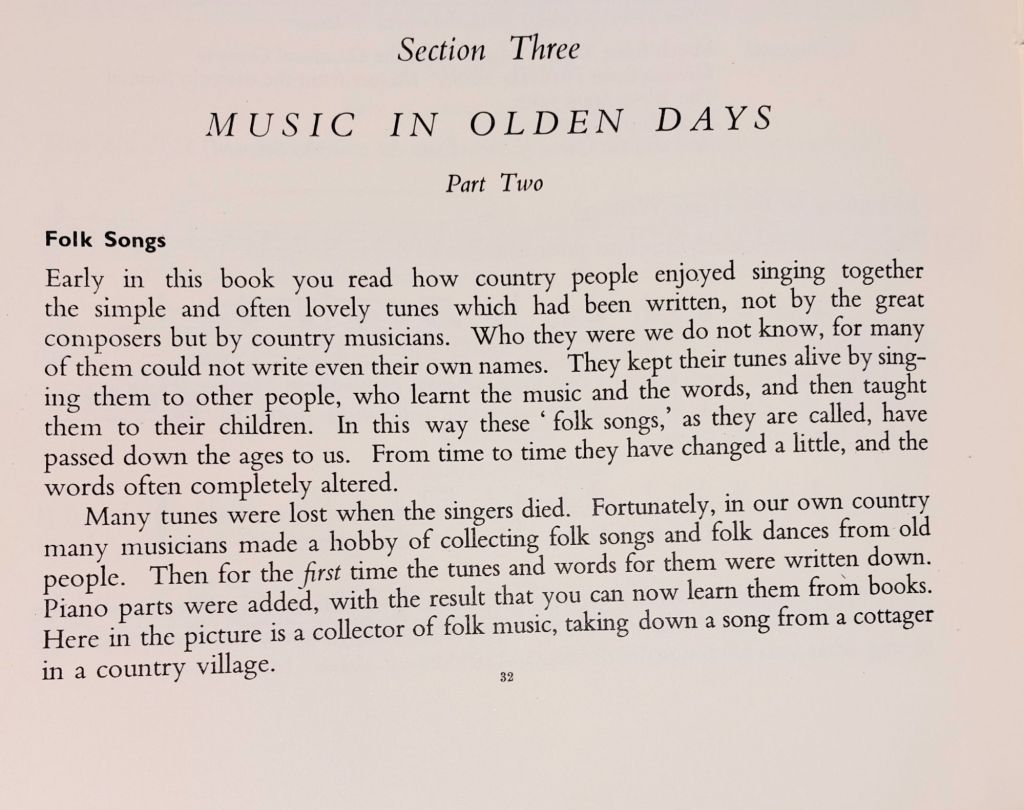
Meanwhile, diving straight into the history, children were immediately introduced to the concept of folk music.
This is an English book, but I only recognised two of the three songs from my own school days. ‘The Carrion Crow’ wasn’t one I knew.
I’m delighted to find that kids were also introduced to the role of a song collector. Although I have to say that the child in the foreground on the right looks bored and unimpressed by the proceedings, in the illustration! Still, Nelson’s editors presumably commissioned the illustration rather than use a stock image, so they’re due some credit.
The song collector
They’re still holding onto the idea that folk music came from country folk. I wonder if pupils ever asked what city folk sang?!
Of course, it wasn’t all folk music. Kids were also introduced to the likes of Brahms, Handel and Purcell. Today, I imagine only examination classes would have textbooks introducing the classical greats. On the other hand, more time is probably spent on world music, and efforts are made to consider music by women and people of underrepresented communities. Times have moved on!
Nonetheless, it’s interesting to see how much knowledge children would have acquired in general classroom music lessons, and to compare it with modern times.
Even the books are brighter and more appealing today, I must admit!