Respectful Academic Writing.

'RESPECT'

I wrote my conference paper a couple of weeks ago. Timed it, trimmed the word-count, timed it again. (Repeat that a few times!) And then today, something occurred to me. Not all at once, no. In stages, let’s say. To start with, it was just a question of technology: wouldn’t it be better, I mused, if I used the tablet rather than a wad of paper? On went the tablet. And (not that I noticed at first) off again. I eventually realised that it needed charging – it’s ages since I last used it. Whilst I waited for it to become functional again, I looked at my paper one last time, thinking I’d just make sure it was absolutely perfect before I looked at it on a different gadget.

And that’s when I spotted it – I could call it a major faux pas, or I could blame it on my generation.  Well, that’s a cheap excuse, isn’t it? Not acceptable. If I want to be accepted as a scholar who is still on the ball, still at the top of her game, then I can’t lamely whimper that I didn’t realise what I was doing was disrespectful …

Equality

It’s a relatively recent academic writing protocol, and one that was long overdue: men and women should be written about with equal respect. By that, I mean that if you wouldn’t refer to Elgar as Edward, then you can’t justify calling Mary Wollstonecraft, just Mary.  Elgar is Elgar, and Wollstonecraft is Wollstonecraft.  Otherwise, it’s not only disrespectful, but diminishes the woman’s standing.

Mary-Anne Smith, Rose B. Smith, Jane Sillars, Flora Woodman …

Now, in my paper, I’m not talking about big names like Elgar or Wollstonecraft.  But I realised that I’d fallen into the trap. Mary-Anne, Rose, Jane and Flora deserved better. They needed their last names.  So I got stuck in.

It’s just a bit more complex than you’d think, especially when you are not only writing about the women, but are also mentioning their menfolk. You can’t refer to three different Smiths as plain, ‘Smith’. But ‘Mr, Mrs and Miss Smith’ doesn’t work, especially when Miss Smith kept her ‘Smith’ professionally after marriage. 

Then there’s the unmarried mother who identified as ‘a widow’ in at least one official document – but married some years later. At which point her daughter’s name changed. (Had she actually got married another time before the marriage I know about, wouldn’t her daughter’s name have changed then, too? But it didn’t, so I’m taking it that ‘widow’ was being used diplomatically. We’re talking of the Edwardian era.)  In any case, her marital status is of absolutely no concern to me, but I am concerned that she and her daughter are called the right names at the right time!

Need I continue? 

And, grammatically, if two individuals with the same last name get mentioned in the same sentence, then either you need to use first names as well, or rephrase for clarity. ‘Her daughter’ and ‘her mother’ are very useful substitutes!

Sometimes it’s just a question of being pragmatic. I haven’t, indeed I couldn’t excise all stand-alone first names.  But I think I’ve improved it. I’ve shown due respect to all the individuals I’ve written about – most of them women.

I do believe I’ve finished my revisions!
Women and Musical Histories, 1789-1914. Conference 2-4 September 2026: Website

Old photo of a woman

I’m looking forward to my trip to London for this conference this week, and I’m grateful both for the invitation to give a paper, and for the support from my home institution, in the form of a Royal Conservatoire of Scotland Athenaeum Award. I thought it would be worthwhile sharing the link to the event again, now that the programme has been finalised.

Women and Musical Histories, 1789-1914

The organisers have shared the following information:-

The final programme can be accessed directly here:

View the full conference schedule.

A more comprehensive programme, including all presenter abstracts and biographies, is accessible as an Exposition on the Research Catalogue platform.

My paper is on the final afternoon, Friday 4th September:-

โ€˜The Trumpet Majorโ€™s โ€˜Poetessโ€™ Widow; the Scottish Shipping Magnateโ€™s Daughter and the Retired Barrister: The Importance of Parental Support to Musically Gifted Girls in the Late Victorian and Edwardian Erasโ€™.

ABSTRACT

Although Iโ€™ve encountered few womenโ€™s names in nineteenth- and early twentieth-century Scottish music publishing, I recently published an article about the five women that I did find. (Two were English by descent, but they all grew up in Scotland.) Meanwhile, in other unrelated research, I encountered a London-born Scotswoman with a completely different background, who made her career as a high-flying soprano recitalist. The common thread was their family background and/or support. In todayโ€™s paper, Iโ€™d like to focus on Rose Buchanan Smith (1870โ€“1942), one of the Scottish-born Englishwomen, and Flora Woodman (1896โ€“1981), the London-born Scot. The cut-off date of this conference, 1914, is significant for both women: itโ€™s the latest possible date for Kerrโ€™s fourth book of Kerrโ€™s Merry Melodies, in which I first encountered Roseโ€™s name; and the year of Floraโ€™s concert debut in Londonโ€™s Bechstein Hall.

One cannot generalise about womenโ€™s musical careers on the strength of two womenโ€™s stories. Nonetheless, when there are comparatively few stories substantial enough to draw any inferences from, those that do survive must perforce carry more weight. In my research, I have realised that it is sometimes surprisingly useful to attempt comparisons between individuals whose lives were entirely unconnected. How did these women curate their careers? What influence might their parents have had? Might their mothers have had a particular influence or been especially supportive? What about marital status? Did being a Scottish-born Englishwoman, or a London-born Scotswoman, have any particular effect on their careers? Did they make use of professional networks? And was the advent of new technologies reflected in their musical activities? I shall outline the resources to which I had access, in tracing their path from adolescence to late middle-age, and demonstrate the importance of families to a young Victorian or Edwardian woman establishing a musical career.

This project has been supported by the Royal Conservatoire of Scotland’s Athenaeum Awards.

Image by chenspec from Pixabay

The Excitement of a Good Spreadsheet!

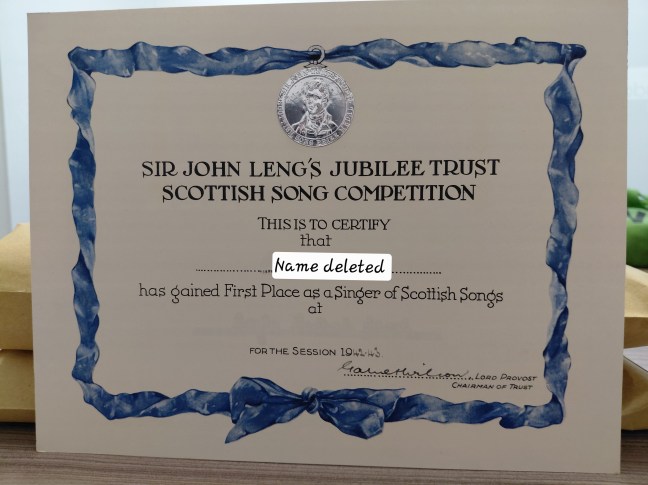
A Leng Medal Certificate

It’s fair enough to say that I find spreadsheets endlessly fascinating, although I don’t use them for number-crunching. However, they’re invaluable for comparing data. In fact, I discovered this before I even knew the word, ‘spreadsheet’, since I did some repertoire comparison for my Masters research degree on mediaeval English plainsong uses at the University of Exeter in 1979-80. It was a 60K-word Masters thesis – I’d intended to continue it to doctoral level, but decided instead to write it up as a Masters then changed subject for the PhD.  (And that became my first doctoral attempt, the one that never got finished.)

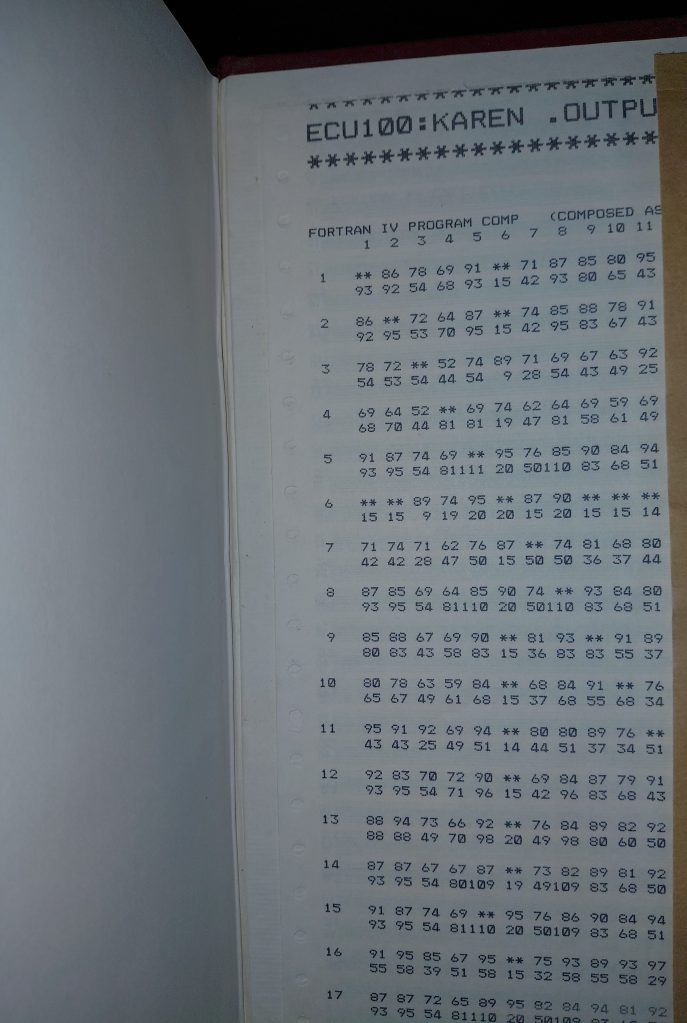
Page of Fortran data printout
Computer printout from my Masters thesis, 1980

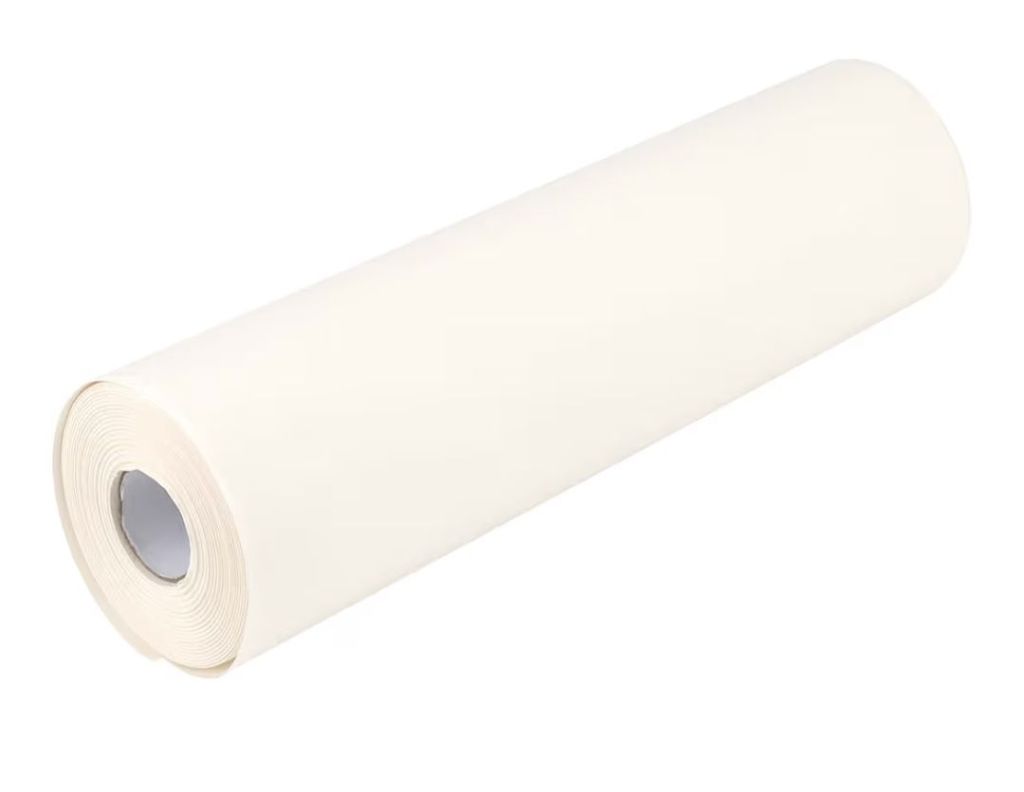
This was before the era of personal computers. My data was tabulated manually on a very long roll of kitchen shelf-lining paper, which opened out the full length of the Music departmental library in ‘Knightley’ on Streatham Drive. I compared post-Pentecostal Alleluias and sequences from various English liturgical manuscripts, along with pieces of plainsong from an Augustinian burial rite, now in Shrewsbury public school library. That’s nearly as much as you need to know about my Masters!

Just a Roll of Paper!

Computer Science? Yes, Indeed!

However, one other interesting fact is that I was the first music postgrad to involve the Computer Science department in my repertoire analysis. I filled in cards – or forms, can’t remember which – which were input by the computer scientists to arrive at statistics as to how much different categories of plainsong correlated in terms of repertoire, across different monastic orders and geographic locations.

If you were interested in that Master’s research, this is how you’d find it in Jisc Library Hub Discover; it hasn’t been digitized, to the best of my knowledge:-

  • Karen Elisabeth Manley, English mediaeval liturgies and their plainsong. Exeter, 1980.

The Magical Microsoft Excel

Since my second incarnation as a musicologist in the present century, I’m sure you can imagine how exciting it has been to be able to compare repertoires of Scottish song in a variety of different contexts. But this time I can save my spreadsheets safely – they’re much more portable and more readily manipulable.

In the context of my Leng Medal research, my ‘cup truly overfloweth’ this week, since I’ve seen lists of songs sung, enabling me to see how tastes have changed over the past sixty or so years. I’ve been comparing what was sung, against a few different song books available at particular times. Obviously, I can’t compare ALL the songs against ALL the song books that exist – I would surely go insane! Indeed, I couldn’t even capture ALL the data for every single year over that period – I simply didn’t have time. But carefully judged snapshots are certainly giving me food for thought. I’ve had endless fun today, producing charts and tables to examine the data in different ways.

The Most Popular Songs sung by Leng Gold Medal Finalists

Oh, did you think I was going to tell you which they were? Sorry, not at the moment – I need to keep specifics for when I write my research up later!  It’s certainly interesting, though.

I only picked nine different years for close examination.   Suffice to say, they have given me plenty of hard data to set my oral history interviews in context.

And not a roll of shelf-lining paper in sight nowadays!


My Leng Medal Memories research is funded by an Athenaeum Award from the Royal Conservatoire of Scotland.

A Teenager! (Should I Bake a Cake?)

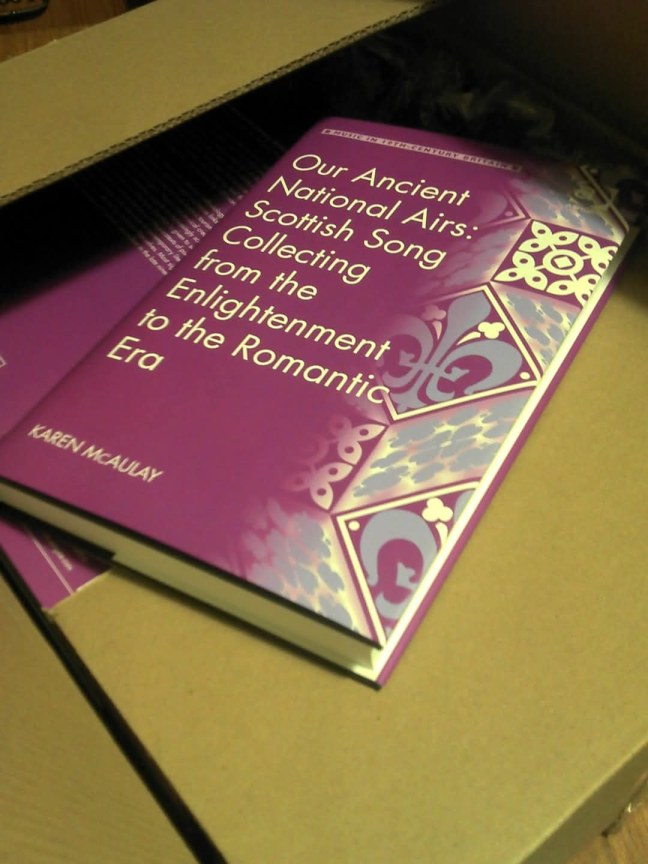
Facebook has just reminded me that it’s thirteen years since the book launch of my first monograph. Surely I should celebrate somehow? Should I bake it a cake? (Any excuse for a cake!)

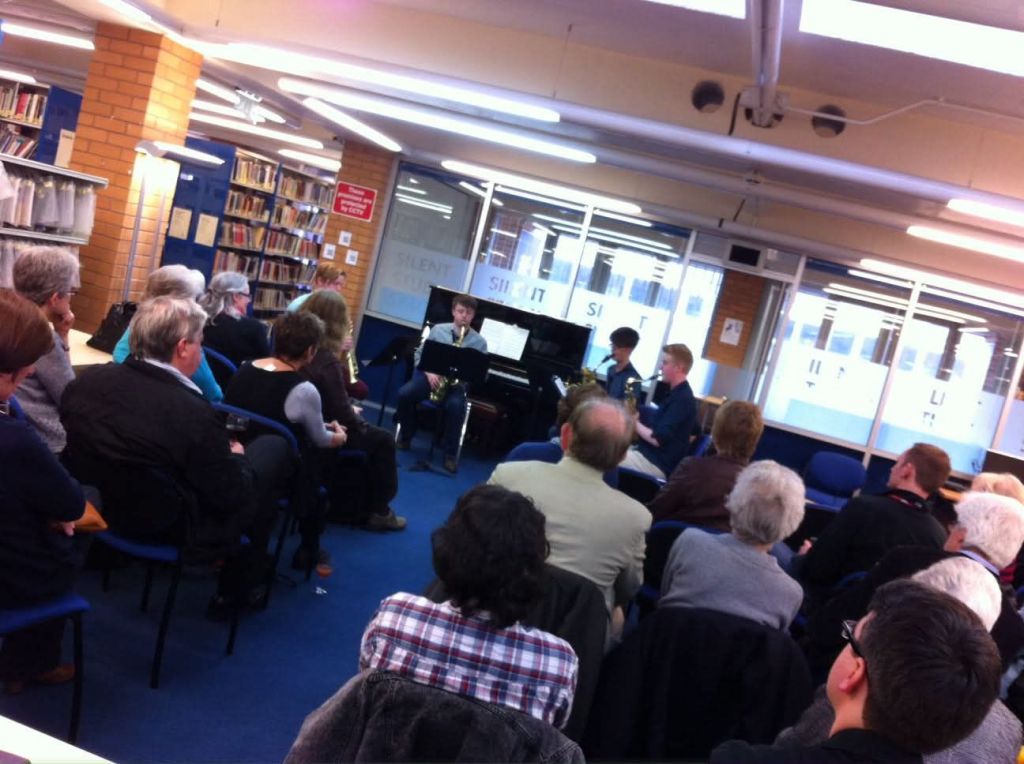
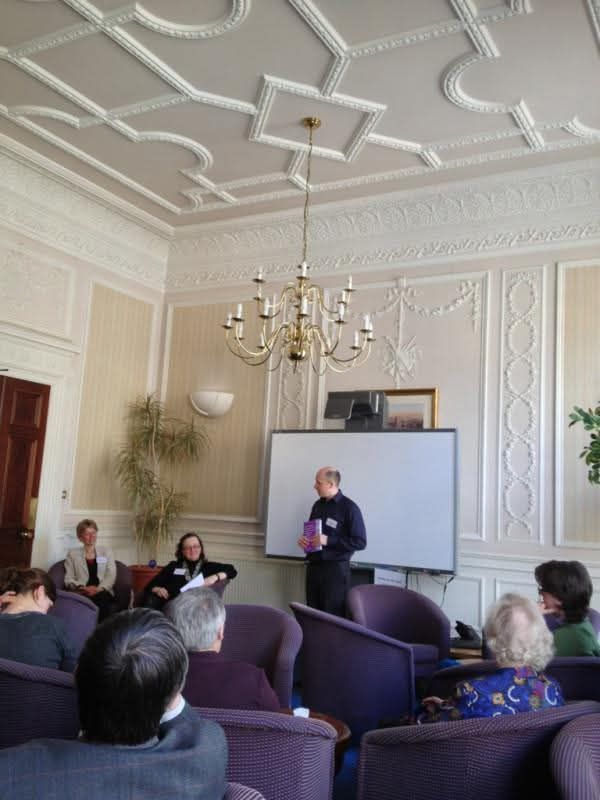
Book launch in the Whittaker Library, 13 years ago

Saxophones, Singing and Harp Strings

The launch had a saxophone ensemble playing arrangements of songs that Alexander Campbell had collected for his two Albyn’s Anthology volumes (1816, 1818). Robyn Stapleton sang with a piano trio.ย  And my friend clarsach player Karen Marshalsay played a tune she had written for me.ย  It was a great celebration, and another milestone for me, the woman who never submitted her first doctoral thesis in the mid 1980s, but had completed another one a quarter of a century later.

We had another no less triumphant, but smaller scholarly launch at the 2013 Musica Scotica conference.

I remain totally convinced that my second research career has been better in every respect than the first abortive attempt. Different subject.  A different environment.  Much more impact. And, with no offence to anyone working on mediaeval music, significantly more useful in the librarianship career I had dedicated myself to. The Royal Conservatoire of Scotland does offer a traditional music degree, so historical Scottish song collections are of some interest, whilst I suspect fewer of our undergraduates would have been excited by cantus firmus treatment in 15th century polyphony!

My research changed me, and changed my subsequent career. So yes, I do need to celebrate Our Ancient National Airs‘ thirteenth birthday.

Before I get started on the first chapter of my next, third book.

A Week with a Difference – and only Halfway Through

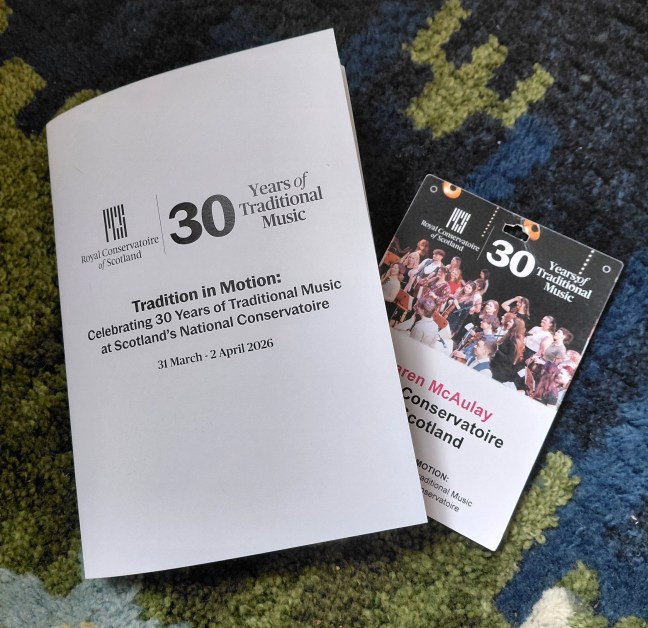
Programme and delegate tag for Tradition in Motion conference at RCS

I started my Leng Medal Memories interviews this week. What a pleasurable experience this is turning out to be! Two of my interviewees still have their silver medals, fifty-odd years later. I subsequently asked the Facebook group, Dundee Pals, and found that lots more people there still have their medals, too. It just goes to show how significant winning the medals actually was to the school pupils who took part.

Anyway, I thought I’d re-share the link to my questionnaire about Dundee Leng Medal memories, in case anyone finds this post and would like to participate in my research project:- https://tinyurl.com/LengMemories

Tradition in Motion


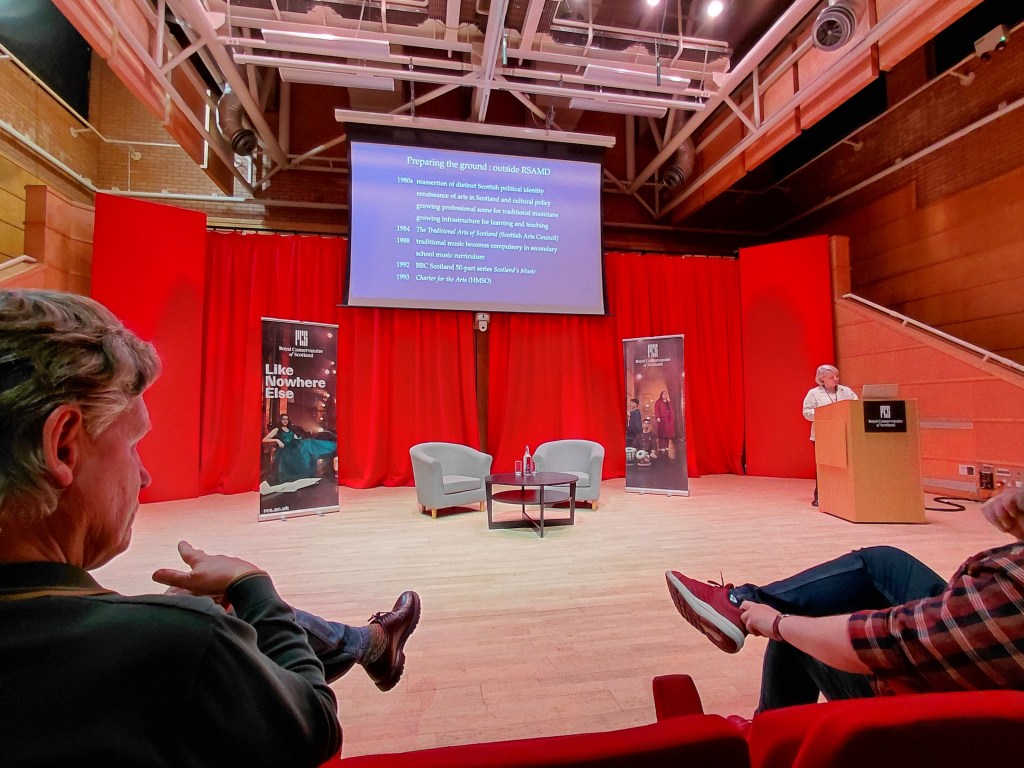
On a different note, yesterday (Tuesday) saw me as a delegate attending the first day of an Royal Conservatoire of Scotland conference, which was celebrating thirty years of traditional music at RCS. The keynote speaker was Dr Jo Miller, one of the co-founders of the Scottish Music degree. As she spoke, her slides showing the chronology of those early years, I realised that when I arrived at what was then RSAMD in 1988, this was just as trad music teaching was getting off the ground.

In 1988, I had no idea that I’d end up recommencing my doctoral studies fifteen years later – little did I know! – forsaking mediaeval polyphony to focus on Scottish songs. My choice of subject was very much influenced by the thought that I’d at least be studying something that might be useful and relevant to students on that course. It took me a little bit longer before I realised that what I was researching counted as ancient history – certainly relevant background, but a very different kind of Scottish song to what today’s contemporary musicians really want to focus on! The songs – their tunes and authors – are still important. But the harpsichord, and subsequently the piano arrangements that I was looking at, represented the soundscape of another world entirely. By contrast, yesterday I heard a paper about sounding Scottish in modern harp-playing; another about the use of traditional Scottish music in videogames; and a third talking about Robert Burns and Hamish Henderson. So many different aspects of Scottish traditional music!

No more interviews or meetings for me this week, but next week I’ll resume my researches. Meanwhile, I need to create another ‘Microsoft Forms’ online form. To think that when I was first a doctoral researcher, I took typing lessons so that I wouldn’t be dependent on paying a typist – as I had done for my Masters dissertation.

By the time I finished my second attempt at a PhD, we had email and PCs. Social media and all the extra Microsoft offerings were still in the future.

And now – I couldn’t even do this present research without Teams, Bookings and Forms. Times change!

World Book Day

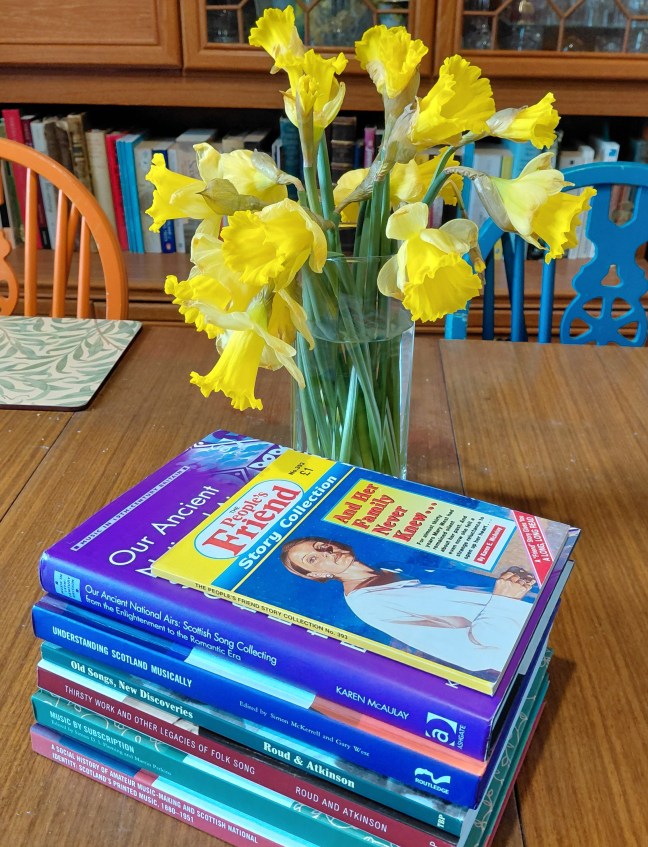
My two monographs, four contributed chapters, and a People's Friend paperback, on the dining room table, with a vase of daffodils.

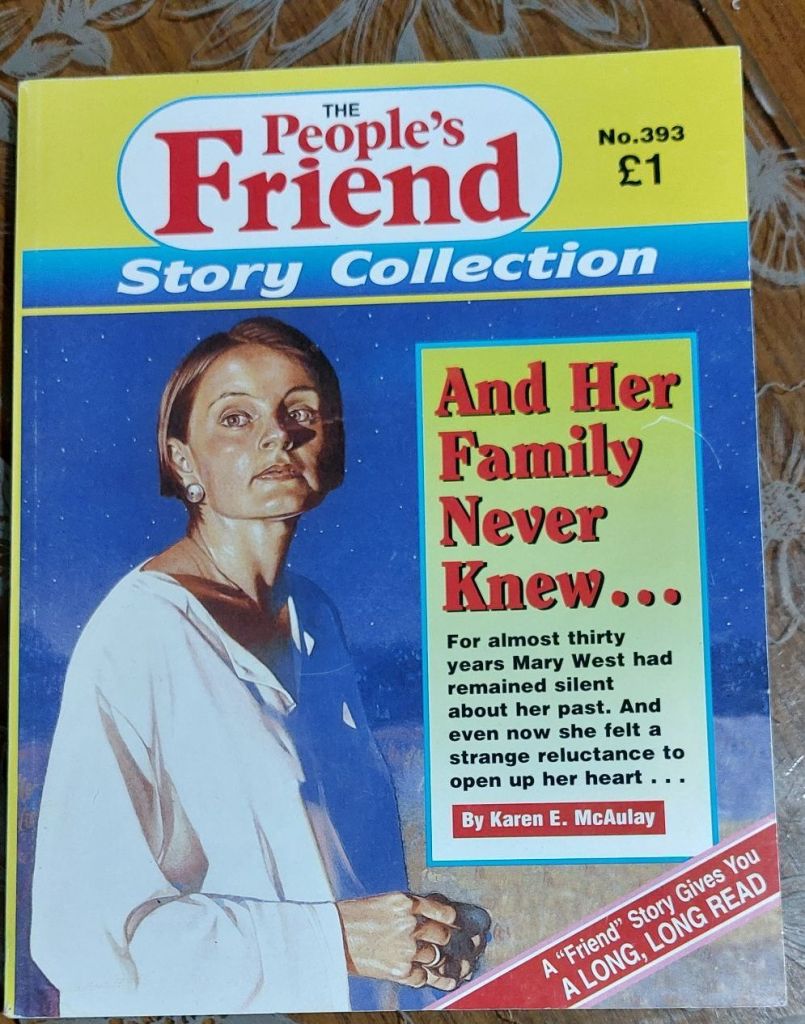
Something you may not know is that my first book was by no stretch an academic one; it was actually a People’s Friend serial-turned-paperback, published in 1996.

And Her Family Never Knew

Fiction

Not many people know (there’s a theme here!) that I published 30 short stories and that serial, long before I made my second start at an academic career.  Writing helped finance my first maternity leave, and even enabled me to replace my car at the end of it. OK, it was a comparatively little-used Lada. But it had four gears compared to the previous Lada’s three, and more significantly, I’d earned it through writing. I was proud of that. I owe a big debt of gratitude to D. C. Thomson, who gave me these writing opportunities, and plenty of feedback along the way.

Writing Skills: Clarity

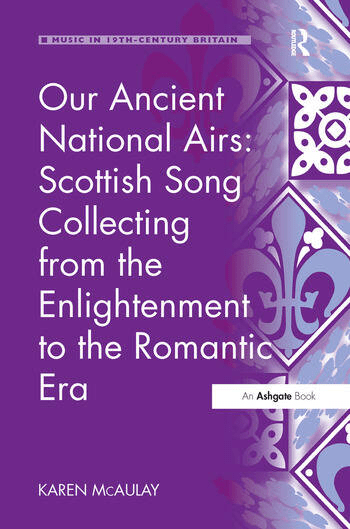
Our Ancient National Airs

I honed my writing skills. Clarity was one thing: a story must progress logically, and readability is crucial. I still try to avoid big words for big words’ sake, unless they are the obvious, unavoidable choice.ย 

And Writing about People

Writing about people was another skill,ย and I have continued to enjoy this in my subsequent work.ย  No, it’s more than enjoyableย  – I love it! I’m never happier than when I’m writing about people whose lives I have researched; I feel as though I actually know them. Walking through Edinburgh, their ghosts surround me, and I’ve often reflected that I probably know as many deceased Edinburgh musicians and publishers as live ones!

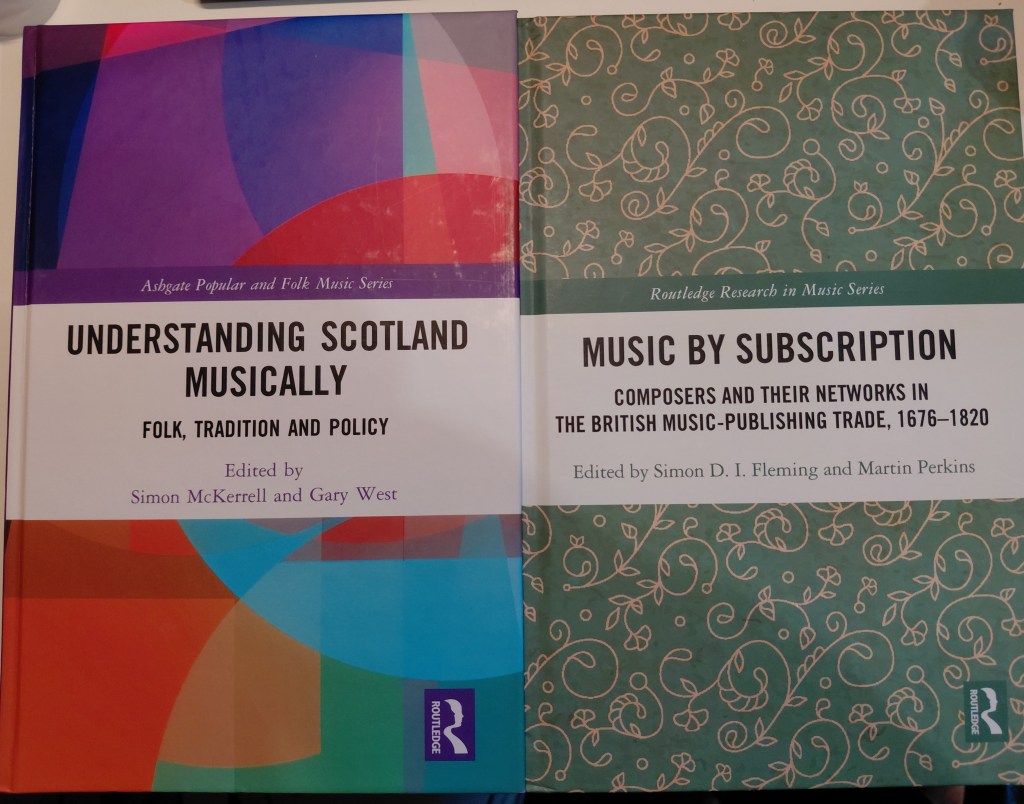
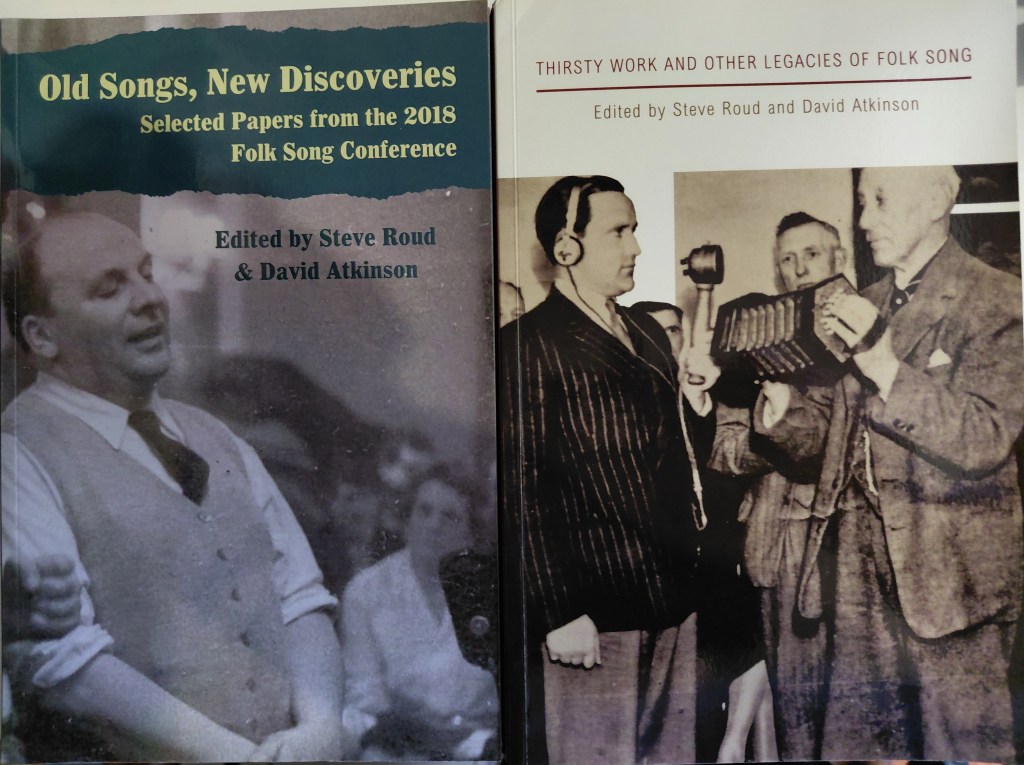
I turned my PhD thesis (2009) into my first monograph (2013), then came a few contributed book chapters, amongst other writings:-

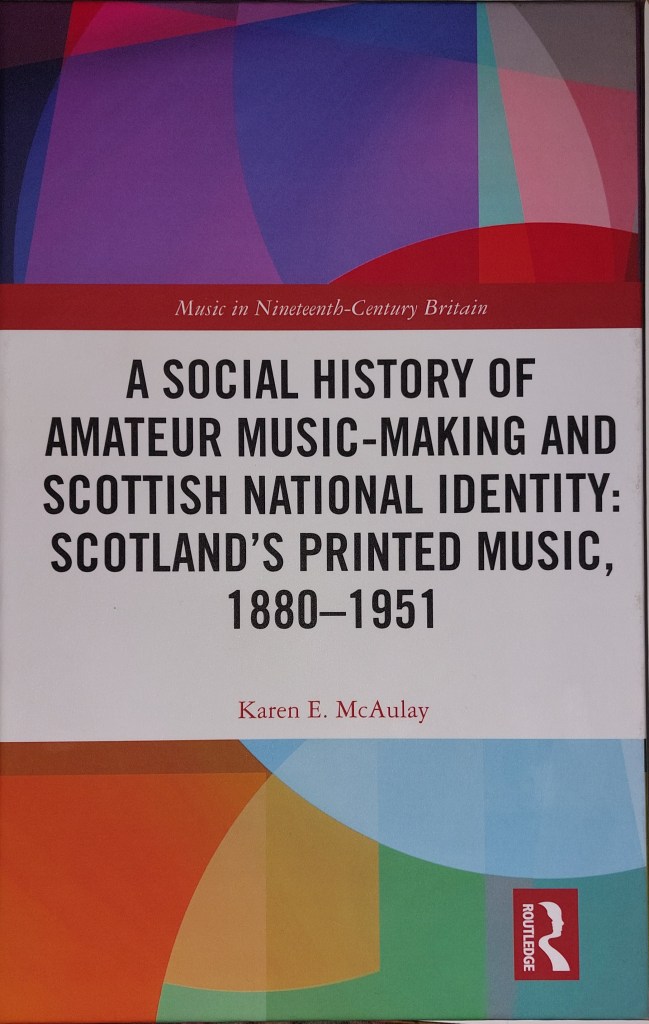
Book cover: A Social History of Amateur Music-Making and Scottish National Identity: Scotland's Printed Music, 1880-1951
A Social History of Amateur Music-Making and Scottish National Identity

My second monograph was published at the end of 2024.  Research has never occupied as much as half my working week, with the exception of last year’s IASH postdoctoral fellowship, so I have to resist making unfavourable comparisons with other full-time academics’ output; mine doesn’t compare.  But, taken in context, I can hold my head up pretty well.

But enough of celebrating my books for World Book Day – I need to get back to the research that will ultimately, I hope, give rise to my third monograph. I’m making up for lost time …

Book Stack

Bibliophilia

Piles of books on the floor whilst their usual room is redecorated.

I forgot to add .. the decorating delays are apparently our fault for having so much stuff. It’s my books and music in the dining roomย that the painter’s alluding to.ย  (He has no idea about Himself’s collection, many of which were originally secretly delivered to his workplace so that I wouldn’t see them, and are now scattered in various parts of the house.)

Last November, one of the electricians also innocently asked why I had so many books. I answered lamely, ‘Well, so I could write these two.’  Which didn’t seem terribly convincing to me,  but seemed to satisfy him!

  • Scholar
  • Former librarian
  • Organist
  • Writes books about music books …

I don’t feel guilty about the books, but I really must reduce the collection before my family have to clear the house once I’m gone! Some are going on eBay, others to the charity shop.

The Highs and Lows of 2025

As I’ve mentioned before, I have mixed feelings about this kind of thing. Outwardly, it smacks uncomfortably of, ‘Look at all my Achievements!!!’  Inwardly, I ask myself if I’ve done enough. Could I have tried harder? (I was brought up with, ‘So long as you know you’ve done your best’, but the unspoken suggestion was often that maybe I could and should have tried harder still!)

Sunshine

In a year of highs and lows, this really has been a rollercoaster.ย  I joyously welcomed the publication of my second Routledge monograph. I was also delighted to accept a visiting Fellowship at IASH (the Institute for Advanced Studies in the Humanities, at the University of Edinburgh), where I explored the Thomas Nelson archives – with more ideas arising out of this.

  • A Social History of Amateur Music-Making and Scottish National Identity: Scotlandโ€™s Printed Music, 1880-1951 (Routledge, 2025)

I saw three articles published, gave a paper at a conference in Surrey, and have another two articles and a contributed book chapter in the pipeline.

  • Article, โ€˜Heart-Moving Storiesโ€™ illustrated by Magic Lantern’, The Magic Lantern no.45, December 2025, pp. 11-12 (ISSN 2057-3723)
  • โ€˜Sir John Macgregor Murray: Preserver of Highland Culture, Music and Songโ€™. Folk Music Journal vol. 13 (2025) no.1, pp.50-63.
  • ‘The โ€˜Scottish Sopranoโ€™ and the โ€˜Voice of Scotlandโ€™: the Importance of Nationality to Flora Woodman and Robert Wilson’, History Scotland Vol.25 no.1 (Spring 2025), 74-81 (accessible online via public library e-magazine apps, or you may be able to order a paper copy online.)
  • Conference paper,  ‘Comparing the Career Trajectories of Two Scottish Singers: Flora Woodman and Robert Wilson’, at the University of Surrey: Actors, Singers and Celebrity Cultures across the Centuries, Thursday 12 to Saturday 14 June 2025,  organised under the aegis of the University’s Theatrical Voice Research Centre.

I also finished supervising and assessing some Honours students’ research projects – an enjoyable new experience.  Having been an ‘Alt-Ac’ since gaining my doctorate in 2009, I had acquired a PGCert and FHEA, but teaching opportunities outside libraryland were infrequent. Being semi-retired certainly opens up new possibilities, and I’m happy to consider other opportunities.

And I have been awarded an Athenaeum Award from my home institution, the Royal Conservatoire of Scotland, for an oral history project in Dundee. That will begin as soon as the  ethical approval process has been completed.

Clouds

However, as well as the professional highs, were the personal lows. In the middle of the year, we lost my mum at the age of 94, and this was far from the only upheaval on the family front. It has not been an easy year.

It would be inaccurate to say that I’m glad to see the back of 2025, because there has been much to celebrate. But, whilst I do hope that 2026 might be less of a bumpy ride, I realise that some things are beyond my control.  ‘Trying hard enough’ isn’t always sufficient guarantee, and some things will be difficult no matter what I do.  Shall we say that I hope the good outweighs the less good?!

Ethical Approval: a Must

Scrabble letters spelling Projects, Jobs, Done

My next research project requires ethical approval – interviewing real live people rather than writing about people long since departed.  And it’s imperative that I get my submission in on time, since the next meeting of our ethics committee is early next year.  

I’ve been working on it for weeks. (Admittedly, I’m a part-time research fellow, so I technically have only 10.5 hours a week to get my research activities done. Yes, we all know that the reality is different!) Anyway, yesterday was my own deadline: it just happened to be the last day we’re open before Christmas, and the morning after my last working day this year.

Efficiency (and Thoroughness)

There’s only one way to fill in a form efficiently, and that’s to make sure every question is answered satisfactorily. To this end, I go through and make myself a list of the information I must provide. Over the past few weeks,  I assembled the info. Attachments were created and labelled. And here’s where Tuesday (not a ‘work’ day) and Thursday came unstuck. I wanted to have a particular collection of old newspaper excerpts to share as an interview prompt.  Finding and listing them was easy enough. Formatting the document in Word, though? With clips of the excerpts? It took hours!

Have I Forgotten Anything?

Finally satisfied, I turned back to the form. And there – I swear they weren’t there when I initially saved it! – were a couple more questions with grey-shaded boxes requiring answers. And attachments.  What a good thing I double-checked. โœ”๏ธ

It’s done. Phew! Details of whom I hope to interview, what I’ll be asking, and how I’ll save and use the gathered information, are all itemised.

And … breathe!

I submitted it. Ensured everyone involved could access it. At last, I can stop thinking about it until after Christmas!

Now, where’s the domestic to-do list (all the stuff I need to do, because no-one else will think about it) …?

Christmas cheer!

Image by Daniel Schmieder from Pixabay

My IASH Fellowship Ends …

IASH - Institute for Advanced Studies in the Humanities

‘All good things must come to an end’, as the saying goes. And an IASH Postdoctoral Research Fellowship is a thoroughly good thing.  I handed back my keys with sadness today, but I have had a great year. (The Fellowship was technically six months, but I was graciously permitted to hang around, retaining the use of my office for the rest of the year, which was wonderful, and enabled me to continue data-gathering in the Library’s Heritage Collections.)

If you are looking for a next step after your PhD, or if like me, you’re making a change of direction – or need a spell concentrating on a particular research question in the Humanities – do consider applying.

I devoted my time to examining the archives of the Edinburgh publishers, Thomas Nelson.  I initially entitled my project, โ€˜From National Songs to Nursery Rhymes, and Discussion Books to Dance Bands: investigating Thomas Nelsonโ€™s Musical Middle Groundโ€™, but the nursery rhymes turned out to be poems, and weren’t what I had in mind! The rest? Yes, I researched them.

I found quite a bit of correspondence between Thomas Nelsonโ€™s editors, authors and compilers, which was gratifying. I was able to trace material in journals that I would not have had access to, had I not been in Edinburgh; there’s the excellent University Library collection of actual and digital resources, and the National Library of Scotland just down the road.

I have deferred commencing any significant written work until I had explored all the potentially relevant materials in the files. I believe I’ve now reached that point.  As a result of conducting this research, I have ideas for extending my research in new directions, and I’m contemplating writing another book, so I need not only to explore potential audiences, but also to start working on a book proposal

However, I have also applied for and recently won an Athenaeum Award from the Royal Conservatoire of Scotland to enable me to conduct an oral history project. This work, to be conducted in 2026, will hopefully enable me to write a final chapter for my proposed monograph. (I’ll be blogging about this before too long, but there are things I need to do first, before I spill the beans!)

I have benefited from being part of a research community, hearing other scholarsโ€™ papers and discussing our research; and attending researcher development sessions. Iย  was able to focus on my new direction as a researcher – important, after so many years as an โ€˜alt-acโ€™ researcher working in professional services. In this regard, I have also been in a position to submit some other unrelated work for publication, and I spoke at a conference at the University of Surrey in June, all of which gives me a sense that my research is gathering momentum.

Today, my last day, I took a cake to the University Library’s Heritage Collections; went to IASH’s Christmas lunch; and mulled over aspects of my ethical approval submission for my next project. (Oh, and drank quite a bit of coffee!)

Thank you so very much for a great year, IASH!

IASH (Institute for Advanced Studies in the Humanities)