Dr Karen McAulay explores the history of Scottish music collecting, publishing and national identity from the 18th to 20th centuries. Research Fellow at Royal Conservatoire of Scotland, author of two Routledge monographs.
Whilst I’m whimsical enough to rather like the idea of a birthday cake for a book, I don’t think I’ll go quite that far. Still …
I’m celebrating the second birthday of my second book – A Social History of Amateur Music Making and Scottish National Identity. It was reviewed by Soundyngs in January 2025 – https://soundyngs.wp.st-andrews.ac.uk/…/review-a…/ (Happily, the paperback and Kindle versions are affordable!)
Since then? Well, I have a couple of research strands on the go at present:-
1. Leng Medal Memories in Dundee, my research sponsored by an Athenaeum Award from the Royal Conservatoire of Scotland. This is really coming together now – I’m working on an article and planning an event.
2. Then there’s the research into a forgotten woman Glasgow composer. I wrote an article in which she was one of the main characters, published a few months ago:- https://www.cambridge.org/…/85AB3A5B58392CEE7FCE07E7009… I have an idea for an event there, too. But I’d better get the first event tied up before I plan the second!
I’ve started writing an article about the Leng Scots Song contests. I haven’t yet decided where it’s going to be submitted, or how long it’ll be! I just want to get a rough draft done first. But what I do know is that I’ve got exactly 12.4 hours of recorded interviews absolutely laden with interesting anecdotes about how the competitors decided what to sing, how they felt about standing up and singing unaccompanied, and lots, lots more. Only earlier this week, I heard from a relative of someone who entered in 1931. I was able to provide them with a photo of the youthful competitor, making for one very happy relative. I feel as though I’ve done a ‘good deed’ this week!
I have lists (of course I have lists; you can’t beat a good list!) of songs, and interviewees, and schools, and song books – sifting through all my gathered information is quite a herculean task in itself.
And now – talking about writing – I’m heading out to a calligraphy class tonight. It’ll be fun to focus on the physical art of putting ink on a page, after a day toiling over a laptop and deciding what to write about, in which order!
Postscript. On second thoughts … the clumsy, left-handed child that I was, came back to haunt me this evening. There will be no elegant copperplate from me, tomorrow or any time in the future. (But I can type very fast …)
Since beginning this research into Dundee’s Leng Medal competitions, I’ve posted updates from time to time. Seven of them, to be precise! If you’d like to read more, I’ve put all the links on a special page dedicated to this project:-
To recap – I have done oral history interviews with a number of people who participated in Dundee’s Leng Medal competitions for Scots song singing – mostly as children, but a few teachers have also talked with me. I’ve checked the transcriptions of 25 out of the total 27 interviews, and I also have a few emailed responses too. If you’re one of the people I’ve interviewed or emailed, then can I offer a big thank you, right now, because I now have lots and lots of information and memories. I really am very grateful. I couldn’t have done this without you. You’ve shared your memories, you’ve made me smile, and some of you have even sung to me. Who could ask for more generosity of spirit than that?
So, what’s next?
Writing. (Writing for the popular, non-academic press, and then writing a book chapter.)
An event, hopefully. Still under discussion.
A book about Thomas Nelson’s educational music publishing, or something along those lines.
And I have more than one string to my bow. I’m also still researching …
The Trumpet Major’s Youngest Daughter
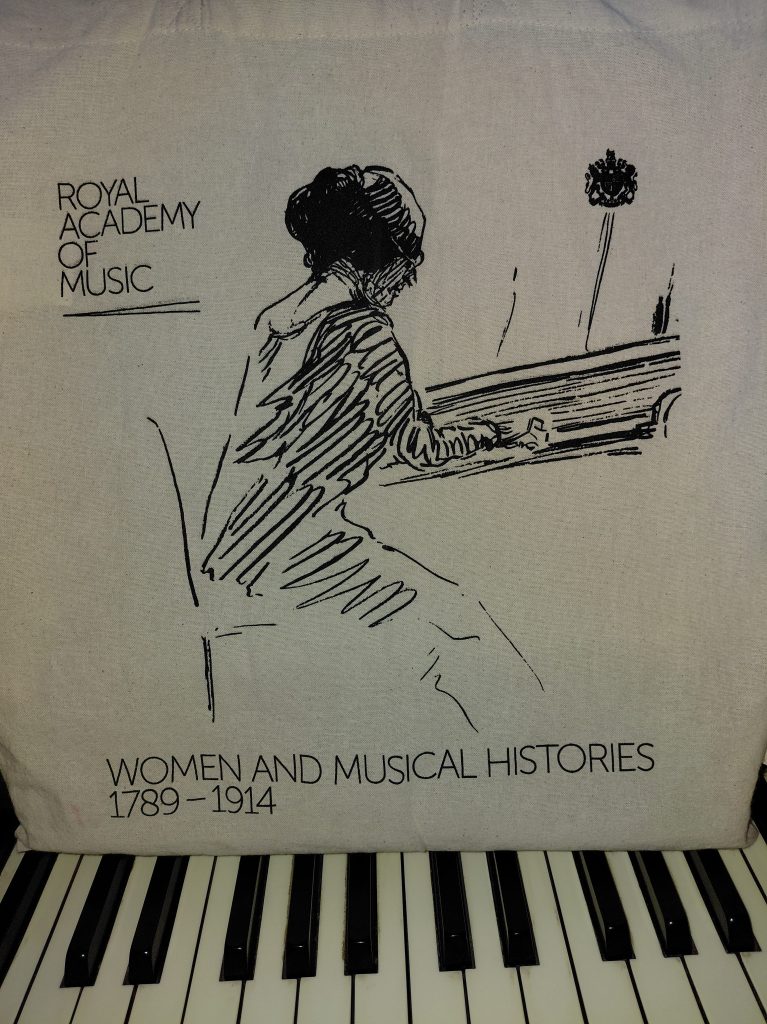
Slightly crumpled conference bag (it has already endured both London and Scottish rain!)
After my talk at the recent Royal Academy of Music conference, Women and Musical Histories, 1789-1914, I have continued researching Rose Smith’s life. I’ve already found out more, and tomorrow I’m off to consult an archive where I hope some of my still outstanding questions might be answered. I foresee a [second, more focused] research trip to Rose’s birthplace in the near future, before our Scottish days get short and wintry!
I’d also like to organise another event! But I really must focus on getting the Dundee research written up and celebrated before I get consumed by this other research thread.
It’s a good thing I’m semi-retired, really! If I was still cataloguing jazz CDs in the library, I certainly wouldn’t have time to plan research expeditions without taking annual leave.
I sat down in my home office alcove this morning, and realised that my desk actually tells you everything about me!
ORGANIST
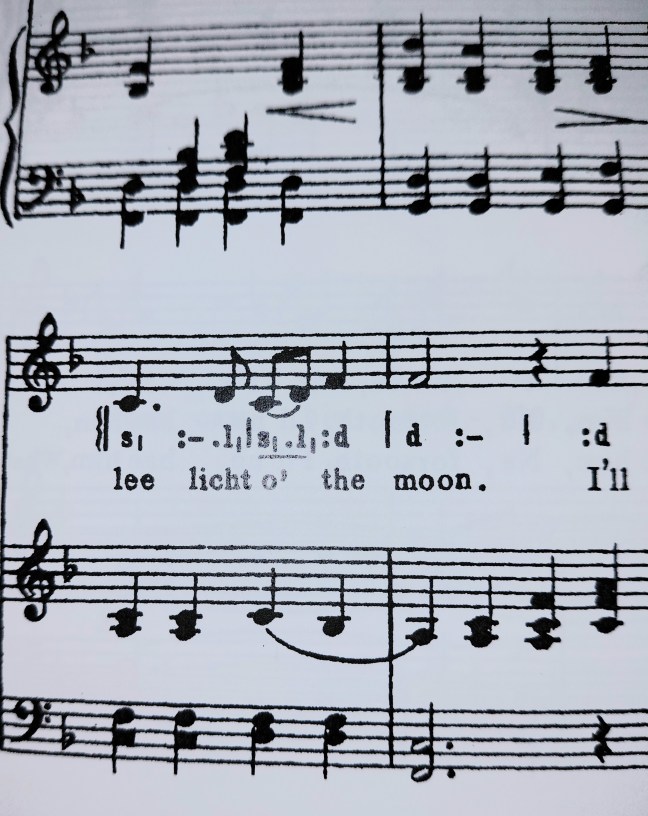
the Billy Graham All-Scotland Crusade 1955 song book, open at ‘The Solid Rock’
Ancient laptop – used only for Allegro Finale Songwriter (I was transposing the song, and reducing it to three rather than four vocal parts)
Under my desk, a box containing new choir anthems …
MUSICOLOGY
CDs of an organ that had been inaugurated by the Athenaeum’s second Principal, Edward Emanuel Allan
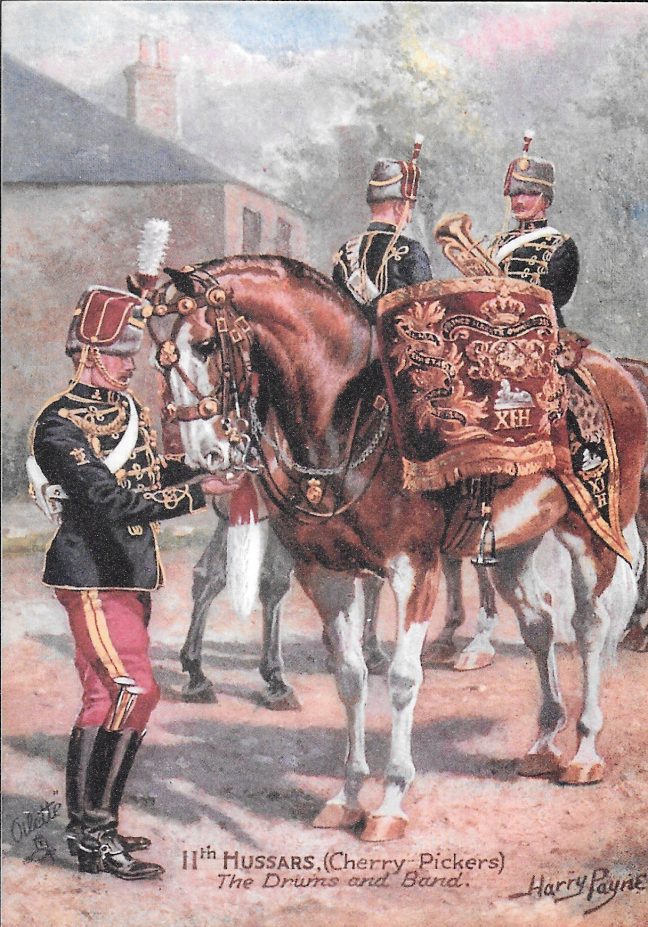
Picture of a Victorian 11th Hussars trumpeter
ANYTHING FABRIC-RELATED
Samples of fabric, most of which I won’t be ordering!
(I could add context, and explain that I’m a semi-retired researcher and a church organist!)
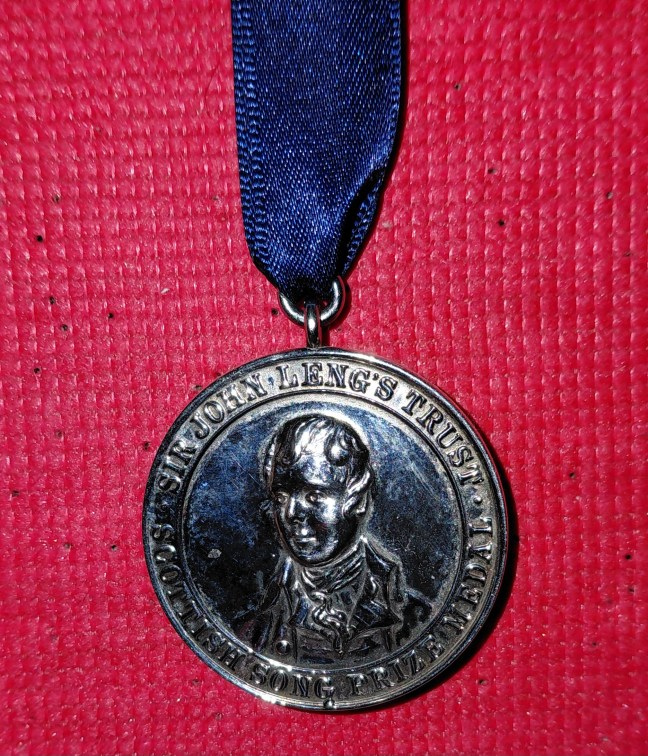
Right, the song book and old laptop are closed. I fix my eyes firmly on the Leng Silver Medal on my pinboard. That’s this morning’s focus! But I just can’t put away the 11th Hussars trumpeter – it’s the closest I’ll get to Trumpet-Major James Smith today!
As a librarian, I would occasionally read articles about reminiscence therapy – when you assemble a collection of assorted ‘things from earlier days’, whether books or household objects, as conversation starters for groups of older people. I only worked in public libraries for three years, and I suspect it was before ‘reminiscence therapy’ was a thing; but later, I would read these articles with interest and think what a lovely idea it was. More recently, I’ve read about how people have strong, mostly positive memories of music they enjoyed in their twenties, when life was fresh and exciting and it felt as though they had the world at their feet.
I have never had the opportunity to organise any activities like this – though I did begin to realise last year, that people also seem to enjoy remembering their school music and singing lessons!
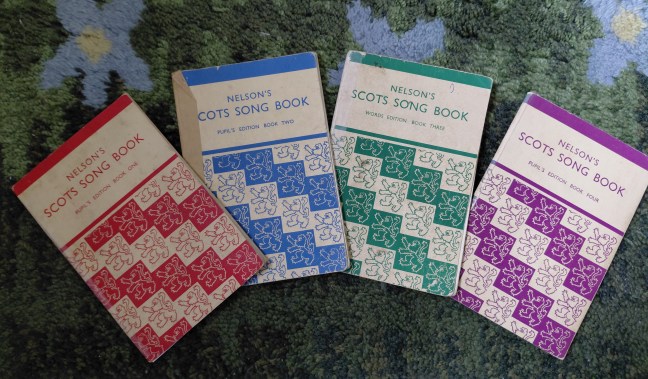
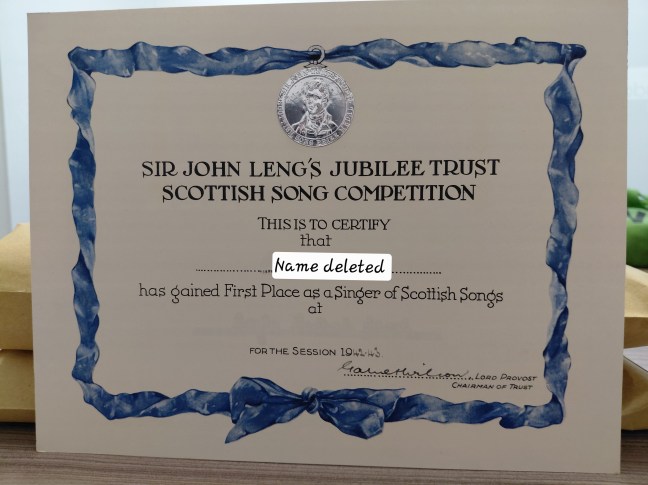
As I review my Leng Medal Memories interviews, watching the video recordings and correcting the transcriptions, I realise that my interviewees often thanked me for this opportunity to relive their memories of singing Scots songs for the Leng silver and gold Medal competitions. In turn, I feel privileged to be ‘there’ with them as they open a window into the past, allowing me a glimpse of the children that they were, and the memories that were still with them. I’ve been showed medals, certificates and prize books. We’ve looked at the little Nelson’s Scots Song Books that school children often used. We’ve talked about teachers they remember, songs that they chose or were encouraged to sing, and a whole range of emotions from fear and anxiety, to immense pride.
Annual Leave
I still have a few transcriptions to review, but I have annual leave coming up, so if I do anything with the transcriptions during that time, it will be with coffee and a biscuit beside me, and a determination not to squander my entire ‘holiday’ at my desk! If I don’t use my vacation allocation, I lose it, and that would never, ever do!
I can’t NOT blog for a whole month. Neither can I really blog ahead, setting timers for it to go live, apart from this present posting. I like to think that anyone returning to this blog will always find something new to read, but I never know what I’ll feel inspired to write about!
Anyway, this is my explanation, if there are fewer postings during the month of July: I’m trying to be on holiday!
My Leng Medal Memories research is funded by an Athenaeum Award from the Royal Conservatoire of Scotland.
It’s important always to bear in mind the wide range of music that can be described as Scottish. It’s certainly not just folksy-sounding songs from farm workers of long ago! Styles have changed, and tastes varied over the centuries. And as I demonstrate here, different types and classes of people made contributions of a more or less lasting kind.
One Single Song
It’s so easy to go chasing after red herrings! This time it was a single song, and I only looked it up because I didn’t recognise the title. I think I’ll stop with what I’ve found out – quite enough for my purposes.
Lady John Scott (1810–1900)
Going through the Leng Gold Medal shortleets (Scots for ‘shortlists’) – I several times encountered a song that I hadn’t any recollection of seeing before: Lady John Scott’s ‘Durisdeer’.
Lady John Scott – born Alicia Ann Spottiswoode – was born in Berwickshire, now referred to as the Scottish Borders. She was a composer and poet, and enthusiastic about Scottish heritage – indeed she was the first female Fellow of the Society of Antiquaries of Scotland.
Ought I to have known more about her? Arguably not. She’s famous for one particular song, ‘Annie Laurie’, out of those that have actually been published. In fact, the Scottish Poetry Library website says that she ‘rewrote’ the words to ‘Annie Laurie’.
‘Durisdeer’
We’ll meet nae mair at sunset, when the weary day is done …
Opening lines of ‘Durisdeer’, by Lady John Scott
I was, in fact, wrong about not having encountered ‘Durisdeer’ before, though, because it’s in a couple of song-books in the Whittaker Library at the Royal Conservatoire of Scotland. Since I indexed most of the Scottish song books in the library – an activity which certainly paid off, because it means that ‘my’ Scottish song index is constantly, and universally available – it follows that I have almost certainly indexed those two instances of ‘Durisdeer’. However, I would have had no reason at the time to have noticed this particular song, which appears to have been published once in London by Lonsdale, ca.1850 (the Whittaker Library hasn’t got that one), and then by Glasgow and London firm Paterson ca.1910 in Lady John Scott’s Thirty Songs, and again by Paterson in the New Scottish Orpheus Vol.3 in 1937. The Thirty Songs must also have been reissued ca.1930-31, for I found a review of it in Music and Letters, April 1931. (More of that anon!)
Significantly, the person at the head of Paterson’s was John Michael Diack, who was a teacher at the Glasgow Athenaeum School of Music and later became Superintendent of Music for Glasgow, as well as being Paterson’s editor. (He gets several mentions in my Social History of Amateur Music-Making and Scottish National Identity, now available in paperback). Diack’s inclusion of this song in two Scottish song compilations (the one by Lady John Scott herself, and the New Scottish Orpheus) would also have helped bring it both to music teachers’ and to singers’ attention.
Kenneth McKellar popularised it in the late 1950s. Probably as a result of this, it began to appear in music festivals! I found it in the Leng Gold Medal shortleets from 1968 onwards – it could have been sung before that, but detailed records only survive from 1967 onwards. It was also sung in the nearby Arbroath Musical Festival in 1959, and in Perthshire festivals in the 1950-60s. I’m sure it must have been sung in a number of music festivals, but I’ve done enough searching!
Kenneth McKellar sings ‘Durisdeer’
‘Durisdeer’ is a pretty piece. It’s named after the place by that name, has Scottish lyrics, and is by a Scottish woman composer, but it’s not what you’d call a ‘traditional’ folk song. Whilst it undeniably is Scottish, it doesn’t sound very Scottish, apart from the use of Scottish dialect and a gapped melodic outline at the midway and final cadences of this two-verse song.
Mind you, I have mused and written often enough about what actually counts as Scottish, concluding that a bit like beauty, Scottishness is in the eye (ear) of the beholder.
Anyway, back (briefly) to the review of Lady John Scott’s Thirty Songs. This reassures me that, for all ‘Durisdeer’ is tuneful enough, I don’t need to feel too bad about not having known it:-
Lady John Scott: Songs (including Annie Laurie). She wrote the tune and fabricated the words of one immortal thing. This volume shows that as long as she stuck to Scots sentiments things went well. There is nothing here to equal ‘Annie Laurie,’ but still some pleasant things remain. [Paterson.]
Music and Letters, Vol. 12, No. 2 (Apr., 1931), p.214, Review by ‘Sc.G.’
‘Sc.G.’ was Scott Goddard (1895-1965), a music critic and Walford Davies’ assistant at Temple Church. He had studied at the Royal College of Music. I don’t know about the other 28 songs in the book. If, like ‘Durisdeer’, they’re ‘pleasant things’ rather than an ‘immortal thing’, then at least Goddard and I agree!
(The Scottish Orpheus Vol.3 is still available, now distributed by Novello.)
My Leng Medal Memories research is funded by an Athenaeum Award from the Royal Conservatoire of Scotland.
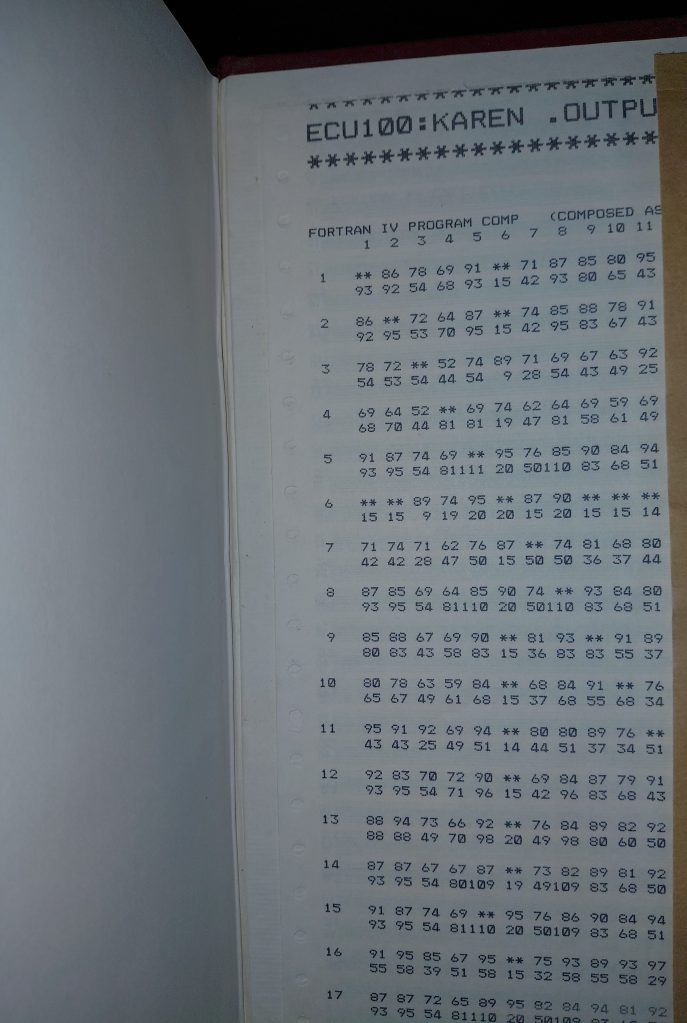
It’s fair enough to say that I find spreadsheets endlessly fascinating, although I don’t use them for number-crunching. However, they’re invaluable for comparing data. In fact, I discovered this before I even knew the word, ‘spreadsheet’, since I did some repertoire comparison for my Masters research degree on mediaeval English plainsong uses at the University of Exeter in 1979-80. It was a 60K-word Masters thesis – I’d intended to continue it to doctoral level, but decided instead to write it up as a Masters then changed subject for the PhD. (And that became my first doctoral attempt, the one that never got finished.)
Computer printout from my Masters thesis, 1980
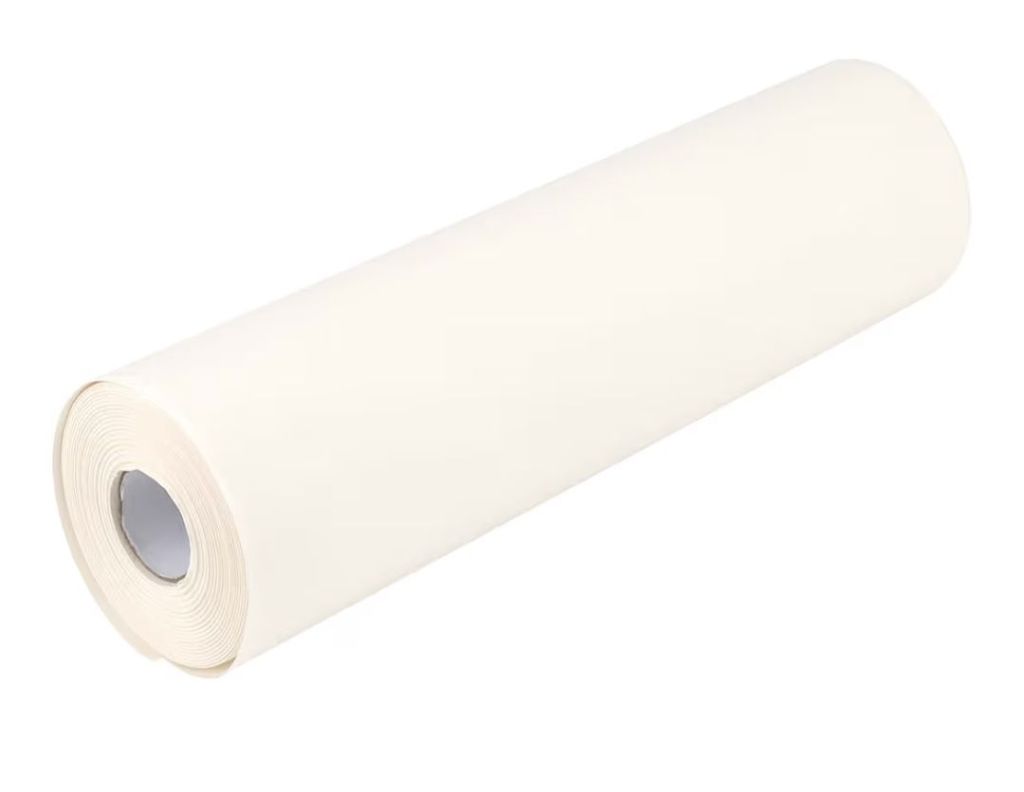
This was before the era of personal computers. My data was tabulated manually on a very long roll of kitchen shelf-lining paper, which opened out the full length of the Music departmental library in ‘Knightley’ on Streatham Drive. I compared post-Pentecostal Alleluias and sequences from various English liturgical manuscripts, along with pieces of plainsong from an Augustinian burial rite, now in Shrewsbury public school library. That’s nearly as much as you need to know about my Masters!
Just a Roll of Paper!
Computer Science? Yes, Indeed!
However, one other interesting fact is that I was the first music postgrad to involve the Computer Science department in my repertoire analysis. I filled in cards – or forms, can’t remember which – which were input by the computer scientists to arrive at statistics as to how much different categories of plainsong correlated in terms of repertoire, across different monastic orders and geographic locations.
Karen Elisabeth Manley, English mediaeval liturgies and their plainsong. Exeter, 1980.
The Magical Microsoft Excel
Since my second incarnation as a musicologist in the present century, I’m sure you can imagine how exciting it has been to be able to compare repertoires of Scottish song in a variety of different contexts. But this time I can save my spreadsheets safely – they’re much more portable and more readily manipulable.
In the context of my Leng Medal research, my ‘cup truly overfloweth’ this week, since I’ve seen lists of songs sung, enabling me to see how tastes have changed over the past sixty or so years. I’ve been comparing what was sung, against a few different song books available at particular times. Obviously, I can’t compare ALL the songs against ALL the song books that exist – I would surely go insane! Indeed, I couldn’t even capture ALL the data for every single year over that period – I simply didn’t have time. But carefully judged snapshots are certainly giving me food for thought. I’ve had endless fun today, producing charts and tables to examine the data in different ways.
The Most Popular Songs sung by Leng Gold Medal Finalists
Oh, did you think I was going to tell you which they were? Sorry, not at the moment – I need to keep specifics for when I write my research up later! It’s certainly interesting, though.
I only picked nine different years for close examination. Suffice to say, they have given me plenty of hard data to set my oral history interviews in context.
And not a roll of shelf-lining paper in sight nowadays!
My Leng Medal Memories research is funded by an Athenaeum Award from the Royal Conservatoire of Scotland.
Whilst I had intended to conduct perhaps 50 interviews in connection with my Leng Medal Memories research, I haven’t amassed quite that many – but the interviews have generally been nearer to 30 minutes than the 15 minutes that I innocently projected, so I’ve probably got easily as many recorded minutes as I initially aimed for!
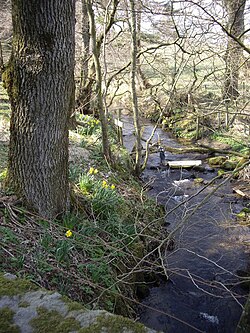
As I mentioned last week, I’ve been editing my interview transcriptions, and correcting any auto-correct infelicities. (Teams and TurboScribe both struggle a little with Scottish place-names and song titles.) One of my interviewees sang, ‘O Gin I were Whar’ Gadie Rins’ in the late 1960s. I knew the name of the song, but I couldn’t put a tune to it, so I Googled it. (As you do!) Spellings vary – as you’ll see.
Well, I found Kenneth McKellar singing it with a small classical chamber ensemble. (Lovely bassoon part, I must say.) The YouTube version was a 1995 Lismore remastered recording. I haven’t tried to establish the original date, though I believe it was recorded for the BBC in the late 1950s or early 1960s. But this setting was so delicate and precise that it was hard to imagine a youngster of eleven or twelve singing it quite like this. Quite apart from the fact that the Leng Medal competition has always been unaccompanied!
My next dip into YouTube found tutor Irene Ross talking about it and then singing it, with a ukelele, for Feis Rois followers. This is livelier and more authentic, but perhaps just a wee bit more ‘folky’ than might have been performed at a music competition by children of my own generation. But I could be wrong!
However, if the folk sound is what you’re looking for, then that interpretation is itself quite sedate compared to an invigorating 1999 recording by the Old Blind Dogs! Actually, I love this – one of my great frustrations in life is that I’ve been so embedded in the more classical side of music-making that I can only enjoy listening to this and would have huge difficulty trying to sing or play in anything like this idiom. I’d love to – but I can’t!
Oh well, I have to get back to these transcriptions, so I’ll stop here for now. Energised, you might say!
Image: Stanley Howe / Upstream Gadie Burn, from Wikimedia.
My Leng Medal Memories research is funded by an Athenaeum Award from the Royal Conservatoire of Scotland.
After a couple of months of online and a few in-person interviews, I’m at the stage now where I’m going through all my recorded interviews and transcriptions, reminding myself of highlights and key details.
This one just leapt out at me:-
‘The one thing I do remember is all the crowd standing up, after I had sung – and cheering and clapping and stuff, and that was the beginning of it, you know.’
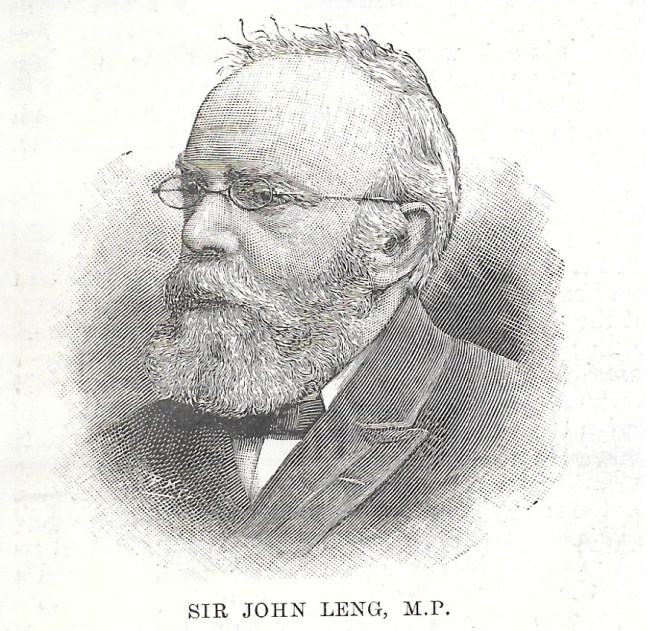
Isn’t that glorious? I’m sure the Sir John Leng Trust will be delighted to read such heartwarming witness to Sir John’s inspired endowment. (I’ll keep the rest of that particular interview for later – I want to leave plenty of material for what I shall be writing in due course. I have a lot of data to draw upon.)
I aim to bring the interviewing to an end by the end of June; after that, I have some annual leave booked, and then I need to start writing! An article or two, a book chapter – and maybe organise a wee event or two.
This has turned out to be absolutely the most enjoyable, affirming piece of research. I’ve decided I love oral history, and conducting interviews is nowhere near as scary as I thought it might be!
(Incidentally – although my interviewing will mostly finish by the end of June, if anyone was literally bursting to share their own Leng Medal memories with me after that, then do get in touch. Even if an interview wasn’t feasible, I still might be able to draw upon memories shared by email.)
My Leng Medal Memories research is funded by an Athenaeum Award from the Royal Conservatoire of Scotland.