It’s time for another update on the research that the Royal Conservatoire of Scotland has awarded me an Athenaeum Award to conduct.
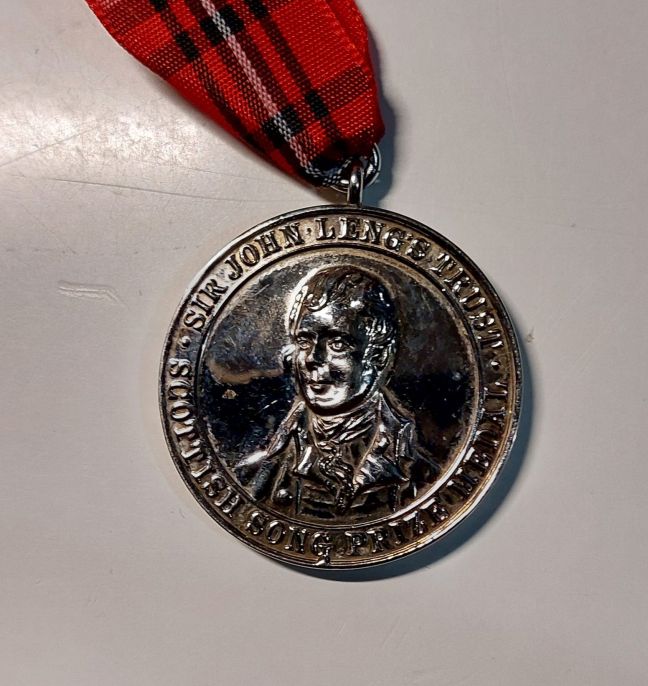
By the end of tomorrow I’ll have interviewed some 25 or so Leng medallists who were awarded their silver and gold medals between the 1960s and 1990s. They went to a wide range of schools, though one or two schools have featured more than once. And they sang a wide range of songs. Some were nervous, some excited. Some knew they could sing – others were surprised to win – and all were overjoyed to be winners. I’ve been shown a lot of medals, proudly kept through the decades.
Interestingly, social media has been very helpful in augmenting my research findings. On Facebook, I’ve found folk in groups like Dundee Pals enjoy answering quick questions, and their answers are often highly informative. When I asked how many people had three or more family members with medals, the number of replies was quite remarkable!
The ‘Scottish Cringe’?
It wasn’t until last weekend when I conducted a face-to-face interview in Dundee, that someone mentioned ‘the Scottish cringe’. I guessed what that meant, and when it was explained to me, it was rather as I had guessed. It refers to the inferiority complex that many in Scotland have, having grown up in a Scotland that felt it was always subordinate to England, and looked down on by many politicians south of the border. I did look up where the phrase originated, but I only made a hasty search, so I’ll hold my tongue until I am sure of my facts. An article in Glasgow University Magazine last year provides useful context:-
Didi Marina Salonia, Death to “Scottish Cringe” (28 April 2025)
In the context of my research into the Leng medal competitions, it occasionally led to pupils being encouraged to sing their songs in a refined, sanitised kind of accent – not exactly English, but certainly toned-down Scots. I’m sensing that this happened more amongst older medallists, and hopefully children now are encouraged to use their own natural accent – as they’d speak – rather than trying to put on something uncomfortably clipped and unnatural. Again, Facebook has been very helpful here – 38 comments in reply to my question! I’m bowled over.
“I was talking to a friend about the Leng medals yesterday and an interesting thing came up. Who was encouraged to sing their Scots song in their natural everyday accent? Did anyone get told to sing it ‘nicely’ in a posh concert-platform accent?!”
For the rest of this month, I’ll be going through my recordings and transcriptions, looking for interesting threads and making sure I have tabulated schools, songs and the names of long-remembered teachers! I’m also going to look at some archival material, which excites me considerably. Hopefully I could find further evidence of Mr Easson (and perhaps Mr Wiseman), the compilers of the Nelson Scots Song Books, around the time the books were published – and introduced into Dundee schools.
Excess Annual Leave Balance
I am taking annual leave in July. (If I don’t, I lose it, and that would never do.)
I won’t be capable of NOT blogging for a whole month, apart from which I do like to think that if someone comes back here after a couple of weeks away, there will always be something new for them to find. What it will be, I cannot yet say! (Additionally, as you’ll have noticed, I have a couple of research side-interests, so who knows what my month’s vacation might lead me to, if I feel the urge to investigate sudden bright ideas?)
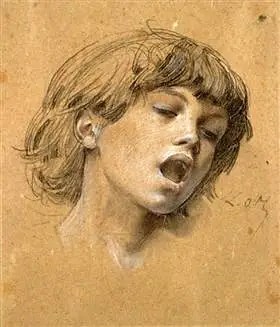
Image: Head of a Boy Singing, by Merson (Creative Commons)
My Leng Medal Memories research is funded by an Athenaeum Award from the Royal Conservatoire of Scotland.