Dr Karen McAulay explores the history of Scottish music collecting, publishing and national identity from the 18th to 20th centuries. Research Fellow at Royal Conservatoire of Scotland, author of two Routledge monographs.
The heading is here to keep me in line. I’ve written the paper on my two fin-de-siecle lady musicians, for next week’s conference. I’m slightly obsessed with them both, to be honest – especially their family history. (Parents James and Mary-Anne Smith, for example!)
But today, I’m getting back to my Dundee Leng Medal Memories transcriptions. Contractually, I work 10.5 hours a week (research at other times isn’t ‘work’), and this week the genuine working hours are dedicated to the social history behind the Dundee Leng Medal. I’ll try to avoid distractions, though I can’t promise not to open tempting emails relating to the Smiths’ back history!
Dundee, here we go! (Metaphorically speaking. I’m not planning any trips this week.) And if you were wondering why I need to check auto-transcriptions, then let me give you just a few wee examples:-
Teams Transcriptions
Teams generally manages just fine with the Scottish accent, but obviously, it cannot know old Scottish songs, and occasionally it is completely stumped. Anyway, I’m getting a few smiles … try these:-
So, here we have a situation! Thoroughly Modern Millie (that’s me) has embraced Microsoft Bookings and Microsoft Forms, and the people I’m hoping to interview for my research project can book a time to chat with me online via Teams. (Or, indeed, in person in Dundee – at a few agreed times when I’ll actually be there!) I did several test-runs of the booking/meeting process with my patient and willing friends, and it all seemed to work smoothly. I particularly wanted to test it with people who didn’t have Microsoft Teams and would have to start from scratch. After the test-runs, it was “All Systems Go”, and I started on the interviews. I’m having a great time listening to people’s Leng Medal memories, though I do still have a lot more folk I’m hoping to speak to!
But if a scheduled Teams meeting doesn’t happen – by which I mean, I click on the link on my calendar at the appointed time, but the other person doesn’t check in – then that suggests that there’s a problem.
A Teams call isn’t a phone-call. The other person’s phone won’t ring, or buzz, at the meeting time. It’s more like Skype, Zoom or Google-meet. They will have got an email with a link to click. Clicking on that link should eventually take them to a Teams screen showing me waiting at my laptop.
My Brainwave (or was it?!)
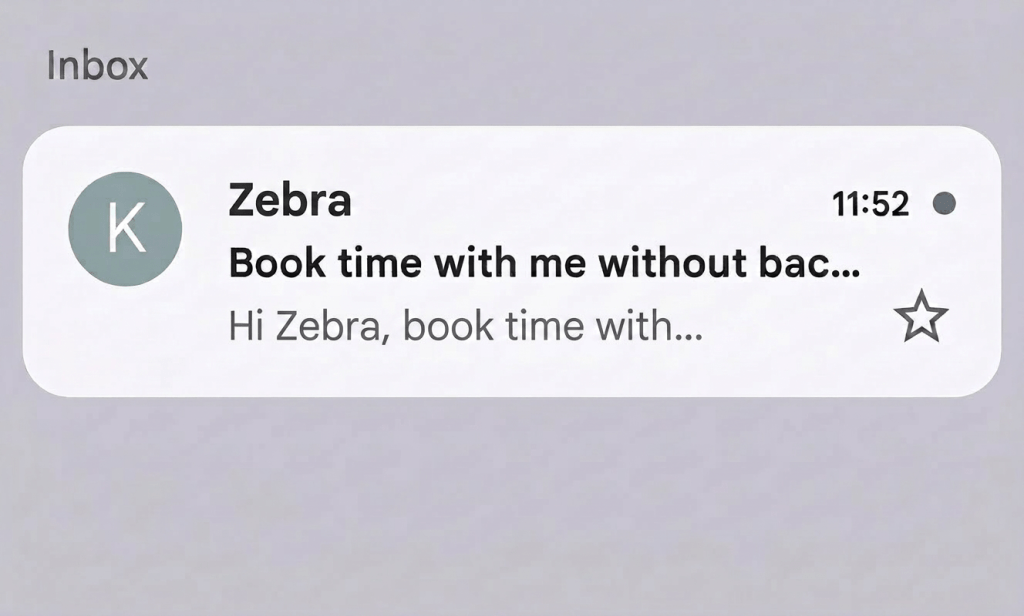
For me, the frustrating thing is not knowing exactly what people are seeing when they click on that link! It’s hard to offer words of advice, when I don’t know what they’re encountering. I wondered if I could arrange a Teams meeting between myself on my work laptop, and myself on my mobile phone, which I could screenshot to demonstrate how it works. So … I emailed myself (the potential interviewee) a link to a Microsoft Bookings page. This is the email subject heading:-
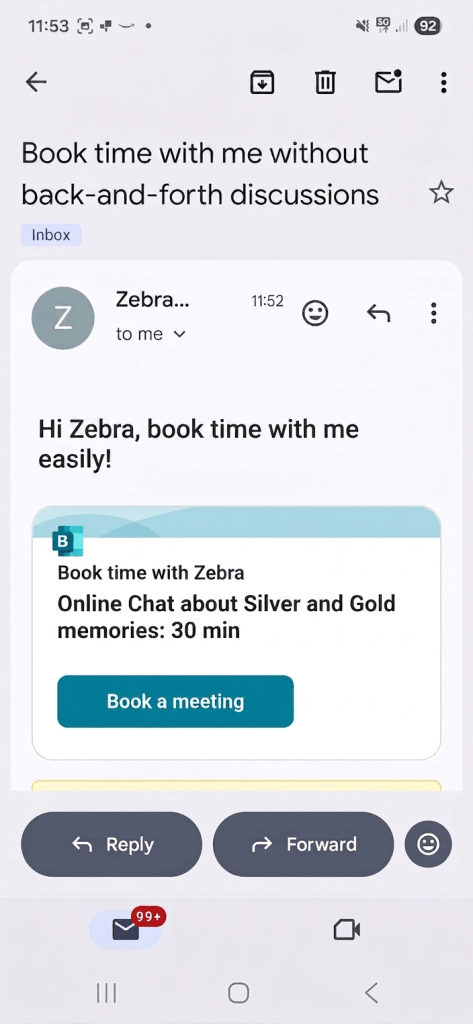
And this is what my Researcher self said to my At-Home self. I soon began to feel as though I had a split personality:-
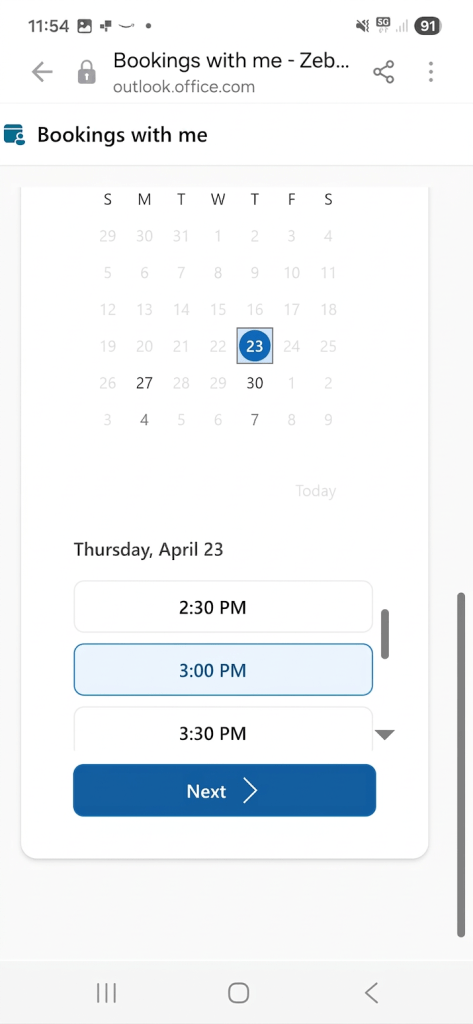
So, my At-Home self clicks on the blue Book a meeting – and this comes up. I have to pick a date and time, then click Next:-
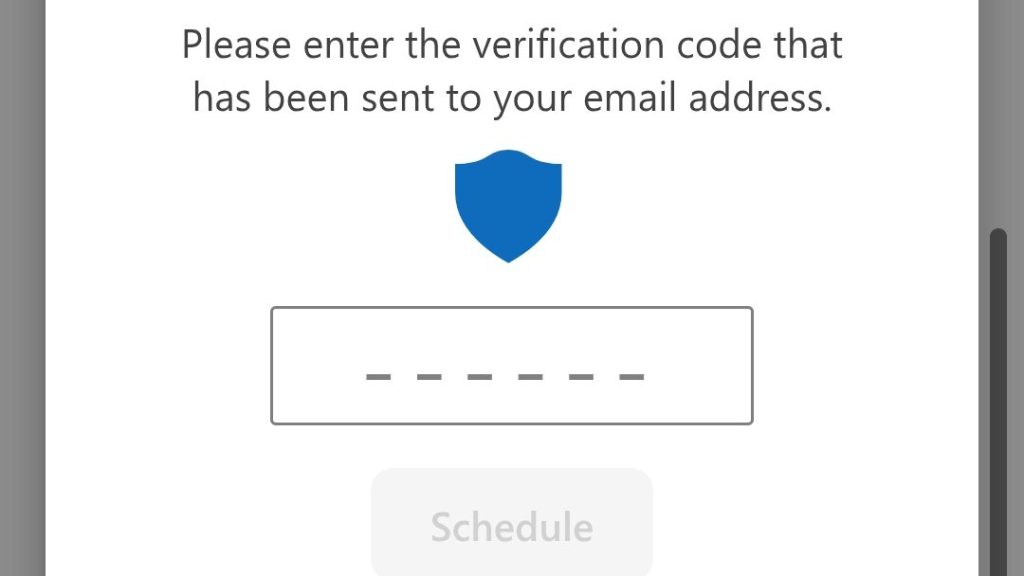
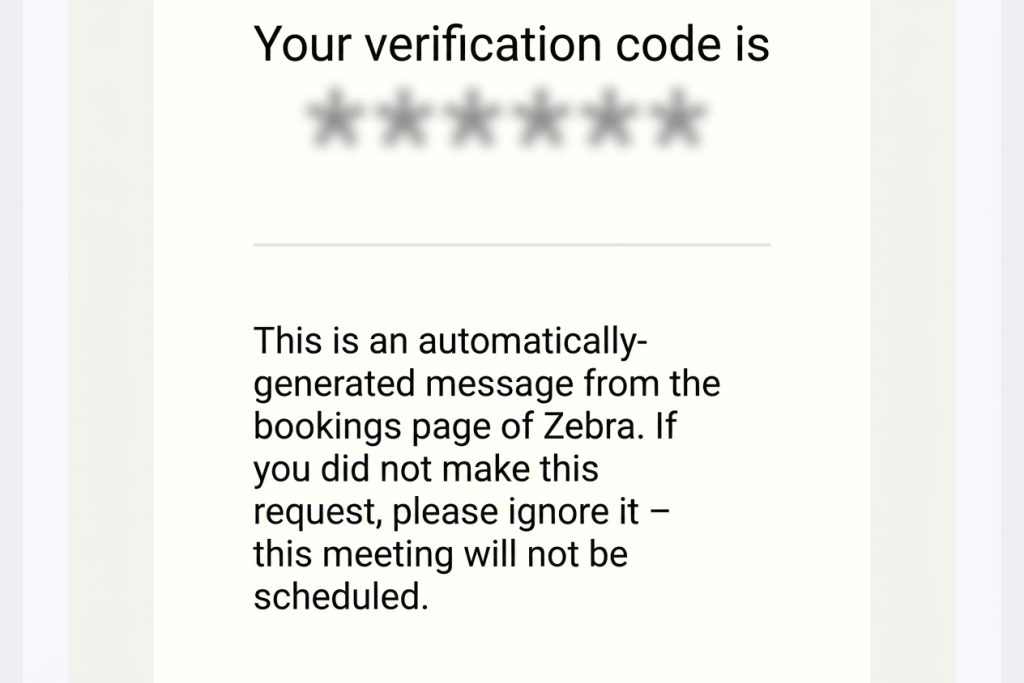
At this point, the potential interviewee will have to verify their email – they will receive a verification code that they need to input. And then they’ll be guided through installing the Teams app. If they already have a Microsoft account, they can use that, or they can join as a Guest:-
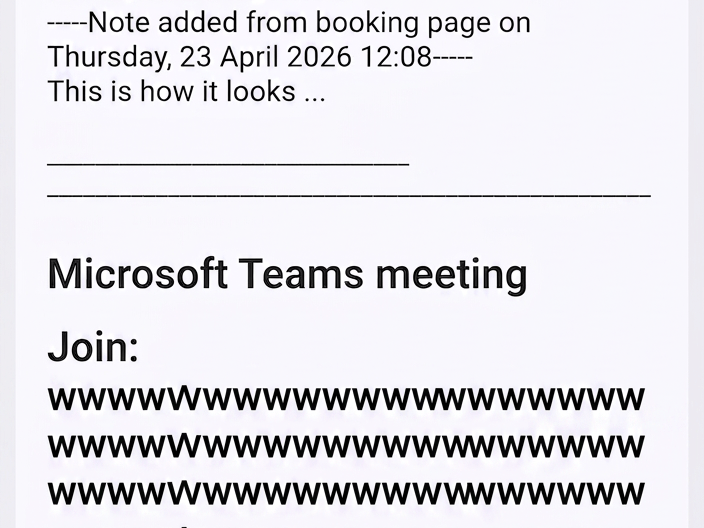
Now my At-Home self receives a hyperlink for joining the meeting at the chosen time. (There’s also a meeting ID and passcode beneath these.)
How to Attend a Teams Meeting if you haven’t got Teams on your Device
1. On your Mobile Phone
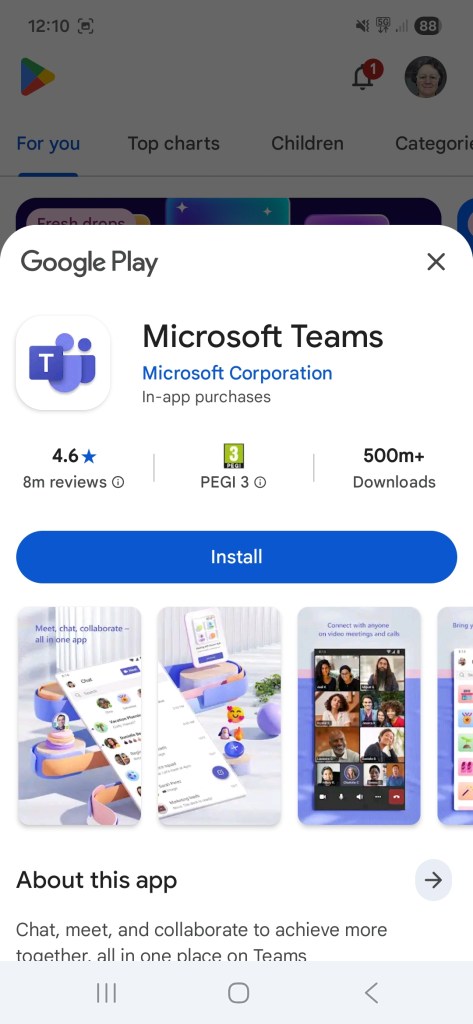
If you’re using a mobile phone, and you haven’t already got Teams, you’ll be invited to download the app, using Google’s PlayStore or Apple’s App Store.
Here, I stopped the experiment, because my phone wanted me to log into my work Microsoft account, and plainly I couldn’t converse with myself from one and the same account!
2. Attending a Teams Meeting on a Computer
I turned to my own personal laptop. Clicking on the Join your Teams meeting link offered the choice of ‘Continue on this browser’ or ‘Join on the Teams app’, followed by, ‘Don’t have the app? Download it now.’ My personal laptop is old – it would only let me continue on the browser. (Shall we just say that operating two laptops side-by-side makes for a completely impossible interview, but I was able to open the meeting on both laptops, so in theory I was conversing with ‘myself’ …. )
The Teams app
I’m assuming that the Teams app would then take you to your appointment. Anyway, you’ll need to click to ‘Join’ the meeting at your chosen time. No bells will ring, no lights will flash. On my work laptop, a reminder comes up, and I can click on that to get into the meeting. Or I can access it via my Outlook calendar.
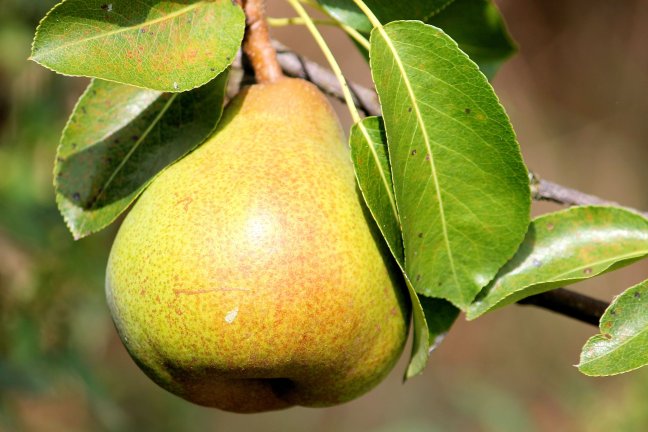
If it all goes Pear-Shaped
Well, we still have emails! And I’m also arranging some face-to-face interviews in Dundee. One way or another, I’m sure we can find a way to share those precious Leng Medal memories. Because every interview has given me fresh insights and some lovely stories stretching way back into people’s childhoods.
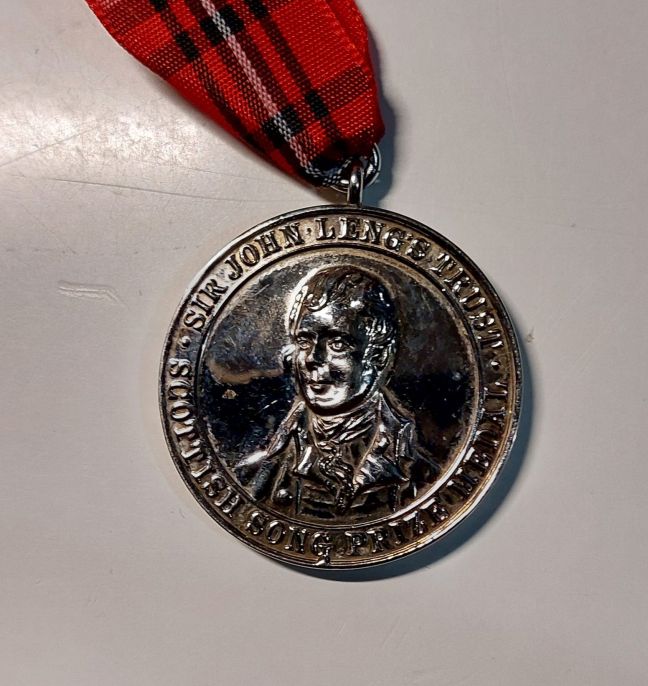
Do you have schooldays memories of taking part in the Dundee-based Leng Medal Scots song singing competitions? Perhaps you were a proud prize-winner of a Silver or Gold Leng Medal?
Maybe you didn’t actually win, but the memories are still vivid? You might remember the song you chose, or which song book you sang from? Or you helped someone else polish up their performance?
Maybe you’ve never stopped singing Scottish songs?
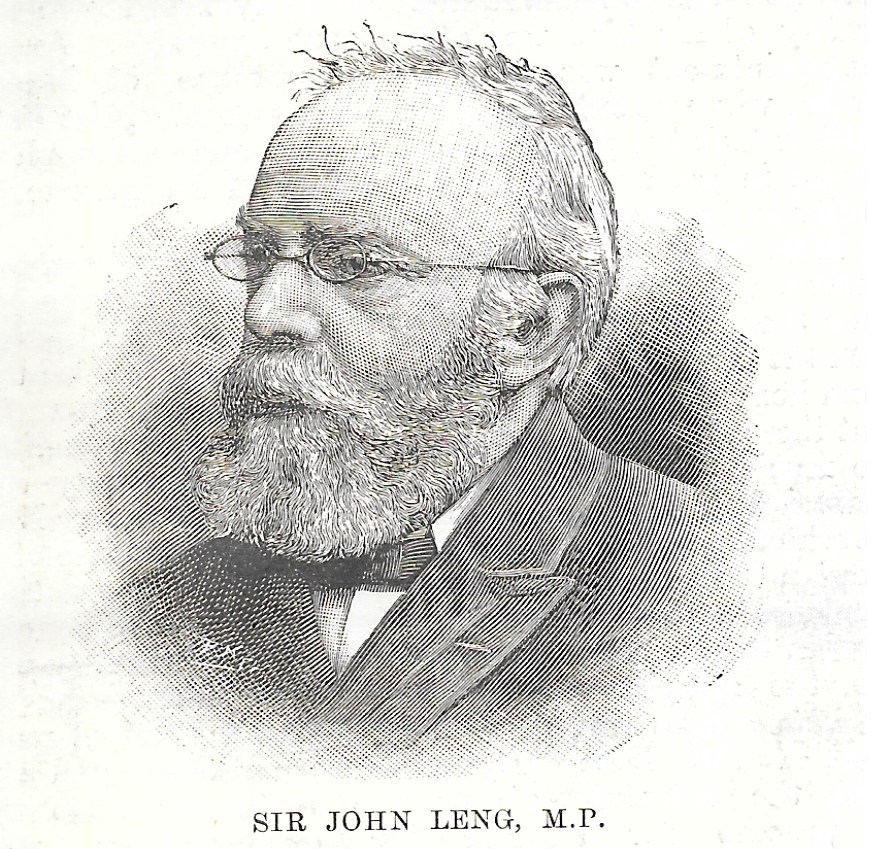
Sir John Leng: Dundee benefactor
I’m on the staff of the Royal Conservatoire of Scotland as a postdoctoral research fellow, researching Scottish music. Whilst investigating an old Scottish song book aimed at school pupils in the post-war era, I became fascinated by the initiative of Sir John Leng (1828-1906), who endowed the singing prize 125 years ago. He died 120 years ago, but his singing competition is still live and kicking all these years later. Encouraging kids to sing Scottish songs was obviously a good thing!
Would you like to help me? If so, I’d be very grateful if you could fill in a very short questionnaire, and I’ll get back in touch as soon as I can to arrange an interview with anyone who has a story to tell!
I decided to find out more, and I’m embarking on a project to talk to as many Leng medallists, entrants, teachers or adjudicators as possible. The Sir John Leng Trust endorses this research, and is looking forward to hearing what I uncover.
My research is made possible with the support of an Athenaeum Award from the Royal Conservatoire of Scotland.
I’m contemplating writing another book. It’ll be based on my recent researches as an IASH Fellow, obviously. But I’ve had a brainwave of an idea for the final chapter – which involves a bit more research – so the past few days have been dedicated to exploring possibilities. As I now know, from the historical Thomas Nelson point of view as much as my own present existence as a scholar, publishers like publishing things in series. It helps them sell, if readers can see how a book fits into a larger grouping of books. I’ve been thinking about where my book might fit in.
I’ve also had a wee jaunt to Dundee to talk to a scholar of my acquaintance; and today, I sat down to write an email. Who’d have thought it would take most of an afternoon to write an email?! But when it’s important, it’s worth taking some effort in the crafting of it.
‘Faint heart never won fair lady’
Finally, I thought it was just right. I mused that maybe I should leave it and re-read it tomorrow. But no, I must be resolute. So, I did not prevaricate. More of this thrilling story in due course …
Yesterday (11 June 2022), I travelled through to Edinburgh to a conference at the Scottish Storytelling Centre. The topic was, ‘Towards a Scottish Traditional Music Archive’. I was there in my capacity as Honorary Librarian of the Friends of Wighton. Professionally, I combine two roles as a Performing Arts Librarian and as a Postdoctoral Researcher at the Royal Conservatoire of Scotland. It was unusual for me to be speaking at a conference with neither my Conservatoire librarian nor musicologist hat on.
Much of the discussion was about sound archives and digital preservation, but I was there to talk about the Wighton Collection, which is firmly rooted in physical materials, even if there are also microfilm copies and an online website. If even one person there confessed that they had ‘never heard of the Wighton Collection before’, then it made me wonder how many other people have similarly not heard of it. So, I thought I’d share my talk here on my blog, too. The talk essentially fell into two halves – the background, and some comments about finding aids in general for this kind of repertoire. Here goes for the first half!
PowerPoint title screen: The Wighton Collection, Dundee
I began by explaining that I’ve worked in libraries for nearly four decades, and I’m a Fellow of the Chartered Institute of Library and Information Professionals – so I have a strong librarianship background, as distinct from that of an archivist.
The Wighton Collection lives under the care of the Local History Library in Dundee’s Wellgate library. This is a public library on the top floor of the Wellgate shopping centre, and it’s the Central Library for the city of Dundee. Although I have an honorary role, I don’t have any paid connection with the city of Dundee. My honorary role is to take a professional interest in the Wighton Collection and its curation, and to help answer queries needing specialist input. In this respect, my doctoral and postdoctoral work on historical Scottish music certainly come in useful.
The Wighton Collection consists of about 700 music publications – some are bound together, so there aren’t as many as 700 bound volumes. They were left to the city by Andrew Wighton, a merchant, violin-restorer and music collector who died in 1866. Wighton had initially considered gifting his collection to the Society of Antiquaries of Scotland, but negotiations broke down concerning some of his preconditions.
Dundee adopted the Free Public Libraries Act shortly before Wighton died, and the council accepted Wighton’s bequest with a view to it forming one of the cornerstones of their new public library. I might add that there was some grumbling amongst the councillors as to whether it had been wise to accept so many music books before they even had anywhere to house it properly. The insistence in Wighton’s bequest that it should be stored in a fire-proof room must have been an extra burden.
However, one Dundee councillor made an observation which now seems laughable with hindsight, when he said it would cost three times as much to compile a catalogue as the volumes were actually worth.
Wighton’s collection has proven to be a jewel in the crown as far as the city library service is concerned – the books are almost beyond value, and certainly beyond the cost of cataloguing them. Wighton’s avowed aim was to collect a copy of every Scottish music publication that existed. In correspondence, one of his friends commented that he must have pretty much succeeded, and they were only half-joking. Wighton was an assiduous, and knowledgeable collector, visiting Edinburgh, London and even travelling abroad in pursuit of his hobby. I read in an 1894 newspaper article that, having no descendants to leave his money to, he was able to indulge his book-collecting passion all the more, though I hasten to add that Mrs Wighton was also left comfortably off!
The Wighton collection itself is a finite collection – self-contained in being the collection that he himself amassed. I won’t attempt to highlight particular volumes – suffice to say that about half of the collection consists of very rare eighteenth and nineteenth century Scottish music, but the remainder is equally rare English, Irish and Welsh material along with some ballad operas. As published material, the library is a natural home for it, but there are a few unique items that would be described as more archival – specifically, a few manuscripts that Wighton himself copied – such as his copy of the Blaikie viola da gamba manuscript, which itself is now lost – and a copy of Alexander Stuart’s 1726 publication, Musick for the Scots Songs in Allan Ramsay’s Tea-Table Miscellany. Other unique handwritten materials are textual rather than musical, and include his own annotated copy of Laing’s additional Illustrations of the Lyric Poetry and Music of Scotland (that’s the additional notes Laing contributed to William Stenhouse’s original Illustrations, the companion volume to Johnson’s earlier Scots Musical Museum.) There is also correspondence (mostly incoming, obviously) between Wighton, his fellow book-collecting enthusiasts and specialists (David Laing, William Chappell, and Aberdonian music publisher James Davie), and some letters concerning Dundee municipal matters, in his capacity as a town councillor. This would definitely count as archival material, were it not for the fact that the Wighton material must perforce be kept together – and it has added value as an entire collection.
MILLAR’S ARTICLE, 1894
The Wighton Collection has always been known about by musicologists and scholars of traditional music. Very early on, the books were expertly bound, and have always been kept as a closed access collection, to be used within the library under supervision. As far back as January 1894, the Dundee Evening Telegraph reproduced a lengthy article by the City Librarian, Alexander Hastie Millar, FSA Scot (who lived from 1847-1927), which had originally been published in the Scottish Musical Monthly, highlighting the significance of the collection and its availability for visitors to study.
WILLSHER’S ARTICLE, 1948
1948 saw another profile-raising article by Dundee librarian Harry M. Willsher, ‘The Wighton Collection of National Music’, in the Review of the Activities of the Dundee Public Libraries, ii/July (1948), 12–13. And of course, the collection is mentioned in Oxford Music Online – the former, Grove Dictionary of Music.
More recently, we have seen the development of the Wighton Heritage Centre, along with other initiatives that have enhanced the usefulness and appeal to today’s musicians and scholars, and it’s to these that I turn now.
WIGHTONHERITAGE CENTRE, 2003
The Heritage Centre was master-minded by librarian David Kett. Filling in a space between the Local History Library and another part of the main library, it was opened in November 2003. It’s a beautiful space beside the Local History Library, designed for small, intimate performances such as the Cappuccino Concerts on Saturday mornings, mid-week lunchtime concerts, adult music classes and study purposes. Events have also been arranged to showcase particular volumes in the collection.
FRIENDS OF WIGHTON
All these activities are supported and promoted by the Friends of Wighton. In pride of place, of course, are the locked bookcases containing the treasured Wighton Collection. Whilst the volumes can be examined by bona fide scholars by arrangement with the Local History Library, the books were microfilmed in their entirety some years ago, to lessen the wear-and-tear on the original volumes.
SALLY GARDEN
To make the largest possible impact at the time of opening, a three-year residency – Historical Musician in Residence – was created from September 2003. This residency was held by Dr Sally Garden. Her remit was to oversee a programme of performances and events; to bring together amateurs and professionals; to research the collection; and to raise its profile as an educational resource and opportunity.
The contents of every volume were also indexed around this time – every song, every dance tune – and saved as a massive Excel spreadsheet which was then interrogated via the Library website as the Wighton Database. It’s a vastly useful resource, and one for which I have had many opportunities to be grateful.
However, at some stage, the local authority stopped hosting the database. Undeterred, a search facility was devised by a committee member of the Friends of Wighton, so that the spreadsheet could still be explored.
This was subsequently – in 2018 – superseded by links to four lists:- the complete, 451 page catalogue; the list of imprints (a list by publisher); a title index, and a short-title list. The information is still there, albeit not searchable in quite the same way as the original facility had intended. The links are all accessible via the Friends of Wighton website. A link from the local authority library website leads to the Friends’ page, so if you know where to look, the material is still very much accessible:-
In recent years, the Wighton Collection has been augmented by a few donations, the most significant of which are the Jimmy Shand Collection, and a handsome donation of scores by Stuart Eydmann. Lottery fund money enabled the Friends to buy at auction, a collection of historical scores that had belonged to the late Jimmy Shand. These have been professionally restored and re-bound by a conservation expert, and they’ve also been digitised and uploaded to IMSLP, with links from the Friends’ website and indices to the contents. A few years later, Jimmy Shand junior gave some further scores to the Friends, which I assume the auctioneers had considered of less value. In one sense, they would have observed that only a few of these were of any great age, but at the same time, this secondary collection represents the working collection of a famous musician with local connections, and they are also of an era which has too often been overlooked as neither “ancient” nor “modern”. Without them, a chunk of popular Scottish music history would be missing. In just a few decades, even the music published between 1900 and 1960 will be more than a hundred years old, and of potential interest in ways we can only imagine now.* I’ve made a listing of all the volumes, and some have been bound – it will not be financially feasible for every item to be bound. The pandemic has meant I haven’t yet discussed with the Friends how best to handle the unbound material, or arranged for the listing to be uploaded to the Friends’ website. Similarly, Stuart Eydmann’s donation has been listed, but not uploaded. As life returns to the ‘new normal’, these tasks once again become a priority.
The talk was all about Wighton, not all about me, so I didn’t mention the fact that I’ve just signed a contract to write a book about Scottish music publishing between 1880 and 1950 – but it does mean that I can certainly see the historical value of the secondary Shand collection!





 Karen McAulay, Musicologist