Ways to Play a Scots Tune

Yesterday being Sunday – and Scotland isn’t out of the World Cup yet – I dug deep to find some more thematically appropriate music to play on the organ.  I’m pleased to report that it IS possible to play, ‘Yes, Sir, I can Boogie’ in a sedate, dignified manner.  Challenging, but possible.  Likewise ‘Scotland The Brave’.  After those, a calmer ‘The Rowan Tree’ and an organ setting of ‘Amazing Grace’ completed the World Cup set.

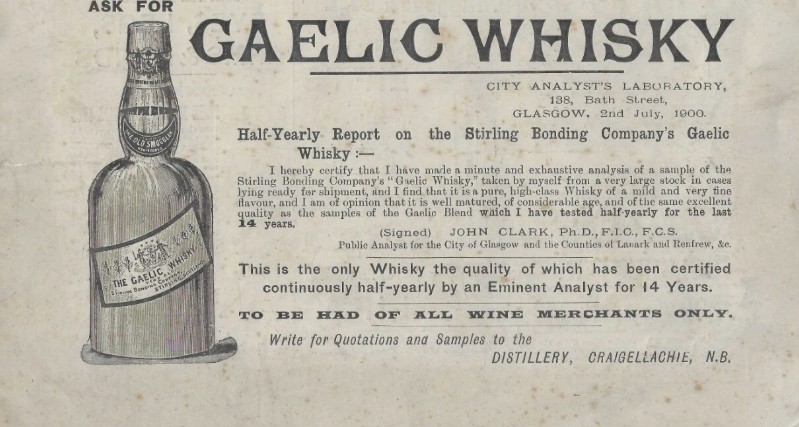
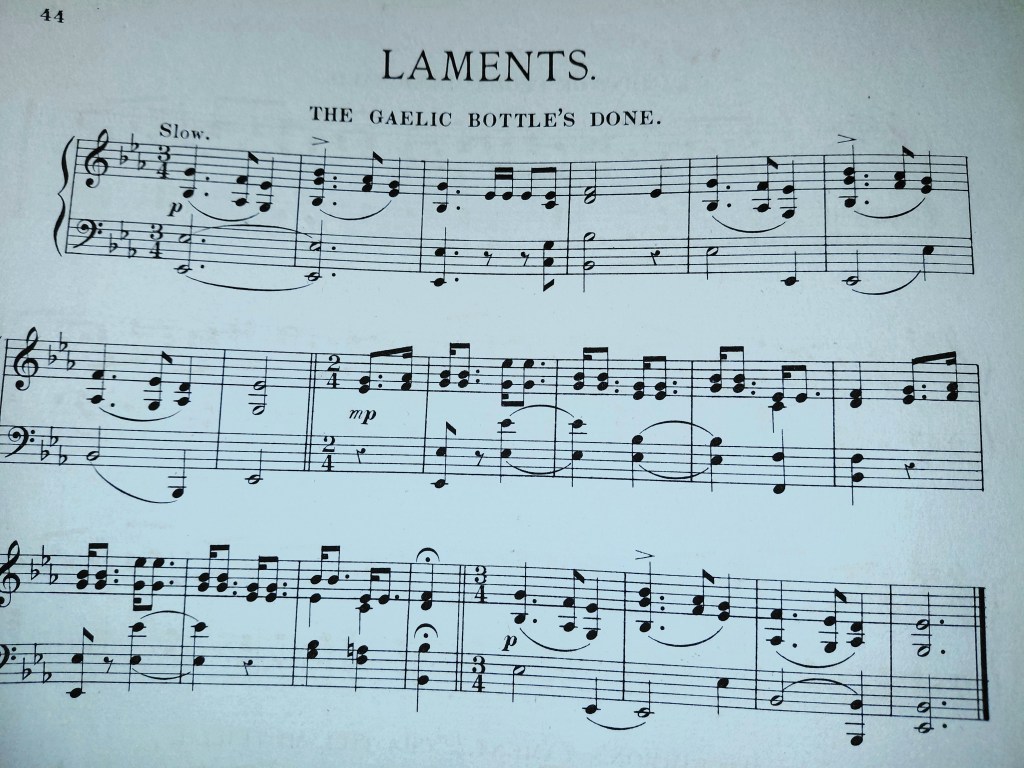
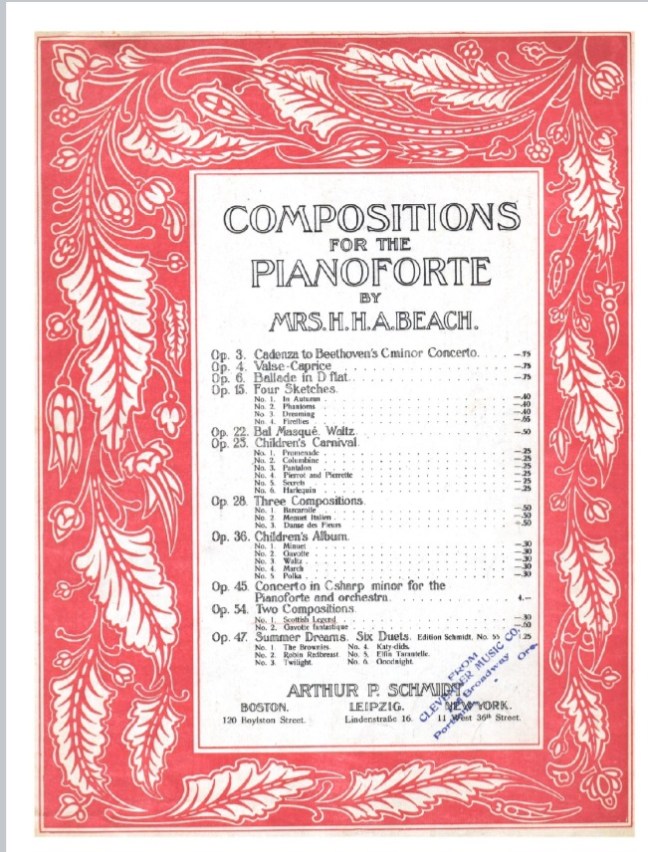
But AFTER the service … although I nominally stuck with a Scottish titled march, absolutely no-one would have known or recognise it. It was an indulgence of my research interests, I’m afraid!  I played a piece of music by Edward E Harper. So … it was

  • composed by an Englishman,
  • who briefly lived in Scotland.
  • His tune was called a Scots March (it doesn’t sound Scottish) –
  • and it was in a collection published by Bayley and Ferguson, a Scottish publisher.
  • The composer himself had emigrated to Canada by this stage.  I don’t know when he composed it.

It gets more complicated.

  • The copy I own was sold in AUSTRALIA,
  • and taken to California by a talented scientist at the start of his career.

I repatriated it through eBay, so today the not-exactly ‘Scots March’ was played by an Englishwoman in Scotland, not that far from where the composer was once organist …

I have a problem now. Just supposing Scotland beats Brazil? I can find any number of traditional tunes, but what would I play as an outgoing voluntary?!

A Win for Scotland – and a Modest Tribute from an Organist  …

Yesterday morning’s organ music just had to be topical. To our small but enthusiastic congregation’s approval, I included ‘Flower of Scotland’, ‘Loch Lomond’, ‘Caledonia’, ‘500 miles’, ‘Highland Cathedral’ (not really Scottish, but much-loved all the same), and I managed something along the lines of ‘Never Stopped Dreaming’, the new World Cup anthem by Skerryvore.

Four bars!

Silver and Gold Leng Medal Memories, Update no.3. Posh Scots and Everyday Scots – the ‘Scottish Cringe’

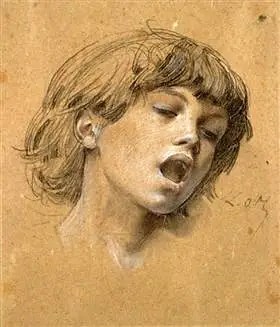
Merson - Head of a boy singing (Creative Commons licence)

It’s time for another update on the research that the Royal  Conservatoire of Scotland has awarded me an Athenaeum Award to conduct.

By the end of tomorrow I’ll have interviewed some 25 or so Leng medallists who were awarded their silver and gold medals between the 1960s and 1990s. They went to a wide range of schools, though one or two schools have featured more than once. And they sang a wide range of songs. Some were nervous, some excited. Some knew they could sing – others were surprised to win – and all were overjoyed to be winners. I’ve been shown a lot of medals, proudly kept through the decades.

Interestingly, social media has been very helpful in augmenting my research findings. On Facebook, I’ve found folk in groups like Dundee Pals enjoy answering quick questions, and their answers are often highly informative. When I asked how many people had three or more family members with medals, the number of replies was quite remarkable!

The ‘Scottish Cringe’?

It wasn’t until last weekend when I conducted a face-to-face interview in Dundee, that someone mentioned ‘the Scottish cringe’. I guessed what that meant, and when it was explained to me, it was rather as I had guessed. It refers to the inferiority complex that many in Scotland have, having grown up in a Scotland that felt it was always subordinate to England, and looked down on by many politicians south of the border. I did look up where the phrase originated, but I only made a hasty search, so I’ll hold my tongue until I am sure of my facts. An article in Glasgow University Magazine last year provides useful context:-

Didi Marina Salonia, Death to “Scottish Cringe” (28 April 2025)

In the context of my research into the Leng medal competitions, it occasionally led to pupils being encouraged to sing their songs in a refined, sanitised kind of accent – not exactly English, but certainly toned-down Scots. I’m sensing that this happened more amongst older medallists, and hopefully children now are encouraged to use their own natural accent – as they’d speak – rather than trying to put on something uncomfortably clipped and unnatural. Again, Facebook has been very helpful here – 38 comments in reply to my question! I’m bowled over.

“I was talking to a friend about the Leng medals yesterday and an interesting thing came up. Who was encouraged to sing their Scots song in their natural everyday accent? Did anyone get told to sing it ‘nicely’ in a posh concert-platform accent?!”

For the rest of this month, I’ll be going through my recordings and transcriptions, looking for interesting threads and making sure I have tabulated schools, songs and the names of long-remembered teachers! I’m also going to look at some archival material, which excites me considerably. Hopefully I could find further evidence of Mr Easson (and perhaps Mr Wiseman), the compilers of the Nelson Scots Song Books, around the time the books were published – and introduced into Dundee schools.

Excess Annual Leave Balance

I am taking annual leave in July. (If I don’t, I lose it, and that would never do.)

I won’t be capable of NOT blogging for a whole month, apart from which I do like to think that if someone comes back here after a couple of weeks away, there will always be something new for them to find. What it will be, I cannot yet say! (Additionally, as you’ll have noticed, I have a couple of research side-interests, so who knows what my month’s vacation might lead me to, if I feel the urge to investigate sudden bright ideas?)

Image: Head of a Boy Singing, by Merson (Creative Commons)

Friends of Wighton – A Celebration of Burns

The Wighton Collection's logo - various musical instruments

Burns Night is on Sunday 25 January 2026

This Saturday, 24 January, is virtually Burns’ Night, so what better afternoon to have A Celebration of  Burns at the Central Library of Dundee? I understand we were fully booked, but those lucky enough to have obtained a ticket had a great afternoon. Click on the link (as long as it’s still there) to see the line-up.

And I finished up  the event with a singalong of three favourite songs by Robert Burns – not bad for a girl from Norfolk! If I play, and everyone else sings, my English accent is well-concealed …

But what are the three songs?

Green Grow the Rashes, O.

Burns’ version of this pre-existing song appeared in the Scots Musical Museum song collection in the late 18th century. It was included in several school song books in the 20th century, and remains popular to this day.


CHORUS: Green grow the rashes, O; Green grow the rashes, O;
The sweetest hours that e’er I spend, Are spent amang the lasses, O.

1. There’s nought but care on ev’ry han’, In ev’ry hour that passes, O:
What signifies the life o’ man,  An’ ’twere na for the lasses, O.
Green …

2. The war’ly race may riches chase, – An’ riches still may fly them, O;
An’ tho’ at last they catch them fast, Their hearts can ne’er enjoy them, O.
Green …

3. Gie me a cannie hour at e’en, My arms about my dearie, O;
An’ war’ly cares, an’ war’ly men, May a’ gae tapsalteerie, O!
Green …

4. For you sae douce, ye sneer at this; Ye’re nought but senseless asses, O:
The wisest man the warl’ e’er saw, He dearly lov’d the lasses, O.
Green …

5. Auld Nature swears, the lovely dears Her noblest work she classes, O:
Her prentice han’ she try’d on man, An’ then she made the lasses, O.
Green …

Comin’ Thro’ the Rye

There was a very famous soprano called Flora Woodman (1896-1981), who was born in London of Scottish parents. For some years, this was practically her signature tune – she sang it a couple of hundred times.

But why? I discovered that there had been a novel called Comin’ thro’ the Rye, written by novelist Helen Mather back in 1875. The heroine sings this song as she walks through a rye-field; that’s the only connection with the song.

But the story became a silent movie in autumn 1916 – months after Flora started singing it. The film was so popular that the film producer remade it in 1923. Flora was still singing the song – probably because the film had popularised it – but the film went out of fashion when the first talkie, The Jazz Singer, came out in 1927, and Flora began to sing the song less often.
As for the words – the clean words – you won’t be surprised to learn that even this version didn’t make it into any school books of Scottish songs!

Comin’ thro’ the rye

1. Gin a body meet a body Comin’ thro’ the rye, Gin a body kiss a body, Need a body cry?

Chorus: Ilka lassie has her laddie, Nane, they say, hae I, Yet a’ the lads they smile at me, When comin’ thro’ the rye.

    2. Gin a body meet a body Comin’ frae the town, Gin a body kiss a body, Need a body frown?  Chorus

      3. Gin a body meet a body, Comin’ frae the well,  Gin a body kiss a body, Need a body tell? Chorus

         4. ‘Mang the train there is a swain I dearly lo’e myself, But what his name or whaur his hame, I dinna care to tell. Chorus

          Auld Lang Syne

          Our last song needed no introduction!

           1. Should auld acquaintance be forgot, And never brought to mind?  Should auld acquaintance be forgot, And the days o’ auld lang syne?

          Chorus: For auld lang syne, my dear, For auld lang syne,  We’ll tak’ a cup o’ kindness yet, For auld lang syne.

          2. And here’s a hand, my trusty fiere, And gie’s a hand o’ thine;  And we’ll tak’ a right guid willie-waught For the days o’ auld lang syne.  Chorus.

            Still True 170 Years Later: James Davie’s Well-Chosen Words

            The Wighton Collection's logo - various musical instruments

            If you’ve made any kind of study of Scottish songs and fiddle tunes, you’ll know that collector Andrew Wighton (1804-1866) bequeathed his fantastic music collection to the City of Dundee. As the Friends of Wighton website says, ‘Andrew J Wighton (1804-1866) was a merchant in Dundee. He built a music collection which is now of international renown and importance. After his death, his Trustees donated the music to the then Free Library in Dundee’. The Friends of Wighton is a charity which exists to promote the collection and the performance and study of Scottish music. I’m proud to be the honorary librarian.

            On 31 December 1855, Wighton’s Aberdonian friend James Davie wrote to him observing that Wighton must, by now, have,

            … the finest collection of old [Scottish] music in the three kingdoms.

            You only have to look at the online catalogue today to see that Davie was perfectly accurate in his observation!

            Friends of Wighton website

            Two Ladies and a Harp: the Maclean-Clephane Sisters of Torloisk on Mull (and Edinburgh)

            You know how you buy a new car, and suddenly everyone seems to be driving the same white Fiat 500? It’s the same with research topics.

            “Enthusiastic collectors of Gaelic songs and Irish harp tunes”

            I researched Gaelic song-collectors Anna and Margaret Maclean-Clephane as part of my PhD (2009).

            • I blogged about the sisters as far back as 2012 in my librarian days, when the Whittaker Library was using Blogspot:- How Far Can a Song Travel? (Author Karen McAulay, Whittaker Live blog, Wednesday, 23 May 2012);
            • and of course they later made it into my book (Our Ancient National Airs, 2013).
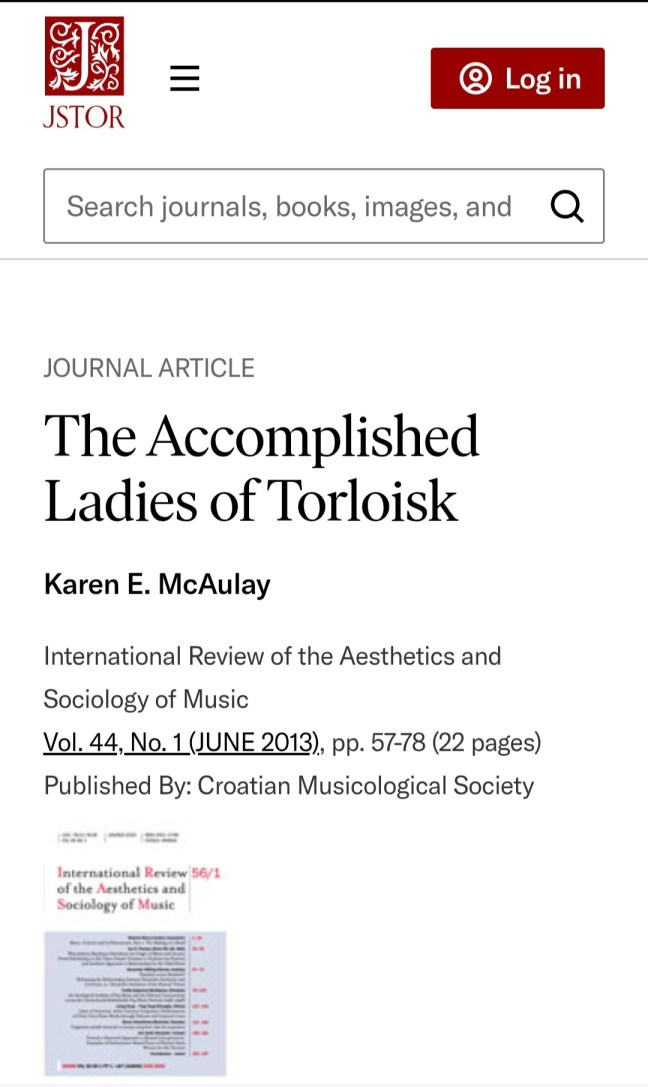
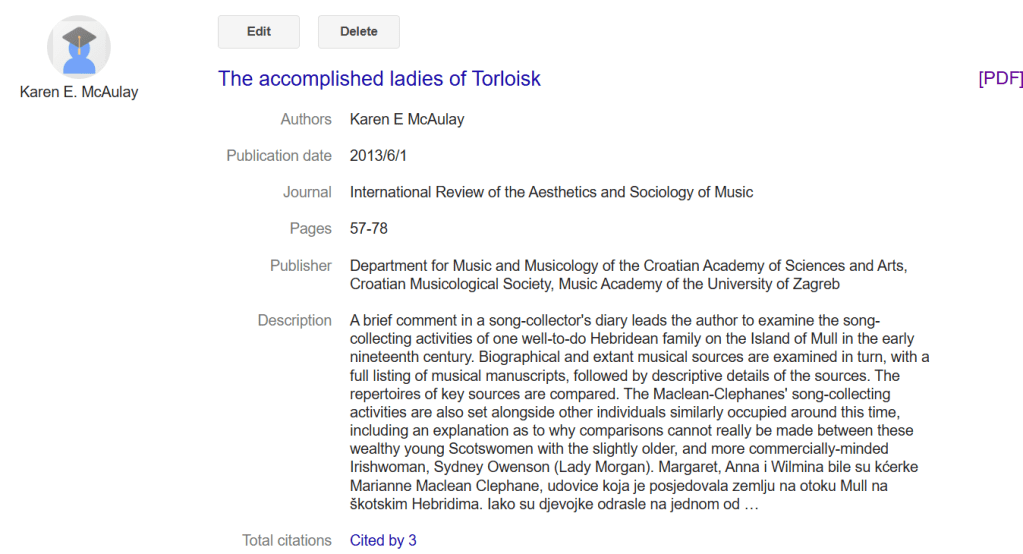
            • I followed up with an extended article about them (also in 2013). See this excerpt from the article:-

            Naturally, the Maclean Clephane sisters are in my Pure institutional repository at the Royal Conservatoire of Scotland. I coined the above phrase, ‘enthusiastic collectors of Gaelic songs and Irish harp tunes’, using it both in my book (p.92) and my article (p.62), both in 2013.

            ‘While they were still in their teens’

            The sisters had a book ‘printed but not published’ while they were still in their teens – you can read about it in my article, p.58. I have to say, the arrangements in their book were – well, okay, but not artistically stylish!

            Margaret had a harp – there is actually a Raeburn portrait of Margaret with her harp – see below.   Alexander Campbell did say the sisters played, but there’s no portrait of Anna with a harp, so we can’t prove it either way. He didn’t meet them. (There was in fact a third sister, though her musical interest didn’t seem to carry through to adulthood. ) Indeed, Anna wasn’t that hot on the piano, as I recall.  They grew up on the Isle of Mull. I’ve driven past the house, Torloisk. It’s massive!

            I just love researching and writing about people, particularly musicians! If they’re women musicians, then that’s all the more interesting – so it’s hardly surprising I was drawn to them, and went looking at materials in the National Library of Scotland and the School of Scottish Studies in Edinburgh, and even visiting a manuscript that’s now down in London. (Blog post Women’s History Month 2024. Musicians, this present blog.)

            Details of my article

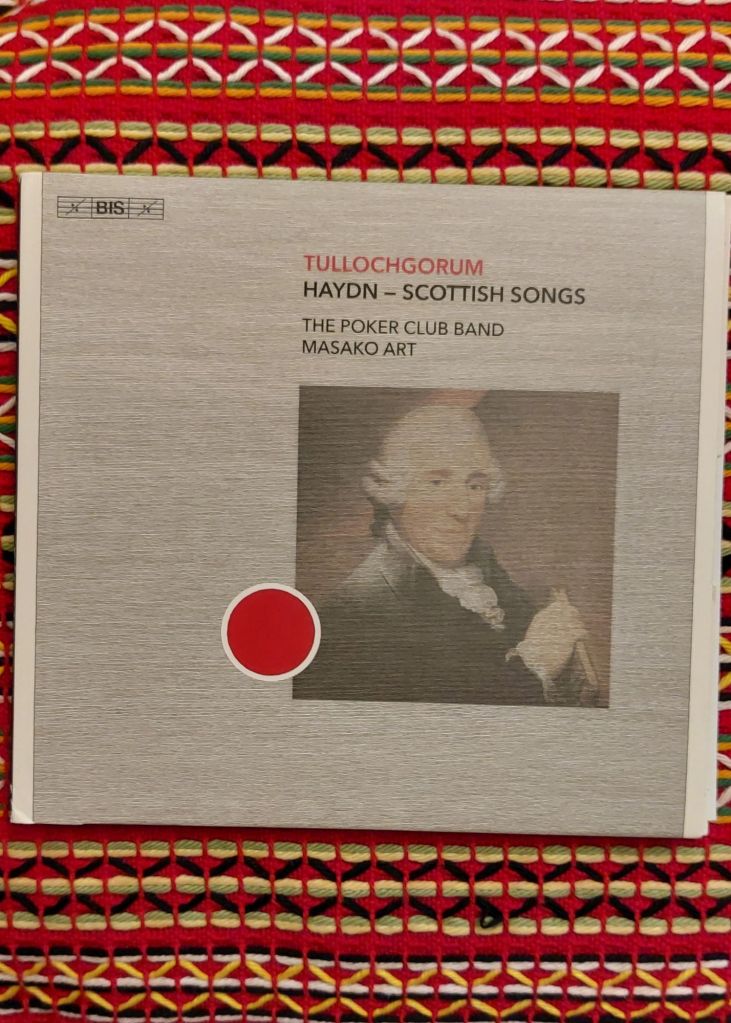
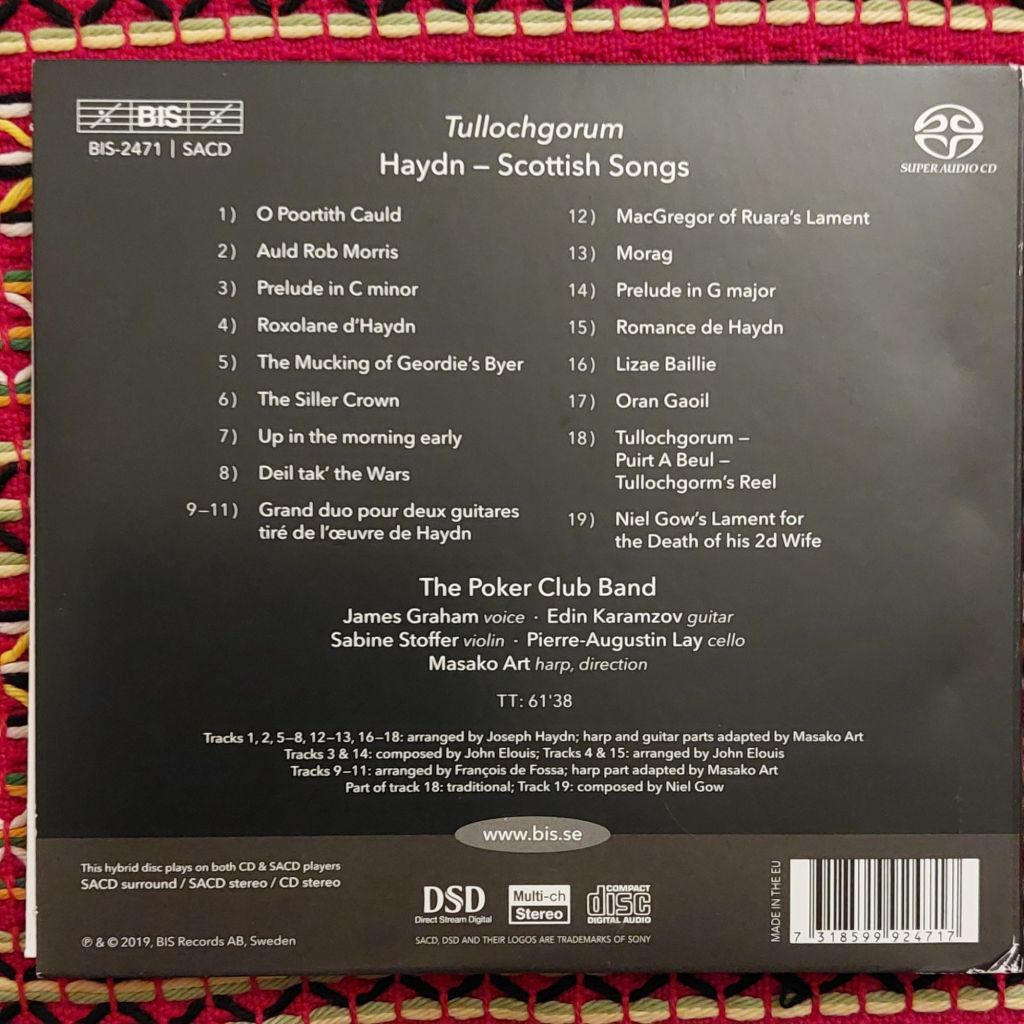
            But ever since, these fascinating and talented ladies keep cropping up in my social media feeds. People who’ve read my writings also contact me from time to time. Thanks to the miracles of modern technology, I get notifications that people have consulted my stuff, too … and there’s also a CD whose notes cite me, too:-

            Tullochgorum – Haydn – Scottish Songs, by The Poker Club Band and Masako Art (BIS-2471 | SACD

            Tullochgorum – Haydn  – Scottish Songs

            The harpist, Masako, asked if she could cite my work – I was very appreciative that she went to the trouble of asking me.

            Correctly cited 😀
            Margaret Clephane … and Masako Art

            I spent so long with my early nineteenth-century heroines, but eventually my research took different directions. Not being a Gaelic scholar was just one of the problems I’d encountered! I attended classes in speaking it, at the Conservatoire. I signed up to local authority evening classes at the Gaelic School in Glasgow. But somehow, I never really had time to give it enough attention, despite having been considered good at languages at school and possessing school certificates in – well, several European languages. I understand when someone agrees with me in Gaelic, and can pronounce ‘Torloisk’, for sure, but Gaelic remains beyond me!

            But look – now the music is going to be played. That’s exciting!

            Aha! New Arrival all the Way from Arran

            Once used in an Edinburgh school, a wee Scots song book (pupil’s edition) found its way to a shop on the Isle of Arran, then back to the mainland to me in Glasgow.

            1, 2 … still looking!

            If you ever find any of these in the back of a school cupboard, or bookshop,  or car boot sale, or Granny’s attic …

            … please do let me know!  I’m trying to get complete set! There were four books for the kids, and four for teachers.

            Hello to All New Visitors! I’m a Research Fellow

            I haven’t been posting much this summer, for personal reasons. So – after more than a week of total blog silence, imagine my surprise to find I have had hundreds and hundreds more visitors since yesterday. What’s happened?!

            Even if it’s some kind of blip, it gives me the opportunity to introduce myself. I’m a postdoctoral research fellow at the Royal Conservatoire of Scotland and also, for a few weeks more, at IASH at the University of Edinburgh. I research all sorts of cool stuff (well, it’s cool to me) about Scottish music publishers, with a distinct interest in national song collections, and in early 20th century music education in Scotland.

            My second book was published at the end of 2024:-

            A Social History of Music-Making and Scottish National Identity: Scotland’s Printed Music, 1880-1951.

            That might look like a strange date-range, but my previous book covered Scottish song-collecting up to the 1880s, so this kind of continues in a slightly different way from that point onwards. The 1951 cut-off date is because that was the year of the Festival of Britain. And it was also a good place to stop because I touched upon magic lanterns, gramophones and the wireless, but I really didn’t feel I was the right person to write about early television in Scotland! By stopping in 1951, I conveniently sidestepped early television. There are plenty of people more knowledgeable than me on that front.

            My current Edinburgh research entails examining archival records of the Thomas Nelson publishing house, an old Edinburgh firm. The British side of this company has ceased trading – it’s an American firm now – but I’ve found plenty to interest me in the documents up the early 1950s. Education became their focus during the era I’m researching.  Whilst my book mostly covers publishers specialising in music, Thomas Nelson really only published music that would be used in schools – though they hoped a few titles would also attract the general public. (The problem being that if you mention ‘school’ or ‘classroom’ in a title, it will turn off the ordinary member of public looking at books in a bookshop!)

            Will there be a third book? Possibly! I’m still pondering.  September is earmarked for concentrated thought about that!

            If this sounds interesting, please do come back and visit this site again.

            Book: A Social History of Amateur Music-Making and Scottish National Identity

            Wavy lines of music and an artistic interpretation of a fiddle

            Folks, I’ve just noticed Routledge has a 20% summer sale on at the moment.  So, if you or your library could use a copy, this might be a good time to get it!  (All books and e-books are 20% off until 1 August 2025.)

            The accent is on social history and Scotland – and music-making, obviously. I’m keen to hear what readers think of it. (If you are a reviews editor, do get in touch with Routledge. There’s a link on the website.)

            • Amateur music making
            • Scottish music publishing
            • Scottish and Irish songs
            • Fiddle tunes and dance music
            • Preserving the heritage and passing it on
            • Nostalgic Scots abroad
            • Newfangled technology

            Routledge link

            Karen E McAulay,  A Social History of Amateur Music-Making: Scotland’s Printed Music 1880-1951 (Routledge, 2005) 

            ISBN 9781032389202
            220 Pages
            Published October 30, 2024 by Routledge

            Wilma Paterson and Alasdair Gray’s ‘Songs of Scotland’

            Front cover of Songs of Scotland by Wilma Paterson and Alasdair Gray, Mainstream Publishing

            Published in 1997, this is quite an unusual collection: I can’t think of another Scottish song book illustrated throughout by a famous contemporary artist.  Inside,  the drawings and graphic art are monochrome  – only the cover is in full colour.  This, it must be said, is not quite what Gray initially envisaged; the decision was necessitated by cost, on the part of the publisher.  It’s still a beautiful piece of – well, book art – I imagine it sitting on coffee tables.  It doesn’t sit very easily on a piano music stand, due to its bulk.

            Today, as I opened it, the dust-jacket fell back, revealing an equally beautiful embossed cloth cover.  I just had to share it!

            It’s a very traditional anthology  – you won’t find modern repertoire here.  But it’s  carefully annotated, with a bibliography bearing witness to the amount of research that went into it.

            I have looked at contemporary reviews, and other related material – and there’s more I could say about this publication. However, I am keeping this for another day.

            If you’d like your own copy, it’s out of print but easy to source second-hand. (Here’s the Abe Books link.)

            Songs of Scotland, ed. by Wilma Paterson, designed and illustrated by Alasdair Gray (Edinburgh: Mainstream Publishing, 1997)