Dr Karen McAulay explores the history of Scottish music collecting, publishing and national identity from the 18th to 20th centuries. Research Fellow at Royal Conservatoire of Scotland, author of two Routledge monographs.
WordPress reminded me today about a blog post that I originally wrote three years ago for WhittakerLive, the Whittaker Library blog.
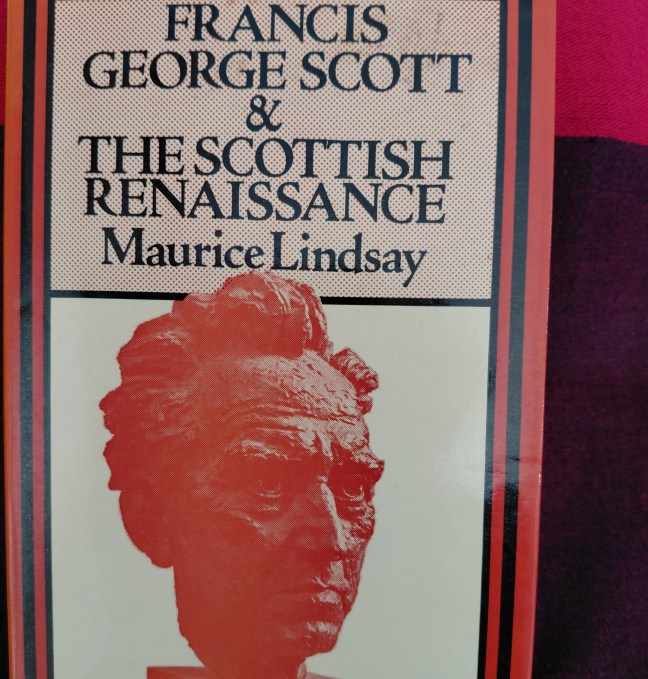
I shared it again in 2024, and because I am an admirer of Francis George Scott’s work arranging Scottish songs, I thought it would be worth airing again today.
I was playing through some of the songs in Song Gems (Scots) last night. My attention was taken by a song here entitled ‘Mary in Heaven’, set to a tune called ‘Mary’s Dream’. This is a Scottish song – nothing whatsoever to do with the Annunciation in the Biblical New Testament. Rather, it’s a song written by John Lowe in the late 18th century, in which a bereaved Scottish girl has a visitation from her dead fiance’s ghost; it was written for a real person whose fiance had died. You can look it up – there are numerous instances of it in old Scottish song books. Antiquarian John Glen’s collection, now in the National Library of Scotland – and digitised – holds plenty of copies. As well as collecting and writing about Scottish songs, Glen was a friend of the compilers of Song Gems (Scots).
Johnson’s Scots Musical Museum ,Vol.1
It was in James Johnson’ Scots Musical Museum, and George Farquhar Graham included it in his Songs of Scotland, published by John Wood (latterly by Bayley & Ferguson as The Popular Songs and Melodies of Scotland).
Suffice to say, I fell in love with this tune! It begins in the minor, goes into the relative major and back, and dallies with the submediant in the second half – it’s beautifully constructed. But how could I use it? I worked out the meter, and after a bit of digging, found the words of an old hymn in the same meter, which were eminently suitable for an introit. I’ve added sparing choral harmonies, and obviously it won’t have soloistic ornamention. But I’m still quite pleased with the results.
And so it shall come about that ‘Mary in Heaven’ will most acceptably be sung in a Presbyterian church …
Here’s Anita Rosati’s gorgeous April 2026 recording of ‘Mary’s Dream’:-
It’s interesting to see how newspaper publishers diversified, producing books and booklets – and even music – for their readership. They advertised other publications within the pages of these booklets. The same practice is of course observed inside and on the back covers of sheet music. Indeed, James S. Kerr sometimes advertised along the bottom of a page of printed music.
In the case of John Leng, it gives a glimpse into the kind of readers they were aiming their publications at, and underlines the importance of music in their lives – specifically Robert Burns’s songs, national songs and dance tunes.
Our Wi-fi was down for 14 hours, and the household was plunged into the depths of despair. (I only slightly exaggerate.) But more to the point, all the detailed text of today’s blog post was trapped on my laptop and couldn’t be transferred to the blog.
(Three adverts in four pages – and not the last you’ll encounter, for this most popular of magazines!)
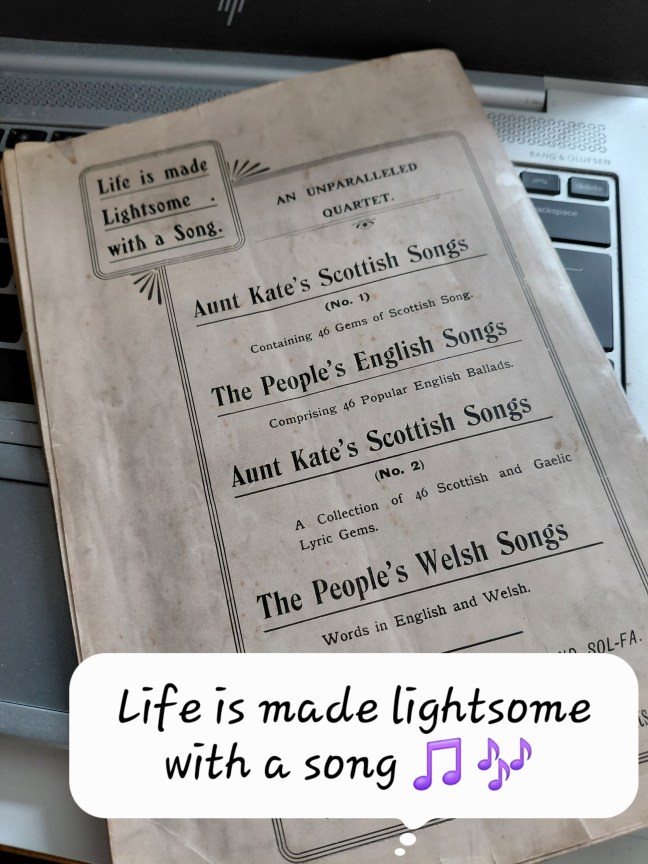
‘Life is made lightsome with a song’
In my earlier post, I promised I’d share details of John Leng & Co.’s advertising strategy, as observed in their booklet, The Songs of Burns – so here we are.
The Songs of Burns is a booklet that I bought purely out of curiosity; I was interested in their support of Scots Song singing through the Dundee Leng Medal prizes, and I wondered if books like this showed another aspect of that interest. I think the only link is probably that Scottish songs in general, and Burns’ songs in particular, were just popular all ways up, so this pamphlet wouldn’t have struggled to find purchasers. As the advert on the back cover says, ‘life is made lightsome with a song’.
Tucked in amongst the Burns songs, are the little column adverts and bigger full-page ones, which clearly indicate which publications they were pushing, around January 1905. Many of the adverts are distinctly aimed at women, which is interesting, considering Burns’s songs are of universal appeal.
As I mentioned in Part 1 of this post, much use was made of ‘Aunt Kate’ for good, sensible advice from a trustworthy auntie!
Moreover, I find it interesting that there’s more marketing for the People’s Friend than the People’s Journal. The magazine is still running, whilst the journal ceased in January 1986 – so even the journal had a good long life.
The People’s Penny Burns
Inside cover: Full page advertisement for its earlier companion, The People’s Penny Burns
p.48 Another full page advertisement for The People’s Penny Burns.
The People’s Penny Stories
p.3 Do you like a good novelette? You do. Well, don’t miss The People’s Penny Stories. Every month. One Penny. None so good.
The question is followed by a firm affirmative answer. Since my own People’s Friend serial ended up as no.393 in the ‘People’s Friend Story Collection’ back in the 1990s, I am naturally disposed to agree, stressing that this is light fiction, not literature!
p.29 A second advertisement for the People’s Penny Stories series.
Caring
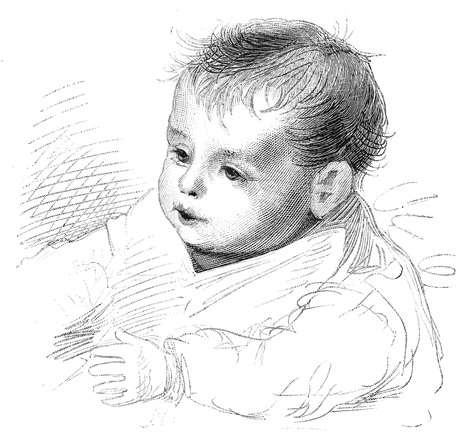
Drawing by Mary Mapes Dodge, Wikimedia
p.1 A LOVING MOTHER’S NEGLECT to rear healthy babies is unpardonable. Aunt Kate’s Mother’s Guide contains much useful information, and anyone who follows its advice will have healthy families. Sold by all Newsagents; Price ONE PENNY.
Taking an indisputably moral tone, the assurance that ‘anyone who follows its advice’ will flourish would probably flout advertising standards today, since some problems simply cannot be put right merely by following sound advice!
p.15 Have you a home pet? If so, and you would like to make the most of it, for its own sake and your own, invest a penny in Aunt Kate’s Canaries and Home Pets. Also uniform in size, style, and price, The People’s Dog Book.
Clothing the Family
p.5 Aunt Kate’s Knitting and Crochet Book contains over 170 Patterns. Price One Penny. (Believe me, this was an absolute bargain!)
p.30 Young Mothers will find the People’s Friend Paper Patterns invaluable. Complete Layette Sets at low prices. Baby’s First Garments, Shortening Clothes, Outdoor Things, Christening Robes, Sleeping and Day Gowns, Newest Bonnets, Hats and Bibs for Young Children of all ages. For styles for spring, summer, autumn and winter, see People’s Friend Fashion Pages.
(Get the paper patterns, or look in – where else, but the People’s Friend? It has to be said that nowadays, the Friend isunashamedly aimed at grandmothers rather than young mums.)
p.41 Make your own Clothes. Full directions how to cut dresses and other garments in AUNT KATE’S DRESS-MAKING BOOK. Price one penny; sold everywhere.
Feeding the Family
p.9 Aunt Kate’s Cookery Book is the best pennyworth in the world. If you have not a copy get one.
Entertainment
p.11 ‘AUNT KATE’S SCOTTISH SONGS’ Nos.1 and 2, and the ‘PEOPLE’S ENGLISH SONGS’ Contain the Cream of our National Minstrelsy. Each comprises nearly half a hundred Songs – Words and Music. The Price of Each is One Penny.
And they soon appeared, together with Welsh songs, in two hardbacked collections. These song books are advertised again on the back cover, see below.
This was, of course, the age of Tonic Sol-Fa, and many schools taught it, so there was a good chance that at least some of the readers of these books could work out a tune from Sol-Fa. The piano accompaniment, however, required someone who could read music. These accompaniments are simple and functional, rather than artistic, but they’re certainly usable. The arranger was a local Dundee music teacher who also wrote for John Leng & Co. Ltd.
Back cover: Life is made Lightsome with a Song: an unparalleled Quartet … ‘Music in each case in staff and sol-fa. One penny each. Sold by all newsagents.’
This is a whole page advert for the books in the smaller column advert on p.11.
Aunt Kate’s Scottish Songs No.1: 46 ‘gems of Scottish Song’
The People’s English Songs: 46 ‘popular English ballads’
The People’s Welsh Songs: Words in English and Welsh
Inside back cover – advertisement for ‘Simply Indispensible! Four Valuable Books [one penny each]:-
Conjuring and Parlour Magic Book: Aunt Kate’s Parlour Magic Book
Parlour Games for Everybody: a Companion to Aunt Kate’s Conjuring and Parlour Magic
The People’s Fortune Teller
Aunt Kate’s Dance Music ‘contains music for no fewer than twenty-six popular dances’ (there’s a little more about this book in another blog, Unsung Histories, Sept 2021, by Katie Howson.)
The People’s Friend
p.14 WHY NOT JOIN A CLUB? The Helper’s Club, conducted by Janette in the “People’s Friend”, is a National Bureau for the exchange of opinions, advice, and experiences among women of all classes.
p.16 Everyone praises the wholesome tone that characterizes every page of THE PEOPLE’S FRIEND.
p.17 A FRIEND INDEED is just what the People’s Friend has all along proved itself to be. No one who has ever known this “Friend” has turned his or her back upon it. It contains something for everybody. Ask your Newsagent to introduce you to the “Friend”; it will cost you a Penny, but you’ll find it worth the money over and over again.
p.25 Tribute to the PEOPLE’S FRIEND […] A miscellany which finds its way into many homes where good reading is courted. It has been a real influence in Scottish life, brightening it, and that must be a chief joy to Sir John Leng. – Daily Chronicle, London.
p.35 Quoting Mr T. P. Connor speaking highly of the People’s Friend and People’s Journal, we find another mention of the Friend and a second of the Journal.
p.47 Space at the bottom of the Table of Contents – filled with a larger advertisement for The People’s Friend, quoting press opinions.
Men’s Stuff?
p.21 If your husband, son or brother wants the best book on a good subject, he should buy – HOW TO READ, WRITE, AND DEBATE. It costs One Penny, and is full of valuable hints to all who desire to become good writers and debaters, and who wish to make the best of their reading.
The People’s Journal
p.23 POINTS about the PEOPLE’S JOURNAL. 10,000 Newsagents sell it. 1,250,000 People read it. A week’s issue weighs 20 tons. It is the People’s Family Newspaper. Sold everywhere, price one penny.
If you’ve made any kind of study of Scottish songs and fiddle tunes, you’ll know that collector Andrew Wighton (1804-1866) bequeathed his fantastic music collection to the City of Dundee. As the Friends of Wighton website says, ‘Andrew J Wighton (1804-1866) was a merchant in Dundee. He built a music collection which is now of international renown and importance. After his death, his Trustees donated the music to the then Free Library in Dundee’. The Friends of Wighton is a charity which exists to promote the collection and the performance and study of Scottish music. I’m proud to be the honorary librarian.
On 31 December 1855, Wighton’s Aberdonian friend James Davie wrote to him observing that Wighton must, by now, have,
… the finest collection of old [Scottish] music in the three kingdoms.
You only have to look at the online catalogue today to see that Davie was perfectly accurate in his observation!
When I’m talking to students about oral transmission of folk songs, my take is – perhaps a bit controversially – that I believe a lot of songs were actually written by ONE person. Passed on, passed around, changed certainly, but I don’t buy the idea that they somehow ‘grew’ anonymously or collectively out of the soil. Maybe a group of pals did sometimes sit in the pub, stand in the fields or sit at their looms working up words or a tune, but as often as not, someone ‘wrote’ or devised that song. We just don’t always know who did.
Tune Variants
The other problem, of course, is variants. If you pass things round and they get picked up by ear, or someone writes it down – but not exactly how it was performed by the last person – the tunes change slightly. Or, in times-gone-by, gaps between crotchets got filled in by two stepwise quavers, or an ornament got written out in full. And how do you determine what the ‘right’ version is? I don’t think you can, often enough, though you can certainly try to identify the most common form of a tune. Or if you’re able to, the earliest printed version. (If Hamish McHamish wrote a song in 1825, then the earliest printed version is most likely to be closest to his intentions. But unless he took his tune to the printer, or published it himself, you can’t be sure. )
The Ravages of Time
So we have at least a couple of centuries in which some tunes had the opportunity to change a multitude of times. (And that’s before an accompanist decided that G7 would be better than E minor at a particular point …) Try and compare a song in three different published collections. It won’t necessarily be exactly the same.
The Strong but Wrong Singer
I also use the modern-day example of my own church organist experience. You teach the congregation a new tune. A strong singer gets something wrong, and thereafter, try as you may, everyone sings Jemima’s version of the tune. That, too, could be construed as oral transmission in action!
(And as for Technology)
Today, we had a new song. The choir had studiously learned it, syncopated rhythms and all. We sang it first as an anthem. Later, we sang it with the congregation. Even the syncopations went moderately well, though I can’t say I was listening out for those who, ‘like sheep had gone astray’ (to quote Handel’s Messiah). There was only one problem: the verses appeared on the PowerPoint in the wrong order, and there was not a thing could be done about it once we’d started. When the choir sang it with the congregation, the latter sang what they could, or what they saw on the screen …. ! Maybe that’s why the syncopations went well – not everyone was actually singing.
All I can do is offer a corrected version of the lyrics for the PowerPoint, and we’ll try again another day. Who knows what might have changed in the meantime?
Remember un-conferences? They were popular a few years ago.
Well, now I’m co-ordinating a Scottish song event, but it’s for entertainment, and not remotely connected with my research. Does that make it an ‘un-research’ event? Anything I might say about these songs will have been learned during my research career. (I grew up in England – it wasn’t my childhood repertoire.)
Community Singing
It’s interesting, all the same. For a start, I am interested in community singing in an early-twentieth-century sense, but my own practical experience of secular community singing is limited. The forthcoming gig may well trigger new trains of thought. (Let’s discount leading congregational singing from the organ, which I’ve done for decades.)
Repertoire
The preparation has been interesting, too. We have collectively chosen the repertoire: some old, some from the 1950s and 60s, and some that our children would have learnt at school. It bears out my findings that the repertoire of favourite Scottish songs does change with every generation.
We’re also channelling Sir Hugh Roberton and his Orpheus Singers for a couple of choral items, but an even earlier choral arrangement felt too dated. You have to know about the west of Scotland’s intimate acquaintance with Roberton’s repertoire to appreciate why those settings go down so well to this day. Somehow, his particular brand of close SATB singing has endured in a nostalgic kind of way, where earlier settings have fallen by the wayside.
Authenticity
It gets better. We’ve debated different versions of the lyrics, and odd discrepancies in tunes. In other words, we re-enacted all the chatter about authenticity and correct versions that has been rolling on for, shall we say, 250 years or more?
And the Squeezeboxes?
Accordion
I debated with myself whether to go all authentic with an accordion accompaniment in appropriate songs, but I don’t think I’m that brave. Singing a solo is brave. A couple of concertina tunes is positively reckless. But the accordion is probably getting left at home. (Although, if you listen carefully between now and then, you might catch me attempting a few strains of ‘The Song of the Clyde’ in private … Jimmy Shand I’m certainly not!)
Why did Scottish music publishers produce so many songbooks and dance tunes? Who took Scottish music overseas to the diaspora? How did classical composers interact with local publishers?
I’ve discussed all this and more. Full details on the publisher’s page, link above.
Preparing for my Good Morning Scotland interview the other day, as I mentioned, I drew up something halfway between a mind-map and a spreadsheet to clarify in my mind how old the songs were, and who they were associated with. I had also – ever the librarian – looked up which of the Whittaker Library songbooks actually contained the songs in question. I wasn’t looking for every copy we had, just a rough overview. I thought you might be interested to see what our library patrons have access to.
It is significant that there are only two genuinely old songs – the last two, by Sir Walter Scott and Robert Burns. Otherwise, they’re popular songs that are Scottish, but folksongs? Not exactly traditional or old, but certainly much beloved today. So, will there still be popular songs in fifty years’ time? Yes, of course – but maybe they haven’t even been written yet!
Here is the list – in order of popularity – that Visit Scotland compiled from their recent survey:-
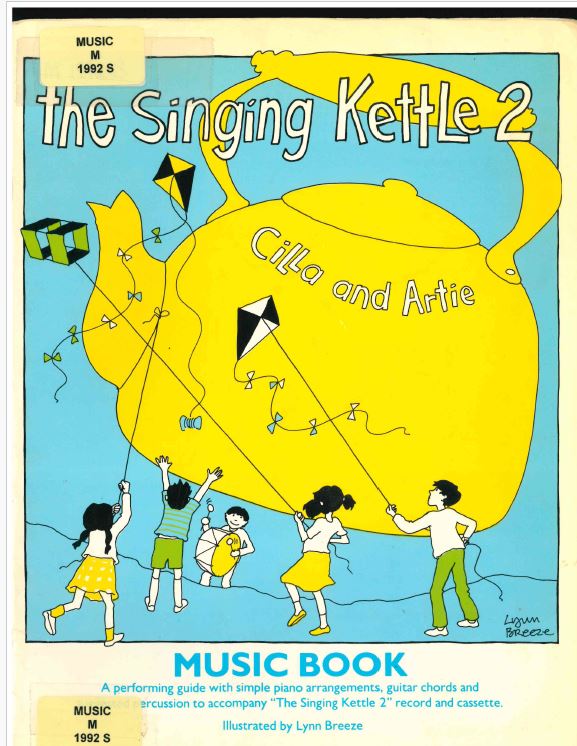
The Singing Kettle, book 2
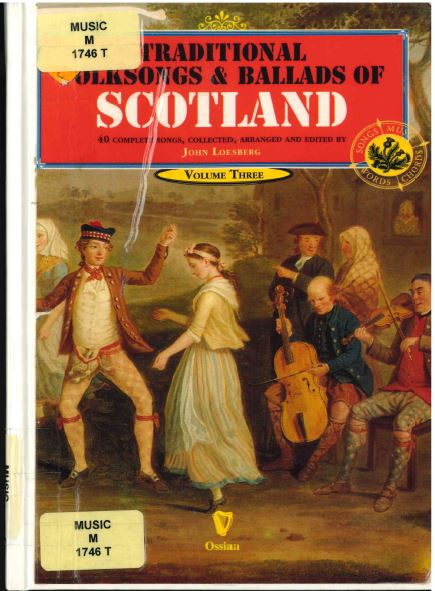
You cannae shove yer grannie aff a bus – it’s in Cilla Fisher and Artie Tresize’s second Singing Kettle music book (1989). Also in Ewan McVicar’s One Singer, one Song (1990) and his Scottish Songs for Younger Children (a words-only book, 2002); and in Traditional Folksongs and Ballads of Scotland Vol.3 (1994).
Donald, where’s your Troosers? Sung by Calum Kennedy and published by our friends Mozart Allan in 1959, and by Andy Stewart, published by Kerr’s in 1960. We listened to Andy’s rendition at home last night – and it still makes us laugh.
Coulter’s Candy – (hint: it’s pronounced ‘Cooters’) in Singing Kettle [book 1]; Katherine Campbell and Ewan McVicar’s Traditional Scottish Songs and Music (St Andrews: Leckie & Leckie, 2001); and Ewan McVicar’s Scottish Songs for Younger Children.
Wee Willie Winkie – I know it, and we have it in the library, but not in the version I know!
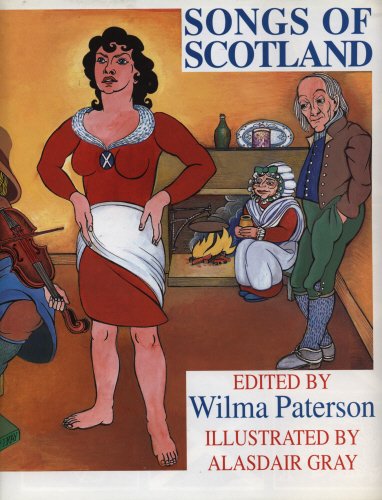
Skinny Malinky – in Wilma Paterson and Alasdair Gray’s Songs of Scotland (1996)
Three Craws – in the second Singing Kettle book; and Jimmie McGregor’s Singing our Own (1970)
The Jeely Piece Song – the library has Adam McNaughtan’s CD, The Words that I used to know (Greentrax, 2000). It’s also known as The Skyscraper Wean and can be found in Morag Henriksen and Barrie Carson Turner’s Sing Around Scotland (1985).
Bonnie wee Jeannie McColl – first sung by Will Fyffe in 1929, and more recently by the Alexander Brothers, it appears in 100 Great ScottishSongs (Dublin: Soodlum,1986)
An oldie: Walter Scott’s, Scots wha’ ha’e – it’s in many, many collections! I found it in Traditional Folksongs and Ballads of Scotland Vol.3; and Wilma Paterson’s Songs of Scotland.
Another oldie; Robert Burns’s My heart’s in the Highlands. People probably know the version sung by Karine Polwart in 2001, and Fara in 2014. There are much earlier versions in printed books, of course, but I suspect not what today’s enthusiasts are looking for!
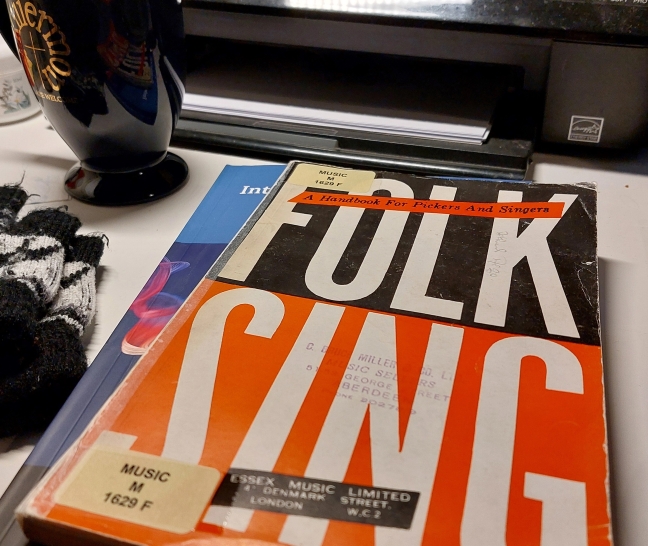
In the closing pages of my second monograph (currently at the publishers, pending approval of the revisions and then copy-editing), I comment on the changing approaches to folk music in the late 1950s and 60s. So, when a colleague presented me with a pile of music which used to be in the library, but needed recataloguing (don’t ask!), my immediate reaction to this book was, ‘Aha, see, I was right. Look how different this is to Mozart Allan, James Kerr’s and Bayley & Ferguson’s folk song collections!’
As a scholar, I smiled with satisfaction as I noted that even the COVER of Folk Sing: A Handbook for Pickers and Singers was more modern – huge white letters on a half-black, half-red background. As for ‘pickers and singers’: well, we didn’t have ‘pickers’ in any of the dozens of Scottish publications that I’ve been writing about! Guitar/accordion chords as an addition, assuredly, but not usually melody, chords and no keyboard line. And as for the term, ‘pickers’? No. A more savvy friend informs me that the book came at the end of the skiffle revival, which according to Oxford Music Online was particularly strong in the UK:-
“While the skiffle revival of the 1950s embraced the USA and Germany, it gained most ground in Great Britain. […] Donegan and his imitators enjoyed considerable popularity until about 1959, when skiffle gave way, both in the USA and Europe, to ‘beat’ music and to rock and roll.”
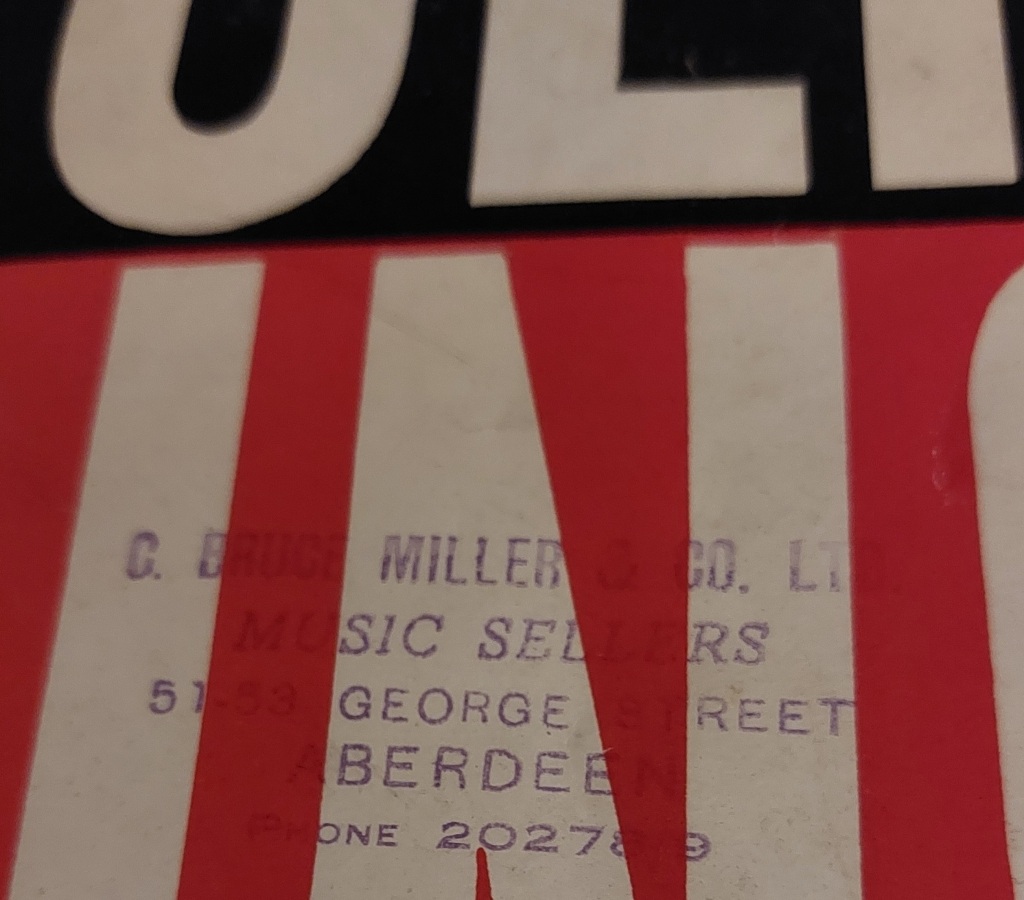
This song book was published in New York by Hollis Music in 1959, but distributed by Essex Music (4 Denmark Street) in London, and this particular copy was actually sold from a shop in Aberdeen. Notwithstanding this, it mainly contains American repertoire with just a few British songs and a single French one for good measure.
I examined it inside-out and backwards, observing contentedly that they indicated the names of the composer/arranger/lyricist above each song, along with which publishers owned the original copyright.
Then I sighed. This morning I had noted with pleasure that already this month, I’ve submitted a revised manuscript for my book, written a librarianship-ish article and two musicology abstracts, done a peer-review and a radio interview, with a research talk coming up to round off the month. That was my research-self.
But what I was supposed to be doing now, was cataloguing this anthology, not studying it.
‘Recataloguing’ means that I have already catalogued the book at some stage in the past … yawn!
The librarian part of me spent half this afternoon re-cataloguing it and copy-typing 150+ song titles from the contents list. It’s certainly useful – it means people will be able to find the songs – but it’s not nearly as rewarding!