It’s World Cup weekend – and as the saying goes, ‘if you can’t beat them, join them’. But what do I know about football? Absolutely nothing. I have two left feet, no eye for a ball, and have never watched a match in my life. (Not even Norwich City’s ‘Canaries’, though I expect my brother did!)
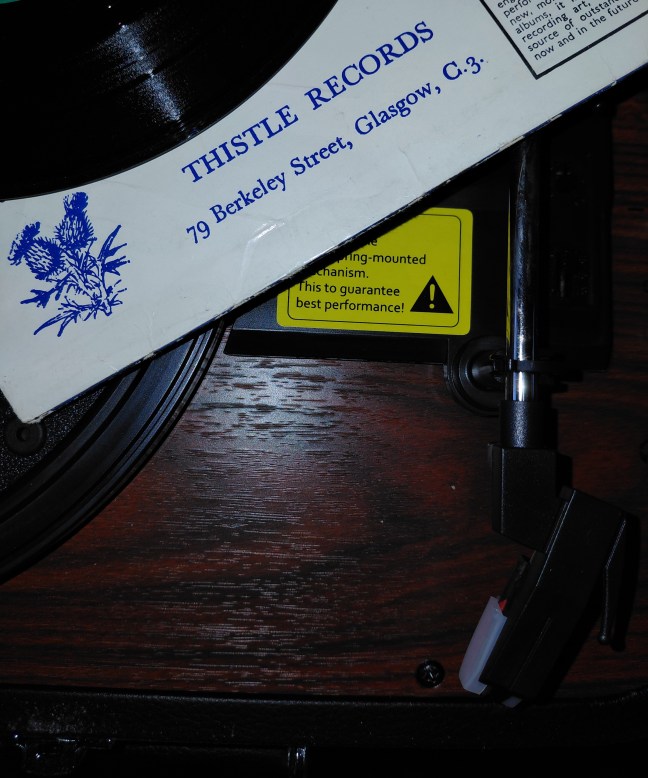
I imagine the proprietors of Thistle Records were a little more clued-up than me, because they included football songs amongst their other 45 rpm singles. Thistle Records was the Scottish record label in which singer Robert Wilson held a part-share, along with Kerr Music Corporation. It started trading in 1962, and Wilson died in 1964, so really he had little to do with it. Gavin D. Farquhar was the Managing Director, and John Cutler the Recording Manager. They overwhelmingly specialised in Scottish artistes, so the football songs must have just been a remunerative sideline. I’m assuming someone was interested in the sport, though they might just have taken interest in the profits from these records. (I’ve written about Robert Wilson and Kerr Music Corporation in my latest book – and I did make passing reference to Thistle Records, but I have to say that my specialism is printed rather than recorded music!)
Discographies like 45cat, and Robert Lyons’ Seventies Sevens (‘a site for seven inch record labels of the 1970s’, uploaded in 2008) enable us to reconstruct a list of Thistle’s football singles. I have quoted dates where they were given, but I haven’t verified them:-
- Rangers With The Caledonian Accordion Band – The Blue Flag And Follow Follow / It’s Rangers For Me – Thistle – UK – TM 80
- The Manchester United Team (With Soloist John Dunbar) – United! United! / The Red And White’s – Thistle – UK – TM 81
- Everton Football Club – E-V-E-R-T-O-N / Everton For Me – Thistle – UK – TM 83 (45cat dates this to 1964)
- The Celtic Team – Celtic! Celtic! / Slattery’s Mounted Fut – Thistle – UK – TM 85
- Rangers Football Team With Lex McLean – Every Other Seturday / R.A.N.G.E.R.S. – Thistle – UK – TM 86 (45cat dates this to 1964)
- The Partick Thistle F.C. – It’s The Jags / Firhill For Thrills – Thistle – UK – TM 97 (Lyons dates this to 1971)
- The Clyde F.C. With Fraser Bruce – Song Of The Clyde / One – Two – Three – Thistle – UK – TM 98
- Rangers [Scottish Football Team] – That’s The Team! / The Glasgow Rangers – Thistle – UK – R.1066
The firm was largely defunct by the late 1970s. Andy Cameron coined the phrase, the ‘Tartan Army’ in his recording, ‘Ally’s Tartan Army’ in 1977, when the Scotland team qualified for the 1978 World Cup in Argentina, but he didn’t turn to Kerr Corporation or Thistle Records to publish it – instead, the score and record were published in London by Klub Music/Mews Music.
So, Kerr Corporation and Thistle Records never got to mark Scotland’s visit to Argentina, and by now, few Scottish football supporters will even have heard of them. Times move on.
Mind you, I was listening to Skerryvore’s ‘Never stopped dreaming (Scotland World Cup Song)’ this afternoon, and reflecting just how much tastes have changed since the 1960s-1970s! I think Messrs Wilson, Farquhar and Cutler would have been a bit surprised.