You Can Please Some People Some of the Time

… But you can’t please all of the people all of the time. So (apparently) said John Lydgate in the fifteenth century. (Thereby proving the veracity of another old adage: ‘There’s nothing new under the sun’.)

I play a wide range of organ music. I throw in a generous pinch of Scottish songs – although not to excess, I think – and cover a range from Baroque to modern. Not wildly modern – Messiaen is beyond me! And I realise that what I consider ‘middle of the road’ may not be the middle of everyone else’s. However, my conscience is pretty clear – because I do try to please everyone at some point or other! So, it is a little hurtful to hear adverse comments. I do rather wish this hadn’t been relayed to me.  (I mean, why? Was it well-intentioned? Was it a direct quotation or paraphrased?)

She always plays such miserable stuff!

I genuinely feel that’s a harsh and rather unjustified criticism. I disagree with it!

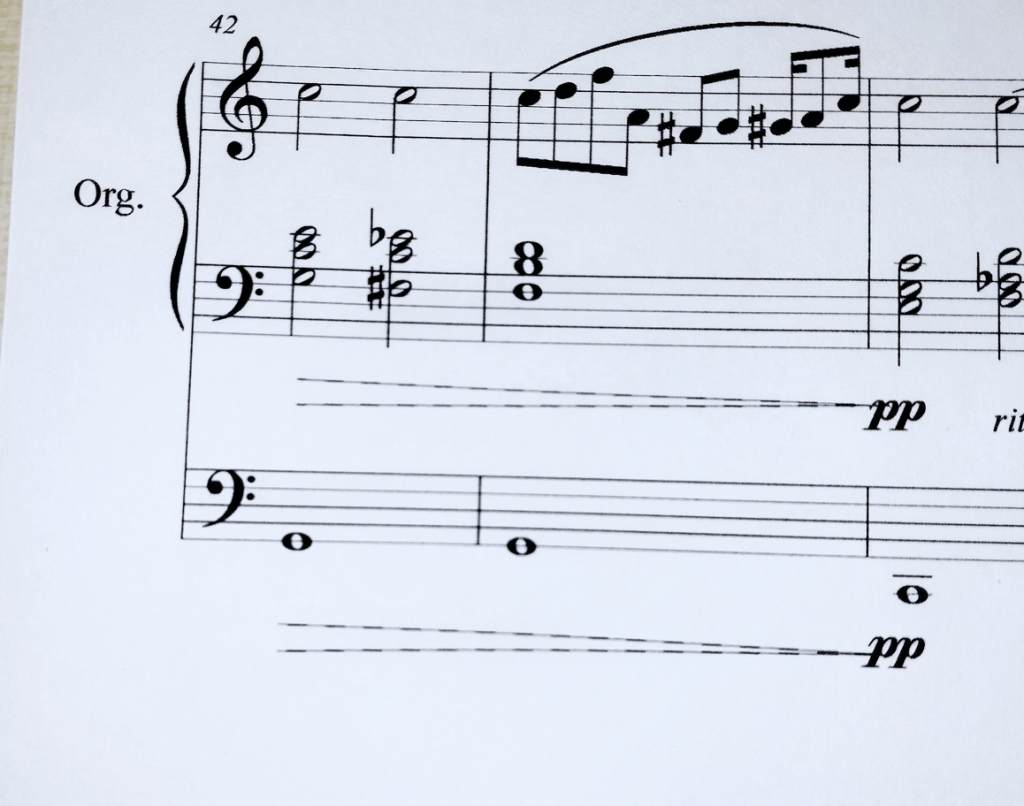
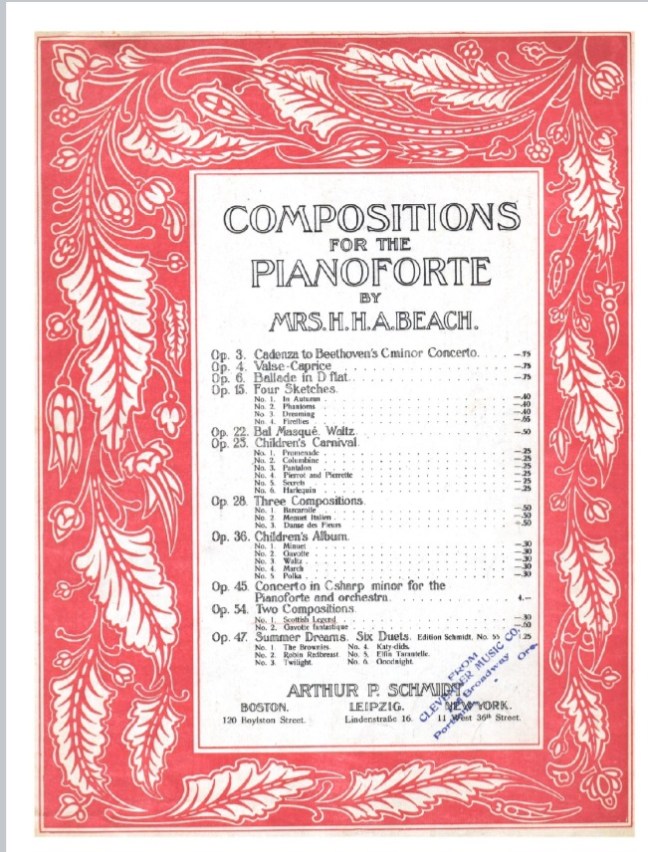
However, I got some new organ music last week, and eagerly took it to church to try out yesterday (Saturday) morning. I’d found Robert Gower’s organ arrangement of Amy Beach’s Scottish Legend, op.54, which by any stretch of the imagination should have been perfect. I like to play music by women composers; I like Scottish-influenced music; and I like turn-of-the century harmonies. The American Amy Beach, currently enjoying a deserved new fame, lived from 1867-1944. I haven’t yet looked into why or when she wrote this particular Celtic-inspired piece, but I do know that it was originally one of the Two Piano Pieces, op.54:-

IMSLP piano original

From my perspective, it looked like a perfectly good, gentle and tuneful piece, and I was looking forward to working on it.  However, when I tried it at the organ, I felt only disappointment.  It sounds like a ‘Coronach’ – a Gaelic funeral song, or dirge. So how will that go down? No-one can say it’s a happy, upbeat tune!

It’s reminiscent of, but slightly more cheerful than the contemporary Coronach by pianist, organist and composer Edgar Barratt (1877-1928). This, too originated as a piano piece:-

Edgar Barratt, Coronach (piano)

Here’s the organ transcription of Barratt’s piece:-

Barratt- Coronach (organ)

Edgar Barratt was the son of English organist John Barratt (b.1848), who by 1881 at latest had moved to Paisley to be the Abbey organist. I haven’t yet discovered where Edgar Barratt trained, although I know his brother William Augustus studied composition at the Royal College of Music. Perhaps I don’t need to know. Anyway, I’m surmising they may have spent most of their childhood in Paisley. Edgar had clearly absorbed the Scottish idiom when he wrote his Coronach. Stylistically, his piece, and Amy Beach’s, sit alongside pieces like Hamish MacCunn’s Land of the Mountain and the Flood, even if they’re on a smaller scale.  There has long been a fondness for Scottish-sounding music!

But, to get back to Beach’s piece – that ‘miserable stuff’ comment echoed in my ears – months after it was relayed to me. I put the music back in my briefcase and headed home without giving it a second try.

Repair, Design

I found myself driving behind a van belonging to a whirlpool spa bath firm, with a slogan on the back: ‘Repair, Design’, and a couple of other skills.  I misread it as, ‘Despair, Resign’, and reflected that it felt like a summary of my mood.  Now, this is evidently plain lunacy.  Why should I  despair, for fear a little organ piece strikes a sombre note?

Anyway, I’m starting to like it. I’ve played the piano recording a couple of times. I’ll have another go at the organ arrangement on the piano at home, before I go back for my next practice session.

I think I should stop caring so much what other people think!

Blog post image from IMSLP

Not Research, exactly! The Organist Plays …

I was playing through some of the songs in Song Gems (Scots) last night. My attention was taken by a song here entitled ‘Mary in Heaven’, set to a tune called ‘Mary’s Dream’. This is a Scottish song – nothing whatsoever to do with the Annunciation in the Biblical New Testament. Rather, it’s a song written by John Lowe in the late 18th century, in which a bereaved Scottish girl has a visitation from her dead fiance’s ghost; it was written for a real person whose fiance had died. You can look it up – there are numerous instances of it in old Scottish song books. Antiquarian John Glen’s collection, now in the National Library of Scotland – and digitised – holds plenty of copies.ย  As well as collecting and writing about Scottish songs, Glen was a friend of the compilers of Song Gems (Scots).

Johnson’s Scots Musical Museum ,Vol.1

It was in James Johnson’ Scots Musical Museum, and George Farquhar Graham included it in his Songs of Scotland, published by John Wood  (latterly by Bayley & Ferguson as The Popular Songs and Melodies of Scotland).

Suffice to say, I fell in love with this tune! It begins in the minor, goes into the relative major and back, and dallies with the submediant in the second half – it’s beautifully constructed.  But how could I use it? I worked out the meter, and after a bit of digging, found the words of an old hymn in the same meter, which were eminently suitable for an introit.  I’ve added sparing choral harmonies, and obviously it won’t have soloistic ornamention. But I’m still quite pleased with the results.

And so it shall come about that ‘Mary in Heaven’ will most acceptably be sung in a Presbyterian church …


Here’s Anita Rosati’s gorgeous April 2026 recording of ‘Mary’s Dream’:-

Blog post image by bzimm3 from Pixabay

Ways to Play a Scots Tune

Yesterday being Sunday – and Scotland isn’t out of the World Cup yet – I dug deep to find some more thematically appropriate music to play on the organ.  I’m pleased to report that it IS possible to play, ‘Yes, Sir, I can Boogie’ in a sedate, dignified manner.  Challenging, but possible.  Likewise ‘Scotland The Brave’.  After those, a calmer ‘The Rowan Tree’ and an organ setting of ‘Amazing Grace’ completed the World Cup set.

But AFTER the service โ€ฆ although I nominally stuck with a Scottish titled march, absolutely no-one would have known or recognised it. It was an indulgence of my research interests, I’m afraid!  I played a piece of music by Edward E Harper. So … it was

  • composed by an Englishman,
  • who briefly lived in Scotland.
  • His tune was called a Scots March (it doesn’t sound Scottish) –
  • and it was in a collection published by Bayley and Ferguson, a Scottish publisher.
  • The composer himself had emigrated to Canada by this stage.  I don’t know when he composed it.

It gets more complicated.

  • The copy I own was sold in AUSTRALIA,
  • and taken to California by a talented scientist at the start of his career.

I repatriated it through eBay, so today the not-exactly ‘Scots March’ was played by an Englishwoman in Scotland, not that far from where the English composer was once organist …

I have a problem now. Just supposing Scotland beats Brazil? I can find any number of traditional tunes, but what would I play as an outgoing voluntary?!

A Win for Scotland – and a Modest Tribute from an Organist  …

Yesterday morning’s organ music just had to be topical. To our small but enthusiastic congregation’s approval, I included ‘Flower of Scotland’, ‘Loch Lomond’, ‘Caledonia’, ‘500 miles’, ‘Highland Cathedral’ (not really Scottish, but much-loved all the same), and I managed something along the lines of ‘Never Stopped Dreaming’, the new World Cup anthem by Skerryvore.

Four bars!

Kilbarchan to Southport to Ottawa to Vancouver: Organist on the Move

So, we’ve talked about the church organ which has been relocated from Kilbarchanย  (near Paisley in the west of Scotland) to Prenzlau in Germany.ย  Well, the first organist to play the instrument in Kilbarchan, went on to travel a whole lot further than that.

Edward Emanuel Harper

I’ve collated a lengthy document about the Glasgow Athenaeum’s second Principal. He was only with us a couple of years, of course. After that, he was Kilbarchan’s organist a little bit longer.

The family went briefly back to Southport, before heading to Ottawa – for a year – and then settled in Vancouver.

My notes are full of clips from newspapers. I traced his first Canadian year as an organist in Ottawa – and some snippets of genealogical data in Vancouver. But nothing of his teaching, and no trace of a large compositional output. I’ve looked at library and archive catalogues. Even a promising entry to his ‘archive’ leads to one piece, contributed anonymously by post in 1971. I’ve seen a digital copy of it. It was self-published.

So What?

You might askย  – I’ve already asked myselfย  – why I need to know? (Apart from the fact that these little research questions tend to take on a life of their own!)ย  And I think it’s because Harper was plainly a gifted individualย  – a PhD from Dublin, an LRAM, a brilliant proponent of Chopin, sought after as an organist and recitalist, and a prolific composer.

So where is his Canadian output, in manuscript or published?

And what led him to resign from the Athenaeum, seen by many as a ‘plum’ job? Our records are missing for that era. Did we let a genius slip away? Or were there difficulties that history has graciously concealed?!

Image: St Andrewโ€™s Church, Ottawa (Copyright: Jamie McCaffrey, Flickr)

Kilbarchan to Prenzlau

It was 2018 when the BBC posted the story of a magnificent three-manual organ built by Hill and Son, which was being taken out of Kilbarchan West Church – no longer needed after a merger – and transported to Prenzlau:-

‘Wonderful’ church organ sent to Germany

The Hill organ at Kilbarchan West Parish Church (photo from Kilbarchan West website). *

It has taken a while – Covid got in the way – but in May 2026, there’s going to be an organ festival to celebrate the inauguration of the organ in its new home.

Festival website

Former Athenaeum Principal Inaugurated Kilbarchan Organ

Well, I’m excited, even though I don’t think I can justify going all that way. (Or can I?) You see, I’ve been researching the second Principal of the Glasgow Athenaeum – Dr Edward Emanuel Harper, who was only with us for two years, 1902-1904. After that, he left. There are no records extant to say why he left. But within a few months, by September 1904, he had been appointed organist of …

Kilbarchan Church.

He played the inaugural recital for the new Hill & Son organ.

British Newspaper Archive: Paisley & Renfrewshire Gazette – Saturday 22 October 1904

I won’t tell you his whole story here – I already mentioned him, only a few weeks ago. By 1909 he had gone back to Stockport, accepted a job offer in Canada, been widowed before they had even moved to Canada, but still moved his young family to Canada as planned, and started a new life. And then another new life on the opposite side of Canada a year later.

Part of his fascination for me is his elusiveness, I must admit. Why did he leave the Athenaeum? What persuaded him to return to his home-town, or to cross the Atlantic? I do know a little about what happened when he got there. And I’ve traced his publications in the UK, but can only find only one published in Canada. Why? It’s hard to imagine he didn’t publish any more.

But most pressingly – do I want to go and hear the rebuilt organ which was, originally, only a few miles away from Neilston, where I am currently organist? After all, I’m not researching organ-building, or organ music. And  Harper wasn’t a Scot, or published in Scotland – but he WAS briefly our Principal.  I’m drawn to the story and the connections  …


* The original Kilbarchan church was more recently known as Kilbarchan West Parish Church, before it combined with Kilbarchan East. At that point, the united congregation elected to use the East Church.

International Women’s Day: Rose Smith (and Marjory Kennedy-Fraser)

The beginning bars of The Road to the Isles, in a piano arrangement by Marjory Kennedy-Fraser.

This has become a two-post day? Well, it’s International Women’s Day. How can I not mention it?

I decided I would play music by women this morning. Rose Smith (one of the women I recently wrote about in the RMA Research Chronicle – you’ll be familiar with her name by now!) was a piano teacher, a composer, and an Episcopalian organist. She was born in Lanark, moved to Glasgow whilst still a child, and later lived with her husband and children in Rutherglen. Her composed songs were rather like those by Ivor Novello – I’ve acquired nearly all of what seems to be extant, but I think a lot is missing. She only self-published a few, and the rest – for variety show singers – may not even have been published at all.

There’s no surviving organ music, so there was nothing for it – I played her songs before morning worship today. I bet you she never played them in church! However, since no-one knew they were secular songs, there was no harm in it. They’re well-written pieces, and I do think it’s a shame they’re not known. I did recommend one to an RCS Finalist a few years ago, and it was performed with enjoyment and appreciation.

I have significant performance anxiety about recording my playing, but I did unearth a piano demo of three songs by Rose Smith, that I recorded for a student a few years ago. Be kind! This isn’t a perfect performance or a perfect recording, but does show how the songs go.

Quick piano demo of three songs by Rose Smith

For my outgoing voluntary today, I turned to a more well-known composer. I played Marjory Kennedy-Fraser’s Eriskay Love Song, followed by The Road to the Isles.

Applause

I scored! I don’t usually get a round of applause after a voluntary.

I’ve got a new book of proper organ voluntaries by women composers, so I really must roll up my sleeves and learn some of them, but I suspect The Road to the Isles will prove hard to beat, as far as audience reaction goes …

‘Seated One Day at the Organ’: Athenaeum Principals’ Music Revived

Gaily through the World - piano music by Allan Macbeth, with a picture of a woman dancing, on the front cover

The first and second Principals of the Glasgow Athenaeum School of Music weren’t actually in post very long. Allan Macbeth managed twelve years (1890-1902); then Edward Emanuel Harper, only two (1902-04). I’ve been researching them recently, and I’ve found out quite a bit more than has hitherto been known. But this post is not about their biographies and achievements – that’s for another time.

No, today is about practical music-making. Amongst a handful of compositions, Macbeth wrote a march and two-step, Gaily Through the World, which is actually very jaunty, and enjoyed quite a long life as a piece of band music. It’s not high art, but it does stand up as an effective piece of light music. It was published in 1908, two years before he died, by Hawkes. (Yes, the Hawkes that later went into partnership with Boosey in 1930.) That in itself is a mark of its respectability, if nothing else. The author of this YouTube posting says it was premiered at a Boosey Promenade Concert in 1896 – when Macbeth was in the middle of his Principalship.

Harper seems to have had a larger output. Again, it was respectable but not remarkable. Nonetheless, I found a piece of organ music on IMSLP, this time published by Vincent Music in 1903, halfway through his own spell at the Athenaeum. (Vincent Music was the firm who would later publish James Woods and Learmont Drysdale’s Song Gems (Scots), which I’ve written about before. They were not as eminent as Boosey or Hawkes.) Abendlied is gentle and reflective, and appeared in an extensive series of ‘Organ Solos Suitable for Recitals’. It’s not hugely memorable, but it’s a nice enough piece for all that. Whilst Macbeth and Harper were both organists, each at several churches, I’ve formed the impression that being an organist occupied perhaps more of Harper’s career than it did of Macbeth’s, but this is really only a guess; moreover, Harper lived much longer than Macbeth and was only Principal of the Athenaeum for a couple of years. He obviously occupied himself in other ways for the rest of his career, and I have quite a list of the churches where he ‘presided’ at the organ.

Anyway, I digress. I played Abendlied before morning worship this morning. (No-one knew it was an ‘Abend Lied’, after all!) It could well have been played by Harper, just a few miles away, when he was organist at Kilbarchan.

But I saved Macbeth’s Gaily Through the World for my outgoing voluntary – and it did get noticed! It fitted the organ so well that I wondered if he had ever tried it at the organ himself – though maybe he might not have considered it serious enough for late Victorian Presbyterians …


Kilbarchan church was more recently known as Kilbarchan West Parish Church, before it combined with Kilbarchan East. At that point, the united congregation elected to use the East Church, and the organ itself was dismantled and sold to St Marienkirche church in Prenzlau, Germany. There’s a festival in May 2026, to celebrate the organ’s inauguration in its new home.

Festival website

Forgotten Local Heroine Margaret Wallace Thomson

On this day, 3 January 2023, I went in search of this late Victorian lady’s grave in a Paisley cemetery.  She’d been a noted local celebrity, reputed to be the best accompanist in the town.  Sadly, she lost her mind to grief after her mother’s death,  and died in an asylum.

The gravestone was extravagantly impressive – even though the obelisk has sadly been taken down for health and safety reasons.

Nonetheless, her story is interesting and moving, and her connection with Paisley publisher Parlane ensured her a mention in my book. 

I also wrote a more detailed biographical article for the Glasgow Society of Organists, and reproduced it in this blog.

Postscript. I went on another 3rd January expedition this afternoon.  More of that another day!

The Organist Celebrates

As I planned what to play for tomorrow’s organ voluntaries, my eye fell on an old book of pieces by Cesar Franck. It had been my father’s book, and I remember my nine-year old self playing one of the melodies on the oboe, as he played the rest of the lines. He loved France, French, and French organ music. Today, I realised that this particular volume was published by none other than one of ‘my’ Scottish music publishers – Bayley and Ferguson. What could be more appropriate to celebrate my new book, than to play our ‘duet’ from that particular anthology?ย  (I had, moreover, already encountered the editor, Henderson, in my research. He’s mentioned in passing in Chapter 3.)

I don’t know when Dad got that book. It was published in 1953, and it has an oldish look to the cover design, so I imagine he got it not long after it was published.Wherever he was at the time, it has since spent decades in Norwich before eventually coming up to Glasgow, Bayley & Ferguson’s original home.

I must admit that the focus of my book means I didn’t make much mention of organ music, and definitely no mention of Cesar Franck!  Looking at it, the Cesar Franck cover design is staid beyond its years.  You wouldn’t think the sixties were just around the corner.   Still, it’s the music that matters.  I’ll enjoy playing it tomorrow, thinking of Dad as I do so.  He would have been so pleased to see my published work – I can only hope he’s smiling from his fleecy cloud now!