

… But you can’t please all of the people all of the time. So (apparently) said John Lydgate in the fifteenth century. (Thereby proving the veracity of another old adage: ‘There’s nothing new under the sun’.)
I play a wide range of organ music. I throw in a generous pinch of Scottish songs – although not to excess, I think – and cover a range from Baroque to modern. Not wildly modern – Messiaen is beyond me! And I realise that what I consider ‘middle of the road’ may not be the middle of everyone else’s. However, my conscience is pretty clear – because I do try to please everyone at some point or other! So, it is a little hurtful to hear adverse comments. I do rather wish this hadn’t been relayed to me. (I mean, why? Was it well-intentioned? Was it a direct quotation or paraphrased?)
She always plays such miserable stuff!
I genuinely feel that’s a harsh and rather unjustified criticism. I disagree with it!
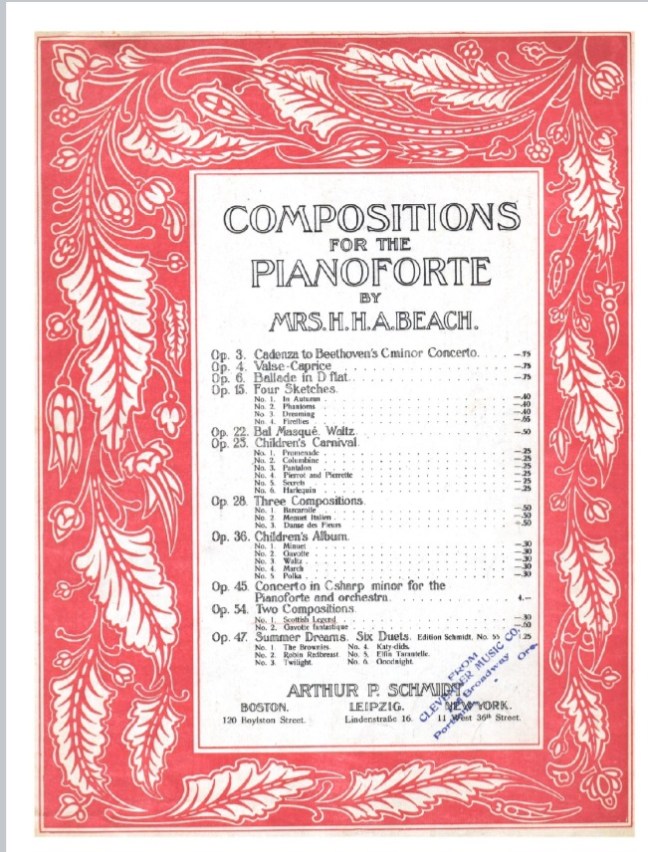
However, I got some new organ music last week, and eagerly took it to church to try out yesterday (Saturday) morning. I’d found Robert Gower’s organ arrangement of Amy Beach’s Scottish Legend, op.54, which by any stretch of the imagination should have been perfect. I like to play music by women composers; I like Scottish-influenced music; and I like turn-of-the century harmonies. The American Amy Beach, currently enjoying a deserved new fame, lived from 1867-1944. I haven’t yet looked into why or when she wrote this particular Celtic-inspired piece, but I do know that it was originally one of the Two Piano Pieces, op.54:-
From my perspective, it looked like a perfectly good, gentle and tuneful piece, and I was looking forward to working on it. However, when I tried it at the organ, I felt only disappointment. It sounds like a ‘Coronach’ – a Gaelic funeral song, or dirge. So how will that go down? No-one can say it’s a happy, upbeat tune!
It’s reminiscent of, but slightly more cheerful than the contemporary Coronach by pianist, organist and composer Edgar Barratt (1877-1928). This, too originated as a piano piece:-
Here’s the organ transcription of Barratt’s piece:-
Edgar Barratt was the son of English organist John Barratt (b.1848), who by 1881 at latest had moved to Paisley to be the Abbey organist. I haven’t yet discovered where Edgar Barratt trained, although I know his brother William Augustus studied composition at the Royal College of Music. Perhaps I don’t need to know. Anyway, I’m surmising they may have spent most of their childhood in Paisley. Edgar had clearly absorbed the Scottish idiom when he wrote his Coronach. Stylistically, his piece, and Amy Beach’s, sit alongside pieces like Hamish MacCunn’s Land of the Mountain and the Flood, even if they’re on a smaller scale. There has long been a fondness for Scottish-sounding music!
But, to get back to Beach’s piece – that ‘miserable stuff’ comment echoed in my ears – months after it was relayed to me. I put the music back in my briefcase and headed home without giving it a second try.
Repair, Design
I found myself driving behind a van belonging to a whirlpool spa bath firm, with a slogan on the back: ‘Repair, Design’, and a couple of other skills. I misread it as, ‘Despair, Resign’, and reflected that it felt like a summary of my mood. Now, this is evidently plain lunacy. Why should I despair, for fear a little organ piece strikes a sombre note?
Anyway, I’m starting to like it. I’ve played the piano recording a couple of times. I’ll have another go at the organ arrangement on the piano at home, before I go back for my next practice session.
I think I should stop caring so much what other people think!
Blog post image from IMSLP

