Dr Karen McAulay explores the history of Scottish music collecting, publishing and national identity from the 18th to 20th centuries. Research Fellow at Royal Conservatoire of Scotland, author of two Routledge monographs.
I can’t be the only person who has quietly seethed when they feel limitations have been placed on them by someone else! It’s annoying both in everyday life, and when it happens at work. I’ve reached an age where I can see patterns, and when someone else identifies the same thing, then I relate to that! Perhaps you will too.
I don’t spend much time looking at LinkedIn, but I’m glad I did today. ‘Why your next career step could start with putting your hand up‘, was the eye-catching headline by Gwendoline Cazenave, CEO of Eurostar. You might reasonably ask why I, a semi-retiree, would even think about career steps. But that simply indicates that you don’t know me.
But never let someone else define what is possible for you.
(Gwendoline Cazenave, Eurostar CEO)
My first thought was the recollection of an indescribably trivial annoyance yesterday. Nothing whatsoever to do with careers, so let’s gloss over that for now.
You Can’t, You Don’t Want to …
And then my mind went back to my well-intentioned, but hardly confidence-instilling mother.
‘Don’t be disappointed if you haven’t passed the 11+.’ (I not only passed it, but got a county scholarship.)
‘You’d better do secretarial training in case your PhD doesn’t get you a job.’ (I didn’t actually finish my first PhD. I did take typing evening classes, which were useful, and a librarianship diploma which kept me employed for four decades. But I was never a secretary.)
‘I never thought I’d see you pass your driving test.’
‘I couldn’t imagine you having children.’
‘You can’t go on being a church organist when the baby arrives.’ (Three babies, four consecutive organist posts …)
‘You don’t want to apply for a post in the USA.’ (I did want to.) I went for interview and had a fantastic couple of days, but in the end, they didn’t want me. Not a problem, because then …
I studied for, and graduated with a PhD, mid-career. I didn’t tell my mother until I’d finished it. I couldn’t face another ‘you can’t’.
The ‘Bloody Librarian’ Rebels
Things did change. I don’t remember precisely when I was jokingly told, ‘You’re a bloody librarian, woman.’ But I had a PhD, and was fortunate in getting research partial secondments.
To whichever unidentified academic who once asked my then line-manager, ‘What does a librarian want with a PhD?’, I would invite them to examine my publications record. I think I can demonstrate what I’ve done with my doctorate!
Another academic asked a subsequent line-manager what a librarian wanted with a teaching diploma. Do I have to spell it out? (The answer begins with ‘T’ …)
So, you can maybe begin to see why Cazenave’s LinkedIn article struck a chord. But, as I mentioned, I’m semi-retired. What this basically means is that I’m paid to do what I love, one and a half days a week, and I do it anyway, as circumstances permit, the rest of the time. But, because it was initially a struggle to establish myself as an equal academic – albeit only part of my working week – I feel as though I forced that door open, and am going to keep my foot in the door as long as I possibly can. I’m a retired librarian, but I consider myself only a mid-career academic.
I Will Not be Told What I Cannot Do
Cazenave’s article is primarily aimed at folk still going up in their careers. I have to accept that this is not me. But I keep an eye open for interesting shorter-term opportunities. I’m fortunate to have had two fellowships, at the Universities of St Andrews and Edinburgh. In today’s financially straitened times, I worry for younger people, struggling for a foothold. I realise that there are probably those who think I’m old, have had my turn, and should move aside. But no, I have this expertise … so why not go on using it?
Moreover, I will not submit to age stereotyping, particularly when you consider that there’s as big a gap between 68 and 90, as there is between 18 and 40. There is no ‘typical’ older person.
I will not be consigned to a diet of daytime TV.
I generally submit to rigid timetables out of kind consideration to others who need them. But my research is still important! It’s incredibly frustrating to have to leave my laptop mid-paragraph, or be told I’ve taken too long finishing a sentence. I don’t consider I’m being selfish to express this opinion.
The Takeaway
Autobiographical narrative is more helpful if some helpful advice comes out of it, so here’s my advice!
Cazenave is right. Never let other people define you.
Never accept limitations that others attempt to impose on you.
Pick your battles. I accepted that I was stuck with librarianship, but I pivoted to adjust as much of my career as I could. And now, I have to accept that I am not as free as the proverbial bird. But I don’t have to live by a rulebook!
Decide what steps you need to take to reach your ultimate goal (preferably!)
Now, this may feel like a cop-out, but I think it’s important:- Identify what would be an acceptable and fulfilling compromise, for you. I wasn’t realistically going to be able to get a full-time job in academia, if I couldn’t relocate and had (still have) caring responsibilities.
If an opportunity presents itself, and you find yourself hesitating, ask yourself this one question:- If I pass this up, am I likely to regret it later? That, rather than other people’s opinions, should be your deciding factor.
So … ‘Never let someone else define what is possible for you.’ Yesterday, I was informed that I shouldn’t have spent five minutes having a coffee after unpleasant dental treatment. Says who?
I’ve just been to Edinburgh today, for a joyous semi-retired research day at the National Library of Scotland. Yesterday, for a few hours it looked as if this might be impossible. I can’t tell you the joy when I realised that my plans could go ahead.
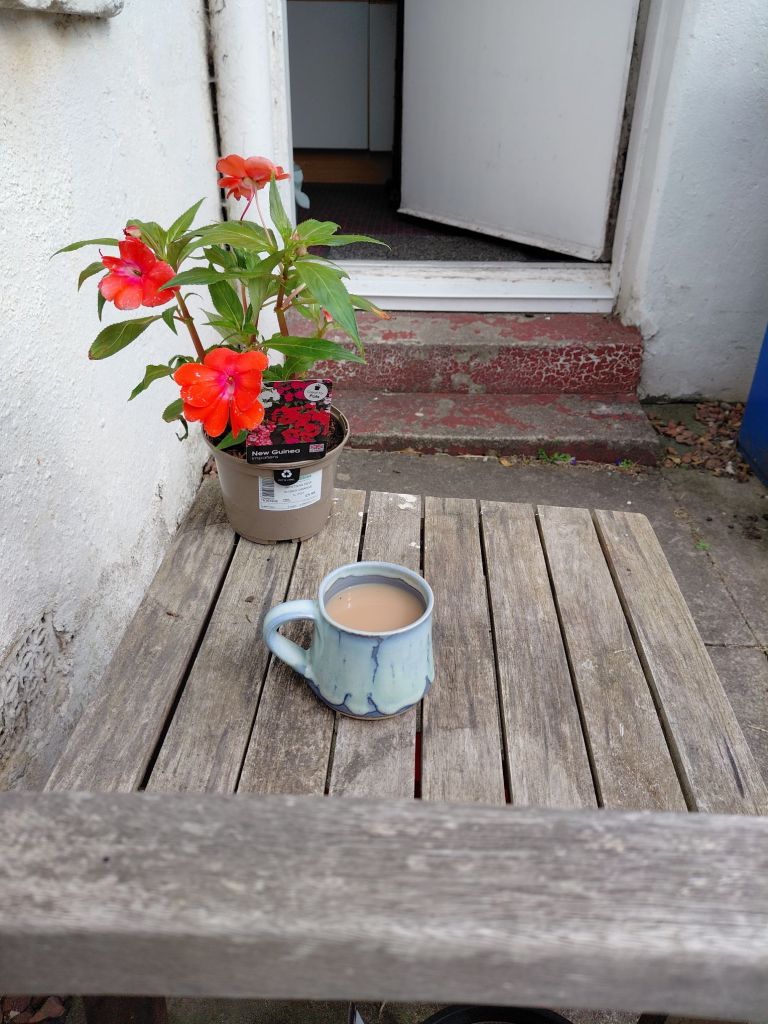
Having done my research at NLS, did I have coffee afterwards? Hell, yes! Fate even found me a research friend to have coffee with.
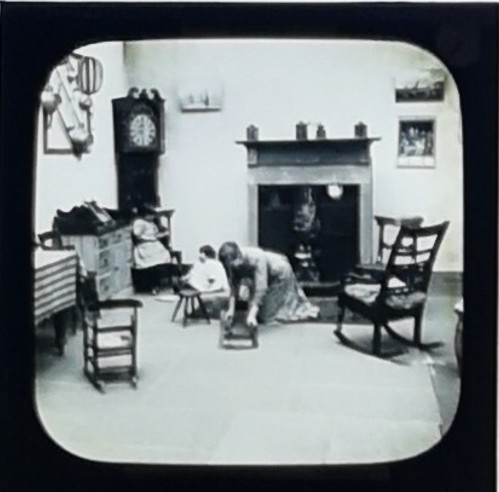
Biddy, the Maid of All Work is the title of a children’s book, dating from as early as 1871 in its original version. My own copy is an attractive bound compilation of three stories in a gift book from the turn of the century – it was given to its original owner as a Sunday School prize, and I bought it when I was researching Bayley & Ferguson’s ‘service of song’ books for magic lantern shows. As I have shared before, it’s a very moralistic Christian tale. (I’ll show you the opening paragraphs later on in this post.)
Women and Domestic Labour
But why have I gone back to services of song? As a matter of fact, that wasn’t why I thought of Biddy. Yesterday, I was thinking about women and domestic labour, and pondering over not only what had changed, but also what seems to have stayed the same. When I was working full-time, we employed a cleaner for two hours a week – we’d done so for three decades, and it certainly lessened the load. We don’t now – partly because the agency was struggling to find cleaners, and partly because I don’t feel it’s justified. But somehow, although we used to share the cleaning bill, I alone have ended up with everything connected with running the house, from mending to muffins, and dusting to drain-unblocking. (I’m told I don’t actually ‘do’ the washing, because the modern home has white goods that do everything for me. All I can say is that the washer-dryer hasn’t yet learned how to gather up the laundry, sort it, hang it, iron it and put everything away again.)
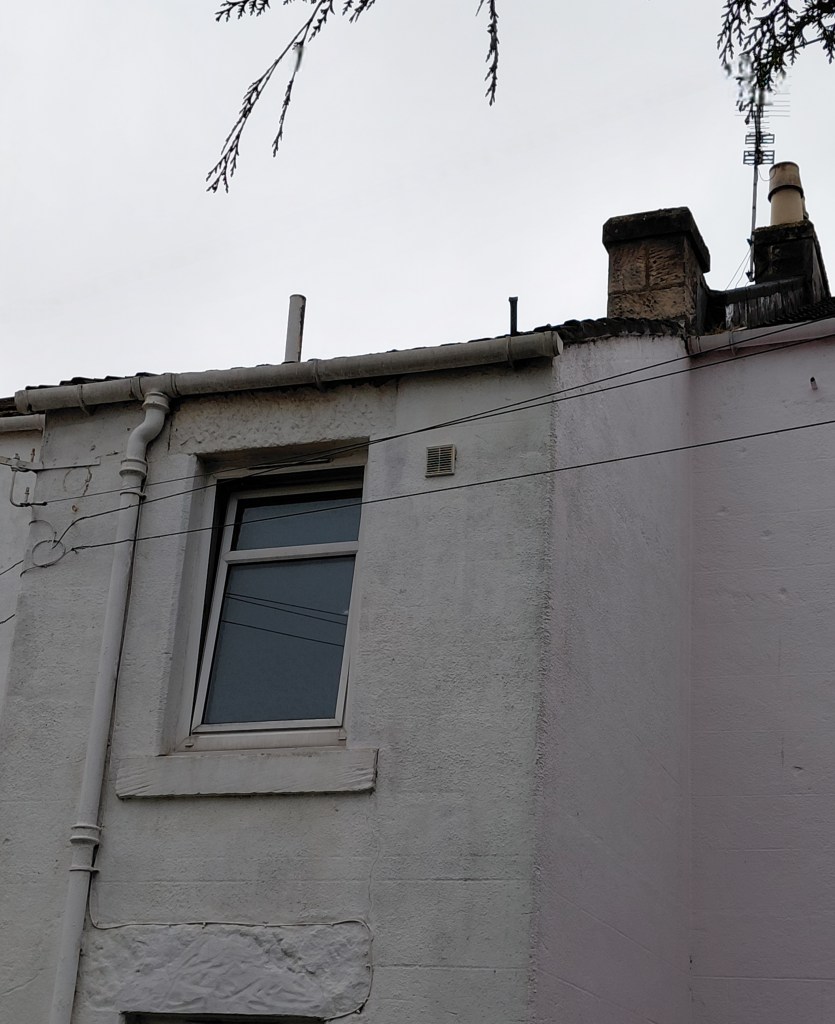
Little chimney with no pot: relic from the wash-boiler days
Our house is contemporary with the lives of ‘my’ musical Scotswomen. It was built in 1904. It was occupied by the proprietor (a shipbuilding clerk), his wife and three daughters. It still has a wee chimney leading from where the scullery boiler would have been, on the ground floor. It’s now our kitchen – but it would have been the wash-house: a place of really hard work. We still have a ‘pulley’ in what would have then have been the kitchen, and my office is what would have been the bed recess, under the stairs. Was there a servant sleeping in it? Well, there wasn’t, in the 1911 census. The range was where our dresser is. The kitchen sink? There’s now another bookcase. But the meal-preparation continues, in what was the wash-house. (A Cordon-Bleu cook would find it nightmarishly cramped!)
Anyway, I’m suitably grateful that there’s less ironing, with a much nicer iron than the first occupants would have had! I visualise scrubbed and starched cotton shirts and white frilled pinafores hanging from the pulley, where tee-shirts and jeans are now casually draped, and I do appreciate the advances in both textiles and technology!
The life of a servant like Biddy was certainly a hard one. The author asks us to have sympathy for her, not only for the hard work, but also for her feelings of being uncared-about. Now then, bear in mind that it’s a piece of fiction for children. It’s impossible to know how accurate the picture conveyed actually is. There must have been good and caring employers, and ‘Biddy’s’ employer isn’t portrayed as bad. But it was a different age. The history of domestic labour is not my area of research expertise!
Much more could be said about domestic labour, particularly about the present occupants’ expectations and recollections of childhood and early adulthood which, I can assure you, were quite a long time ago. A different era, made more complicated by the fact that there are also two sets of memories, since our childhoods weren’t simultaneous! And I’ve heard it said that as we age, our most vivid memories are of our early adulthood, when everything was new and exciting. This book (on eBay) is from the ‘sixties: my childhood, not early adulthood. But it is, sadly, from an era when the ‘young wife’ did everything domestically-related. I feel as though I’m dragged back through a time-warp into those dizzy days six decades ago.
The Time of Vivid Memories? (The Young Wife’s Cookery Book, ed. E. Maxwell-Arnot (1967)
Rose and Iden’s Live-in Servant
Anyway, my mind again turned to Rose Smith, the late Victorian/Edwardian church organist who didn’t let three children curtail her musical activities. How much help did she have around the house? So, let’s recap. Rose was born in 1870 in Lanark, and brought up by her widowed mother, mainly in Glasgow. They didn’t have a servant in the 1891 census – indeed, her mother had two lodgers as well as Rose and her older sister to look after.
Rose married in 1898. I knew that Iden and Rose Rigden’s first son was born in June 1899, so at the time of the 1901 census, there were Iden, a tax official; Rose, a teacher and church organist working from home on her ‘own account’ (ie, she was self-employed) and Iden junior, aged nearly two. Iden’s wee brother wouldn’t come along until August 1903. Although it was a small household, there was also a live-in servant, the 17-year old Bella Johnston[e], who was born in Port Logan in Wigtonshire around 1884.
I don’t know exactly how long Johnston stayed with the Rigdens. They had their second son in 1903 and a daughter in 1907, and had moved house by 1911 – where there was no live-in servant. Of course, we don’t know if Rose perhaps had a daily, non-resident maid to help her. We do tend to assume that domestic service became a less common occupation after the Great War, yet here we find the Rigdens without a resident maid, three years before the War. Selina Todd, author of an excellent article on domestic service in the first half of the century, would be unsurprised by this, however, as she demonstrates how, although practices changed, domestic service did continue. Just in a different form:-
The ‘disappearance’ of service — already heralded in the 1920s, when press coverage of ‘the servant problem’ was filled with nostalgic laments for the faithful Victorian maid — never happened. Change, of course, did occur — the live-in housemaid of the 1900s was replaced with the part-time cleaner of the 1950s […]
(Todd, see reference below)
Meanwhile, Bella Johnston herself was still a live-in domestic servant in 1911, working back in Wigtonshire in Kirkmaiden (where her grandmother had lived), for the Cook family in Weston House, Church Street. She married a Kirkmaiden fisherman in 1915.
By 1921, the Rigdons had moved up in the world – from a flat, to a house – but there was still no maid in the census.
It set me wondering. What about the other women musicians whom I’ve researched? In all honesty, I don’t think the Census data is enough on which to base any conclusions, simply because we don’t know about the domestic servants who didn’t live in – often called, ‘charladies’. The term sounds derogatory now, but may not have been considered so at the time. If anything can be deduced from a rainy Friday morning’s searching, it is that having a resident servant seems, in the early 20th century, to have depended on the level of affluence and/or evident need for help.
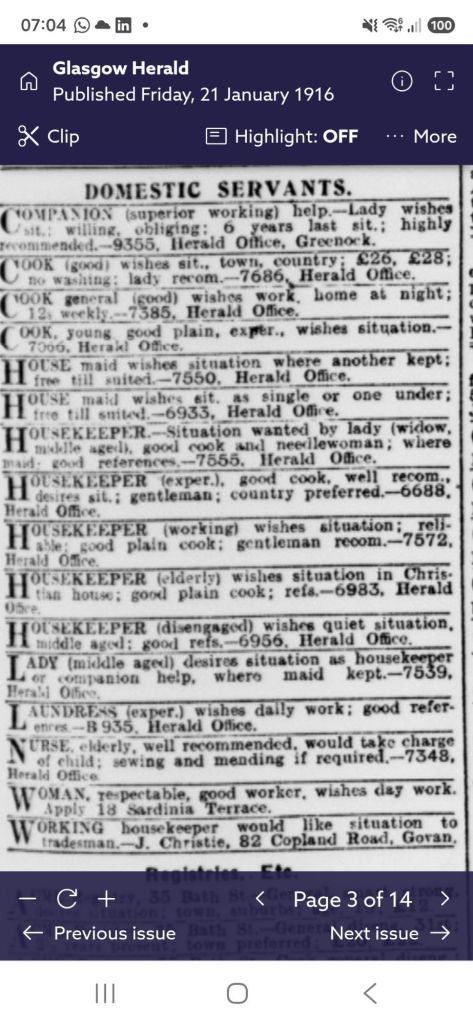
One thing is certain: the newspapers were full of adverts for Situations Vacant, and from job-seekers.
British Newspaper Archive
Clarinda Augusta Webster (1844-1920), was a music educationalist, and school proprietor in Aberdeen before she moved down to London. No census entry has been traced for 1901. In 1911 in Streatham, Webster employed 31-year old general servant Julia Fullick, who must have been either married or widowed at the time, because her name was the same in 1921, and she was then described as a widow, living with her sister and brother-in-law. Fullick’s occupation was now, ‘charwoman’. Webster had died in 1920; I don’t know if Fullick worked for Webster right up to when she died.
Mary Kerr (ca.1848-1908), was the wife of Glasgow music publisher James S. Kerr, and inheritor of the publishing firm. The couple had a servant whilst their family were young. Widowed and living in Saltcoats in 1901, Mary still had a ‘general servant domestic’, 21-year old Sarah Reid. By this time she had two adult children, two teenagers and a mother of 82 living with her, so I imagine Kerr and Reid would both have been kept busy! Kerr and her mother later moved back to Glasgow with at least one of the adult children – but I don’t know how much paid help they had latterly. (Mary’s mother actually outlived her by three months, living to the grand old age of 90.)
Euphemia Allan (1861-1948) was the sister of Glasgow music publisher Mozart Allan; she was a music teacher and also involved in the family firm. There’s no record of a resident servant either in Mozart Allan’s home in 1901 or 1911, or when Euphemia and her nephew (also Mozart Allan) lived there in 1921. I wonder whether Euphemia and her nephew had a charwoman – surely they must have done?!
Kate Logan (1862-1936) grew up in Inverness, where her parents had a servant and three lodgers by 1881, when Kate was the last of their offspring still at home, working as a music teacher. By 1901, her husband David was working as a music seller and employer, whilst Kate was certainly working as a pianist, although there’s no job designated against her name in the census. There was no live-in servant at that point, but after her husband’s family firm went bankrupt, Kate opened her Pianoforte and Music Saloon in 1904. Thus, by 1911 they were both designated as music sellers – and were employing 17-year old Daisy Shaw as their live-in servant. However, by 1921, the census listed no servant.
Flora Woodman (1896-1981) was a famous coloratura soprano, born in London to a mother with ‘private means’. Her mother grew up in Glasgow; in 1891 there had been two servants to look after a widow and three adult children. It comes as no surprise to learn that Flora’s own single mother had a servant, 18-year old Annie F. Butler, in the 1901 census; 22-year old Emily Owen in the 1911 census; and 34-year old Louie Hurst in 1921.
As a musicologist, I haven’t had to think about domestic service in the context of social history, but as a working mother myself, obviously I can draw on my own lived experience of running a household. I’m still left feeling distinctly impressed with Rose Smith Rigden, who performed the same juggling act of balancing a career with raising a family, when the physical work was unarguably harder. Meanwhile, I also take pleasure in the fact that I’ve memorialised the names of a number of female servants who have probably never before been mentioned in print!
NAME
BIOGRAPHY
Bella [Isabella] Johnstone [Johnston].
Born ca.1884, Wigtonshire. Worked for the Rigdens aged 17 in 1901. Aged 27, a live-in servant in Kirkmaiden in 1911. Married a fisherman in Kirkmaiden, Wigtonshire, in 1915.
Julia Mullins.
Born ca.1880. Aged 21, a servant in Bexley in 1901. Aged 31, now Julia Fullick working for Clarinda Webster, in 1911. A widowed charlady living with her sister and brother-in-law in 1921.
Sarah Reid.
Born ca.1880. Aged 21 in 1901, working for Mary Kerr.
Daisy [Margaret?] Shaw.
Born ca.1894. Aged 17 in 1911, working for the Logans.
Annie F. Butler.
Born ca.1883. Aged 18 in 1901, working for Jane [Janie] Sillars.
Emily Owen.
Born ca. 1889. Aged 22 in 1911, working for the Woodmans
Louie Hurst.
Born ca. 1887. Aged 34 in 1921, working for the Woodmans.
If you’re interested in the broader subject, Selina Todd’s article, is informative:- ‘Domestic Service and Class Relations in Britain 1900–1950’, in Past & Present, Volume 203, Issue 1, May 2009, Pages 181–204, https://doi.org/10.1093/pastj/gtp014.
Biddy, Tibby and French Bessie, by S. C. P. (Edinburgh and London: Oliphant, Anderson & Ferrier). I initially thought this was published in 1900, but I think it was mentioned in the press in 1897 – whether or not it was an identical edition. It also seems to have appeared as three individual titles in 1871. The anonymous S. C. P. also wrote other titles in the publisher’s ‘Sixpenny Books for Young People’ series.
Here’s a taster of Biddy:- the opening of Chapter 1.
Biddy worked hard, and got few thanks for it, – poor Biddy! She was maid-of-all work in a large family; and it was, “Biddy, do this,” and “Biddy, do that,” from the time she got up in the morning, till she tumbled into her hard bed at night. She had come to Glasgow from Ireland a warm-hearted, impulsive girl; but had been gradually going through a hardening process, till she was practically saying in her heart, “I care for nobody, for nobody cares for me.” Mrs Pettigrew, her present mistress, was just and faithful in all her dealings with her, and valued Biddy highly as an active, honest, efficient servant; but she was “only a servant” to her, and any other girl who worked as well could have supplied her place; and she never dreamt of the large fund of love lying unkindled at the bottom of that servant’s heart, which a little kindness and sympathy on her part would have touched like a spark amongst gunpowder, and brought forth blazing into loving action.
Mistresses lose much who have no sympathy with their servants. How many hearts are saddened and steeled for want of it, even as Biddy’s was!
I’ve had my Finale Songwriter music engraving software for a very long time, and it has served me well. Apart from occasional glitches, that is. However, it’s no longer sold, no longer supported – and is installed on a very old laptop. (I only keep it for Finale.) This week, I took it into my head to arrange a hymn for my church choir. All went well until …
RIP Finale Songwriter
The Finale Songwriter sound crashed. And with it, the scrolling playback. I tried to fix it. I tried a system restore, which takes hours and hours, but has always fixed it in the past. However, the system didn’t restore. (It’s a very old laptop.) With much persistence, I retrieved some kind of sound, but not the sampled sound. Hooray – I could playback my efforts with a tinny MIDI sound, and it scrolled obediently along. But it’s not how it should be. It was time to get new software for the new laptop. Before that, however, I thought I’d prune my Finale files, so that I’d have less to transfer across.
I file most of my Finale documents by year, and I’ve only reached 2020 in the pruning exercise. This will take a while! I’m deleting tunes that were either transient, functional versions of hymns, or really not worth saving for even family posterity.
Invisible Organist
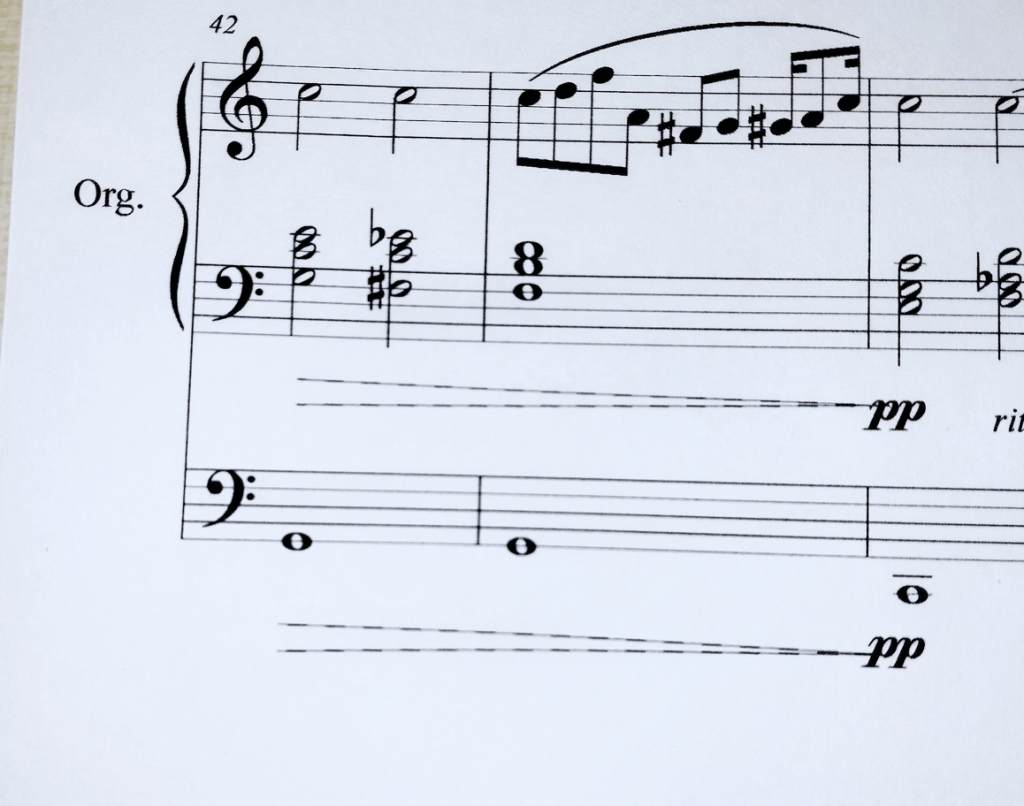
But I found a piece I’d written for organ, back in the Covid pandemic lockdown. Entitled, Invisible Organist’s Blues, I can no longer remember if I wrote it whilst literally locked down at home, or if it was written at some stage in the next strange months when we conducted services with no congregation, or no singing. I may have written the piece whilst I was not only invisible but also almost inaudible – with not much to play. It felt as though little notice was taken when I did play.
In other words, I was disgruntled. Invisible Organist’s Blues was born out of sadness and frustration. I think it was only played once. It is blues-y. It ends with ‘Nobody knows the trouble I’ve seen’, and that was chosen intentionally. I suspected I might have written something that really didn’t sound very agreeable, but I wanted to hear it again before I deleted it. Finding this piece brought back a lot of unpleasant emotions. In my last months there before I left in 2021, I felt my mental health suffering. I cried behind my glasses and face-mask each Sunday – no-one would have noticed the tears streaming. And I cried as I drove home, which was certainly not ideal. I felt marginalised, and for long enough, I told myself to ‘man up’ and accept that it was all in my head – I was imagining it.
Reality
Until, finally, I came to the conclusion that the sadness was real. Was I imagining my shrinking role? It was shrinking. Churches are absolutely entitled to change ways of doing things, and the organist just has to understand that. Was I imagining that the choir and organ were unmentioned throughout an online Zoom group meeting that I attended? They weren’t mentioned. If I was suffering, then that, too was real. Yes, times were changing – and it was time for me to accept it. I did accept it. A few months after my resignation, I was fortunate to find another organist position, where the welcome was as embracing as a warm hug. This was more how things were meant to be!
Neilston Parish Church, West of Scotland, my new church.
Fast forward back to this present week. My finger hovered over Invisible Organist’s Blues. Should I just delete it, and its uncomfortable memories? I played it back with my tinny, defective Finale Songwriter playback, prepared to be disgusted.
But I wasn’t! The tinny playback certainly didn’t enhance it. It lost any semblance of a deep pedal bass-line, but it felt as though there was something worth keeping. I tried it on the piano at home (and any organist will tell you that playing organ music on the piano is weird, because you have somehow to accommodate music that’s intended for two hands and two feet, without having an organ pedal-board) – and I was quite gratified by the results.
Today, I headed for church and tried it there. Tweaked a couple of chords, and – yes, two movements will be played tomorrow. The third does need a bit of practice. I need to decide whether the rhythms are not only too difficult, but unnecessarily so. (Nobody will hear the trouble I’ve seen, either!)
It would be nice to think that by resurrecting the piece and playing it sensitively, I can put the ghosts to rest, and make use of something that I put a lot of work into.
I’ve installed new music-engraving software. I haven’t even tried it out yet, but I did bite the bullet, decide which one to go for, and pay for it! Maybe at some point I’ll convert Invisible Organist’s Blues into music XML and transfer it across. Alternatively, I could just save it as a pdf and accept that that’s it, finished and unchangeable!
I’m not going to share it here yet – not whilst it’s still technically a work-in-progress! However, here’s a Scottish folk song that I played as my warm-up when I was practising this morning – Flow Gently, Sweet Afton – clattering tracker action and all!
I’ve had a series of phone-calls from the in-house talent team at IQVIA today. This is apparently because I am looking for clinical manager roles. I can see one tiny problem. No, more than one!
AM I?
I’m semi-retired, and geographically tied to where I am. I can’t relocate. And whether or not I would take on more work is hardly the question, because I haven’t activated LinkedIn’s looking-for-work function. Quite apart from the elephant in the room – that job title.
They were Persistent!
I ignored the first call. Told the second and third that I hadn’t asked them to contact me. Finally, I asked the fourth caller – Amelia – why she thought I was suited for a role as clinical manager, and she said it was because of my LinkedIn profile.
Have I ever intimated that I have medical qualifications? I have not. I told Amelia very firmly to remove me from their database because I am utterly unqualified for a clinical manager role. (I’m not even entirely sure what a clinical manager does!)
However, if I get any more calls, I can’t promise that I won’t enjoy myself stringing them along and wasting a bit of their time. I’ll share my age and qualifications. I’ll tell them about my specialisms, and bring them up to date with my latest research. It’ll be most amusing – well, to me, at any rate.
After all, my insights into the history of Scottish music publishing might be exactly what is needed to cure someone’s duodenal ulcer …
WordPress has a habit of reminding me what I posted ‘on this day’ in previous years. Today’s reminder has been quite interesting!
2019
… seems a long time ago! I was in Killin, speaking at the Clan Gregor Weekend. Sir John Macgregor Murray was an interesting historical figure whom I’d encountered in passing during my doctoral research. A decade later, I’d been invited to give a research paper about him at the Sorbonne, and it turned out that Clan Gregor was also interested in my research, so I gave an after-dinner talk there, too.
The paper eventually became a peer-reviewed article in vol.13 no.1 (2026), pp.50-63 of the Folk Music Journal, ‘Sir John Macgregor Murray: Preserver of Highland Culture, Music and Song’.
2022
I gave a lightening paper at a HoPIN webinar. HoPIN is the History of the Printed Image Network, so my paper was probably rather unfamiliar territory for researchers more familiar with images than old sheet music.
2023
A Social History of Amateur Music-Making and Scottish National Identity: Scotland’s Printed Music, 1880-1951
I was revising my second monograph prior to submitting it to the publisher. And looking forward to taking up my Ketelbey Fellowship in the History Department at the University of St Andrews. (By the end of the fellowship, I’d be working on revisions to the book!)
2024
I had not long retired from librarianship, but now I identified as semi-retired. So for the research fellow part of me, it was full-steam-ahead on indexing the second monograph, and my ‘vacation’ was somewhat busy. I was also contemplating an emergency visit down to Norfolk – I can’t remember if I actually went that time, because there were several such crises, some resolving sooner than others.
2025
Again, my vacation was far from relaxing. I was back from a trip to Norfolk, and in Glasgow we were having a new bathroom fitted. Meanwhile, we knew that a family bereavement was very imminent. I got the sad news on the final day of the bathroom re-fit, with a houseful of plumbers and electricians around. The news and our domestic circumstances will always be combined in my memory!
2026
Down-time
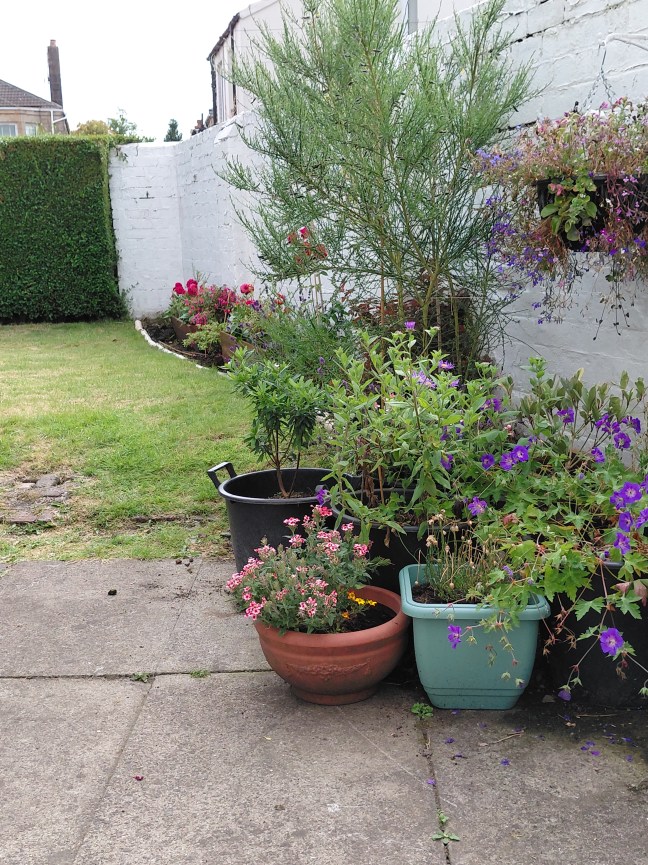
It’s more like a vacation this year, I guess. It’s warm and sunny. The garden’s looking moderately tidy, and I’m not rushing to meet a deadline. If I feel unsettled and vaguely guilty for my laziness … well, maybe I’m just out of practice!
Anyway, I know I’ll be busy enough when my holidays come to an end.
The morning started well. I was so early arriving at the dentist that the receptionist made me a coffee, and I was back off the bus in Govan, five minutes after my Partick appointment should have started. (Don’t worry – no hammer or pliers were needed there. I just had a filling replaced. The nougat my son bought me had a lot to answer for!)
With more morning left than I anticipated, I turned to look at the proofs of my article about the Song Gems (Scots). Tweaking the abstract (still no hammer or pliers in sight), I decided I ought to look at the cover again, before using the word ‘beneath’. But there was a problem …
No Song Gems (Scots), my much-loved pride and joy.
I blamed my boxing-up and un-boxings occasioned by the rewire and redecorating projects, but only I could be blamed – no-one else was permitted near my precious research materials. Whilst I was still in a state of panic, I moved the duet piano stool to get better access to the bookshelf.
The bottom fell out of my world. Or, more correctly, out of the duet piano stool. Did I say I had time in hand? The hammer and pliers are easily accessible, but the tool-box containing nails is far less so.
The regular piano music is now back IN the piano stool; the tool-box is back under the stairs; and the prodigal Song Gems (Scots) has been found hiding in a pile of equally big, heavy books that are too tall for the allocated bookshelf. Proofs have been read, a bio written and the abstract perfected.
I could not use the word, ‘beneath’. Good thing I checked!
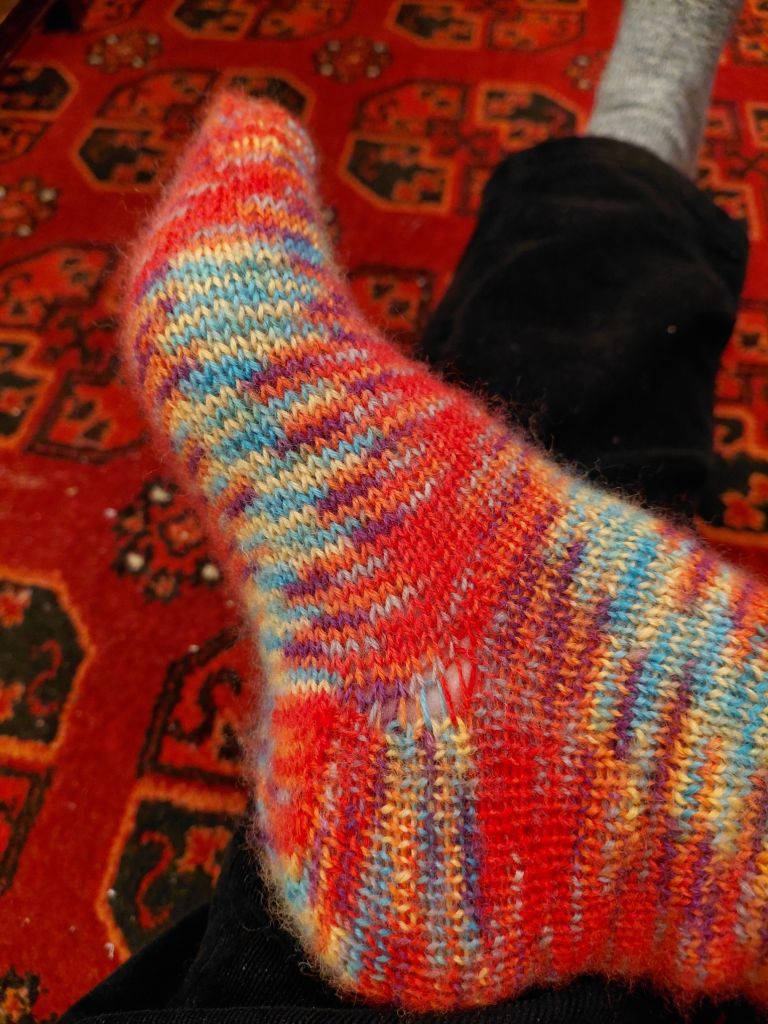
There’s no such thing as a typical semi-retired researcher! But my mail this week pretty much sums up my current preoccupations: a tripod for the Zoom 5 Handy Recorder (research) and assorted double-ended knitting needles (semi-retirement sock project)! I now have all the tech I need, both for my oral history interviews, and for learning how to knit socks.
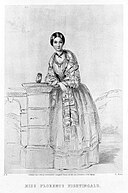
Researchwise, I’ve designated this week, The Last Week of Procrastination. I need to get started on my interviews – no more ‘I must just …’ prevarication. Florence Nightingale’s ‘invalid’ of last week is not technically an invalid this week; I do know how my various technical options work – why, I even have a wee tripod to help me look the part! – all that remains is to start scheduling. (This is proving easier said than done, but I’m working on it …)
Who’d have thought a tripod was such dangerous tech?!
Retirement-wise, though, I’m not quite sure where the sock-knitting fixation came from. My feet feel the cold, true. And I need something else to do other than embroidery, at times when I find myself ‘relaxing’ in front of the TV. (Let’s just park those inverted commas for now.)
Sheer Bloody-Minded Determination
But I’ve been driving myself crazy with this knitting malarky! If only I had an amenable granny sitting beside me telling me what to do next. As it is, I’ve downloaded instructions off the internet, bought a couple of books, and sworn quite a bit … I absolutely hate being beaten by a circular needle and a variable quantity of double-ended needles. (Manipulating these is worse than trying to hold bagpipes.*) I can’t admit defeat to a 4-ply woollen sock, for heaven’s sake. I’m meant to be intelligent. As my late mother said about cookery, surely anyone who can read instructions can do this thing?
If nothing else, it’s proof that I don’t give up easily. In the grand scheme of things, I made a second attempt at a PhD. On this micro level, I will work out how to knit socks.
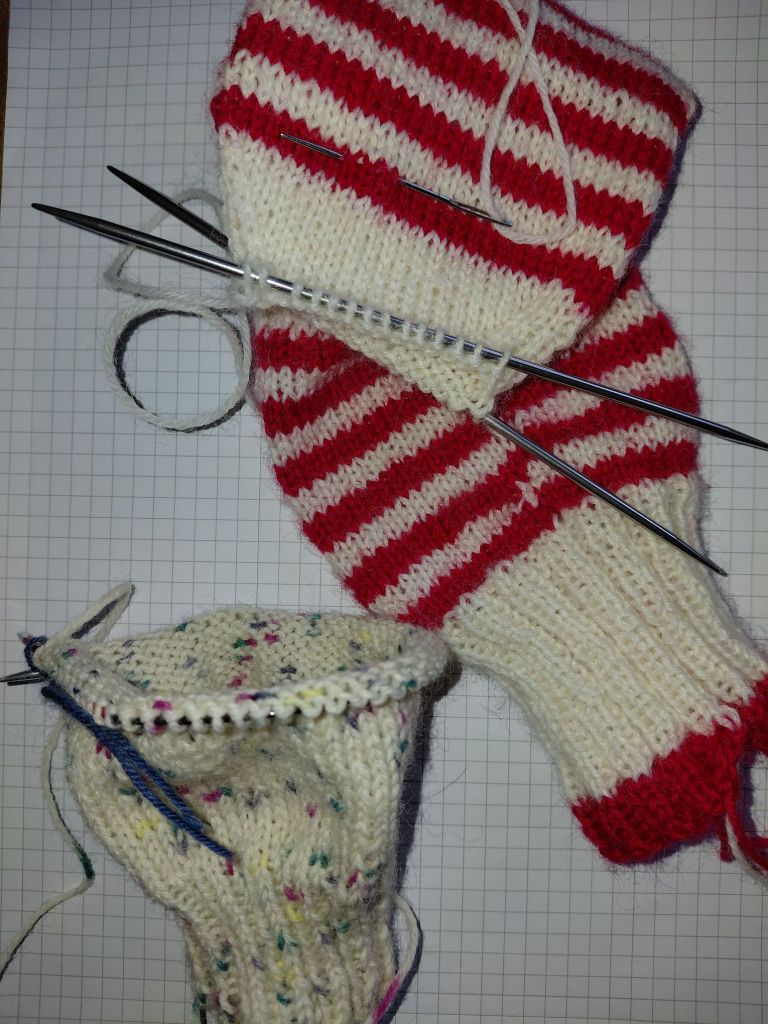
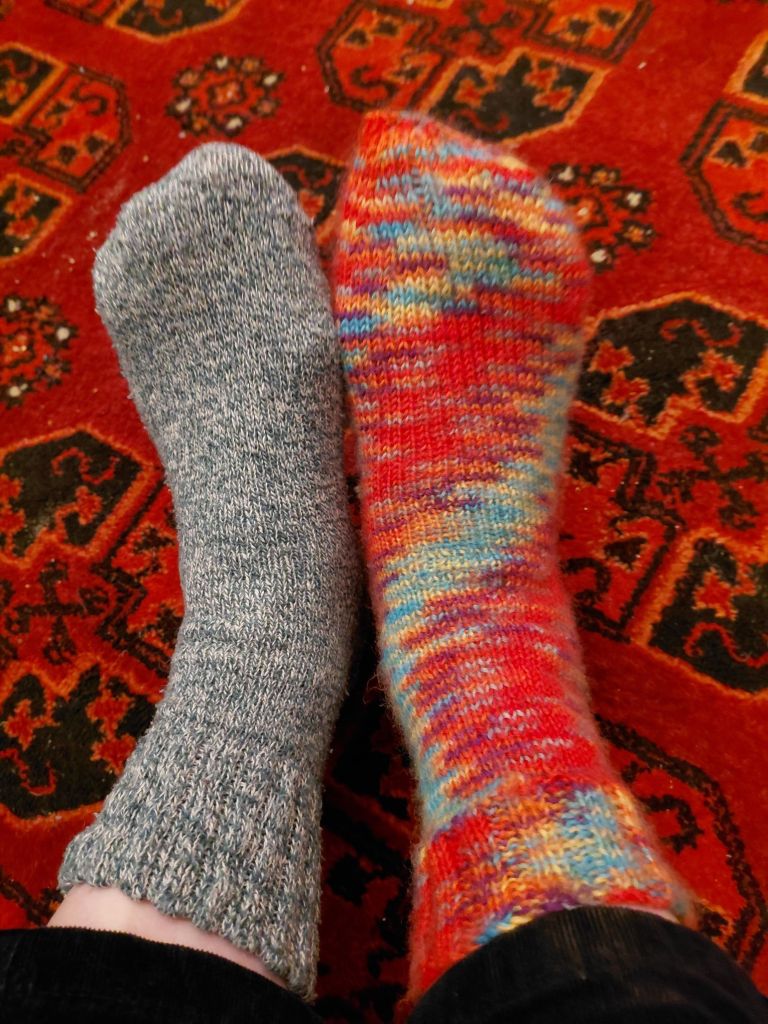
I finally (at the fourth attempt) turned a heel, and arrived at something resembling a sock. If it’s on my foot, it’s a sock, right? Even if Kitchener Stitch is a form of torture, and the sock foot is really only just long enough.
The other one of the pair will be better. And quicker. I’m getting there. The BBC recently showcased research proving knitting to be good for one’s mental health. Relaxing. Well …
Okay, it’s a ‘neat’ fit!
*Postscript. I did give up on the bagpipes. Learning whilst completing the second PhD was really not a good idea!
Last year, there were spanners a-plenty. Family and domestic life presented sadness and major challenges respectively. Nonetheless, last year was amazing. My IASH Fellowship was more than a highlight – it was a great big blazing beacon, giving me focus and purpose.
This year, we’ve had the rogue trader, in the guise of the unreliable painter and decorator. Then a succession of good guys (plasterers, windowsill-fixers, tilers …). The round of home improvements is nearly finished now. (Let’s just get the kitchen lino replaced, then we can settle down to await the stone-masons.)
However, more challenges still remain in other quarters. There are so many spanners in the works, that it’s a blessing my work’s only a small part of my week.
I didn’t even want to knit or sew, this morning. Until I finally decided that even if sewing didn’t raise my spirits, I would at least have a new jacket, if I just got on with it. And in between the 8000 steps occasioned by unexpectedly role-playing Florence Nightingale, I did achieve my mission. Well, very nearly.
Here’s hoping I’ll be wearing it when I go into work on Thursday! However, I’m still hoping I get to go to town at all. I’ve never been what you’d call a Florence Nightingale. And I know I’m a disappointment (this comes across loud and clear!) when it comes to stroking brows and smoothing sheets. I can handle disinfectant and laundry, but I’d never have made a nurse! Thursday is still something of an unknown quantity. Whether I’ll be Florence Nightingale or a research fellow is equally unknown.
Anyway, let’s see what the rest of the week brings. I’m itching to get on with the research project, circumstances permitting.
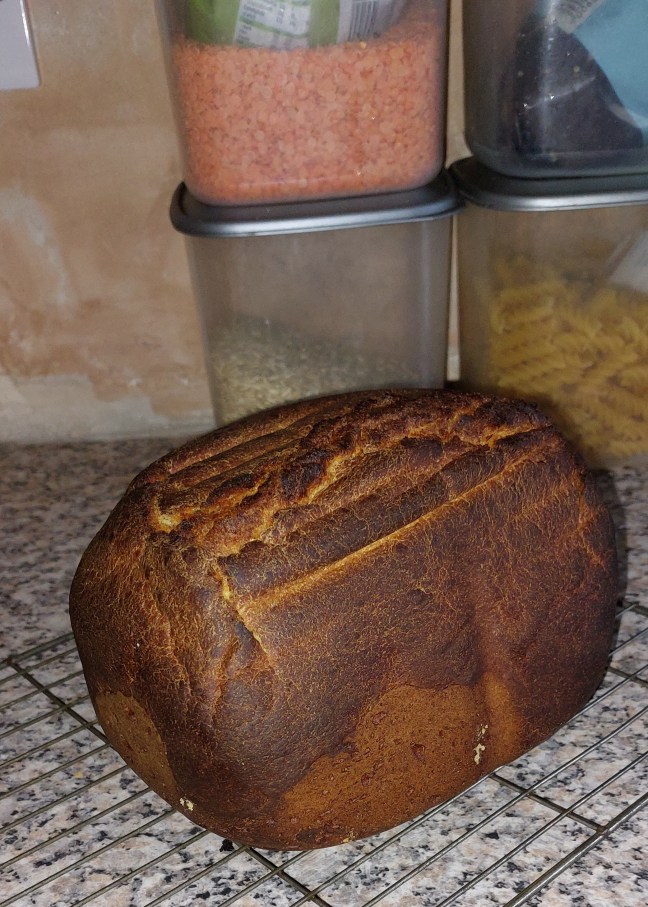
I thought I’d make bread for lunch. (It’s a semi-retirement day.) The idea occurred to me too late, so I decided to try the bread-machine’s fast-bake setting. I measured my ingredients carefully, but evidently not carefully enough. It came out underdone: solid, squishy, and pale. Pasty – as in complexion, not the Cornish kind.
I could fix this. Into the oven it went, and then I sat down to reply to Checkatrade. My dealings with them have been wholly positive. (More than can be said about one of their traders, but let’s not go there.) I composed one of my best replies, because I do appreciate the care they’ve taken with my complaint.
My nose alerted me to a problem. I had forgotten about the underdone loaf. ‘Well-fired’ is a thing in Scottish bread products, admittedly. But I’m no’ Scottish, and I can tell a burnt loaf when I smell it.
Ah, well. I sent my email, and the dead bread proved surprisingly edible. I won’t be using ‘fast-bake’ again. (Neither will I bake it myself from scratch – I’ll just use the regular setting!)
I’m not writing about scholarship today. Indeed, this is more a case of, ‘Don’t do as I do …’
Buy old house
After 30 years, learn that rewiring is needed
Box most household goods (this is mainly my remit) to facilitate rewiring
Pull a muscle in your back (ouch!)
Vacate premises
Return to scenes like this:-
Upheaval is Anathema
Now, having very elderly and neuro-divergent family members will make any upheaval twice as traumatic. It was. Keep this in mind.
Despite the need for redecorating next, I was told that We could not live like that, so the majority of the boxes had to be unboxed (again, my remit) before Christmas. A painter was engaged to start after Christmas.
But first, I had to coordinate Christmas and pack it away again, singlehandedly. The pulled muscle complained.
And boxing up began again. (Again mainly, painfully, my remit).
But this time, more of my books had to be boxed. Even for a former librarian, heaving big boxes of books about is strenuous work.
There were delays. And timekeeping issues. The estimated 4-5 days (this is disputed; apparently they estimated 5-6) extended to 18 immensely stressful days. Testosterone Towers took it out on me. I’m mentally exhausted, and now the house has to be unboxed and tidied again.
OK, so now is a good time to go for a shingles vaccination. Only a mild reaction, but temporarily adding physical aches and tiredness to the mental draining.
Between 4 and 10 pm yesterday, I emptied 12 boxes and cooked dinner. Testosterone Towers can’t wait for order to be restored out of chaos. It will happen.
In Fairness
Three rooms completely redecorated
Two rooms, hall and landings repaired
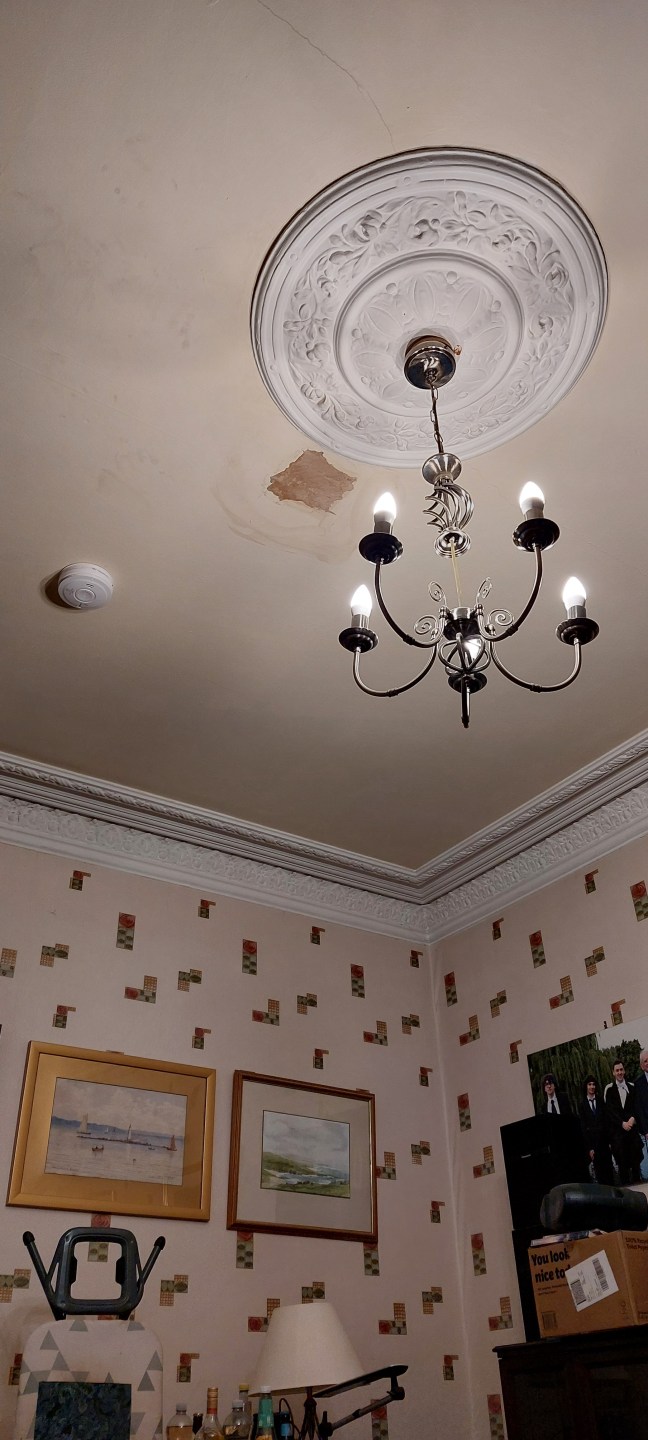
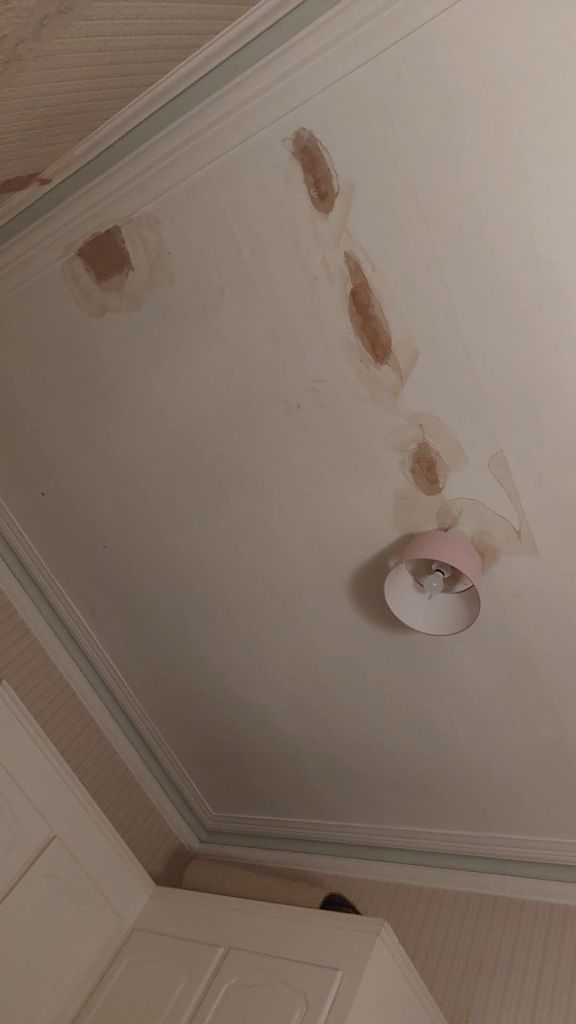
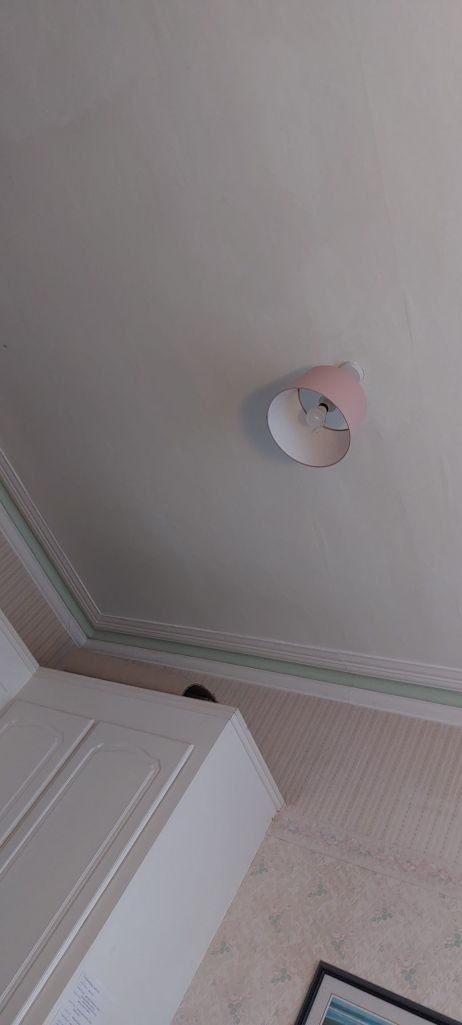
Although we had expected a couple of ceilings to be fully repainted, which weren’t, I have to say that the painter’s partial solution was masterful. The highlight of my morning today? Waking to this:-
Never was I happier to look up at a white ceiling. (Even if other parts of it are less pristine!)
I cannot think about research just yet. I don’t need to, today or most of tomorrow. My mind is still frazzled, and there’s major tidying to do. But hopefully a nicer environment will make for a calmer mind.
(Now, where’s the hot water bottle for my back?)
Writing a Review
We academics are good at writing reviews. I wrote a fair, but honest review of the work done. The ongoing outcome was a bit of a nightmare. Shall we just say, it was not well-received. (Some things are best left off social media.)
Suffice to say that I can recognise extortion. I spoke to Trading Standards and Checkatrade. I noticed last night that the trader is no longer affiliated to Checkatrade.