Biddy, the Maid of All Work
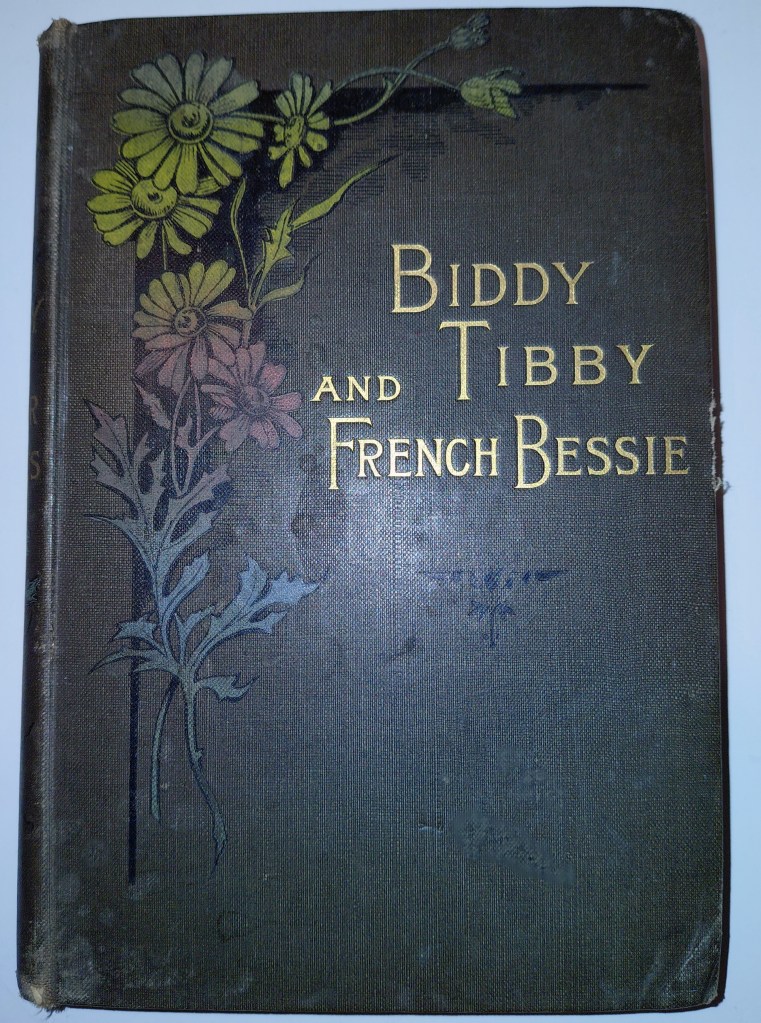
Biddy, the Maid of All Work is the title of a children’s book, dating from as early as 1871 in its original version. My own copy is an attractive bound compilation of three stories in a gift book from the turn of the century – it was given to its original owner as a Sunday School prize, and I bought it when I was researching Bayley & Ferguson’s ‘service of song’ books for magic lantern shows. As I have shared before, it’s a very moralistic Christian tale. (I’ll show you the opening paragraphs later on in this post.)
Women and Domestic Labour
But why have I gone back to services of song? As a matter of fact, that wasn’t why I thought of Biddy. Yesterday, I was thinking about women and domestic labour, and pondering over not only what had changed, but also what seems to have stayed the same. When I was working full-time, we employed a cleaner for two hours a week – we’d done so for three decades, and it certainly lessened the load. We don’t now – partly because the agency was struggling to find cleaners, and partly because I don’t feel it’s justified. But somehow, although we used to share the cleaning bill, I alone have ended up with everything connected with running the house, from mending to muffins, and dusting to drain-unblocking. (I’m told I don’t actually ‘do’ the washing, because the modern home has white goods that do everything for me. All I can say is that the washer-dryer hasn’t yet learned how to gather up the laundry, sort it, hang it, iron it and put everything away again.)

Our house is contemporary with the lives of ‘my’ musical Scotswomen. It was built in 1904. It was occupied by the proprietor (a shipbuilding clerk), his wife and three daughters. It still has a wee chimney leading from where the scullery boiler would have been, on the ground floor. It’s now our kitchen – but it would have been the wash-house: a place of really hard work. We still have a ‘pulley’ in what would have then have been the kitchen, and my office is what would have been the bed recess, under the stairs. Was there a servant sleeping in it? Well, there wasn’t, in the 1911 census. The range was where our dresser is. The kitchen sink? There’s now another bookcase. But the meal-preparation continues, in what was the wash-house. (A Cordon-Bleu cook would find it nightmarishly cramped!)
Anyway, I’m suitably grateful that there’s less ironing, with a much nicer iron than the first occupants would have had! I visualise scrubbed and starched cotton shirts and white frilled pinafores hanging from the pulley, where tee-shirts and jeans are now casually draped, and I do appreciate the advances in both textiles and technology!
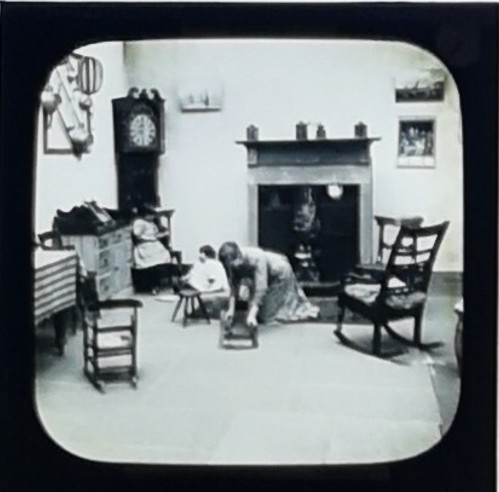
The life of a servant like Biddy was certainly a hard one. The author asks us to have sympathy for her, not only for the hard work, but also for her feelings of being uncared-about. Now then, bear in mind that it’s a piece of fiction for children. It’s impossible to know how accurate the picture conveyed actually is. There must have been good and caring employers, and ‘Biddy’s’ employer isn’t portrayed as bad. But it was a different age. The history of domestic labour is not my area of research expertise!
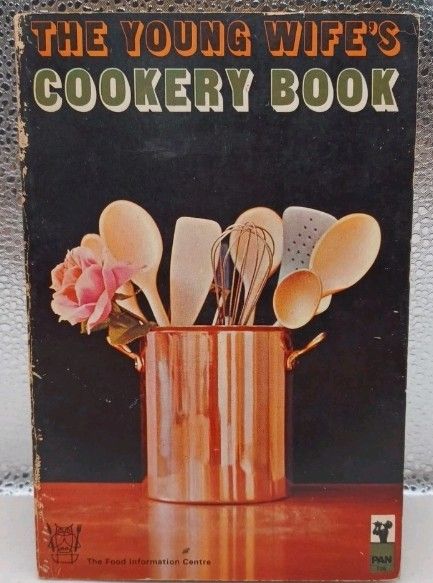
Much more could be said about domestic labour, particularly about the present occupants’ expectations and recollections of childhood and early adulthood which, I can assure you, were quite a long time ago. A different era, made more complicated by the fact that there are also two sets of memories, since our childhoods weren’t simultaneous! And I’ve heard it said that as we age, our most vivid memories are of our early adulthood, when everything was new and exciting. This book (on eBay) is from the ‘sixties: my childhood, not early adulthood. But it is, sadly, from an era when the ‘young wife’ did everything domestically-related. I feel as though I’m dragged back through a time-warp into those dizzy days six decades ago.
Rose and Iden’s Live-in Servant
Anyway, my mind again turned to Rose Smith, the late Victorian/Edwardian church organist who didn’t let three children curtail her musical activities. How much help did she have around the house? So, let’s recap. Rose was born in 1870 in Lanark, and brought up by her widowed mother, mainly in Glasgow. They didn’t have a servant in the 1891 census – indeed, her mother had two lodgers as well as Rose and her older sister to look after.
Rose married in 1898. I knew that Iden and Rose Rigden’s first son was born in June 1899, so at the time of the 1901 census, there were Iden, a tax official; Rose, a teacher and church organist working from home on her ‘own account’ (ie, she was self-employed) and Iden junior, aged nearly two. Iden’s wee brother wouldn’t come along until August 1903. Although it was a small household, there was also a live-in servant, the 17-year old Bella Johnston[e], who was born in Port Logan in Wigtonshire around 1884.
I don’t know exactly how long Johnston stayed with the Rigdens. They had their second son in 1903 and a daughter in 1907, and had moved house by 1911 – where there was no live-in servant. Of course, we don’t know if Rose perhaps had a daily, non-resident maid to help her. We do tend to assume that domestic service became a less common occupation after the Great War, yet here we find the Rigdens without a resident maid, three years before the War. Selina Todd, author of an excellent article on domestic service in the first half of the century, would be unsurprised by this, however, as she demonstrates how, although practices changed, domestic service did continue. Just in a different form:-
The ‘disappearance’ of service — already heralded in the 1920s, when press coverage of ‘the servant problem’ was filled with nostalgic laments for the faithful Victorian maid — never happened. Change, of course, did occur — the live-in housemaid of the 1900s was replaced with the part-time cleaner of the 1950s […]
(Todd, see reference below)
Meanwhile, Bella Johnston herself was still a live-in domestic servant in 1911, working back in Wigtonshire in Kirkmaiden (where her grandmother had lived), for the Cook family in Weston House, Church Street. She married a Kirkmaiden fisherman in 1915.
By 1921, the Rigdons had moved up in the world – from a flat, to a house – but there was still no maid in the census.
It set me wondering. What about the other women musicians whom I’ve researched? In all honesty, I don’t think the Census data is enough on which to base any conclusions, simply because we don’t know about the domestic servants who didn’t live in – often called, ‘charladies’. The term sounds derogatory now, but may not have been considered so at the time. If anything can be deduced from a rainy Friday morning’s searching, it is that having a resident servant seems, in the early 20th century, to have depended on the level of affluence and/or evident need for help.
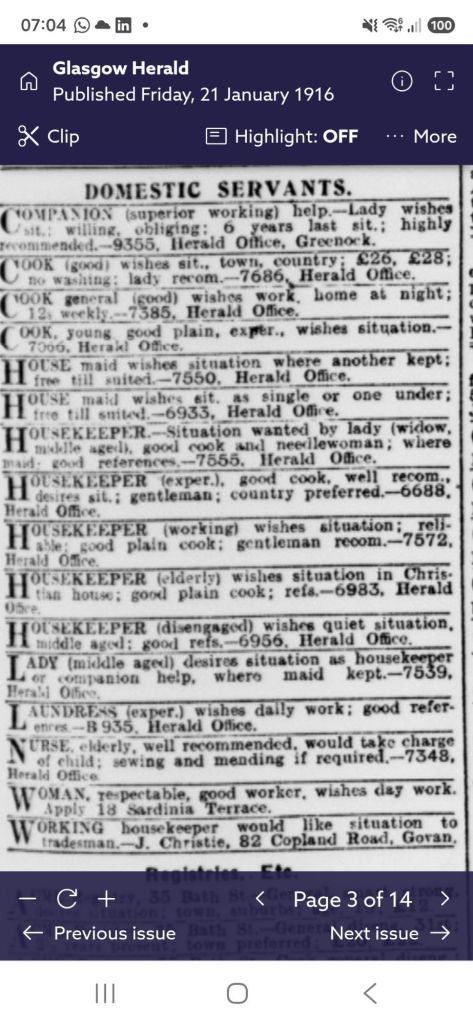
One thing is certain: the newspapers were full of adverts for Situations Vacant, and from job-seekers.
Clarinda Augusta Webster (1844-1920), was a music educationalist, and school proprietor in Aberdeen before she moved down to London. No census entry has been traced for 1901. In 1911 in Streatham, Webster employed 31-year old general servant Julia Fullick, who must have been either married or widowed at the time, because her name was the same in 1921, and she was then described as a widow, living with her sister and brother-in-law. Fullick’s occupation was now, ‘charwoman’. Webster had died in 1920; I don’t know if Fullick worked for Webster right up to when she died.
Mary Kerr (ca.1848-1908), was the wife of Glasgow music publisher James S. Kerr, and inheritor of the publishing firm. The couple had a servant whilst their family were young. Widowed and living in Saltcoats in 1901, Mary still had a ‘general servant domestic’, 21-year old Sarah Reid. By this time she had two adult children, two teenagers and a mother of 82 living with her, so I imagine Kerr and Reid would both have been kept busy! Kerr and her mother later moved back to Glasgow with at least one of the adult children – but I don’t know how much paid help they had latterly. (Mary’s mother actually outlived her by three months, living to the grand old age of 90.)
Euphemia Allan (1861-1948) was the sister of Glasgow music publisher Mozart Allan; she was a music teacher and also involved in the family firm. There’s no record of a resident servant either in Mozart Allan’s home in 1901 or 1911, or when Euphemia and her nephew (also Mozart Allan) lived there in 1921. I wonder whether Euphemia and her nephew had a charwoman – surely they must have done?!
Kate Logan (1862-1936) grew up in Inverness, where her parents had a servant and three lodgers by 1881, when Kate was the last of their offspring still at home, working as a music teacher. By 1901, her husband David was working as a music seller and employer, whilst Kate was certainly working as a pianist, although there’s no job designated against her name in the census. There was no live-in servant at that point, but after her husband’s family firm went bankrupt, Kate opened her Pianoforte and Music Saloon in 1904. Thus, by 1911 they were both designated as music sellers – and were employing 17-year old Daisy Shaw as their live-in servant. However, by 1921, the census listed no servant.
Flora Woodman (1896-1981) was a famous coloratura soprano, born in London to a mother with ‘private means’. Her mother grew up in Glasgow; in 1891 there had been two servants to look after a widow and three adult children. It comes as no surprise to learn that Flora’s own single mother had a servant, 18-year old Annie F. Butler, in the 1901 census; 22-year old Emily Owen in the 1911 census; and 34-year old Louie Hurst in 1921.
As a musicologist, I haven’t had to think about domestic service in the context of social history, but as a working mother myself, obviously I can draw on my own lived experience of running a household. I’m still left feeling distinctly impressed with Rose Smith Rigden, who performed the same juggling act of balancing a career with raising a family, when the physical work was unarguably harder. Meanwhile, I also take pleasure in the fact that I’ve memorialised the names of a number of female servants who have probably never before been mentioned in print!
| NAME | BIOGRAPHY |
| Bella [Isabella] Johnstone [Johnston]. | Born ca.1884, Wigtonshire. Worked for the Rigdens aged 17 in 1901. Aged 27, a live-in servant in Kirkmaiden in 1911. Married a fisherman in Kirkmaiden, Wigtonshire, in 1915. |
| Julia Mullins. | Born ca.1880. Aged 21, a servant in Bexley in 1901. Aged 31, now Julia Fullick working for Clarinda Webster, in 1911. A widowed charlady living with her sister and brother-in-law in 1921. |
| Sarah Reid. | Born ca.1880. Aged 21 in 1901, working for Mary Kerr. |
| Daisy [Margaret?] Shaw. | Born ca.1894. Aged 17 in 1911, working for the Logans. |
| Annie F. Butler. | Born ca.1883. Aged 18 in 1901, working for Jane [Janie] Sillars. |
| Emily Owen. | Born ca. 1889. Aged 22 in 1911, working for the Woodmans |
| Louie Hurst. | Born ca. 1887. Aged 34 in 1921, working for the Woodmans. |
If you’re interested in the broader subject, Selina Todd’s article, is informative:- ‘Domestic Service and Class Relations in Britain 1900–1950’, in Past & Present, Volume 203, Issue 1, May 2009, Pages 181–204, https://doi.org/10.1093/pastj/gtp014.
You can read more about my Scottish ladies in my recent RMA Research Chronicle article, or various other articles all listed on my publications page. https://karenmcaulaymusicologist.blog/my-publications/
Biddy, Tibby and French Bessie, by S. C. P. (Edinburgh and London: Oliphant, Anderson & Ferrier). I initially thought this was published in 1900, but I think it was mentioned in the press in 1897 – whether or not it was an identical edition. It also seems to have appeared as three individual titles in 1871. The anonymous S. C. P. also wrote other titles in the publisher’s ‘Sixpenny Books for Young People’ series.
Here’s a taster of Biddy:- the opening of Chapter 1.
Biddy worked hard, and got few thanks for it, – poor Biddy! She was maid-of-all work in a large family; and it was, “Biddy, do this,” and “Biddy, do that,” from the time she got up in the morning, till she tumbled into her hard bed at night. She had come to Glasgow from Ireland a warm-hearted, impulsive girl; but had been gradually going through a hardening process, till she was practically saying in her heart, “I care for nobody, for nobody cares for me.” Mrs Pettigrew, her present mistress, was just and faithful in all her dealings with her, and valued Biddy highly as an active, honest, efficient servant; but she was “only a servant” to her, and any other girl who worked as well could have supplied her place; and she never dreamt of the large fund of love lying unkindled at the bottom of that servant’s heart, which a little kindness and sympathy on her part would have touched like a spark amongst gunpowder, and brought forth blazing into loving action.
Mistresses lose much who have no sympathy with their servants. How many hearts are saddened and steeled for want of it, even as Biddy’s was!