The Maid of All Work: Then and (Ahem!) Now

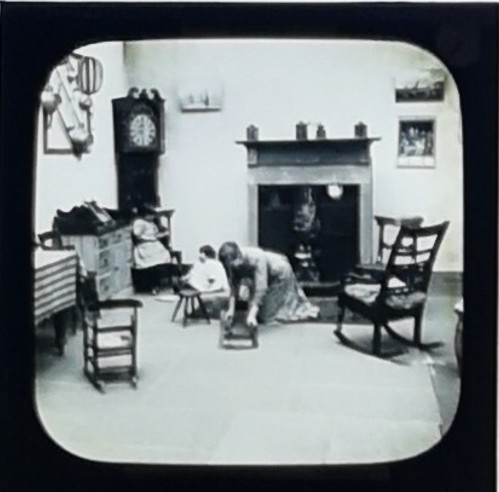
First slide of Biddy, showing servant girl scrubbing the floor.

Biddy, the Maid of All Work

Biddy, the Maid of All Work is the title of a childrenโ€™s book, dating from as early as 1871 in its original version.  My own copy is an attractive bound compilation of three stories in a gift book from the turn of the century โ€“ it was given to its original owner as a Sunday School prize, and I bought it when I was researching Bayley & Fergusonโ€™s โ€˜service of songโ€™ books for magic lantern shows.  As I have shared before, itโ€™s a very moralistic Christian tale.  (Iโ€™ll show you the opening paragraphs later on in this post.)

Women and Domestic Labour

But why have I gone back to services of song? As a matter of fact, that wasnโ€™t why I thought of Biddy. Yesterday, I was thinking about women and domestic labour, and pondering over not only what had changed, but also what seems to have stayed the same. When I was working full-time, we employed a cleaner for two hours a week โ€“ weโ€™d done so for three decades, and it certainly lessened the load. We donโ€™t now โ€“ partly because the agency was struggling to find cleaners, and partly because I donโ€™t feel itโ€™s justified. But somehow, although we used to share the cleaning bill, I alone have ended up with everything connected with running the house, from mending to muffins, and dusting to drain-unblocking. (Iโ€™m told I donโ€™t actually โ€˜doโ€™ the washing, because the modern home has white goods that do everything for me. All I can say is that the washer-dryer hasnโ€™t yet learned how to gather up the laundry, sort it, hang it, iron it and put everything away again.)

Little chimney with no pot: relic from the wash-boiler days

Our house is contemporary with the lives of ‘my’ musical Scotswomen.ย  It was built in 1904.ย  It still has a wee chimney leading from where the scullery boiler would have been, on the ground floor.ย  Itโ€™s now our kitchen โ€“ but it would have been the wash-house: a place of really hard work.ย  We still have a โ€˜pulleyโ€™ in what would have then have been the kitchen, and my office is what would have been the bed recess, under the stairs.ย  Was there a servant sleeping in it? I donโ€™t know.ย  The range was where our dresser is. The kitchen sink? There’s now another bookcase. But the meal-preparation continues, in what was the wash-house. (A Cordon-Bleu cook would find it nightmarishly cramped!)

Anyway, Iโ€™m suitably grateful that thereโ€™s less ironing, with a much nicer iron than the first occupants would have had! I visualise scrubbed and starched cotton shirts and white frilled pinafores hanging from the pulley, where tee-shirts and jeans are now casually draped, and I do appreciate the advances in both textiles and technology!

The life of a servant like Biddy was certainly a hard one.  The author asks us to have sympathy for her, not only for the hard work, but also for her feelings of being uncared-about.  Now then, bear in mind that itโ€™s a piece of fiction for children.  It’s impossible to know how accurate the picture conveyed actually is.  There must have been good and caring employers, and ‘Biddy’s’ employer isn’t portrayed as bad.  But it was a different age.  The history of domestic labour is not my area of research expertise!

Much more could be said about domestic labour, particularly about the present occupantsโ€™ expectations and recollections of childhood and early adulthood which, I can assure you, were quite a long time ago. A different era, made more complicated by the fact that there are also two sets of memories, since our childhoods werenโ€™t simultaneous! And I’ve heard it said that as we age, our most vivid memories are of our early adulthood, when everything was new and exciting. This book (on eBay) is from the ‘sixties: my childhood, not early adulthood. But it is, sadly, from an era when the ‘young wife’ did everything domestically-related. I feel as though I’m dragged back through a time-warp into those dizzy days six decades ago.

The Time of Vivid Memories? (The Young Wife’s Cookery Book, ed. E. Maxwell-Arnot (1967)

Rose and Iden’s Live-in Servant

Anyway, my mind again turned to Rose Smith, the late Victorian/Edwardian church organist who didnโ€™t let three children curtail her musical activities.  How much help did she have around the house?  So, letโ€™s recap.  Rose was born in 1870 in Lanark, and brought up by her widowed mother, mainly in Glasgow.  They didnโ€™t have a servant in the 1891 census โ€“ indeed, her mother had two lodgers as well as Rose and her older sister to look after.  

Rose married in 1898.  I knew that Iden and Rose Rigdenโ€™s first son was born in June 1899, so at the time of the 1901 census, there were Iden, a tax official; Rose, a teacher and church organist working from home on her โ€˜own accountโ€™ (ie, she was self-employed) and Iden junior, aged nearly two.  Idenโ€™s wee brother wouldnโ€™t come along until August 1903.  Although it was a small household, there was also a live-in servant, the 17-year old Bella Johnston[e], who was born in Port Logan in Wigtonshire around 1884.

I donโ€™t know exactly how long Johnston stayed with the Rigdens. They had their second son in 1903 and a daughter in 1907, and had moved house by 1911 – where there was no live-in servant. Of course, we donโ€™t know if Rose perhaps had a daily, non-resident maid to help her. We do tend to assume that domestic service became a less common occupation after the Great War, yet here we find the Rigdens without a resident maid, three years before the War. Selina Todd, author of an excellent article on domestic service in the first half of the century, would be unsurprised by this, however, as she demonstrates how, although practices changed, domestic service did continue. Just in a different form:-

The โ€˜disappearanceโ€™ of service โ€” already heralded in the 1920s, when press coverage of โ€˜the servant problemโ€™ was filled with nostalgic laments for the faithful Victorian maid โ€” never happened. Change, of course, did occur โ€” the live-in housemaid of the 1900s was replaced with the part-time cleaner of the 1950s [โ€ฆ]

(Todd, see reference below)

Meanwhile, Bella Johnston herself was still a live-in domestic servant in 1911, working back in Wigtonshire in Kirkmaiden (where her grandmother had lived), for the Cook family in Weston House, Church Street. She married a Kirkmaiden fisherman in 1915. 

By 1921, the Rigdons had moved up in the world โ€“ from a flat, to a house โ€“ but there was still no maid in the census. 

It set me wondering.  What about the other women musicians whom Iโ€™ve researched? In all honesty, I donโ€™t think the Census data is enough on which to base any conclusions, simply because we donโ€™t know about the domestic servants who didnโ€™t live in โ€“ often called, โ€˜charladiesโ€™.  The term sounds derogatory now, but may not have been considered so at the time.  If anything can be deduced from a rainy Friday morningโ€™s searching, it is that having a resident servant seems, in the early 20th century, to have depended on the level of affluence and/or evident need for help.

One thing is certain: the newspapers were full of adverts for Situations Vacant, and from job-seekers.
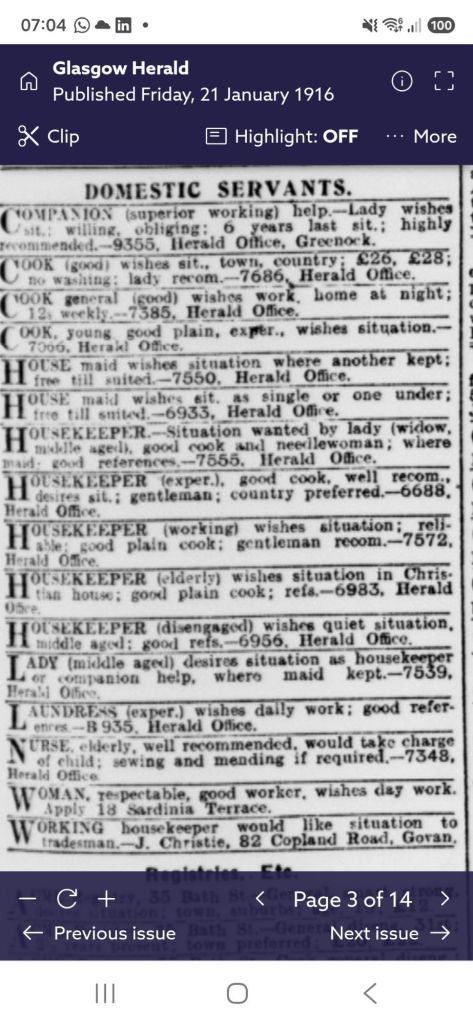
British Newspaper Archive

Clarinda Augusta Webster (1844-1920), was a music educationalist, and school proprietor in Aberdeen before she moved down to London.  No census entry has been traced for 1901.  In 1911 in Streatham, Webster employed 31-year old general servant Julia Fullick, who must have been either married or widowed at the time, because her name was the same in 1921, and she was then described as a widow,  living with her sister and brother-in-law.  Fullickโ€™s occupation was now, โ€˜charwomanโ€™.  Webster had died in 1920; I donโ€™t know if Fullick worked for Webster right up to when she died.

Mary Kerr (ca.1848-1908), was the wife of Glasgow music publisher James S. Kerr, and inheritor of the publishing firm. The couple had a servant whilst their family were young. Widowed and living in Saltcoats in 1901, Mary still had a โ€˜general servant domesticโ€™, 21-year old Sarah Reid. By this time she had two adult children, two teenagers and a mother of 82 living with her, so I imagine Kerr and Reid would both have been kept busy! Kerr and her mother later moved back to Glasgow with at least one of the adult children โ€“ but I donโ€™t know how much paid help they had latterly. (Maryโ€™s mother actually outlived her by three months, living to the grand old age of 90.)

Euphemia Allan (1861-1948) was the sister of Glasgow music publisher Mozart Allan; she was a music teacher and also involved in the family firm.  Thereโ€™s no record of a resident servant either in Mozart Allanโ€™s home in 1901 or 1911, or when Euphemia and her nephew (also Mozart Allan) lived there in 1921. I wonder whether Euphemia and her nephew had a charwoman โ€“ surely they must have done?!

Kate Logan (1862-1936) grew up in Inverness, where her parents had a servant and three lodgers by 1881, when Kate was the last of their offspring still at home, working as a music teacher.  By 1901, her husband David was working as a music seller and employer, whilst Kate  was certainly working as a pianist, although thereโ€™s no job designated against her name in the census.  There was no live-in servant at that point, but after her husbandโ€™s family firm went bankrupt, Kate opened her Pianoforte and Music Saloon in 1904. Thus, by 1911 they were both designated as music sellers โ€“ and were employing 17-year old Daisy Shaw as their live-in servant.  However, by 1921, the census listed no servant.

Flora Woodman (1896-1981) was a famous coloratura soprano, born in London to a mother with โ€˜private meansโ€™.  Her mother grew up in Glasgow; in 1891 there had been two servants to look after a widow and three adult children.  It comes as no surprise to learn that Floraโ€™s own single mother had a servant, 18-year old Annie F. Butler, in the 1901 census; 22-year old Emily Owen in the 1911 census; and 34-year old Louie Hurst in 1921. 

As a musicologist, I havenโ€™t had to think about domestic service in the context of social history, but as a working mother myself, obviously I can draw on my own lived experience of running a household.  Iโ€™m still left feeling distinctly impressed with Rose Smith Rigden, who performed the same juggling act of balancing a career with raising a family, when the physical work was unarguably harder. Meanwhile, I also take pleasure in the fact that I’ve memorialised the names of a number of female servants who have probably never before been mentioned in print!

NAMEBIOGRAPHY
Bella [Isabella] Johnstone [Johnston].Born ca.1884, Wigtonshire.  Worked for the Rigdens aged 17 in 1901. Aged 27, a live-in servant in Kirkmaiden in 1911.  Married a fisherman in Kirkmaiden, Wigtonshire, in 1915.
Julia Mullins.Born ca.1880.  Aged 21, a servant in Bexley in 1901.  Aged 31, now Julia Fullick working for Clarinda Webster, in 1911. A widowed charlady living with her sister and brother-in-law in 1921.
Sarah Reid.Born ca.1880.  Aged 21 in 1901, working for Mary Kerr.
Daisy [Margaret?] Shaw.Born ca.1894. Aged 17 in 1911, working for the Logans.
Annie F. Butler. Born ca.1883. Aged 18 in 1901, working for Jane [Janie] Sillars.
Emily Owen.Born ca. 1889.  Aged 22 in 1911, working for the Woodmans
Louie Hurst.Born ca. 1887.  Aged 34 in 1921, working for the Woodmans.

If youโ€™re interested in the broader subject, Selina Toddโ€™s article, is informative:- โ€˜Domestic Service and Class Relations in Britain 1900โ€“1950โ€™, in Past & Present, Volume 203, Issue 1, May 2009, Pages 181โ€“204, https://doi.org/10.1093/pastj/gtp014.

You can read more about my Scottish ladies in my recent RMA Research Chronicle article, or various other articles all listed on my publications page. https://karenmcaulaymusicologist.blog/my-publications/

Biddy, Tibby and French Bessie, by S. C. P.  (Edinburgh and London: Oliphant, Anderson & Ferrier). I initially thought this was published in 1900, but I think it was mentioned in the press in 1897 โ€“ whether or not it was an identical edition.  It also seems to have appeared as three individual titles in 1871.  The anonymous S. C. P. also wrote other titles in the publisherโ€™s โ€˜Sixpenny Books for Young Peopleโ€™ series.

Hereโ€™s a taster of Biddy:- the opening of Chapter 1.

Biddy worked hard, and got few thanks for it, – poor Biddy! She was maid-of-all work in a large family; and it was, โ€œBiddy, do this,โ€ and โ€œBiddy, do that,โ€ from the time she got up in the morning, till she tumbled into her hard bed at night. She had come to Glasgow from Ireland a warm-hearted, impulsive girl; but had been gradually going through a hardening process, till she was practically saying in her heart, โ€œI care for nobody, for nobody cares for me.โ€  Mrs Pettigrew, her present mistress, was just and faithful in all her dealings with her, and valued Biddy highly as an active, honest, efficient servant; but she was โ€œonly a servantโ€ to her, and any other girl who worked as well could have supplied her place; and she never dreamt of the large fund of love lying unkindled at the bottom of that servantโ€™s heart, which a little kindness and sympathy on her part would have touched like a spark amongst gunpowder, and brought forth blazing into loving action.

Mistresses lose much who have no sympathy with their servants. How many hearts are saddened and steeled for want of it, even as Biddyโ€™s was!

On This Day in Past Summers

WordPress has a habit of reminding me what I posted ‘on this day’ in previous years. Today’s reminder has been quite interesting!

2019

… seems a long time ago! I was in Killin, speaking at the Clan Gregor Weekend. Sir John Macgregor Murray was an interesting historical figure whom I’d encountered in passing during my doctoral research. A decade later, I’d been invited to give a research paper about him at the Sorbonne, and it turned out that Clan Gregor was also interested in my research, so I gave an after-dinner talk there, too.

The paper eventually became a peer-reviewed article in vol.13 no.1 (2026),  pp.50-63 of the Folk Music Journal, ‘Sir John Macgregor Murray: Preserver of Highland Culture, Music and Song’.

2022

I gave a lightening paper at a HoPIN webinar. HoPIN is the History of the Printed Image Network, so my paper was probably rather unfamiliar territory for researchers more familiar with images than old sheet music.

2023

A Social History of Amateur Music-Making and Scottish National Identity: Scotland’s Printed Music, 1880-1951

I was revising my second monograph prior to submitting it to the publisher. And looking forward to taking up my Ketelbey Fellowship in the History Department at the University of St Andrews. (By the end of the fellowship, I’d be working on revisions to the book!)

2024

I had not long retired from librarianship, but now I identified as semi-retired. So for the research fellow part of me, it was full-steam-ahead on indexing the second monograph, and my ‘vacation’ was somewhat busy. I was also contemplating an emergency visit down to Norfolk – I can’t remember if I actually went that time, because there were several such crises, some resolving sooner than others.

2025

Again, my vacation was far from relaxing. I was back from a trip to Norfolk, and in Glasgow we were having a new bathroom fitted. Meanwhile, we knew that a family bereavement was very imminent. I got the sad news on the final day of the bathroom re-fit, with a houseful of plumbers and electricians around. The news and our domestic circumstances will always be combined in my memory!

2026

Down-time

It’s more like a vacation this year, I guess. It’s warm and sunny. The garden’s looking moderately tidy, and I’m not rushing to meet a deadline.  If I feel unsettled and vaguely guilty for my laziness … well, maybe I’m just out of practice!

Anyway, I know I’ll be busy enough when my holidays come to an end.

Reminiscence Therapy for the Not-Yet-Old! Silver and Gold Leng Medal Memories, Update No.6

River Clyde

As a librarian, I would occasionally read articles about reminiscence therapy – when you assemble a collection of assorted ‘things from earlier days’, whether books or household objects, as conversation starters for groups of older people. I only worked in public libraries for three years, and I suspect it was before ‘reminiscence therapy’ was a thing; but later, I would read these articles with interest and think what a lovely idea it was. More recently, I’ve read about how people have strong, mostly positive memories of music they enjoyed in their twenties, when life was fresh and exciting and it felt as though they had the world at their feet.

I have never had the opportunity to organise any activities like this – though I did begin to realise last year, that people also seem to enjoy remembering their school music and singing lessons!

As I review my Leng Medal Memories interviews, watching the video recordings and correcting the transcriptions, I realise that my interviewees often thanked me for this opportunity to relive their memories of singing Scots songs for the Leng silver and gold Medal competitions. In turn, I feel privileged to be ‘there’ with them as they open a window into the past, allowing me a glimpse of the children that they were, and the memories that were still with them. I’ve been showed medals, certificates and prize books. We’ve looked at the little Nelson’s Scots Song Books that school children often used. We’ve talked about teachers they remember, songs that they chose or were encouraged to sing, and a whole range of emotions from fear and anxiety, to immense pride.

Annual Leave

I still have a few transcriptions to review, but I have annual leave coming up, so if I do anything with the transcriptions during that time, it will be with coffee and a biscuit beside me, and a determination not to squander my entire ‘holiday’ at my desk! If I don’t use my vacation allocation, I lose it, and that would never, ever do!

I can’t NOT blog for a whole month. Neither can I really blog ahead, setting timers for it to go live, apart from this present posting. I like to think that anyone returning to this blog will always find something new to read, but I never know what I’ll feel inspired to write about!

Anyway, this is my explanation, if there are fewer postings during the month of July: I’m trying to be on holiday!


My Leng Medal Memories research is funded by an Athenaeum Award from the Royal Conservatoire of Scotland.

Research: Distracting Oneself from Distractions

My oldies are giving cause for serious concern, and I’m distracted.  These situations happen to most of us – I won’t elaborate. Suffice to say that research itself can be a distraction from the awfulness, but not entirely!

Young Disrupter

Take yesterday. I thought I’d find solace in our big city public library.ย  First, I headed for the library cafรฉ, but although the coffee was good, someone else’s screaming, beaker-flinging toddler didn’t make for a calming experience. I don’t blame the parent – it was just unfortunate.

Horrible old Technology!

Then the microfiche reader screen was too high for my varifocals, so I had to stand to consult it;  there was only just room and nowhere to plug in the laptop; and not  enough room for my notebook unless I sat back down and balanced it on the edge of the table. I have never liked microfiches anyway! I disliked them in 1988 – nothing has changed.

Although I would like to have stayed longer – I didn’t complete my mission – I wasn’t entirely sorry to have to leave in order not to disappoint expectations that I’d be home to fix lunch.

Back at my own desk, I fiddled with my notes, checked out some details, and quickly checked in with relatives. No news.

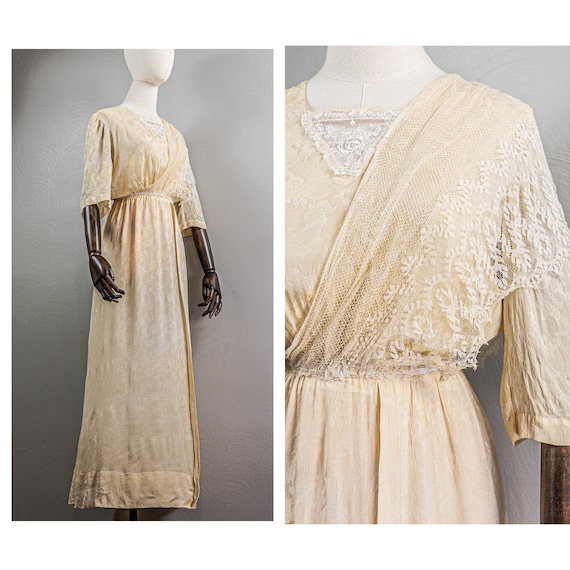
Finally, giving in to temptation, I headed back to my happy place.  Fabric.  In this case, examining Flora Woodman’s concert wardrobe through her performance log! I’ve mentioned before that she logged every outfit worn. It’s a shame that the only outfits we can see, are those in publicity photos. Still, the log gives a good impression of the range of outfits, and some of her accessories.  Let me share the concert attire worn by the emerging young star in her first couple of years.  Obviously, there’s no indication of style or design, so you’ll need to visit a few historical costume websites for 1913-1915 and form your own imagined impressions.

(I’ve indicated the source of this blog picture below – it has nothing to do with Flora.)  There’s also a Facebook page called Attire’s Mind, which gives plenty more food for thought.

1913-1914

Cream Lace
Navy Blue
White and Pink
White Coat & skirt
White Silk

1915

Black & White
Blue (Spanish)
Cream Lace
Fur Coat & Pink Hat
Navy Coat & Skirt & White Hat
Pale Green & White
Pink (blue sash)
Pink Rose
Silver, Pink & Mauve
White Silk
White (with Black Tulle, Ermine or Swansdown on different occasions)

I found the most beautiful dress on The Romantiquary; in my imagination, this might have been one of Flora’s fabulous frocks. Meanwhile, I need to get a grip on myself and get back to the research proper. I’m not a historical costume expert!

PS. I could be persuaded to list more of Floraโ€™s wardrobe later … ?!

Season’s Greetings! Even Research Fellows Take a Break …

So, the book was published. What next, you ask? Well, I’ve recently submitted a couple of articles, one about some women related to Scottish music publishers, and one about an 18th-19th century supporter of Highland culture. I’m patiently waiting to hear if either article finds a home – and impatiently waiting to see if the book gets decent reviews! I see a couple of libraries have already got it in stock, which is comforting.

Now, I have an article to write (about two famous Scottish singers) and then in January I’m off on a postdoctoral research fellowship at the University of Edinburgh. These are exciting times!

Twirling like a Top?

However, first it’s time for the crescendo of Christmas to reach its peak, and then a few days of diminuendo and rallentando to a graceful pause. I generally find that after I’ve recovered from organising the family festivities, I’m raring to get going on some writing, so hopefully I’ll get that article at least drafted before I embark on the Edinburgh adventure.

Meanwhile, I hope everyone gets just the right balance of rest, relaxation and fun. If it’s a quiet or subdued time for you, then I hope that you’ll find solace in the small things, and the comfort and companionship of friends.

Back soon!

Scheduling!

This morning, I was talking to students about devising a structure for a research project – and scheduling the writing of it. Oh, I waxed lyrical. I explained how I scheduled my PhD chapters, and more recently, I scheduled my second book chapters, editing, indexing and so on. All perfectly true. It’s how I meet deadlines, ensuring I don’t overlook anything crucial. For me, this works; I do accept that not everyone likes to organise themselves this way, though.

But things have been a bit disarranged this autumn – I’ve actually been robbing myself of free time in my enthusiasm to do the scholarly things that I never felt I had enough time for before! This autumn, I had the book launch to look forward to, as well as some teaching (an unexpected bonus), and the writing of a substantial article. I had a couple of other writing ideas lined up for after I’d finished the aforementioned article, and I have been eagerly looking forward to my fellowship in Edinburgh next year – I don’t want to get started on that particular project until I have a desk in Edinburgh.

However, I’m just at the end of the substantial article, and now I need to check it meets the house style of the journal I’m hoping to submit it to. The other writing ideas? I think they’re likely to spill over into my RCS research existence in the days when I’m not in Edinburgh next year!  (For a start, I haven’t delved quite deep enough to have a clear grasp of certain nuances.)

How did December creep up on me so sneakily?! Suddenly, semi-retired or not, I find I have the usual scramble to plan Christmas music, Christmas presents and all the usual seasonal silliness. If anyone sees a little semi-retirement just roaming around looking displaced, please turn it round gently and send it back to me. I’ll have to continue working on my time management skills – I think I’m guilty of allowing part-time commitments to overflow into time that isn’t actually meant to be work!

My new year’s resolution? Still to achieve work-life balance!

My Life as an Alt-Ac (a summary of a keynote lecture)

I thought folk might be interested to see a quick summary – NOT the whole talk – of the keynote I gave at the University of Birmingham yesterday. ‘Alt-Ac’ is Alternative Academia, or Alternative Academic. You’ll see what I mean …

Pedals! I’m fated!

Pedals (2)

He says I wasted money buying my bike a couple of years ago. I’ve only ridden it twice. My answer is that I will, eventually ride it – maybe in retirement. But that’s only four calendar weeks away. (Indeed, only twelve working days as a librarian, considering the remainder are research days.) So, I really ought to get a grip on myself and wobble off into the sunset. But I haven’t yet!

Pedals (1)

Trying hard to practise my work-life balance, however, I did get out my dressmaking materials yesterday. I was getting on just fine, when – SNAP! The sewing machine needle broke. ‘Clumsy, careless’, I muttered to myself, assuming I must have caught a pin by mistake. I replaced it and continued.

SNAP! But there wasn’t a pin in sight. Five minutes later – SNAP! SNAP! Enough was enough. It was time for another holiday expedition. I visited the sewing machine A&E which is conveniently only five minutes away by car. Apparently the machine might have something wrong with its timing. (You’re not kidding! I want to finish and wear a new summer dress.) Leaving the machine, I went and got the car washed, then headed for Waterstones to buy a book.

But that left me machine-less, so I summoned up the courage to look at Mum’s Second-Best Machine, which is far more sophisticated than my own old workhorse. I’m just as terrified of it as I am of falling off the new bike.

What is it about me and pedals this weekend?

What is it about me and pedals this weekend? I’m fated. She had given me the wrong foot-control, and it wouldn’t fit the Second-Best Machine. Much searching later, and I had tracked down an eBay vendor who might be able to sell me one. Not only that, Mum had found a pedal at home, which sounded like the one that I should have had all along. It’s just 400 miles away. I should have one or two working sewing machines within the week, providing there isn’t actually anything wrong with the Second-Best Machine, as Mum darkly hinted …

Still, I was quite pleased with myself for not doing research all day, and promptly rewarded myself by visiting the website of the Working Class Movement Library in Salford. This is fascinating – I’d never heard of it before. Definitely worth adding to my Zotero account. I have the glimmering of an idea, depending on how my future research plans pan out, and this could be a very useful library to know about. Unfortunately, the catalogue only had the two particular titles that I’d already identified, so I sent a quick email of enquiry, and headed to the British Newspaper Archive to pursue other options … you’re right, this looks suspiciously like research!

Pedals (32)

Today, I slept in. I did a bucket-load of housework, and rewarded myself with pedals of a different kind – by going to do some organ practice. It’s been glorious weather, and there’s a lovely smell of grass outside. The old church wasn’t chilly, but comfortable – and very peaceful.

I haven’t done any research, so in that respect at least, I’ve had a restful day – if laundry and cleaning stair-carpets counts as restful. Indeed, I might even go and read outside in the sun now. Reading about ultra-processed foods is very definitely not research. (Strange to relate, as a teenager I did once wonder about training as a nutritionist. Not fancying biology kind of scuppered that ambition.) But it does still interest me. Retirement will hopefully mean fewer convenience foods and more home-cooking. I’m sure it’ll be better for us.

Chris van Tulleken, Ultra-Processed People: Why do we all Eat Stuff that isn’t Food … and why can’t we Stop?

Better nutrition, more exercise … I’m determined NOT to over-commit myself when semi-retirement actually comes, but there are some general principles that surely won’t go amiss!