Dr Karen McAulay explores the history of Scottish music collecting, publishing and national identity from the 18th to 20th centuries. Research Fellow at Royal Conservatoire of Scotland, author of two Routledge monographs.
Not long ago, I was bought a copy of The Feminist Art of Walking, by Morag Rose (Pluto Press, 2025). It falls into the category of Gender/Urban Studies, which certainly isn’t in my usual ballpark, but I’m often pleasantly surprised to read something completely different, so I dived in. Did you know that Rose established the Loiterers Resistance Movement (LRM)? You do now.
After my two ‘fieldwork’ outings to Rutherglen and Lanark this week, both entailing a fair bit of walking, it occurred to me that my own walks were a kind of feminist walking, insofar as I was commemorating Rose Smith, a forgotten woman composer who was born in Lanark, grew up and spent her early adulthood in Glasgow, then spent most of her adult life in Rutherglen – and also her mother, the ‘Lanarkshire Poetess’. (Not a bad title for an Englishwoman who had lived in Ireland before the family moved to Lanark!)
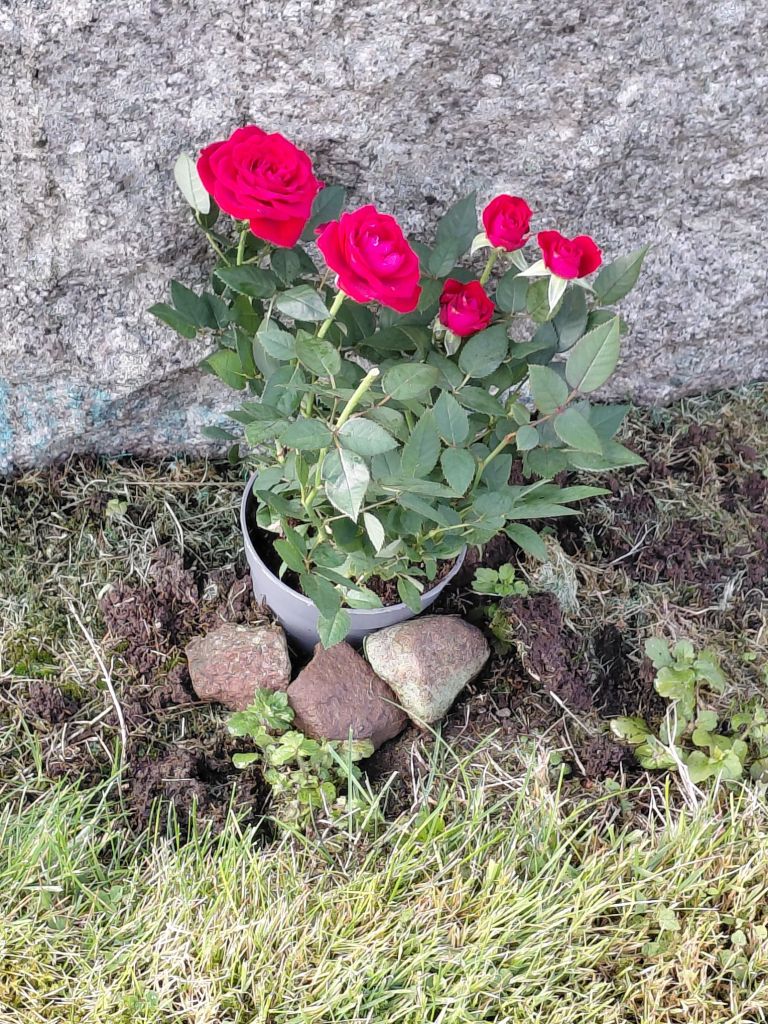
Honouring the Trumpet Major
As I walked from the cemetery down to the cenotaph in Rutherglen on Monday, I pondered that Rose would have walked over the same ground – although it would have looked very different. Likewise, her steam train would have traversed essentially the same line between Glasgow and Lanark that I travelled yesterday, and I walked on streets that she, her mother and siblings must have used daily. I even walked past the spot where their house stood. Too late, I realised I could have gone and looked at the Episcopal church that they attended. I glimpsed it, just up the road from the Library, I think, but I was too slow on the uptake and didn’t realise that was it. I was more focused on getting to the cemetery without getting drenched en route! Rose had stood at both those gravesides. Mary-Ann was remembered on the Trumpet Major’s headstone, even though she’d actually died whilst staying with a daughter in England.
Today, however, I’ve stayed at home. It’s not a ‘working’ day, but I didn’t feel inclined to make another expedition. (I need to visit the National Library of Scotland, but I can’t in all honesty justify a trip to Edinburgh when I’m going there next week in any case.)
So, I baked, washed floors and dealt with laundry. (This is the reality of semi-retirement!) I wondered if Mary-Ann or Rose made their own bread, or if they’d have laughed as they informed me that there was a perfectly good baker on the high street? They certainly wouldn’t have had a bread-machine to make the dough for rolls, or a packet-mix for an experimental batch of muffins! (Spoiler alert: they came out fine, but the ones I make from scratch are a nicer texture. And my recipes make more of them!) They’d still have had a ‘pulley’ to dry the laundry – but doing the laundry itself would’ve been much more labour-intensive. The ironing? Yes, that’s easier today, too. I’ve already addressed the question of whether they had paid help – answer, the censuses reveal that they certainly didn’t have anyone living in, apart from when Rose’s children were wee.
So, much has changed – but in my situation, at least, the domestic labour is still entirely, 100% mine. The ironing basket will sit there scowling at me until I deal with it. Nothing will be tidied up or put away unless I do it. And (despite frequently being told to be grateful for the white goods in our kitchen, which ‘do everything’), the business of keeping things going, still seems to be defined as ‘women’s work’. (Don’t condemn me. It’s easier this way. IYKYK.)
However, the relative absence of hard graft today makes me all the more respectful of Mary-Ann and Rose, still writing poetry and music as well as doing all the housework! I suppose their daughters helped them. I bet they didn’t have to be politely asked or cajoled – it was probably accepted that this was what was expected of them.
When I go into town next week, Rose’s ghost may well be hanging around the old Glasgow Athenaeum, too. There’s no denying the School of Music opened doors for her. Come to think of it – the name has changed, the remit is far wider and the reach is now global – but the opening of doors is something else that RCS has continued to faciliate. ‘Plus ça change, plus c’est la même chose’, as they say.
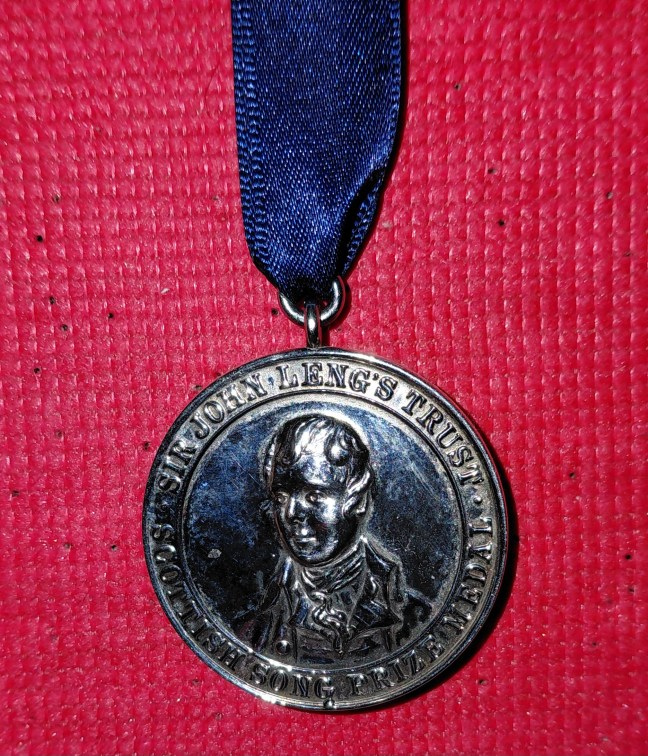
To recap – I have done oral history interviews with a number of people who participated in Dundee’s Leng Medal competitions for Scots song singing – mostly as children, but a few teachers have also talked with me. I’ve checked the transcriptions of 25 out of the total 27 interviews, and I also have a few emailed responses too. If you’re one of the people I’ve interviewed or emailed, then can I offer a big thank you, right now, because I now have lots and lots of information and memories. I really am very grateful. I couldn’t have done this without you. You’ve shared your memories, you’ve made me smile, and some of you have even sung to me. Who could ask for more generosity of spirit than that?
So, what’s next?
Writing. (Writing for the popular, non-academic press, and then writing a book chapter.)
An event, hopefully. Still under discussion.
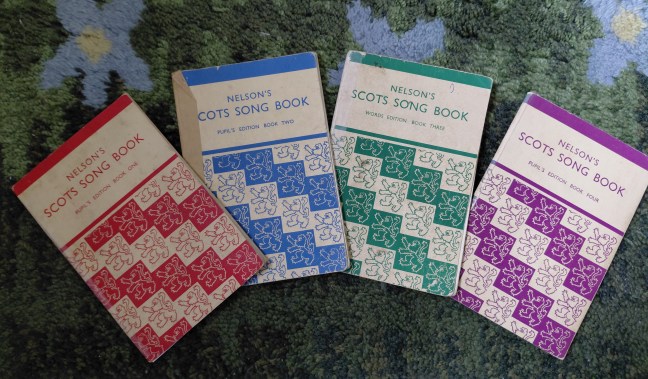
A book about Thomas Nelson’s educational music publishing, or something along those lines.
And I have more than one string to my bow. I’m also still researching …
The Trumpet Major’s Youngest Daughter
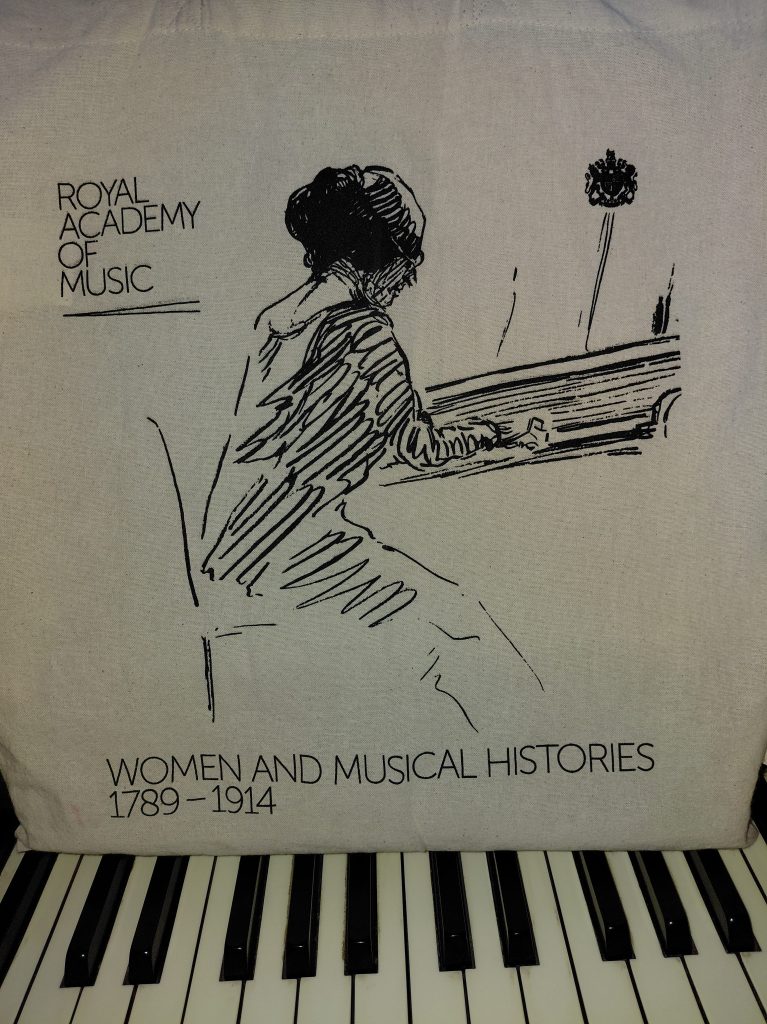
Slightly crumpled conference bag (it has already endured both London and Scottish rain!)
After my talk at the recent Royal Academy of Music conference, Women and Musical Histories, 1789-1914, I have continued researching Rose Smith’s life. I’ve already found out more, and tomorrow I’m off to consult an archive where I hope some of my still outstanding questions might be answered. I foresee a [second, more focused] research trip to Rose’s birthplace in the near future, before our Scottish days get short and wintry!
I’d also like to organise another event! But I really must focus on getting the Dundee research written up and celebrated before I get consumed by this other research thread.
It’s a good thing I’m semi-retired, really! If I was still cataloguing jazz CDs in the library, I certainly wouldn’t have time to plan research expeditions without taking annual leave.
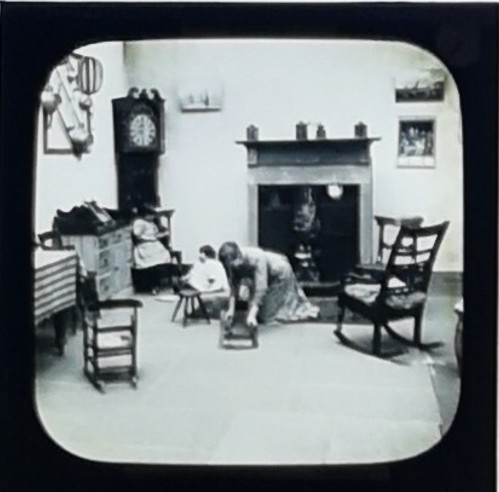
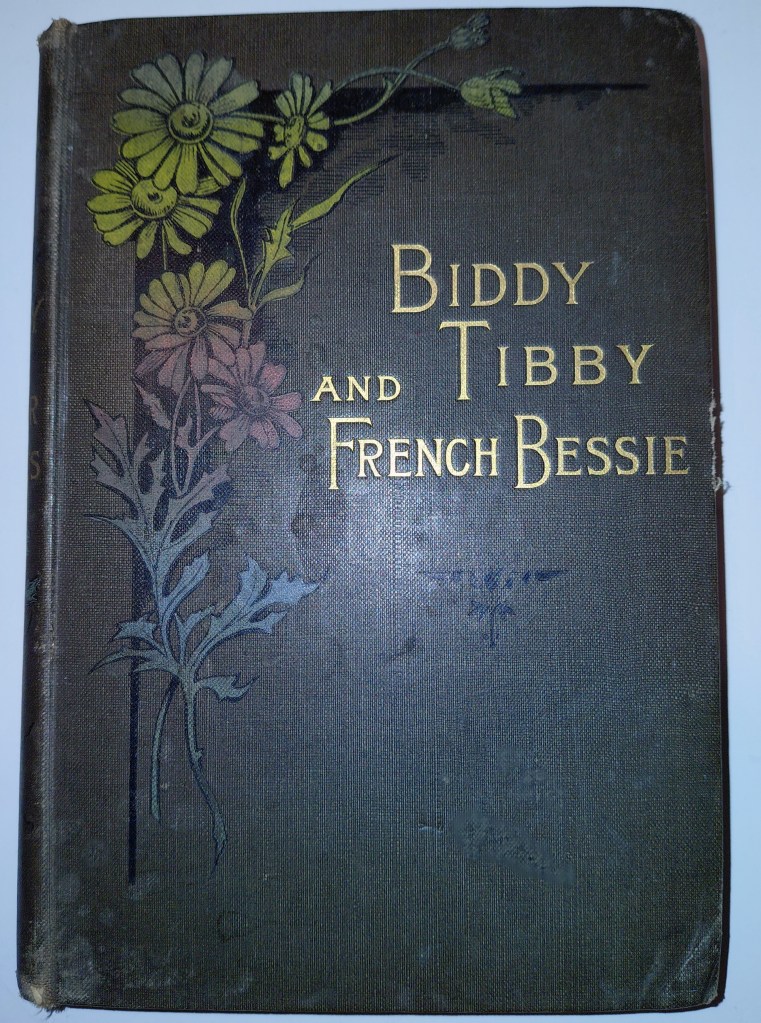
Biddy, the Maid of All Work is the title of a children’s book, dating from as early as 1871 in its original version. My own copy is an attractive bound compilation of three stories in a gift book from the turn of the century – it was given to its original owner as a Sunday School prize, and I bought it when I was researching Bayley & Ferguson’s ‘service of song’ books for magic lantern shows. As I have shared before, it’s a very moralistic Christian tale. (I’ll show you the opening paragraphs later on in this post.)
Women and Domestic Labour
But why have I gone back to services of song? As a matter of fact, that wasn’t why I thought of Biddy. Yesterday, I was thinking about women and domestic labour, and pondering over not only what had changed, but also what seems to have stayed the same. When I was working full-time, we employed a cleaner for two hours a week – we’d done so for three decades, and it certainly lessened the load. We don’t now – partly because the agency was struggling to find cleaners, and partly because I don’t feel it’s justified. But somehow, although we used to share the cleaning bill, I alone have ended up with everything connected with running the house, from mending to muffins, and dusting to drain-unblocking. (I’m told I don’t actually ‘do’ the washing, because the modern home has white goods that do everything for me. All I can say is that the washer-dryer hasn’t yet learned how to gather up the laundry, sort it, hang it, iron it and put everything away again.)
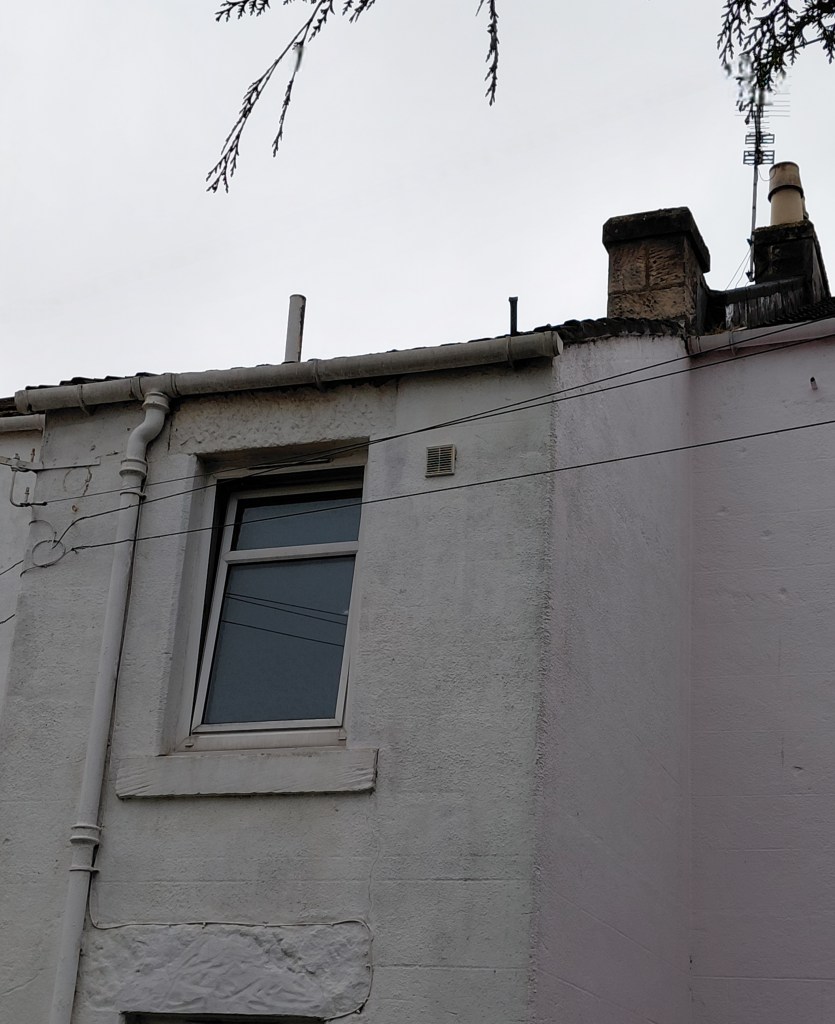
Little chimney with no pot: relic from the wash-boiler days
Our house is contemporary with the lives of ‘my’ musical Scotswomen. It was built in 1904. It was occupied by the proprietor (a shipbuilding clerk), his wife and three daughters. It still has a wee chimney leading from where the scullery boiler would have been, on the ground floor. It’s now our kitchen – but it would have been the wash-house: a place of really hard work. We still have a ‘pulley’ in what would have then have been the kitchen, and my office is what would have been the bed recess, under the stairs. Was there a servant sleeping in it? Well, there wasn’t, in the 1911 census. The range was where our dresser is. The kitchen sink? There’s now another bookcase. But the meal-preparation continues, in what was the wash-house. (A Cordon-Bleu cook would find it nightmarishly cramped!)
Anyway, I’m suitably grateful that there’s less ironing, with a much nicer iron than the first occupants would have had! I visualise scrubbed and starched cotton shirts and white frilled pinafores hanging from the pulley, where tee-shirts and jeans are now casually draped, and I do appreciate the advances in both textiles and technology!
The life of a servant like Biddy was certainly a hard one. The author asks us to have sympathy for her, not only for the hard work, but also for her feelings of being uncared-about. Now then, bear in mind that it’s a piece of fiction for children. It’s impossible to know how accurate the picture conveyed actually is. There must have been good and caring employers, and ‘Biddy’s’ employer isn’t portrayed as bad. But it was a different age. The history of domestic labour is not my area of research expertise!
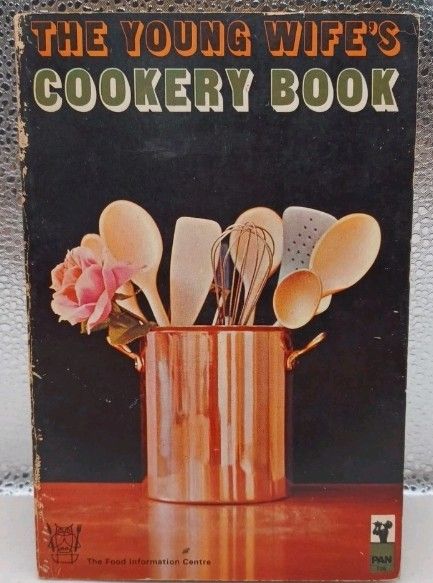
Much more could be said about domestic labour, particularly about the present occupants’ expectations and recollections of childhood and early adulthood which, I can assure you, were quite a long time ago. A different era, made more complicated by the fact that there are also two sets of memories, since our childhoods weren’t simultaneous! And I’ve heard it said that as we age, our most vivid memories are of our early adulthood, when everything was new and exciting. This book (on eBay) is from the ‘sixties: my childhood, not early adulthood. But it is, sadly, from an era when the ‘young wife’ did everything domestically-related. I feel as though I’m dragged back through a time-warp into those dizzy days six decades ago.
The Time of Vivid Memories? (The Young Wife’s Cookery Book, ed. E. Maxwell-Arnot (1967)
Rose and Iden’s Live-in Servant
Anyway, my mind again turned to Rose Smith, the late Victorian/Edwardian church organist who didn’t let three children curtail her musical activities. How much help did she have around the house? So, let’s recap. Rose was born in 1870 in Lanark, and brought up by her widowed mother, mainly in Glasgow. They didn’t have a servant in the 1891 census – indeed, her mother had two lodgers as well as Rose and her older sister to look after.
Rose married in 1898. I knew that Iden and Rose Rigden’s first son was born in June 1899, so at the time of the 1901 census, there were Iden, a tax official; Rose, a teacher and church organist working from home on her ‘own account’ (ie, she was self-employed) and Iden junior, aged nearly two. Iden’s wee brother wouldn’t come along until August 1903. Although it was a small household, there was also a live-in servant, the 17-year old Bella Johnston[e], who was born in Port Logan in Wigtonshire around 1884.
I don’t know exactly how long Johnston stayed with the Rigdens. They had their second son in 1903 and a daughter in 1907, and had moved house by 1911 – where there was no live-in servant. Of course, we don’t know if Rose perhaps had a daily, non-resident maid to help her. We do tend to assume that domestic service became a less common occupation after the Great War, yet here we find the Rigdens without a resident maid, three years before the War. Selina Todd, author of an excellent article on domestic service in the first half of the century, would be unsurprised by this, however, as she demonstrates how, although practices changed, domestic service did continue. Just in a different form:-
The ‘disappearance’ of service — already heralded in the 1920s, when press coverage of ‘the servant problem’ was filled with nostalgic laments for the faithful Victorian maid — never happened. Change, of course, did occur — the live-in housemaid of the 1900s was replaced with the part-time cleaner of the 1950s […]
(Todd, see reference below)
Meanwhile, Bella Johnston herself was still a live-in domestic servant in 1911, working back in Wigtonshire in Kirkmaiden (where her grandmother had lived), for the Cook family in Weston House, Church Street. She married a Kirkmaiden fisherman in 1915.
By 1921, the Rigdons had moved up in the world – from a flat, to a house – but there was still no maid in the census.
It set me wondering. What about the other women musicians whom I’ve researched? In all honesty, I don’t think the Census data is enough on which to base any conclusions, simply because we don’t know about the domestic servants who didn’t live in – often called, ‘charladies’. The term sounds derogatory now, but may not have been considered so at the time. If anything can be deduced from a rainy Friday morning’s searching, it is that having a resident servant seems, in the early 20th century, to have depended on the level of affluence and/or evident need for help.
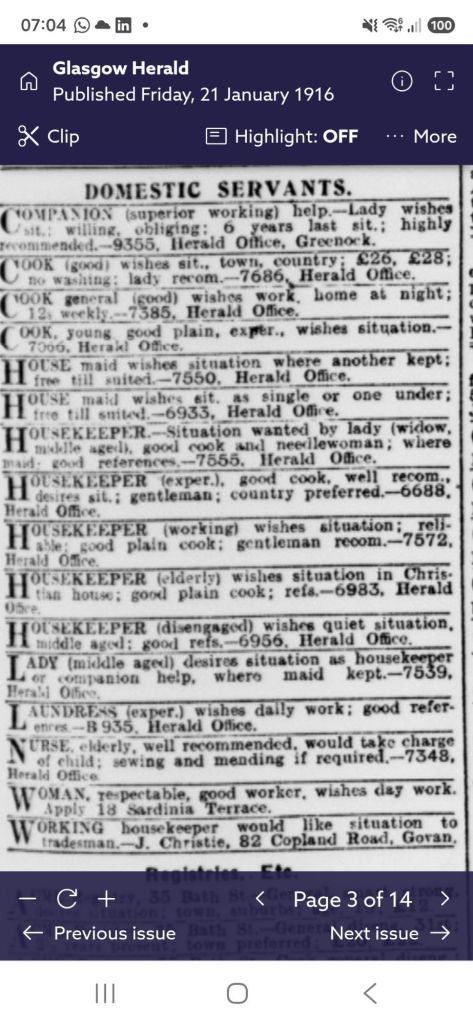
One thing is certain: the newspapers were full of adverts for Situations Vacant, and from job-seekers.
British Newspaper Archive
Clarinda Augusta Webster (1844-1920), was a music educationalist, and school proprietor in Aberdeen before she moved down to London. No census entry has been traced for 1901. In 1911 in Streatham, Webster employed 31-year old general servant Julia Fullick, who must have been either married or widowed at the time, because her name was the same in 1921, and she was then described as a widow, living with her sister and brother-in-law. Fullick’s occupation was now, ‘charwoman’. Webster had died in 1920; I don’t know if Fullick worked for Webster right up to when she died.
Mary Kerr (ca.1848-1908), was the wife of Glasgow music publisher James S. Kerr, and inheritor of the publishing firm. The couple had a servant whilst their family were young. Widowed and living in Saltcoats in 1901, Mary still had a ‘general servant domestic’, 21-year old Sarah Reid. By this time she had two adult children, two teenagers and a mother of 82 living with her, so I imagine Kerr and Reid would both have been kept busy! Kerr and her mother later moved back to Glasgow with at least one of the adult children – but I don’t know how much paid help they had latterly. (Mary’s mother actually outlived her by three months, living to the grand old age of 90.)
Euphemia Allan (1861-1948) was the sister of Glasgow music publisher Mozart Allan; she was a music teacher and also involved in the family firm. There’s no record of a resident servant either in Mozart Allan’s home in 1901 or 1911, or when Euphemia and her nephew (also Mozart Allan) lived there in 1921. I wonder whether Euphemia and her nephew had a charwoman – surely they must have done?!
Kate Logan (1862-1936) grew up in Inverness, where her parents had a servant and three lodgers by 1881, when Kate was the last of their offspring still at home, working as a music teacher. By 1901, her husband David was working as a music seller and employer, whilst Kate was certainly working as a pianist, although there’s no job designated against her name in the census. There was no live-in servant at that point, but after her husband’s family firm went bankrupt, Kate opened her Pianoforte and Music Saloon in 1904. Thus, by 1911 they were both designated as music sellers – and were employing 17-year old Daisy Shaw as their live-in servant. However, by 1921, the census listed no servant.
Flora Woodman (1896-1981) was a famous coloratura soprano, born in London to a mother with ‘private means’. Her mother grew up in Glasgow; in 1891 there had been two servants to look after a widow and three adult children. It comes as no surprise to learn that Flora’s own single mother had a servant, 18-year old Annie F. Butler, in the 1901 census; 22-year old Emily Owen in the 1911 census; and 34-year old Louie Hurst in 1921.
As a musicologist, I haven’t had to think about domestic service in the context of social history, but as a working mother myself, obviously I can draw on my own lived experience of running a household. I’m still left feeling distinctly impressed with Rose Smith Rigden, who performed the same juggling act of balancing a career with raising a family, when the physical work was unarguably harder. Meanwhile, I also take pleasure in the fact that I’ve memorialised the names of a number of female servants who have probably never before been mentioned in print!
NAME
BIOGRAPHY
Bella [Isabella] Johnstone [Johnston].
Born ca.1884, Wigtonshire. Worked for the Rigdens aged 17 in 1901. Aged 27, a live-in servant in Kirkmaiden in 1911. Married a fisherman in Kirkmaiden, Wigtonshire, in 1915.
Julia Mullins.
Born ca.1880. Aged 21, a servant in Bexley in 1901. Aged 31, now Julia Fullick working for Clarinda Webster, in 1911. A widowed charlady living with her sister and brother-in-law in 1921.
Sarah Reid.
Born ca.1880. Aged 21 in 1901, working for Mary Kerr.
Daisy [Margaret?] Shaw.
Born ca.1894. Aged 17 in 1911, working for the Logans.
Annie F. Butler.
Born ca.1883. Aged 18 in 1901, working for Jane [Janie] Sillars.
Emily Owen.
Born ca. 1889. Aged 22 in 1911, working for the Woodmans
Louie Hurst.
Born ca. 1887. Aged 34 in 1921, working for the Woodmans.
If you’re interested in the broader subject, Selina Todd’s article, is informative:- ‘Domestic Service and Class Relations in Britain 1900–1950’, in Past & Present, Volume 203, Issue 1, May 2009, Pages 181–204, https://doi.org/10.1093/pastj/gtp014.
Biddy, Tibby and French Bessie, by S. C. P. (Edinburgh and London: Oliphant, Anderson & Ferrier). I initially thought this was published in 1900, but I think it was mentioned in the press in 1897 – whether or not it was an identical edition. It also seems to have appeared as three individual titles in 1871. The anonymous S. C. P. also wrote other titles in the publisher’s ‘Sixpenny Books for Young People’ series.
Here’s a taster of Biddy:- the opening of Chapter 1.
Biddy worked hard, and got few thanks for it, – poor Biddy! She was maid-of-all work in a large family; and it was, “Biddy, do this,” and “Biddy, do that,” from the time she got up in the morning, till she tumbled into her hard bed at night. She had come to Glasgow from Ireland a warm-hearted, impulsive girl; but had been gradually going through a hardening process, till she was practically saying in her heart, “I care for nobody, for nobody cares for me.” Mrs Pettigrew, her present mistress, was just and faithful in all her dealings with her, and valued Biddy highly as an active, honest, efficient servant; but she was “only a servant” to her, and any other girl who worked as well could have supplied her place; and she never dreamt of the large fund of love lying unkindled at the bottom of that servant’s heart, which a little kindness and sympathy on her part would have touched like a spark amongst gunpowder, and brought forth blazing into loving action.
Mistresses lose much who have no sympathy with their servants. How many hearts are saddened and steeled for want of it, even as Biddy’s was!
Why do I persist in researching Rose Smith? I suspect my interest is partly because I see myself in her.
Smith attended, and briefly taught at the Athenaeum. Throughout her life, she played, accompanied, composed and taught. I half-wondered if she gave up playing the organ when the family came along, but no! There she was in 1900, and in 1911, still playing.
Did she leave the baby at home with the maid? There wouldn’t have been a creche! And what about when there were three small children? (They were born ca. 1899, 1903 and 1907.) That’s something I probably don’t need to know.
But when you consider that my own mother told me I’d have to stop playing when the baby arrived (that was in 1993 – and I didn’t stop! Don’t tell me what I can’t do), then for Rose Smith to keep playing in 1899 seems quite unconventional. Or maybe not – I haven’t researched any other Edwardian organists who were mothers.
I’ve temporarily lost track of her organ playing after 1911. And did they move to a closer Episcopal church when they moved house? (I know where to look, but access isn’t easy. Give me time!)
But I do know she was still listed as a piano teacher at the age of 67.
I’ll just keep digging away. I find out a little bit more every time I start looking. Why, only this afternoon I discovered her younger son was a music salesman for Paterson’s in Glasgow, and must have known J. Michael Diack. Another little link with what I already know of Glasgow’s music scene …
Image shows the tenement near Glasgow Green, where Smith grew up.
Today was the final day of the Women and Musical Histories conference at the Royal Academy of Music. It has been both enjoyable, and highly informative, and there was enough live music to make it feel like a real treat. Presentations and performances alike were of a very high quality.
My presentation was in the final session, so I had two days of debating with myself as to whether I’d play that musical example.
PROS
It would quite possibly be the first performance since the 1940s, if not before.
No-one will have heard Rose’s music before
It’s lovely
It has THE most wonderful, powerful ending.
CONS
I once played a simple example (on home ground), made a tiny slip, and someone sniggered.
I’m a scholar, not ‘a performer’.
Dare I reveal my shortcomings within the hallowed walls of another conservatoire?
I had brought a scanned copy of Rose Smith’s last verse, as a precaution against losing it in transit. Since I may have the only privately-owned copy, I couldn’t risk bringing it with me. This turned out to have been a wise precaution, because a torrential downpour rendered my scanned copy very soggy round the edges! Nonetheless, it dried out enough that I couldn’t use the sogginess as an excuse.
I heard someone warming up for a lecture recital, and almost took fright. Who did I think I was?!!
‘Tell the audience you were a librarian’, a friend advised me. Well, that was a better idea than confessing that I didn’t rate myself very highly. I know better than to put an audience off by sowing seeds of doubt in their minds!
Finally, I convinced myself. A bit like when I was deciding whether to have another go at a PhD, back in 2003, I asked myself the question that usually helps me make up my mind.
Will I regret it if I don’t do this?
I took a deep breath. ‘I used to be a librarian, not a performer’, I stated. ‘But I’m going to play you an example of Rose’s music.’
It was an absolutely fabulous piano! Quite exhilarating.
This has become a two-post day? Well, it’s International Women’s Day. How can I not mention it?
I decided I would play music by women this morning. Rose Smith (one of the women I recently wrote about in the RMA Research Chronicle – you’ll be familiar with her name by now!) was a piano teacher, a composer, and an Episcopalian organist. She was born in Lanark, moved to Glasgow whilst still a child, and later lived with her husband and children in Rutherglen. Her composed songs were rather like those by Ivor Novello – I’ve acquired nearly all of what seems to be extant, but I think a lot is missing. She only self-published a few, and the rest – for variety show singers – may not even have been published at all.
There’s no surviving organ music, so there was nothing for it – I played her songs before morning worship today. I bet you she never played them in church! However, since no-one knew they were secular songs, there was no harm in it. They’re well-written pieces, and I do think it’s a shame they’re not known. I did recommend one to an RCS Finalist a few years ago, and it was performed with enjoyment and appreciation.
I have significant performance anxiety about recording my playing, but I did unearth a piano demo of three songs by Rose Smith, that I recorded for a student a few years ago. Be kind! This isn’t a perfect performance or a perfect recording, but does show how the songs go.
Quick piano demo of three songs by Rose Smith
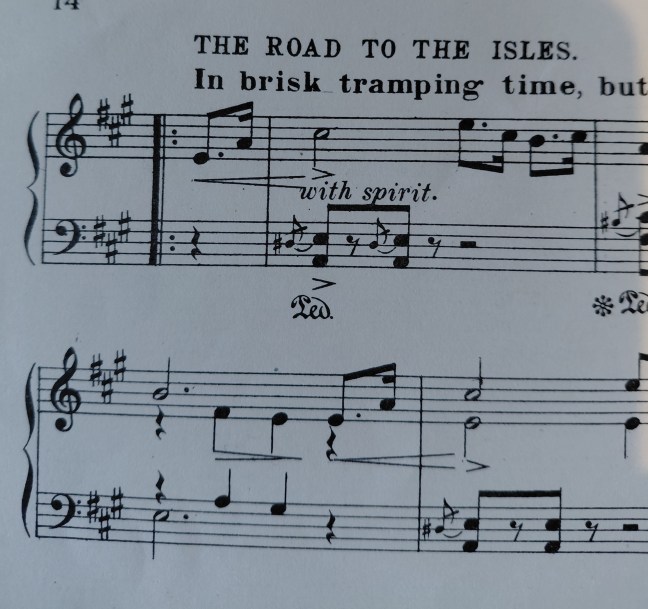
For my outgoing voluntary today, I turned to a more well-known composer. I played Marjory Kennedy-Fraser’s Eriskay Love Song, followed by The Road to the Isles.
Applause
I scored! I don’t usually get a round of applause after a voluntary.
I’ve got a new book of proper organ voluntaries by women composers, so I really must roll up my sleeves and learn some of them, but I suspect The Road to the Isles will prove hard to beat, as far as audience reaction goes …
Published online today, 12 January 2026, in the RMA (Royal Musical Association) Research Chronicle, by Cambridge University Press, on Open Access:-click here.
Writing this article was enormously fulfilling. I had encountered these ladies whilst researching my latest monograph, and I became convinced that they deserved profiling in their own right, and not merely as bit-parts in the larger picture occupied by their husbands, fathers and brothers.
The kernel of the abstract states that, ‘This article focuses on a group of Scottish women who did not make their names solely as art music composers or stellar performers, and for whom piano teaching was only part of their musical work. Four were related to the Scottish music publishers Mozart Allan, James Kerr, and the Logan brothers; the fifth published with Allan and Kerr, and also self-published.’
And all had fulfilling portfolio musical careers. Read on, and I’m sure you’ll agree!