I’ve had my Finale Songwriter music engraving software for a very long time, and it has served me well. Apart from occasional glitches, that is. However, it’s no longer sold, no longer supported – and is installed on a very old laptop. (I only keep it for Finale.) This week, I took it into my head to arrange a hymn for my church choir. All went well until …
RIP Finale Songwriter
The Finale Songwriter sound crashed. And with it, the scrolling playback. I tried to fix it. I tried a system restore, which takes hours and hours, but has always fixed it in the past. However, the system didn’t restore. (It’s a very old laptop.) With much persistence, I retrieved some kind of sound, but not the sampled sound. Hooray – I could playback my efforts with a tinny MIDI sound, and it scrolled obediently along. But it’s not how it should be. It was time to get new software for the new laptop. Before that, however, I thought I’d prune my Finale files, so that I’d have less to transfer across.
I file most of my Finale documents by year, and I’ve only reached 2020 in the pruning exercise. This will take a while! I’m deleting tunes that were either transient, functional versions of hymns, or really not worth saving for even family posterity.
Invisible Organist
But I found a piece I’d written for organ, back in the Covid pandemic lockdown. Entitled, Invisible Organist’s Blues, I can no longer remember if I wrote it whilst literally locked down at home, or if it was written at some stage in the next strange months when we conducted services with no congregation, or no singing. I may have written the piece whilst I was not only invisible but also almost inaudible – with not much to play. It felt as though little notice was taken when I did play.
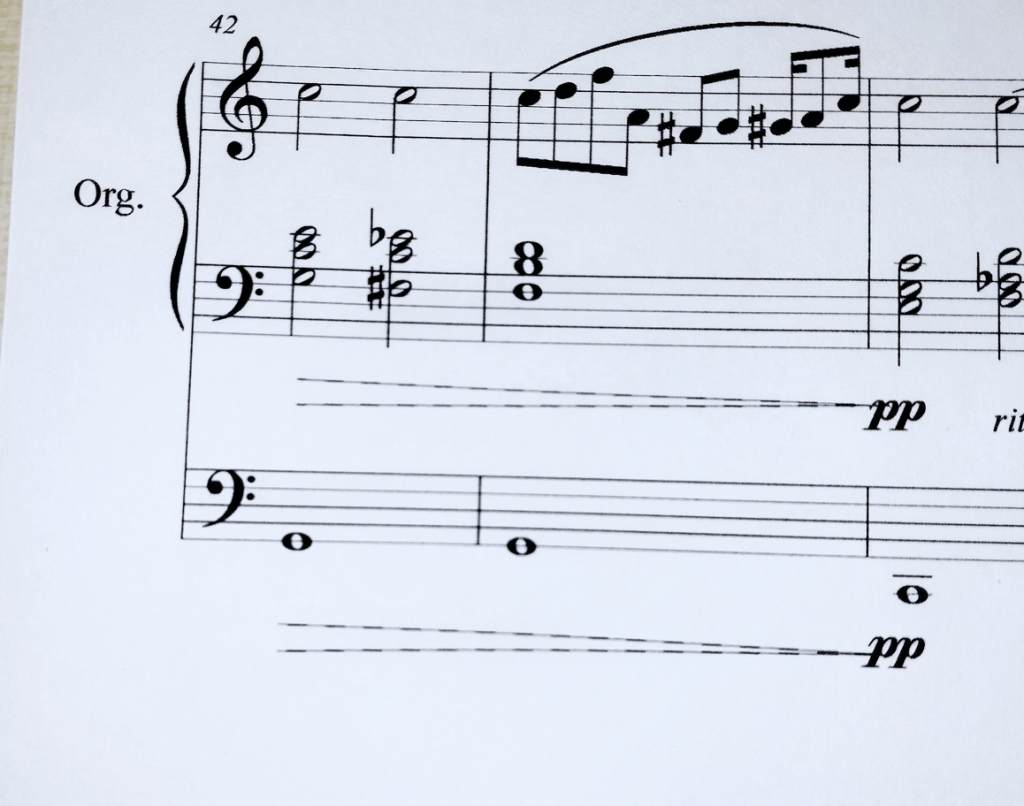
In other words, I was disgruntled. Invisible Organist’s Blues was born out of sadness and frustration. I think it was only played once. It is blues-y. It ends with ‘Nobody knows the trouble I’ve seen’, and that was chosen intentionally. I suspected I might have written something that really didn’t sound very agreeable, but I wanted to hear it again before I deleted it. Finding this piece brought back a lot of unpleasant emotions. In my last months there before I left in 2021, I felt my mental health suffering. I cried behind my glasses and face-mask each Sunday – no-one would have noticed the tears streaming. And I cried as I drove home, which was certainly not ideal. I felt marginalised, and for long enough, I told myself to ‘man up’ and accept that it was all in my head – I was imagining it.
Reality
Until, finally, I came to the conclusion that the sadness was real. Was I imagining my shrinking role? It was shrinking. Churches are absolutely entitled to change ways of doing things, and the organist just has to understand that. Was I imagining that the choir and organ were unmentioned throughout an online Zoom group meeting that I attended? They weren’t mentioned. If I was suffering, then that, too was real. Yes, times were changing – and it was time for me to accept it. I did accept it. A few months after my resignation, I was fortunate to find another organist position, where the welcome was as embracing as a warm hug. This was more how things were meant to be!

Fast forward back to this present week. My finger hovered over Invisible Organist’s Blues. Should I just delete it, and its uncomfortable memories? I played it back with my tinny, defective Finale Songwriter playback, prepared to be disgusted.
But I wasn’t! The tinny playback certainly didn’t enhance it. It lost any semblance of a deep pedal bass-line, but it felt as though there was something worth keeping. I tried it on the piano at home (and any organist will tell you that playing organ music on the piano is weird, because you have somehow to accommodate music that’s intended for two hands and two feet, without having an organ pedal-board) – and I was quite gratified by the results.
Today, I headed for church and tried it there. Tweaked a couple of chords, and – yes, two movements will be played tomorrow. The third does need a bit of practice. I need to decide whether the rhythms are not only too difficult, but unnecessarily so. (Nobody will hear the trouble I’ve seen, either!)
It would be nice to think that by resurrecting the piece and playing it sensitively, I can put the ghosts to rest, and make use of something that I put a lot of work into.
I’ve installed new music-engraving software. I haven’t even tried it out yet, but I did bite the bullet, decide which one to go for, and pay for it! Maybe at some point I’ll convert Invisible Organist’s Blues into music XML and transfer it across. Alternatively, I could just save it as a pdf and accept that that’s it, finished and unchangeable!
I’m not going to share it here yet – not whilst it’s still technically a work-in-progress! However, here’s a Scottish folk song that I played as my warm-up when I was practising this morning – Flow Gently, Sweet Afton – clattering tracker action and all!