Welcome to my first podcast – I’m talking about organist Dr Edward E. Harper, the second Principal of Glasgow Athenaeum School of Music, and why I find his story so interesting.
Hi! I’m Dr Karen McAulay, a research fellow at the Royal Conservatoire of Scotland. I study the social history of various aspects, of amateur music-making and music education in Scotland.
This is my first attempt at a podcast, which I’m hosting on my own blog – Karen McAulay, Musicologist. I’m going to be talking about a little piece of research I’ve been doing, into the life and work of a man who was briefly associated with our institution in the early twentieth century. I’ll tell you what I’ve been researching, and why I think it’s both interesting and important.
–
Sometimes a side-hustle can take on a life of its own, before you realise what’s happening. In my case, this is a piece of research into the intriguing life of Dr Edward Emanuel Harper – that I’ve pursued more out of curiosity than for his connection with my main research topic. Intersecting threads from different aspects of my research, combined with local interest – and a personal interest in organ music – made Harper an almost irresistible target for a research side-project.
Where should I begin?
The first thread is the Athenaeum itself. Researching for my most recent book on historical Scottish music publishers, the early years of my own institution were obviously of interest – not because the Glasgow Athenaeum School of Music was engaged in music publishing, but because there would obviously be names of local musicians whose work was published either in Scotland or further afield.
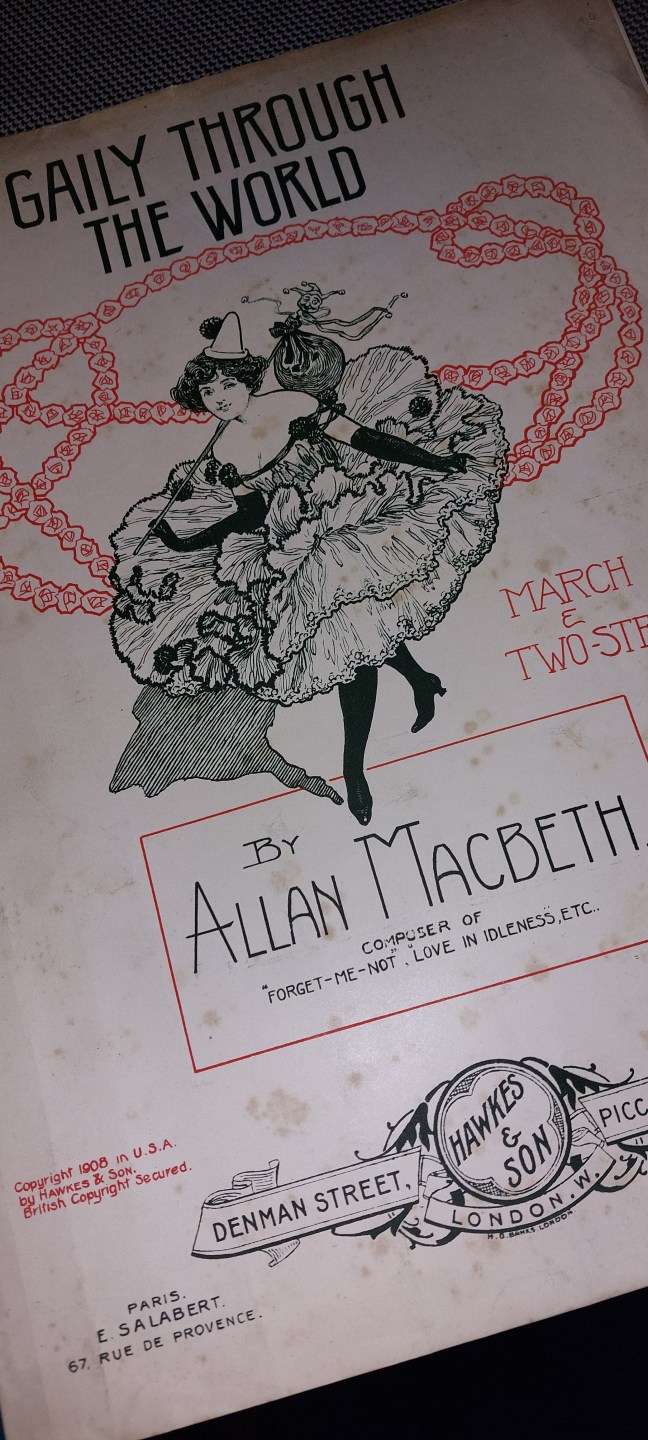
The first Athenaeum School of Music Principal, Allan Macbeth, left in 1902 when the Board decided they didn’t want a Principal who also taught. Macbeth resigned in a huff, and opened his own music school. I traced a few of Macbeth’s compositions, and I’ve done some research into his life – but not as extensively as I have for the second Principal, Dr Harper.
Harper had been working in Southport, which is on the north-west English coast between Blackpool and Liverpool. He came highly recommended. However, he only held his Athenaeum post for a couple of years (1902-1904), then resigned. The absence of institutional records for those years means we’ll probably never know why. Did he jump, or was he pushed? Was it a repetition of the Macbeth situation? His resignation from a different post, some years later, was attributed in some quarters to a lack of tact, but there could have been extenuating circumstances, and we certainly shouldn’t believe all that we read in newspapers! Anyway, it was some fifteen years before the Athenaeum School of Music had another Principal. I outline more of the Athenaeum’s story in my book, A Social History of Amateur Music-Making and Scottish National Identity -but it’s not part of today’s podcast.
The Athenaeum School of Music thread is just one line of enquiry. An English gentleman who moved to the West of Scotland and only stayed in his prestigious post for two years, may not have made a huge impression on the overall trajectory of the institution.
Indeed, two years in the life of a man who lived to the age of 75 (or possibly a little older) is barely a drop in the ocean. However, it did make me curious about the rest of his life! That’s the second thread – to establish a basic biographical outline for Dr Harper, LRAM.
However, the aspect of most irresistible, and most immediate appeal, was neither Harper’s place in the annals of the Athenaeum, nor the tracing of his life and career, fascinating as it turns out to be. Instead, it is one particular three-manual organ that Harper played. This organ, and Harper’s organ-playing, has been my third line of enquiry.
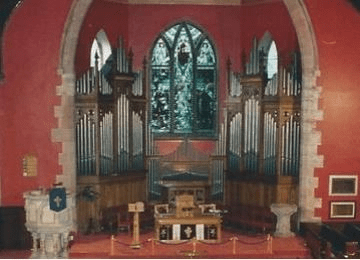
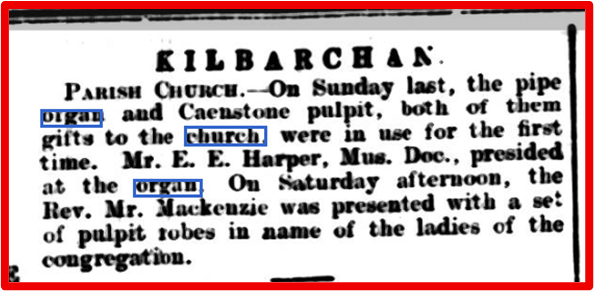
You see, when Harper left the Athenaeum, he remained in the West of Scotland, and became the first organist of a spectacular new organ in the new parish church at Kilbarchan, five miles from Paisley. The old parish church had been replaced by a large new building at the turn of the century. The three-manual organ was gifted by an unnamed lady, and was built by an English firm called William Hill and Son. Harper played for the inaugural recital in Autumn 1904, and stayed for five years. The Athenaeum’s loss was clearly Kilbarchan’s gain.
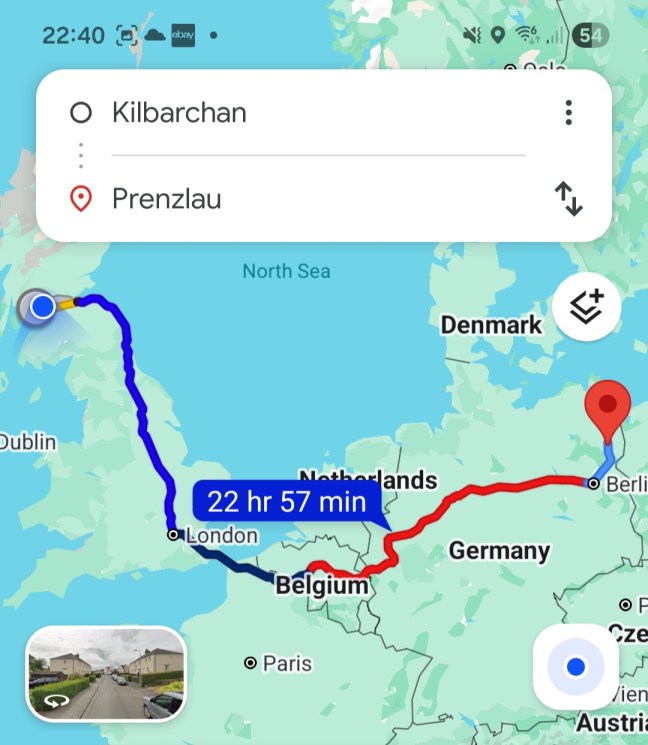
And why is this of immediate interest? It’s because the organ has recently been moved and installed at St Marien, in Prenzlau, Germany.
You see, despite being only a small village, for many years Kilbarchan had two Presbyterian churches – for reasons concerned with mid nineteenth century Church of Scotland politics. The one with the Hill organ was eventually named the West Kirk, and the other the East. In the present century, the churches combined, leaving the West Kirk redundant, and the organ needing a new home. A home was found, organists and churches liaised, and organ builders got to work on the complex operation of dismantling, transporting and reassembling this substantial instrument.
There’s a festival and weekend conference taking place in mid-May 2026, at its inauguration in Prenzlau. The organist there, Hannes Ludwig, has a Facebook page neatly entitled ‘Hill’s Angels’, about the organs built by this firm, and the excitement about St Marien’s new instrument is – I might say – off the register, in organist circles. It’s a fantastic story. I really wish I could go to Prenzlau, but I’m already committed to an equally important weekend engagement among.
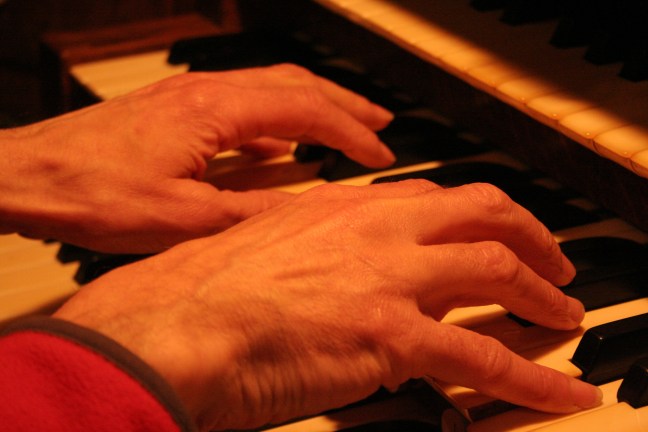
Kilbarchan isn’t very far from Neilston, where I’m currently organist in the parish church. The organ I play is smaller than the Kilbarchan instrument – we only have two manuals – ie, keyboards – compared to their three. And our organ, barely a few years older, was originally powered by a person operating a manual pump. (The stump of the lever is still visible.) Their’s was quite possibly powered electrically from the start. This means the organist could go and practise freely, without needing someone to pump the handle! And there’s another difference – the Neilston instrument is still tracker action – the notes are sounded by levers connecting the keys to the opening and closing of individual pipes. The more stops you pull out, the heavier the action. From what I’ve read, the Kilbarchan instrument was probably always electro-pneumatic. A bigger instrument, more stops, and less physical effort.
I’m not an organologist – incidentally, that’s actually someone who researches musical instruments of any kind, not just organs. So, what have I been researching?
Well, I’ve got a very detailed chronology of Harper’s life in England before he moved to Glasgow for the Athenaeum post. I’ve traced where he lived after he left the Ath., and his subsequent life after he emigrated across the Atlantic.
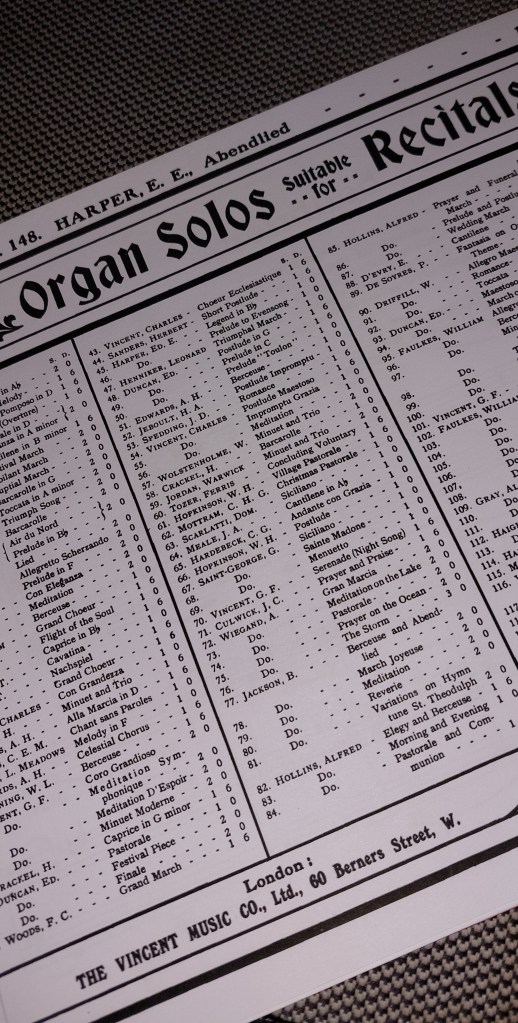
He seems to have been a teacher not only in institutions, but also as a private music teacher. However, being an organist is a thread that runs throughout his life. I’ve traced his professional education and training, and the places where he was organist. I’m compiling quite a lengthy list of his compositions. Not much of it is extant, and just one single piece is accessible on IMSLP. I picked up another rare volume in a local second-hand music shop. It’s a bound volume including three of his pieces from just before he was employed by the Athenaeum. And I’m waiting excitedly for the arrival from America of another collection that I sourced on eBay. (Having been a music librarian professionally, I do have a certain aptitude for sourcing old music!) The latter book may not contain particularly demanding music, since it’s for American organ or harmonium, and that means, no pedals. Nonetheless, if it contains a dozen or so pieces by Harper – AND was published by a Glasgow publisher, possibly after Harper left Scotland – then plainly I had to acquire it! It metaphorically had my name on it.
So, in short – I’ve researched his life, his career, and his compositional output. From an institutional perspective, I wanted to know the strengths of this individual who was recommended to the Athenaeum by no less than his doctoral supervisor, Ebenezer Prout . (If you’ve ever sung Handel’s Messiah from an ancient Novello copy, then you’ve held a piece edited by Prout. He was a big name.)
I can conclude that Harper was a capable teacher, organist and composer. His compositions may not have endured any longer than his own lifetime, but he was certainly competent, and I’ll be adding the proper organ pieces to my own repertoire, although I don’t know what the American organ/ harmonium pieces will be like! Moreover, to judge by a contemporary remark by someone who worked alongside him in his first year overseas, a huge, unquantifiable amount of music seems not even to have been published at all.
In a wider sense, it has underlined just how important a position church organists held in the late nineteenth and early twentieth centuries. Of course, I can’t tell how much of his income was earned by being an organist, compared to classroom or private teaching. I sense that being an organist may have been the main part, but I don’t know enough to reach an informed conclusion here.
When he left Kilbarchan, there were no less than – wait for it – 85 applicants for the vacancy. For a small village, a short train-ride from Paisley, that’s a lot of applicants. There were clearly a lot of organists about, and the three-manual Hill organ was obviously a big draw. To this day, it’s considered a fine instrument.
He’d never have guessed that by 2015, Kilbarchan West and East churches would have united, and the West Kirk would have been vacated. Nor that the magnificent three-manual organ would have been relocated to Germany, to such great acclaim.
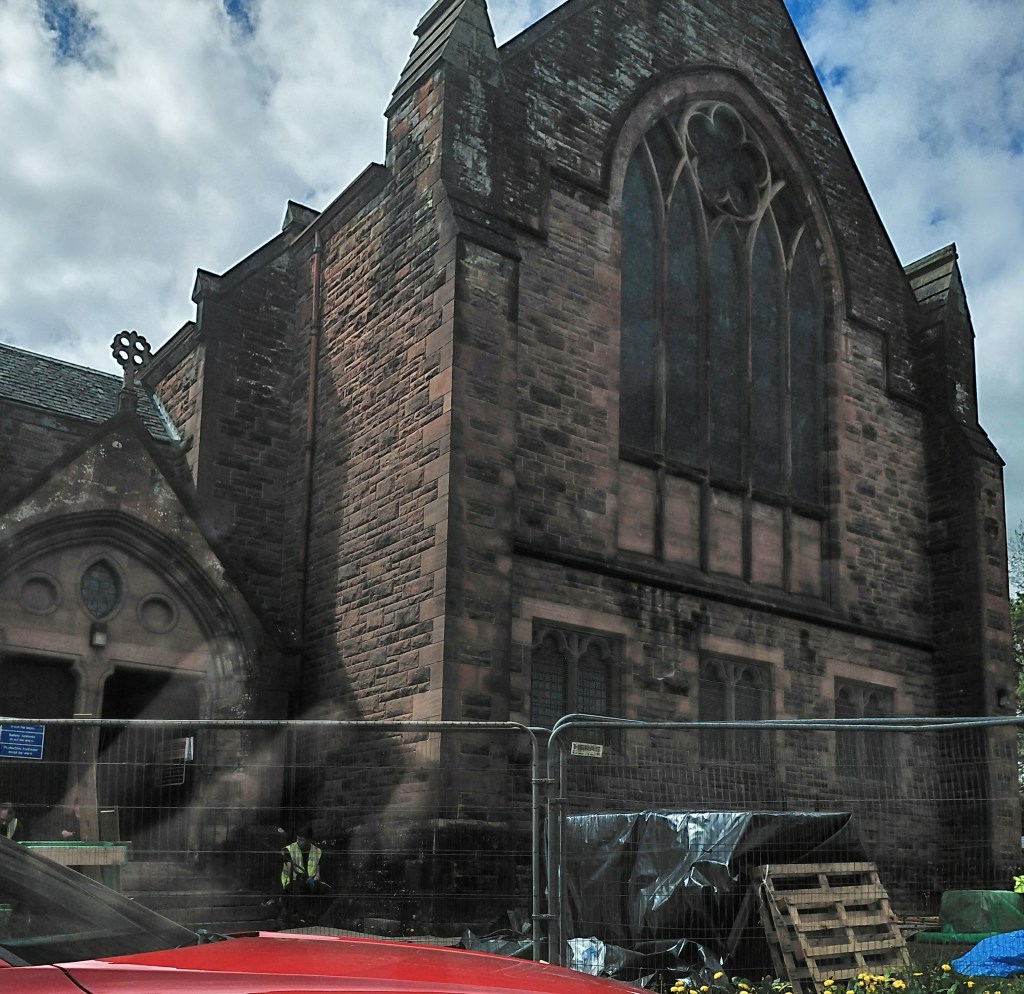
We went to Kilbarchan earlier this week. It’s still a small village of only 3,600 or so people, and that could be the largest it has ever been. I’d have liked to have stood on the doorstep that Dr Harper finally left in summer 1909. However, there were fences up, and construction workers buzzing around. It was sold almost exactly a year ago at auction, with planning permission for 17 flats.
The doors were open, but I wasn’t going to intrude upon a building site. It felt as though I’d chanced upon a quietly significant moment in time: the organ re-purposed and brought back to glowing life in a new country, and the church itself re-configured for secular use in the present day. I wonder what Edward Harper would have made of these changes?
We’ll never know! [pause]
Any more than we’ll know why he left the Athenaeum in Spring 1904!