Dr Karen McAulay explores the history of Scottish music collecting, publishing and national identity from the 18th to 20th centuries. Research Fellow at Royal Conservatoire of Scotland, author of two Routledge monographs.
The 10 June 1902 was a significant day in the life of the Glasgow Athenaeum School of Music. The next day (11 June), The Scotsman reported:-
Glasgow Athenaeum School of Music
Dr Edward E. Harper, the new principal of Glasgow Athenaeum School of Music, was introduced yesterday in the hall of the Athenaeum to a large gathering of students and others interested in music. Councillor Ure Primrose, who presided, said that Dr Harper’s appointment was undoubtedly an epoch in the history of the Athenaeum, and especially of its School of Music. They had a Royal Academy of Music in London, the only one in the kingdom [this was actually incorrect – it wasn’t the only such institution], and he saw no reason why they should not have a similar institution in Scotland. Dr. Harper spoke briefly, and remarked that it would be his earnest endeavour to realise the aim of the directors to make the school a thoroughly effective one.
Harper was our second ever Principal, succeeding Allan Macbeth. He was only to be in post for a couple of years, and there’s no record of why he left. Indeed, we’ve come on a lot since then, and increased hugely in standing. He’d be astonished if he came back today and discovered jazz, traditional music, drama and production arts, film, television and ballet!
I recorded a podcast about Edward Emanuel Harper a few weeks ago – you can hear it here.
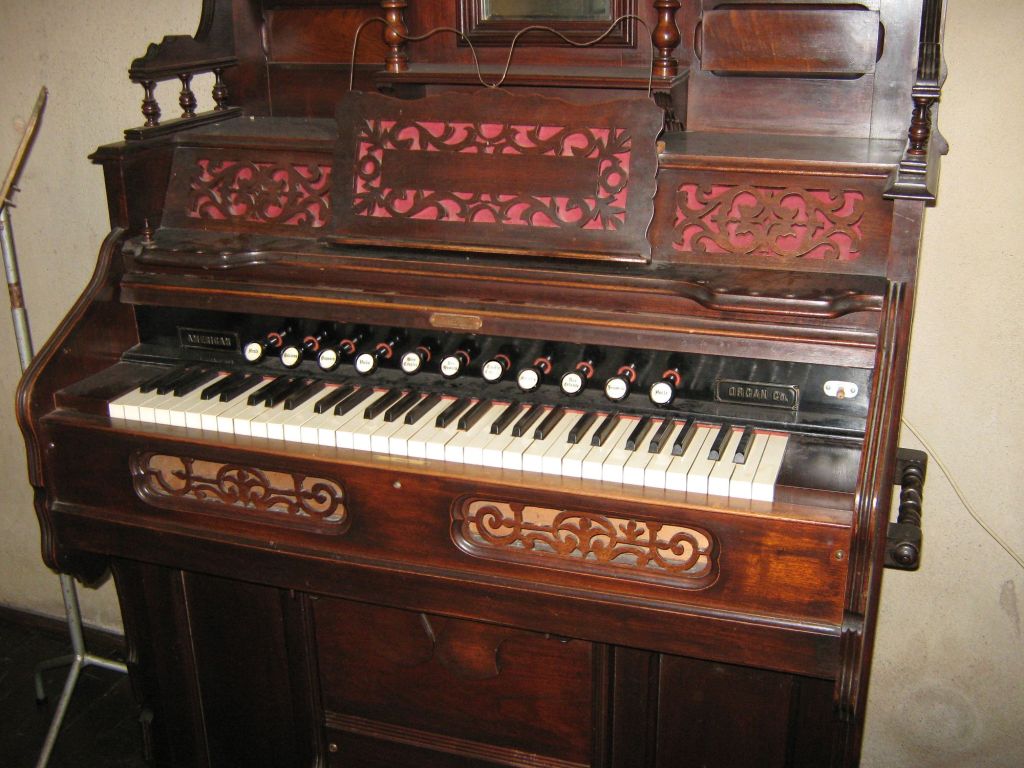
Dr Edward Emanuel Harper has a lot to answer for. As I mentioned in my podcast, I was awaiting a book of American organ/ harmonium pieces, published in 1926, which included a number of pieces by Harper. It’s quite a small book, and arrived from California – in a huge box – yesterday. (An American organ is an instrument very much like a harmonium – a keyboard instrument powered by wind, often for domestic use. My own Welsh grandfather had one.)
American organ (Wikimedia)
As I suspected, they’re short, easy pieces. Amongst the 51 pieces are thirteen by Harper, along with pieces by eight other composers, some of whom would still have been living, and some dead. (Nine pieces were by an American woman of English parentage. That’s not part of today’s story – but kudos to Bayley & Ferguson for including her. All the other composers were men.)
However, even if the pieces in this book – the second book in a series of six – are predictably straightforward, I shall still play them over, just out of curiosity. There’s not a great deal to say about them, after observing that Harper liked chromaticism in the slower pieces, but he also contributed some more diatonic march-like items – and a ‘Scots Coronation March’ which is remarkably un-Scottish.
Notwithstanding the simplicity of the contents, the book itself had more surprises for me. And I fell down a rabbit-hole, as I investigated.
Transcontinental
I’ve written about Scottish music publications having been distributed across the diaspora, but this usually entails one transcontinental trip from the UK, whether commercially, as a gift or by a migrating owner. This copy has travelled thousands more miles than that!
Here we have a book from a Glasgow/London publisher, including pieces by Harper (now in Canada) and the Anglo-American lady, and a German composer who had died some sixty-odd years earlier. It was first published a hundred years ago. Obviously, I’ve no idea whether it was a new copy, ie still in print, when the late owner apparently acquired it in the 1950s (bear with me, I can explain how I think it was then), or if they were given it by someone else, and subsequently wrote their own name on it. The book was ‘printed in Great Britain’ (so I guess that probably means it was NOT printed by Aird and Coghill in Glasgow) – but it was sold to a previous owner, by a firm in Adelaide, Australia – Cawthornes Ltd.
How, I wondered, had the book got from Adelaide to California?
There are Doctors and Doctors …
The late owner’s name is on my copy. It was a distinctive name – so I looked it up, out of curiosity. In deference to their memory, I won’t name them, but the details proved really quite easy to find out, so it feels okay to share the barest outline of my discoveries.
The book had clearly belonged to someone in Adelaide. I can pinpoint the 1950s because the Australian owner gained their undergraduate and Masters degrees in Adelaide, having travelled thousands of miles across Australia to get there. They married there – indeed, their father conducted the ceremony. (This versatile pastor had also played the organ on an evangelical mission to a first nation community in his younger days.)
The newly-weds moved from Adelaide to California to further the career of the named individual on my American organ compilation – who became an eminent scientist. I do know, from the eBay vendor, that the book was one of a number of church-related music publications being disposed of. Although I don’t know for certain if the owner of the book was an organist, their name was on it. I like to think they played it. Does it matter? No, not really!
Of course, the singular, distinctive life-history of one single copy has no bearing whatsoever upon Edward Emanuel Harper, who was in his sixties in Canada by the time the book was published, and was long deceased by the time the book’s owner was a student in Adelaide.
The whole story is just a series of unrelated happenings during the course of its life. It just amuses me to think that an Anglo-Scottish book including short organ pieces by our second Glasgow Athenaeum School of Music Principal – a Doctor of Music – ended up being sold to an Australian scientist at the start of their career, remaining in their music collection as they gained their PhD in one American state and grew in stature and reputation in another – they were not the kind of medical doctor that we think of when we talk of hospital doctors, but certainly working very closely alongside them . I wonder if and when they last played this music?
Home Again
It would have left Britain between 1926 and around 1958, went to Australia and then the USA, but now, finally, it is back in Glasgow, flown back to the home town of the former Bayley & Ferguson, where it’s being pored over by another musical doctor – this time a PhD rather than a Mus.Doc.
That’s quite a life-story for a humble little book of Church Voluntaries!
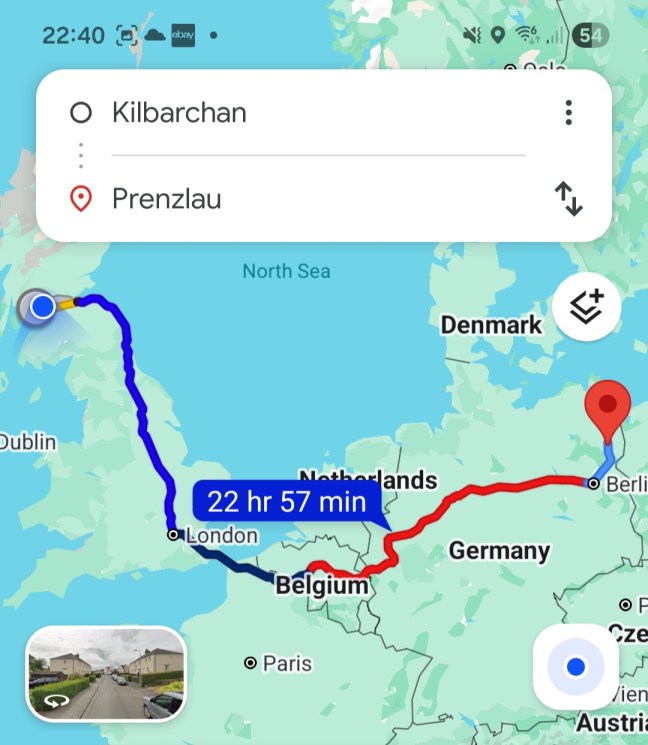
So, we’ve talked about the church organ which has been relocated from Kilbarchan (near Paisley in the west of Scotland) to Prenzlau in Germany. Well, the first organist to play the instrument in Kilbarchan, went on to travel a whole lot further than that.
Edward Emanuel Harper
I’ve collated a lengthy document about the Glasgow Athenaeum’s second Principal. He was only with us a couple of years, of course. After that, he was Kilbarchan’s organist a little bit longer.
The family went briefly back to Southport, before heading to Ottawa – for a year – and then settled in Vancouver.
My notes are full of clips from newspapers. I traced his first Canadian year as an organist in Ottawa – and some snippets of genealogical data in Vancouver. But nothing of his teaching, and no trace of a large compositional output. I’ve looked at library and archive catalogues. Even a promising entry to his ‘archive’ leads to one piece, contributed anonymously by post in 1971. I’ve seen a digital copy of it. It was self-published.
So What?
You might ask – I’ve already asked myself – why I need to know? (Apart from the fact that these little research questions tend to take on a life of their own!) And I think it’s because Harper was plainly a gifted individual – a PhD from Dublin, an LRAM, a brilliant proponent of Chopin, sought after as an organist and recitalist, and a prolific composer.
So where is his Canadian output, in manuscript or published?
And what led him to resign from the Athenaeum, seen by many as a ‘plum’ job? Our records are missing for that era. Did we let a genius slip away? Or were there difficulties that history has graciously concealed?!
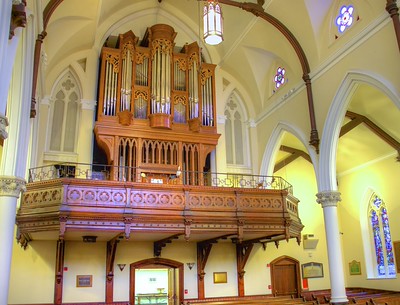
Image: St Andrew’s Church, Ottawa (Copyright: Jamie McCaffrey, Flickr)
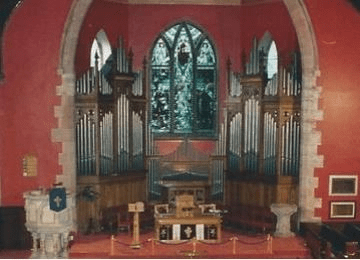
It was 2018 when the BBC posted the story of a magnificent three-manual organ built by Hill and Son, which was being taken out of Kilbarchan West Church – no longer needed after a merger – and transported to Prenzlau:-
The Hill organ at Kilbarchan West Parish Church (photo from Kilbarchan West website). *
It has taken a while – Covid got in the way – but in May 2026, there’s going to be an organ festival to celebrate the inauguration of the organ in its new home.
Former Athenaeum Principal Inaugurated Kilbarchan Organ
Well, I’m excited, even though I don’t think I can justify going all that way. (Or can I?) You see, I’ve been researching the second Principal of the Glasgow Athenaeum – Dr Edward Emanuel Harper, who was only with us for two years, 1902-1904. After that, he left. There are no records extant to say why he left. But within a few months, by September 1904, he had been appointed organist of …
Kilbarchan Church.
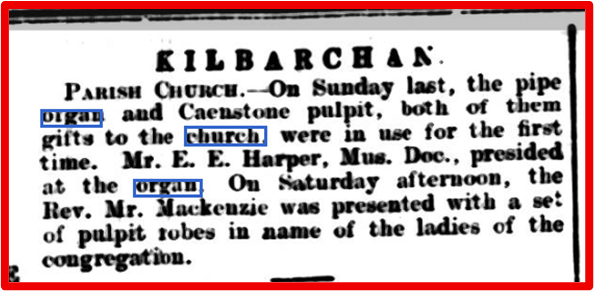
He played the inaugural recital for the new Hill & Son organ.
British Newspaper Archive: Paisley & Renfrewshire Gazette – Saturday 22 October 1904
I won’t tell you his whole story here – I already mentioned him, only a few weeks ago. By 1909 he had gone back to Stockport, accepted a job offer in Canada, been widowed before they had even moved to Canada, but still moved his young family to Canada as planned, and started a new life. And then another new life on the opposite side of Canada a year later.
Part of his fascination for me is his elusiveness, I must admit. Why did he leave the Athenaeum? What persuaded him to return to his home-town, or to cross the Atlantic? I do know a little about what happened when he got there. And I’ve traced his publications in the UK, but can only find only one published in Canada. Why? It’s hard to imagine he didn’t publish any more.
But most pressingly – do I want to go and hear the rebuilt organ which was, originally, only a few miles away from Neilston, where I am currently organist? After all, I’m not researching organ-building, or organ music. And Harper wasn’t a Scot, or published in Scotland – but he WAS briefly our Principal. I’m drawn to the story and the connections …
* The original Kilbarchan church was more recently known as Kilbarchan West Parish Church, before it combined with Kilbarchan East. At that point, the united congregation elected to use the East Church.
The first and second Principals of the Glasgow Athenaeum School of Music weren’t actually in post very long. Allan Macbeth managed twelve years (1890-1902); then Edward Emanuel Harper, only two (1902-04). I’ve been researching them recently, and I’ve found out quite a bit more than has hitherto been known. But this post is not about their biographies and achievements – that’s for another time.
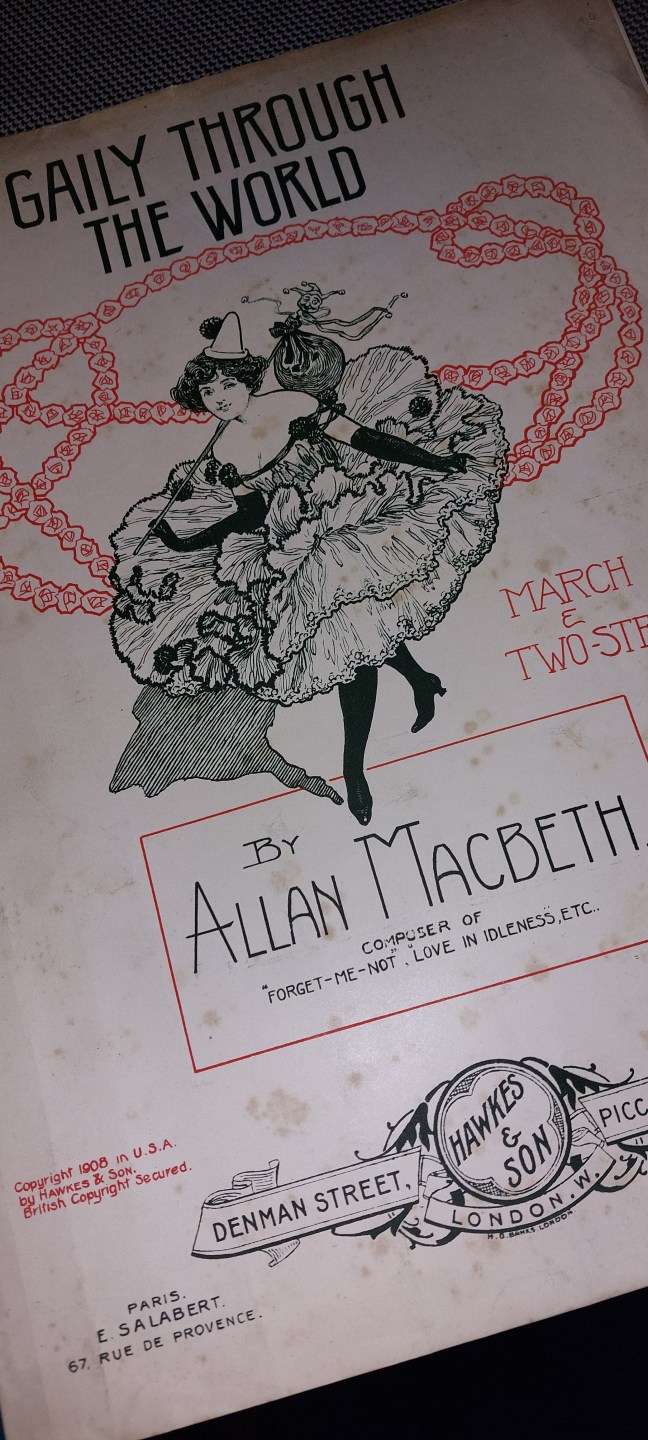
No, today is about practical music-making. Amongst a handful of compositions, Macbeth wrote a march and two-step, Gaily Through the World, which is actually very jaunty, and enjoyed quite a long life as a piece of band music. It’s not high art, but it does stand up as an effective piece of light music. It was published in 1908, two years before he died, by Hawkes. (Yes, the Hawkes that later went into partnership with Boosey in 1930.) That in itself is a mark of its respectability, if nothing else. The author of this YouTube posting says it was premiered at a Boosey Promenade Concert in 1896 – when Macbeth was in the middle of his Principalship.
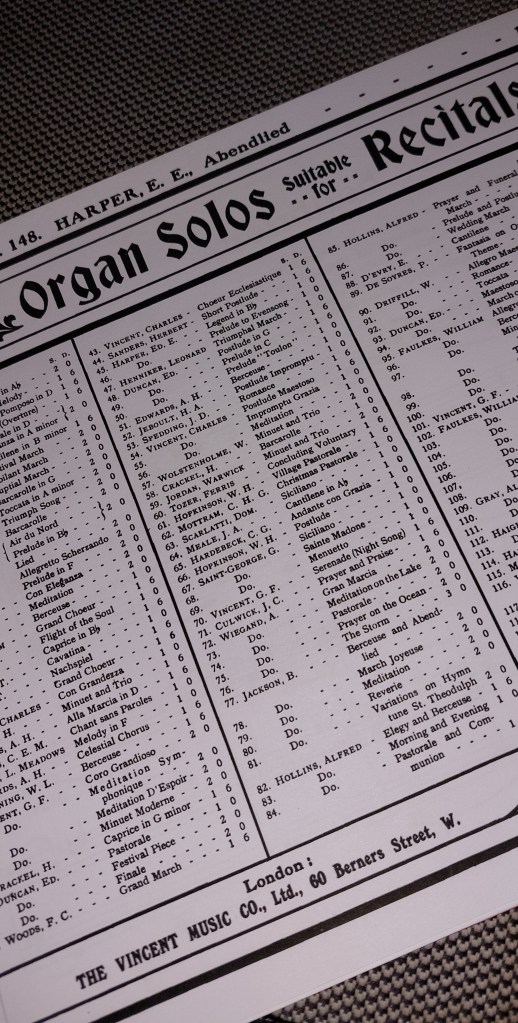
Harper seems to have had a larger output. Again, it was respectable but not remarkable. Nonetheless, I found a piece of organ music on IMSLP, this time published by Vincent Music in 1903, halfway through his own spell at the Athenaeum. (Vincent Music was the firm who would later publish James Woods and Learmont Drysdale’s Song Gems (Scots), which I’ve written about before. They were not as eminent as Boosey or Hawkes.) Abendlied is gentle and reflective, and appeared in an extensive series of ‘Organ Solos Suitable for Recitals’. It’s not hugely memorable, but it’s a nice enough piece for all that. Whilst Macbeth and Harper were both organists, each at several churches, I’ve formed the impression that being an organist occupied perhaps more of Harper’s career than it did of Macbeth’s, but this is really only a guess; moreover, Harper lived much longer than Macbeth and was only Principal of the Athenaeum for a couple of years. He obviously occupied himself in other ways for the rest of his career, and I have quite a list of the churches where he ‘presided’ at the organ.
Anyway, I digress. I played Abendlied before morning worship this morning. (No-one knew it was an ‘Abend Lied’, after all!) It could well have been played by Harper, just a few miles away, when he was organist at Kilbarchan.
But I saved Macbeth’s Gaily Through the World for my outgoing voluntary – and it did get noticed! It fitted the organ so well that I wondered if he had ever tried it at the organ himself – though maybe he might not have considered it serious enough for late Victorian Presbyterians …
Kilbarchan church was more recently known as Kilbarchan West Parish Church, before it combined with Kilbarchan East. At that point, the united congregation elected to use the East Church, and the organ itself was dismantled and sold to St Marienkirche church in Prenzlau, Germany. There’s a festival in May 2026, to celebrate the organ’s inauguration in its new home.