Scottish Songs and Social History: ‘The Gaelic Hotch Potch of Story, Song and Music’

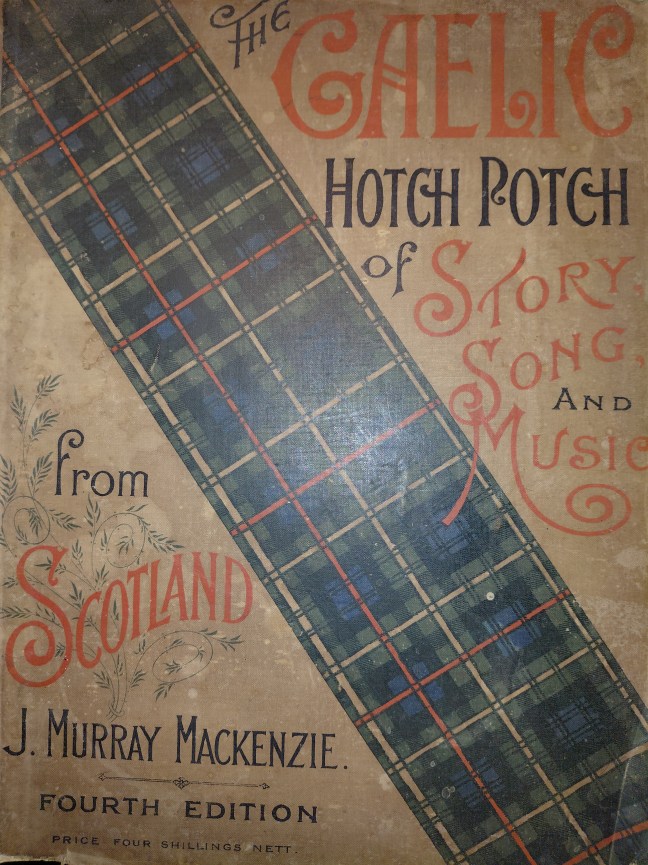
Cover of song book, Gaelic Hotch Potch

An Unusual Anthology

Whilst the rain pours and a breeze gets up outside, I decided that today was definitely a day for indoor pursuits, and – with my mind on a forthcoming lecture – I thought it was time to look at a volume which is quite the most unexpected of all the Scottish song books in my collection. My interest was in the motivation for its compilation. I love working out what the compiler had in mind, and who his intended audience might be.

The whole book was ‘printed for the proprietors’ by McCorquodale & Co., Ltd and Aird & Coghill, (letterpress and music respectively) both in Glasgow. It’s a scruffy old tome – I really haven’t looked at it closely before, largely because it looks so unappealing from the outside. It was clearly compiled for advertising purposes, and I didn’t expect to find much of note inside. Don’t get too excited about the ‘Gaelic’, though. It’s the name of a brand of whisky…

The Gaelic Hotch Potch of Story, Song and Music from Scotland, by J. Murray Mackenzie (4th ed.) Stirling, 1895

Diagonally across the cover, is printed a strip of the compiler’s family tartan. (I’ve written before about the obsession with tartan on this kind of book. It would have appealed to the target audience.) This 4th edition was published in Stirling in January 1895. However, a notice in the Indian Daily News (30 Oct 1895) says that the book is in its fourth year of publication, so I imagine it first came out ca. 1891.

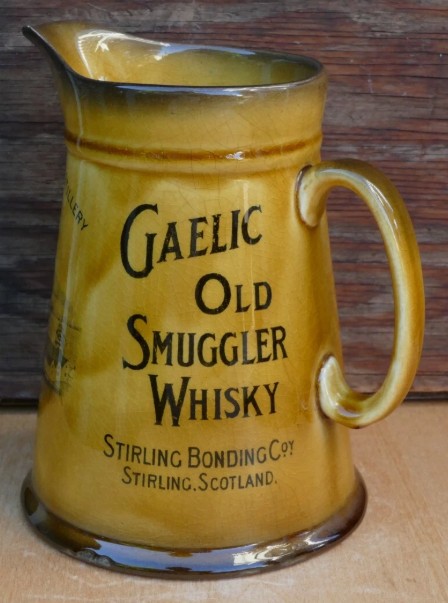
The National Library of Scotland has the only library copy – of the subsequent, 5th edition, which dates from 1911. By this time it was entitled The Gaelic Old Smuggler hotch-potch, which actually tells you all you need to know. It is connected with a whisky company, The Stirling Bonding Company, Ltd. (My heroines, poet Mary Ann and her composer daughter Rose Smith would not have been impressed, being firmly committed the temperance movement!) Anyway, my 1895 copy informs the reader that,

The “Gaelic” Whisky and “Old Smuggler” bottle are both registered, and we warn those infringing the above trademarks in any way, that they will at once be proceeded against.

Mr Mackenzie declares in the ‘Introductory’ preface that ‘many friends’ had requested this fourth edition. He describes it quite accurately, as,

… a short collection of familiar Scotch Songs, Highland Music, and Stories of an anecdotal character associated with the district of Stirling, interspersed with a few facts about Scotch Whisky, and Recipes for Haggis, Scones, Porridge, and Oat-Cakes, in truth, a veritable Hotch-Potch. Many of the anecdotes are old […] To some they may not be “cauld kail”. To the many I trust they may have more than a mere passing interest, and may serve to carry their fancies back to “Bonnie Scotland”, the land of their birth.

For the Overseas Market

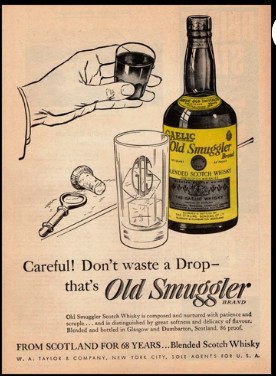
Aha! This book is for the ex-pat in the Scottish diaspora. It wasn’t just advertised in India – I found it advertised in New Zealand, too. Even into the 1940s-50s, this “Gaelic Whisky” and “Old Smuggler” went to Australia and America, and plenty of ephemera can be found on eBay accordingly. There’s far less ephemera to be found on home ground, and the book itself appears to be quite rare.
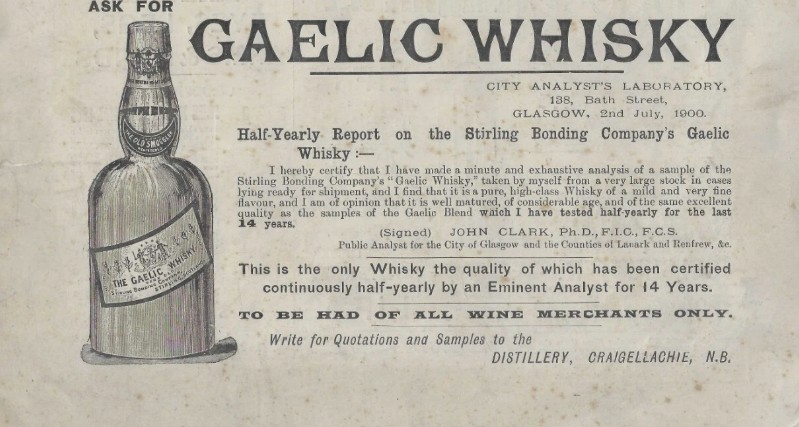
My copy, which was priced at four shillings, is dedicated to the Directors of the Stirling Bonding Company, Limited, as a mark of the compiler’s ‘appreciation of [their] endeavours to maintain the character of true Scotch Whisky abroad, and upright dealings at home.’

The Compiler, J. Murray Mackenzie

Restaurateur?

Despite his ‘Introductory’ being signed ‘Stirling, 1895’, Mr J. Murray Mackenzie is not easy to track down, but I don’t think he published any other books of Scottish songs and tunes. Did he work for Stirling Bonding Company, or maybe have something to do with their advertising? He was not amongst the senior managers who signed an agreement to become part of a larger company in 1896. I’m intrigued! Despite AI having suggested he was an Edinburgh architect, I’m more inclined to think he’s the man who, having previously been an invalid attendant for some years, got a public house licence for wine and beer in Edinburgh in 1910, and was described as a restaurateur from 1912 onwards. This bloke lived from 1859-1928, so he’d have been 32 in 1891.  I haven’t yet linked him to any music making, but this does at least link him to alcohol supply! It’s feasible. *

Piper? Highland Dancer?

But please don’t take my word for it – it’s such a common name! There was also a Glasgow John Mackenzie who won prizes for piping and Highland dancing at Highland games and gatherings, certainly from 1889 onwards. It would be nice if it were the same man, but first we’d have to explain why he was in Glasgow. (And I found a married John Mackenzie, recent Piper to the Caledonian Asylum in London, in spring 1880, but the Edinburgh man that I found first was ‘John M. Mackenzie’, and a bachelor when he married in 1894, so that tends to rule out the earlier London-based Scot.)

Contents

So, what have we got here?

  • Introductory
  • Recipe for Scotch Haggis by Mistress Meg Dods of the Cleikum Inn, St Ronan’s (Vegetarians might turn the page quickly here! It’s detailed. Meg Dods was the proprietor of the Inn as early as 1823 and seemingly published a cookery book in 1827.
  • Recipe for Scones by Mary Fraser. I’d have tried this for you, but I don’t have any sour buttermilk, nor a hot girdle. Shame.
  • Recipe for Oat-Cakes by Kirsty MacDonald. (Same problem – no hot girdle.)
  • Recipe for Porridge, by every Decent Scotch Woman.
  • An “End” at a Curling Match. [Comic Dialogue]
  • The Dangers of Tea-Drinking. Reprinted from a leading article in the “Glasgow Herald”, 31st December, 1894.
  • Scotch Whisky. By a Highland Malt Distiller. The opening sentence tells you all you need to know:- ‘[…] in the East it is the universal medical opinion that throughout the tropics a moderate use of alcohol is most necessary to the maintenance of sound health in a tropical resident.’ [Six sides of text, including an advertising puff for the “Gaelic” Whisky, advice and illustrations as to how to tap and store whisky in casks. Extravagant advertising copy is nothing new, either:-

Made in the lonely highlands of Scotland from pure hill water, far removed from the smoke of large cities, distilled from Scotch barley and bere […] This small species of barley, as grown on the upland soils, is sweeter and makes finer whisky than the heavy barley grown in the lowlands. Foreign barley we never touch – thus assuring the quality of our whisky. […]

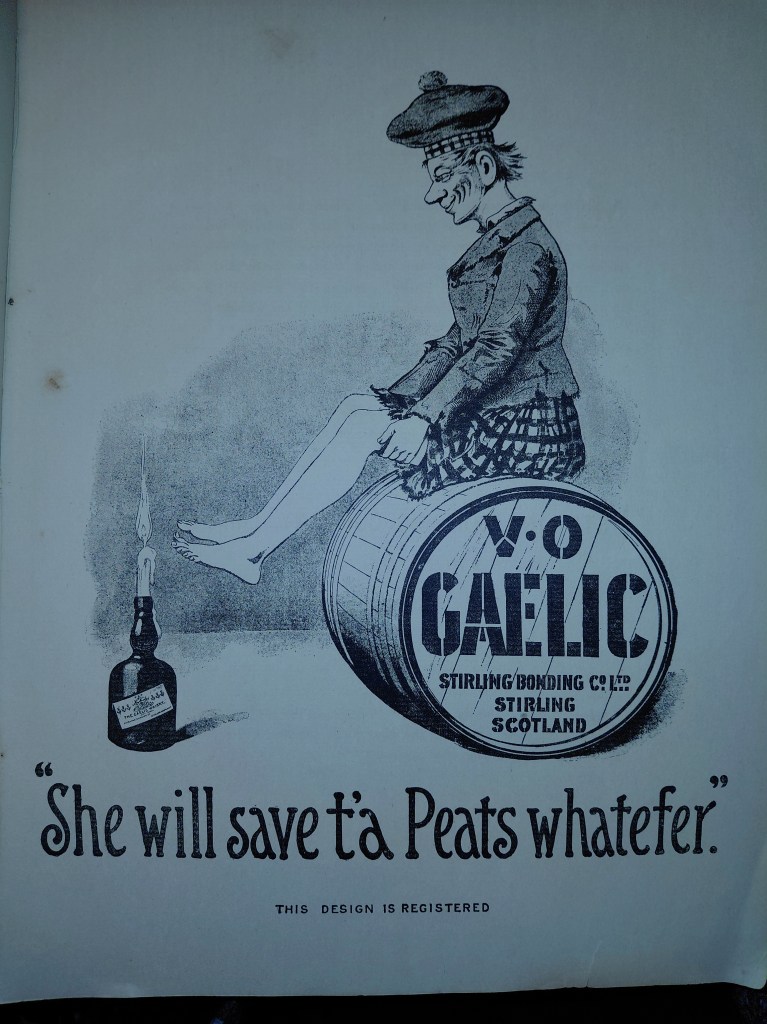
  • A full-page cartoon of a kilted Highlander seated on a cask, warming his feet on a candle stuck in a “Gaelic” whisky bottle
  • 18 pages of ‘local anecdotes’ – 45 of them.

Dance Tunes, Marches, Laments & Songs

And then, at last, we reach the Highland Music. There’s a brief introduction advising the reader that the music is arranged ‘in sets for a full Highland Reel’ – a strathspey to be slowly played four times, followed by a reel, quickly ditto, and another strathspey, slowly ditto.

‘And lastly, the Reel of Tulloch or Hullachan is played as often as the spirit of the dancers can keep it up. I have seen it played for thirty minutes, till couple by couple dropped out.’

Now, gentle reader, here’s the surprise. There are twelve sets of dances provided, and the Reel of Tulloch is repeated at the end of every single set. Wow! So, that’s pp.2-27 taken care of. There’s more.

  • pp. 2-27 Reels and strathspeys
  • pp. 28-38 Marches
  • pp.38-43 Pibrochs [sic]. Note that these piobaireachds are in piano settings – they’re not written for bagpipe performance.
  • pp. 44-50 Laments
  • pp. 52-100 Songs

So, is there anything noteworthy about the contents? The first thing that hit me was that there are just the titles of the dance tunes or songs, and no attributions, So, if you wanted something by Robert Burns or James Hogg … you’d have to know that already, because the book won’t tell you. Burns is well represented amongst the songs.

There is no index or contents page.

The accompaniments for the dances are fairly basic, but grace notes are indicated. Meanwhile, the song accompaniments are competent, and generally don’t mirror the vocal line. Some of the dances have dynamics indicated, whilst the songs have both dynamics and Italian tempo markings.
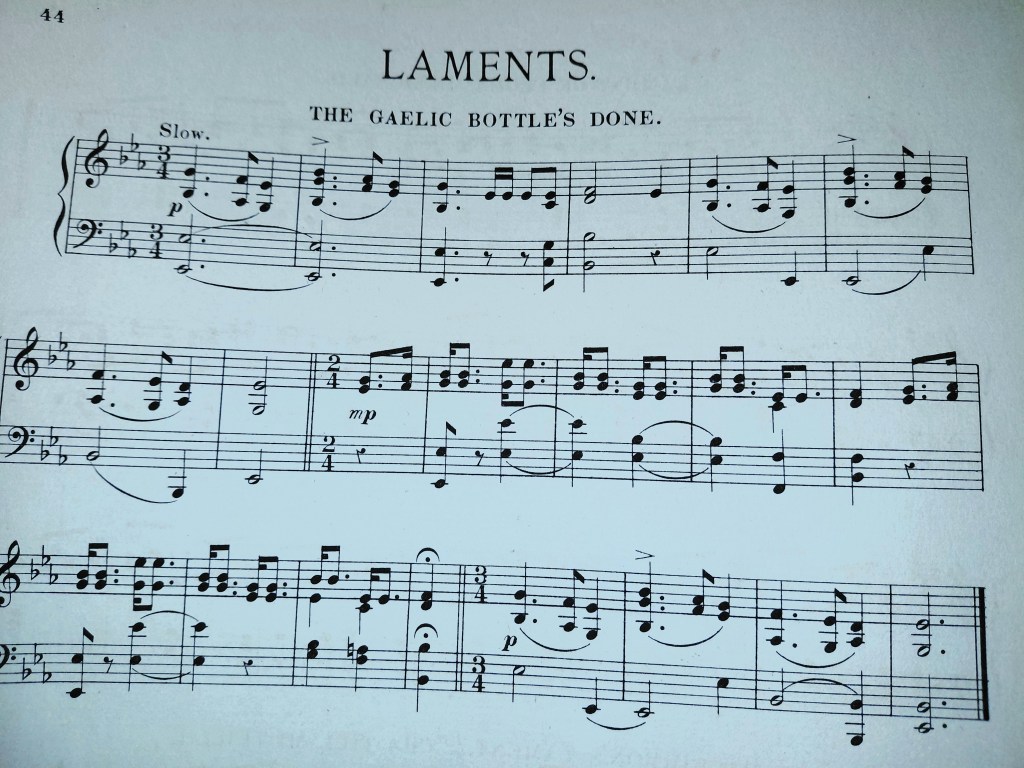
Mackenzie must have had a sense of humour, as the first dance in the book is a strathspey entitled ‘Highland Whisky’. The first lament? ‘The Gaelic bottle’s done’, marked ‘Slow’. And the final song in the book? ‘O, Willie brew’d a peck o’ maut’, sung appropriately enough in an ‘Allegro gioviale’ tempo.

Most of the tunes, including ‘Highland Whisky’, are pre-existent tunes. ‘The Gaelic bottle’s done’ has a new whisky-appropriate name to an old tune. And although I believe the pibroch ‘Cabar Feidh’ has a connection with the Highland Mackenzie clan, it too is a pre-existent tune. I know exactly where Mackenzie got pretty much all of his marches, pibrochs and laments, and quite a few of his strathspeys and reels.

I can also trace most (17 out of 24) of his song repertoire to one particular older published collection, but this doesn’t tell us much. Mackenzie’s accompaniments are a little more advanced, with introductions and codas that the earlier book does not have. And occasionally he’ll have a different version of a Scots word. All it tells us is that Mackenzie chose a fairly common repertoire, and the earlier book has such a massive contents list that it would be surprising if there weren’t as many correspondences.
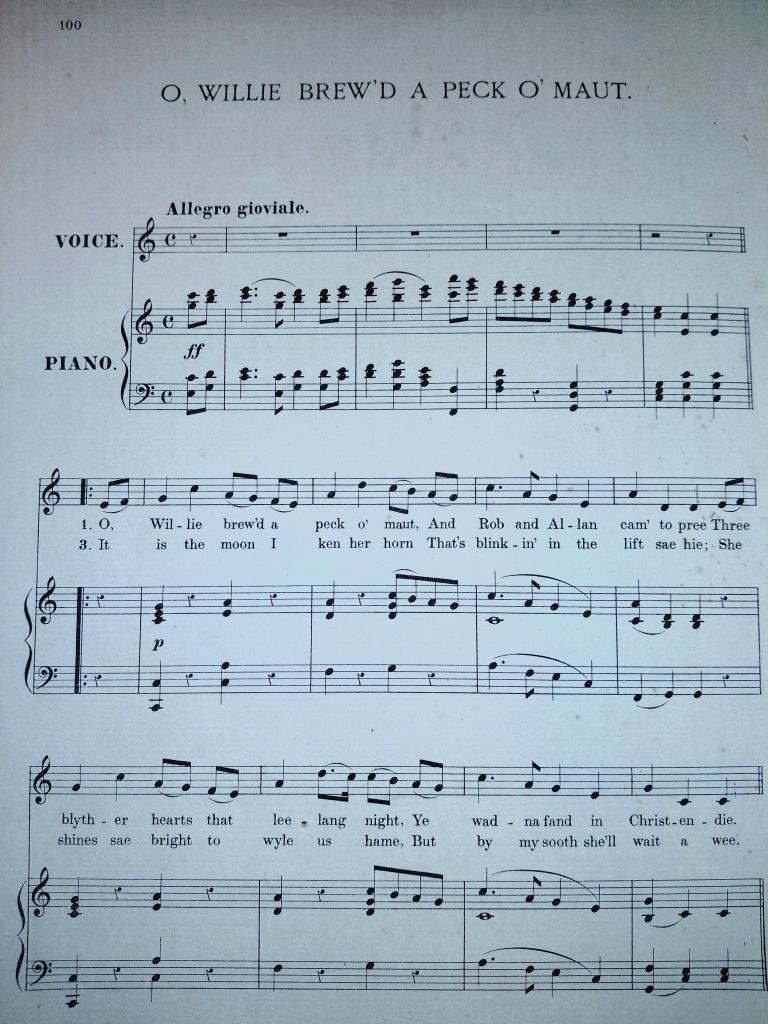
O, Willie Brew’d a Peck o’ Maut

Absent Friends

Unusually, there is no ‘Auld Lang’, and no, ‘Oh, why left I my Hame’.  For a book destined to be sent overseas, it’s surprisingly unsentimental!


The Book’s Afterlife?

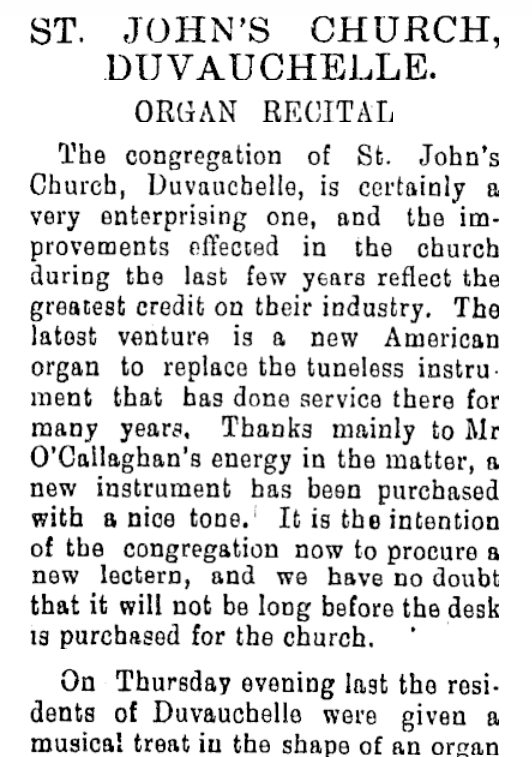
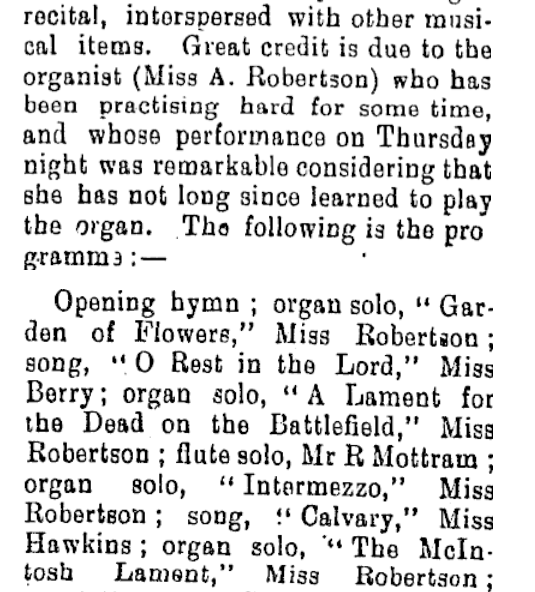
I think I may have found a newspaper report of a lady in New Zealand actually using this book. I’ll share the news-clip, which made me both smile, and wince slightly for the long-suffering congregation! It’s in the Papers Past database from New Zealand’s National Library (Akaroa Mail and Banks Peninsula Advertiser, Volume LXX, Issue 4260, 10 December 1912, Page 2). The ‘Lament for the Dead on the Battlefield’ and ‘Mackintosh’s Lament’ are on consecutive pages in the collection I’ve been describing:-
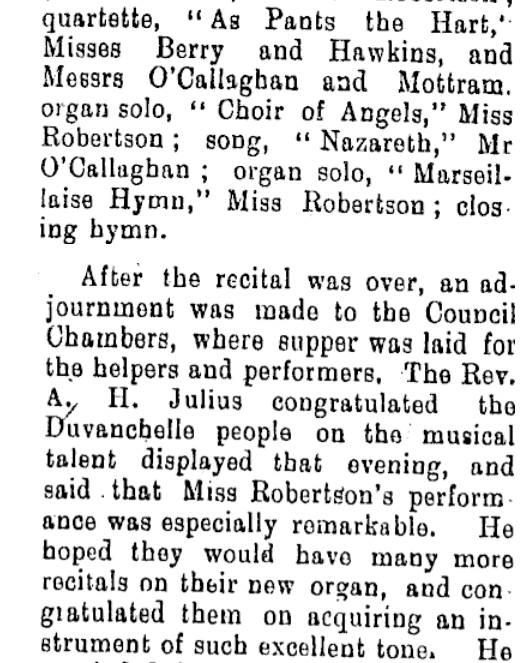
My copy of this book is old and battered. However, I like to think that it has enjoyed an active, possibly rather merry life …


* The AI link to an Eastern European website does name the compilation under the later edition’s title, but their Murray Mackenzie would still have been a schoolboy when he compiled the 1891 first edition!

There’s more about the Stirling Bonding Company on the Bay Bottles website, explicitly emphasising the exporting activity.

And … going off at a complete tangent, I saw a headline in The Herald newspaper today (29 October 2026), saying that tax on whisky is now 74 pence in the pound. I’m certainly no economist, nor a whisky connoisseur, but I was curious to know how this compared with 1895. Oh my goodness! Tax was then 25% or 30%. Mr Mackenzie and the directors of the Stirling Bonding Company would have been most alarmed.

74p in every pound goes to tax as Scot whisky industry sounds alarm
https://www.heraldscotland.com/news/26678541.scotch-whisky-tax-rise-industry-warns-jobs-sales-slump/

Book: A Social History of Amateur Music-Making and Scottish National Identity

Wavy lines of music and an artistic interpretation of a fiddle

Folks, I’ve just noticed Routledge has a 20% summer sale on at the moment.ย  So, if you or your library could use a copy, this might be a good time to get it!ย  (All books and e-books are 20% off until 1 August 2025.)

The accent is on social history and Scotland – and music-making, obviously. I’m keen to hear what readers think of it.ย (If you are a reviews editor, do get in touch with Routledge. There’s a link on the website.)

  • Amateur music making
  • Scottish music publishing
  • Scottish and Irish songs
  • Fiddle tunes and dance music
  • Preserving the heritage and passing it on
  • Nostalgic Scots abroad
  • Newfangled technology

Routledge link

Karen E McAulay,  A Social History of Amateur Music-Making: Scotland’s Printed Music 1880-1951 (Routledge, 2005) 

ISBN 9781032389202
220 Pages
Published October 30, 2024 by Routledge

A Gift Idea? A Social History of Amateur Music-Making

Stumped for a present for your Scottish music enthusiast? My new book is affordable as an e-book! (Just sayin’ …)

A Social History of Amateur Music-Making and Scottish National Identity: Scotland’s Printed Music 1880-1951

Why did Scottish music publishers produce so many songbooks and dance tunes? Who took Scottish music overseas to the diaspora? How did classical composers interact with local publishers?

I’ve discussed all this and more. Full details on the publisher’s page, link above.

Avoiding Dancing (until Research Took me There …)

You probably have to be Glaswegian to know this old chestnut:-

‘Heh, does this tram go to the Palais?’

‘Naw – it cannae dance!’

Well, the tram has my sympathy, as I can’t either. ‘Himself’ and I each have two left feet, when it comes to tripping the light fantastic.  Indeed, his mother used to wonder how someone so musical could be such a hopeless dancer. On the other hand, I realised I disliked the activity as a small child at a party for preschoolers, when a well-intentioned parent tried to make me dance the Twist.  I remember the discomfort and embarrassment to this day.

Image by Luda Kot from Pixabay

We must have been terrible disappointments.  After all, dancing was in the Fyfe’s blood:

  • Great Grandfather, a stonemason, played bass up in Fyvie for winter dances
  • My Grandpa-in-law went to dance classes in Turriff as a boy
  • Mother-in-law was Miss Milligan’s first dance pianist at Jordanhill Teacher Training College, before Jean Milligan even set up the Scottish Country Dancing Society.  Later, after a lifetime accompanying Scottish country dance in Newcastle, she got a certificate of recognition from RSCDS at the St Andrews Summer School.

Meanwhile, my own Mum was a PE teacher like Miss Milligan, taught country dancing at a school in Whitstable, and even got my father to play for her on occasions.

I myself had a Saturday job as a ballet class piano accompanist. It felt a comfortable place to be.

So, it feels as though fate has caught up with me, when recent research into a dance accompanist led me to explore early digitised committee minutes on the RSCDS website (thanks, folks – this was really useful!).  In Glasgow’s Mitchell Library yesterday, I learned some more, from a book I only discovered at the weekend.  I thought the secondhand copy that I found online looked too expensive, but I am reassessing this opinion!

And here I am on a bus to Edinburgh in the pouring rain. I am hoping to see two rare books of reels and strathspeys connected with this one particular pianist who, it appears, was nothing if not a force of nature.  A renowned accompanist, I read that when she and her band had to share the dances with other non country dance bands, they really didn’t know quite how to deal with her – they hadn’t encountered anyone like her!

It’s such a damp and dismal day, that I really hope the National Library of Scotland books are just stuffed with interesting paratext, to make the outing worth the effort!

Image by Michael Drummond from Pixabay

Responding to a Coronation: Sheet Music, Piano Stools & Radios

Since I’m currently working on a book about Scottish music publishers, I suppose it was inevitable that I’d ask myself just one question last night:-

Did 20th century Scottish music publishers publish any music to commemorate the four Coronations of their day? 

Well, you’d have thought they might, wouldn’t you?  There were militaristic books of marches and national songs in war-time, so why not patriotic books of national favourites when a new monarch acceded to the throne?

A couple of klaxon warnings should be sounded straight away. 

  • It would be easy to say that Kerr and Mozart Allan never published anything related to coronations, but the truth of the matter is that I have plenty of evidence that what survives in libraries is certainly not the same as what was published in the first place.  The more ephemeral the music, the slimmer the chance of its surviving.  And, without putting too fine a point on it, a library might keep Mozart Allan’s book of songs by Robert Burns, but a flimsy, contemporary song of the music hall or variety performance kind, not designed for longevity, probably won’t have been added to a University Library’s stock at the time it was published, even if there might be scholars today eagerly seizing upon any lucky survivors.  Similarly, a ‘Coronation Waltz’ or ‘Coronation March’ wouldn’t have been something studied by music undergraduates studying Palestrina or Mozart in a red-brick British University.
  • If you’ve been following social media or broadcast news recently, you’ll realise that some Scottish people are decidedly not Royalist in their leanings.  However, it would be risky to say this was the reason for Kerr and Mozart Allan’s apparent lack of interest in publishing music on a coronation theme.  There is no written evidence about their political views whatsoever.
  • I searched for pieces with ‘coronation’, ‘King’ or ‘Queen’ in the title.  It was a quick and easy search, but certainly not a comprehensive one.  (For example, if there was a song called ‘Westminster Pageantry’, without any of my search terms in the catalogue entry, then I would not have retrieved it.)

But the fact remains that music celebrating the coronation of a British monarch appears not to have been of interest to Kerr and Mozart Allan, the two popular music publishers holding sway in Glasgow for the first part of the twentieth century.

Edward VII and Alexandra’s Coronation, 1902

I found just one Scottish publication, the Glasgow and Galloway Diocesan Choral Association’s Book of the Music to be used at the sixth festival service in St. Mary’s Church, Glasgow on Saturday, June 28, 1902 (in connection with the coronation of His Majesty King Edward VII) etc.  And that was it!

The English firm Bosworth, on the other hand, published Alexander Campbell Mackenzie’s Coronation March, op.63, in various formats: for piano, a full score, and arranged for piano duet by J B McEwen.  Mackenzie (1847-1935) was Edinburgh born, but became Principal of the Royal Academy of Music in 1887.  McEwen (1868-1948), another Scot, was professor of harmony and composition at the Royal Academy, and in time became their next Principal.  Mackenzie’s Coronation March was dedicated to the King, and first performed at Crystal Palace with anything up to nine military bands.  A march was an accessible genre, but the composer was very much part of the English musical establishment.

So, not much to see in 1902, then.  But wait!

George V and Mary’s Coronation, 1911

Bayley and Ferguson had offices in Glasgow and London – and had done for some years.  On the occasion of George V and Mary’s Coronation, they published Carlo F. Roberti’s The Crowning of our King & Queen; or, The Coronation Song of – Semper fidelis.  I know nothing about Roberti, but someone at the Dundee Courier wrote in 1990 that his real name was Charlie Robertson, of Perthshire.  (If you have access to the British Newspaper Archive, you can read how the readers responded to this snippet, on 8 February 1990.  Robertson was a violin teacher.  His song was taught to local schoolchildren at the time.) 

The Scottish firm Paterson’s had offices in both Scotland and London, too.  They published a Coronation song by a Durham man, Thomas Richardson, who had moved to Edinburgh to become organist at St Peter’s Episcopal Church in 1879, and singing-master at George Watson’s College in 1883.  His song, ‘Mary’ had an alternative title, ‘Queen Mary. Coronation Song’, with words by K. Kelly, and was for some two decades popular as what people imagined to be a Scottish song. Which raises the interesting debate as to what makes a song ‘Scottish’!

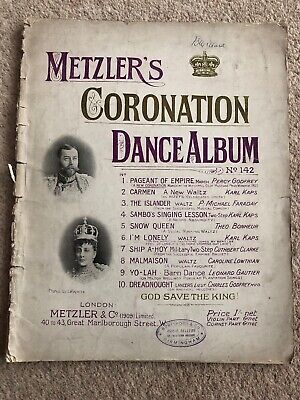
Metzler’s Coronation Dance Album (image from eBay)

Meanwhile in London, light music publisher Metzler published a book of tunes around this time, which included at least one piece composed for Edward’s Coronation: Metzlerโ€™s Coronation Dance Album.  The precise date is uncertain: Metzler gives 1911 in Roman numerals, and (1909) in Arabic.  Very helpful, Mr Metzler!

George VI and Elizabeth’s Coronation, 1937

Paterson’s was essentially a London firm by this time.  J Michael Diack, one of the directors, had moved down south some years earlier.  And that means that the only Coronation theme publications that I traced were either published in England, or overseas.  Perhaps it was the advent of radio broadcasting that made people more enthusiastic about such things, but the outpouring of Coronation-related music was suddenly – well, remarkable!  Many people got a wireless in time to listen to the Coronation – the first time such an event could be broadcast.

‘This Most Historic Event’

Which brings me to an advertisement in the Coatbridge Leader on Saturday 27 May 1937.  F. Mills & Co sold pianos, organs and radios from his two shops in Coatbridge, a town about a quarter of the way between Glasgow and Edinburgh.  (He also had a shop in Motherwell at some point – I haven’t checked dates.)  If you bought a piano or organ before the Coronation, he would give you a free stool.  If you bought a radio – to listen to the broadcast – then there was a discounted price. 

Mr Mills didn’t mention sheet-music, but you’d be surprised how many English music publishers rushed to publish relatively lightweight music for popular consumption, whilst Paterson’s also offered a choral arrangement of a Handel anthem by one of Diack’s favourite composers:-

  • Let all the people rejoice : coronation anthem S.A.T.B. / Handel;  arranged by W.F.R. Gibbs ; edited by J. Michael Diack. (Lyric collection of choral music, sacred. No. 1647) London: Paterson’s 1936
  • Paterson’s Coronation music book
  • Royal cavalcade : coronation march / Albert W. Ketelbey, in piano or orchestral score (Bosworth, 1937)
  • Chappell’s Coronation Album. A Musical Cavalcade, etc. [Marches and Songs.], 1937
  • The Coronation Waltz / Jimmy Kennedy (Peter Maurice, 1937)
  • Long live the King (Paxton, 1936)
  • The Coronation Song / Martin Silver (London: Silver’s, 1936)
  • Coronation March Album / Granville Bantock (London: Joseph Williams, 1936)

Slightly to my surprise – though it was obvious, when I thought about it, with emigration still high – I found publications from Australia, Canada and America too:-

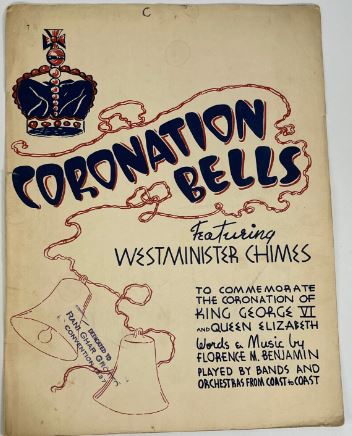
Coronation Bells – image from eBay
  • Sterlingโ€™s Coronation Community Album (1937?)  Disappointingly, the contents of  this publication from the Antipodes didn’t seem to have anything to do with the – erm, actual Coronation.  But I suppose the word ‘Coronation’ would have been eye-catching.
  • In Toronto, Florence M Benjamin published her Coronation Bells in 1937
  • And in Chicago, Moissaye Boguslawski’s Coronation March: dedicated to their Majesties King George and Queen Elizabeth of England was published by Calumet Music in 1937

Elizabeth II’s Coronation in 1953

There was a rush to get television sets for Queen Elizabeth II’s Coronation, although comparatively few people in Scotland would have had them this early on.  Francis, Day and Hunter published a new dance introduced on television for the Coronation.

However, despite now being basically an English firm, Paterson’s turned to their Scottish roots for their Coronation offerings, which had nothing to do with the television broadcast at all.  Indeed, country dancing was very popular across Britain:-

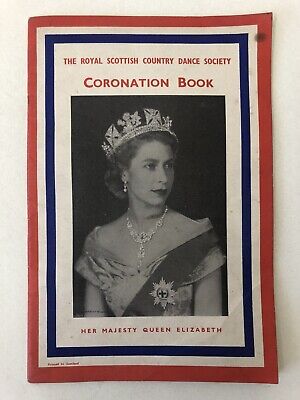
  • For the Royal Scottish Country Dance Society, Paterson’s published The Scottish country dance book. Book 17 : Coronation book / music arranged by Herbert Wiseman.
  • Paterson’s also published Pipe-Major William Ross’s The coronation bagpipe marchโ€ฆ entitled “The coronation of Queen Elizabeth 1953”
  • The English Folk Dance and Song Society also published a book of dances: The Coronation Country Dance Book.

Many other publishers produced music in their own preferred genres, but I didn’t see anything from Kerr’s, Mozart Allan or Bayley & Ferguson.

  • From Bosworth came Coronation march album for piano solo, with music by Ketelbey and a variety of other composers.
  • Bosworth also published a Coronation Suite for piano by Barbara Kirkby-Mason, who was known for writing educational material.
  • Francis, Day and Hunter produced Francis & Dayโ€™s coronation album in 1952, along with
  • Archie Alexander’s The Coronation Polka, followed by
  • Kenneth Wright’s A Waltz For The Queen (Television’s New Coronation Dance), arranged by Sydney Thompson in 1953
  • The Northern Music Company – a London firm – published Coronation Waltz by Christine Hurst and George Warren, with words by Bill Tomlinson and Stanley Barnes.  Reported in The Stage in October 1952, it was written by ‘four northern songwriters’ and received favourable reviews at its introduction in a Butlin’s holiday camp dance contest.  If this makes you think of ‘Hi-de-Hi’, then you’re absolutely right – Butlin’s holidays were cheap, accessible, didn’t involve travelling abroad, and as we all know, dance contests have never gone out of favour!
Coronation Waltz music cover, picture of royal crown.
Coronation Waltz- image from eBay

Last night, I was just idly searching to see if ‘my’ Scottish music publishers showed much interest in Coronation-themed publishing.  On the face of it, those with an English office did make a token effort.  Those based solely in Glasgow may not have done, with the caveat that they might have produced ephemeral material no longer traceable, and there could have been songs that my quick search didn’t reveal.

But I know a lot more about light music publishing in England around those times!

IMAGES: All from eBay!

  • If you enjoyed this blog post about popular printed music, then you might like to read another post about music with a more serious, ceremonial slant, that I wrote for our library blog, Whittaker Live: Tracing our Musical History through National Events.

Dance Instruction and Dance Etiquette

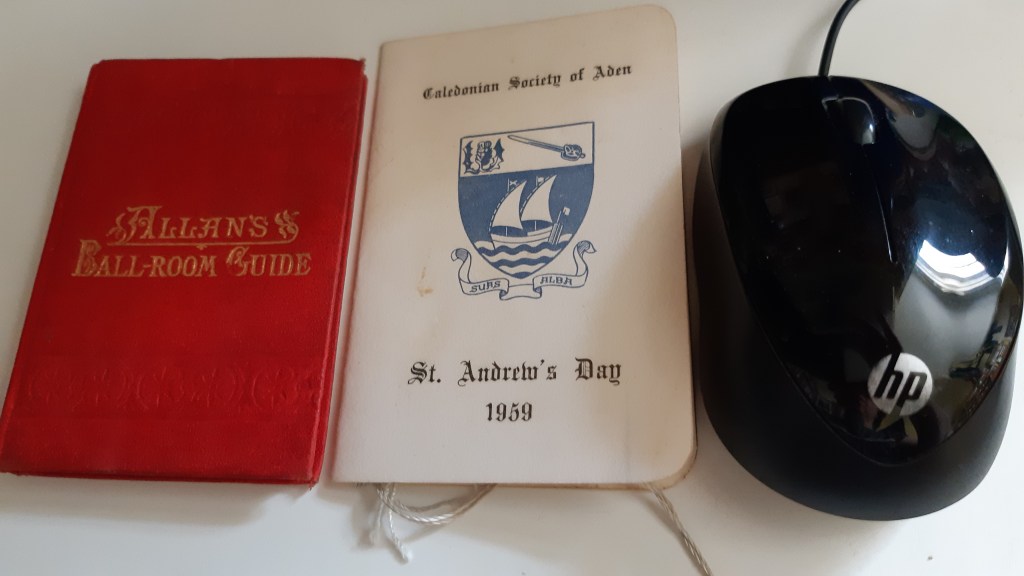
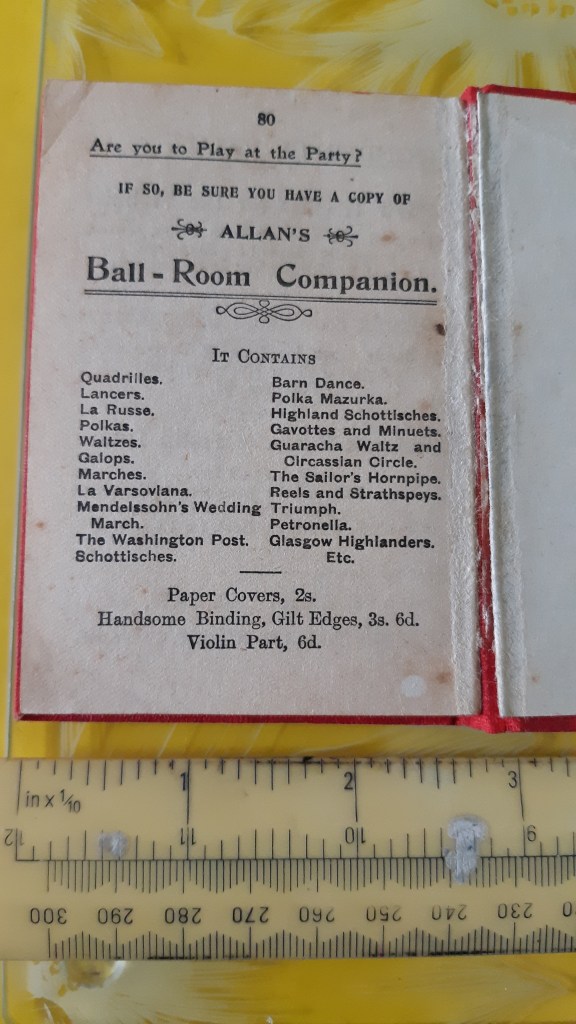
Pocket-size instructions, a dance-card, and a mouse – just for size comparison!

Mind you, the Society had a very traditional programme of dances, didn’t it? Mozart Allan would’ve known at least half the dances listed!

(Featured top image: No spitting on the carpet, please, gents – it’s a sure sign of low breeding!)