

An Unusual Anthology
Whilst the rain pours and a breeze gets up outside, I decided that today was definitely a day for indoor pursuits, and – with my mind on a forthcoming lecture – I thought it was time to look at a volume which is quite the most unexpected of all the Scottish song books in my collection. My interest was in the motivation for its compilation. I love working out what the compiler had in mind, and who his intended audience might be.
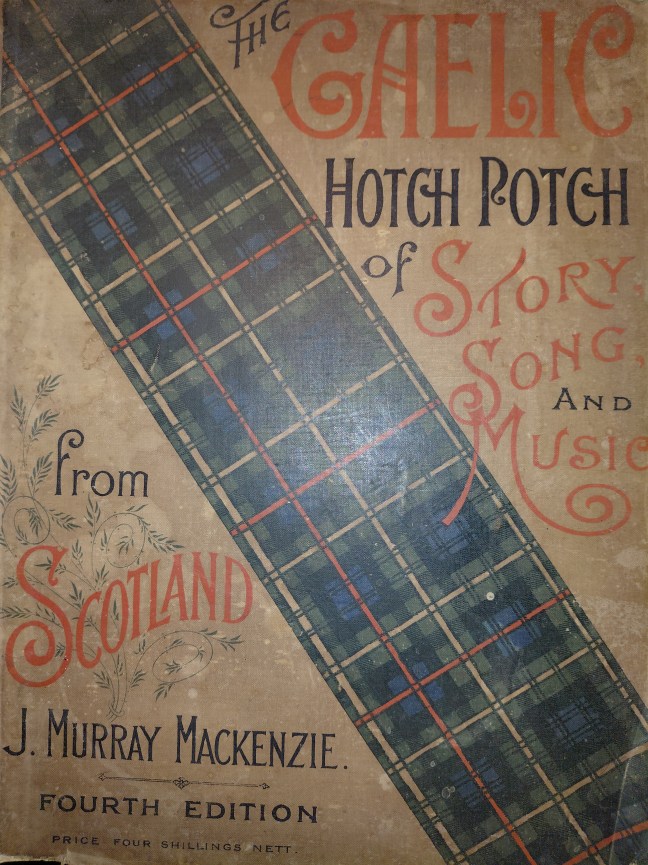
The whole book was ‘printed for the proprietors’ by McCorquodale & Co., Ltd and Aird & Coghill, (letterpress and music respectively) both in Glasgow. It’s a scruffy old tome – I really haven’t looked at it closely before, largely because it looks so unappealing from the outside. It was clearly compiled for advertising purposes, and I didn’t expect to find much of note inside. Don’t get too excited about the ‘Gaelic’, though. It’s the name of a brand of whisky…
The Gaelic Hotch Potch of Story, Song and Music from Scotland, by J. Murray Mackenzie
This is the 4th edition, published in Stirling in January 1895. However, a notice in the Indian Daily News (30 Oct 1895) says that the book is in its fourth year of publication, so I imagine it first came out ca. 1891.
The National Library of Scotland has the only library copy – of the subsequent, 5th edition, which dates from 1911. By this time it was entitled The Gaelic Old Smuggler hotch-potch, which actually tells you all you need to know. It is connected with a whisky company, The Stirling Bonding Company, Ltd. (My heroines, poet Mary Ann and her composer daughter Rose Smith would not have been impressed, being firmly committed the temperance movement!) Anyway, my 1895 copy informs the reader that,
The “Gaelic” Whisky and “Old Smuggler” bottle are both registered, and we warn those infringing the above trademarks in any way, that they will at once be proceeded against.
Mr Mackenzie declares in the ‘Introductory’ preface that ‘many friends’ had requested this fourth edition. He describes it quite accurately, as,
… a short collection of familiar Scotch Songs, Highland Music, and Stories of an anecdotal character associated with the district of Stirling, interspersed with a few facts about Scotch Whisky, and Recipes for Haggis, Scones, Porridge, and Oat-Cakes, in truth, a veritable Hotch-Potch. Many of the anecdotes are old […] To some they may not be “cauld kail”. To the many I trust they may have more than a mere passing interest, and may serve to carry their fancies back to “Bonnie Scotland”, the land of their birth.
For the Overseas Market
Aha! This book is for the ex-pat in the Scottish diaspora. It wasn’t just advertised in India – I found it advertised in New Zealand, too. Even into the 1940s-50s, this “Gaelic Whisky” and “Old Smuggler” went to Australia and America, and plenty of ephemera can be found on eBay accordingly. There’s far less ephemera to be found on home ground, and the book itself appears to be quite rare.
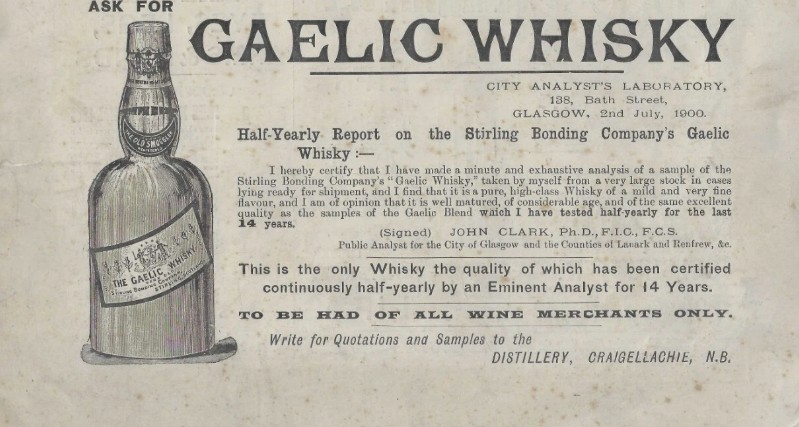
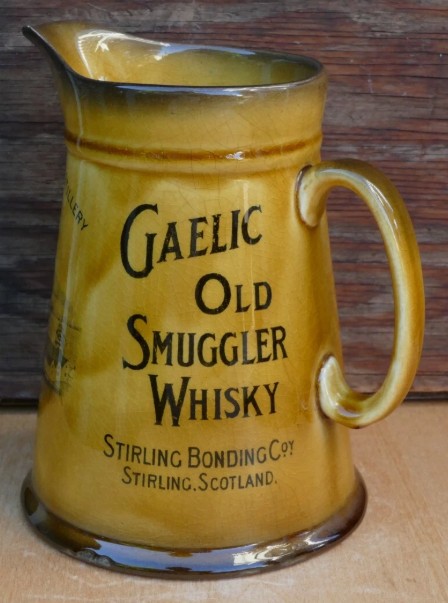
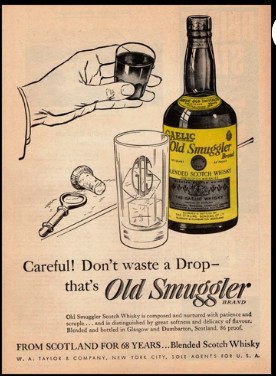
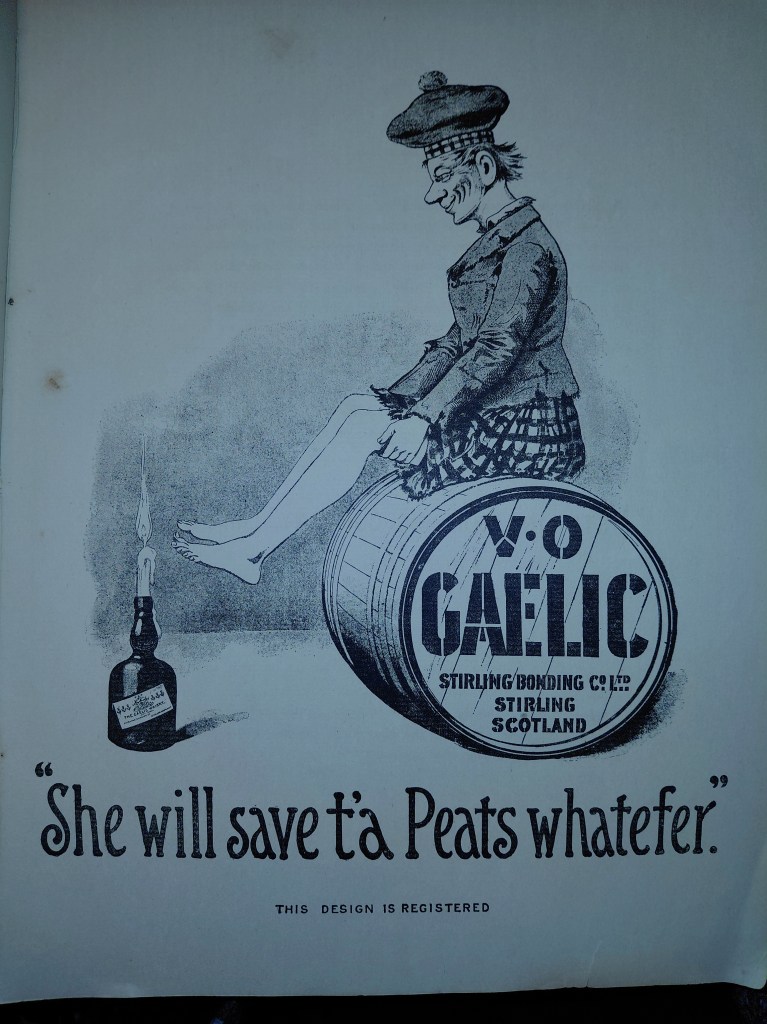
My copy, which was priced at four shillings, is dedicated to the Directors of the Stirling Bonding Company, Limited, as a mark of the compiler’s ‘appreciation of [their] endeavours to maintain the character of true Scotch Whisky abroad, and upright dealings at home.’
Despite his ‘Introductory’ being signed ‘Stirling, 1895’, Mr J. Murray Mackenzie is not easy to track down, but I don’t think he published any other books of Scottish songs and tunes. Did he work for Stirling Bonding Company, or maybe have something to do with their advertising? I’m intrigued! Despite AI having suggested he was an Edinburgh architect, I’m more inclined to think he’s the man who, having previously been an invalid attendant for some years, got a public house licence for wine and beer in Edinburgh in 1910, and was described as a restaurateur from 1912 onwards. This bloke lived from 1859-1928, so he’d have been 32 in 1891. ‘My’ Mr Mackenzie died in 1928. I haven’t yet linked him to any music making, but this does at least link him to alcohol supply! It’s feasible. *
So, what have we got here?
- Introductory
- Recipe for Scotch Haggis by Mistress Meg Dods of the Cleikum Inn, St Ronan’s (Vegetarians might turn the page quickly here! It’s detailed. Meg Dods was the proprietor of the Inn as early as 1823 and seemingly published a cookery book in 1827.
- Recipe for Scones by Mary Fraser. I’d have tried this for you, but I don’t have any sour buttermilk, nor a hot girdle. Shame.
- Recipe for Oat-Cakes by Kirsty MacDonald. (Same problem – no hot girdle.)
- Recipe for Porridge, by every Decent Scotch Woman.
- An “End” at a Curling Match. [Comic Dialogue]
- The Dangers of Tea-Drinking. Reprinted from a leading article in the “Glasgow Herald”, 31st December, 1894.
- Scotch Whisky. By a Highland Malt Distiller. The opening sentence tells you all you need to know:- ‘[…] in the East it is the universal medical opinion that throughout the tropics a moderate use of alcohol is most necessary to the maintenance of sound health in a tropical resident.’ [Six sides of text, including an advertising puff for the “Gaelic” Whisky, advice and illustrations as to how to tap and store whisky in casks. Extravagant advertising copy is nothing new, either:-
Made in the lonely highlands of Scotland from pure hill water, far removed from the smoke of large cities, distilled from Scotch barley and bere […] This small species of barley, as grown on the upland soils, is sweeter and makes finer whisky than the heavy barley grown in the lowlands. Foreign barley we never touch – thus assuring the quality of our whisky. […]
- A full-page cartoon of a kilted Highlander seated on a cask, warming his feet on a candle stuck in a “Gaelic” whisky bottle
- 18 pages of ‘local anecdotes’ – 45 of them.
And then, at last, we reach the Highland Music. There’s a brief introduction advising the reader that the music is arranged ‘in sets for a full Highland Reel’ – a strathspey to be slowly played four times, followed by a reel, quickly ditto, and another strathspey, slowly ditto.
‘And lastly, the Reel of Tulloch or Hullachan is played as often as the spirit of the dancers can keep it up. I have seen it played for thirty minutes, till couple by couple dropped out.’
Now, gentle reader, here’s the surprise. There are twelve sets of dances provided, and the Reel of Tulloch is repeated at the end of every single set. Wow! So, that’s pp.2-27 taken care of. There’s more.
- 2-27 Reels and strathspeys
- 28-43 Marches
- 44-50 Laments
- 52-100 Songs
So, is there anything noteworthy about the contents? The first thing that hit me was that there are no attributions, just the titles of the dance tunes or songs. So, if you wanted something by Robert Burns or James Hogg … you’d have to know that already, because the book won’t tell you. The accompaniments for the dances are fairly basic, but grace notes are indicated. Meanwhile, the song accompaniments are competent, and generally don’t mirror the vocal line.
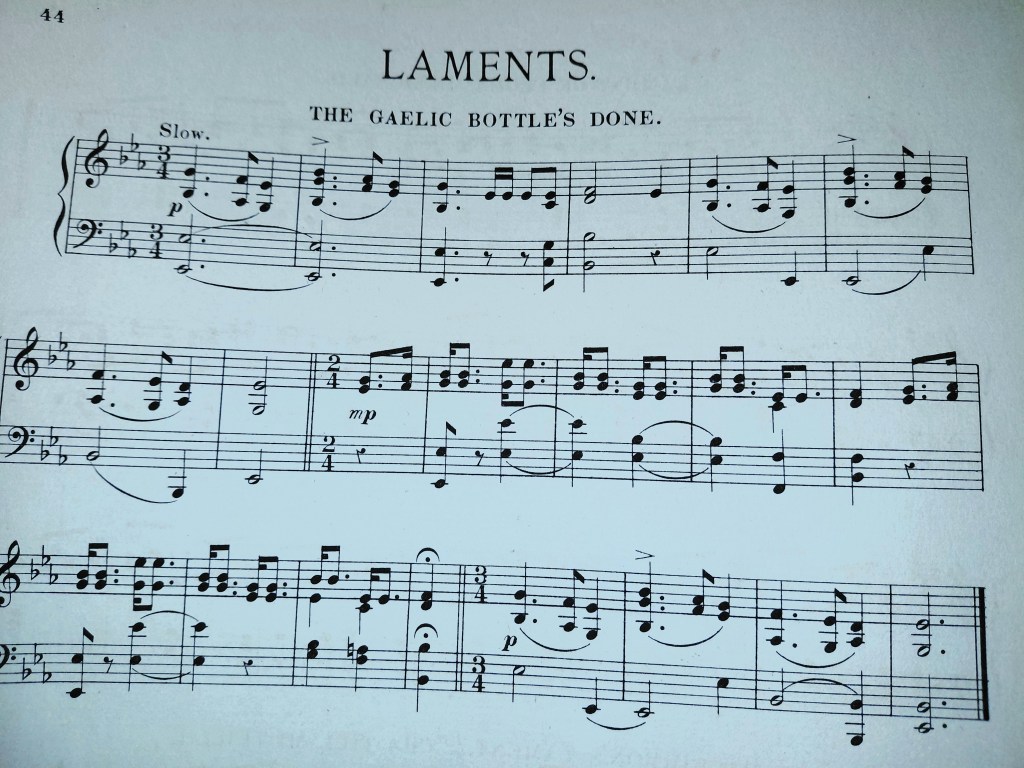
Mackenzie must have had a sense of humour, as the first dance in the book is a strathspey entitled ‘Highland Whisky’. The first lament? ‘The Gaelic bottle’s done’. And the final song in the book? ‘O, Willie brew’d a peck o’ maut’.
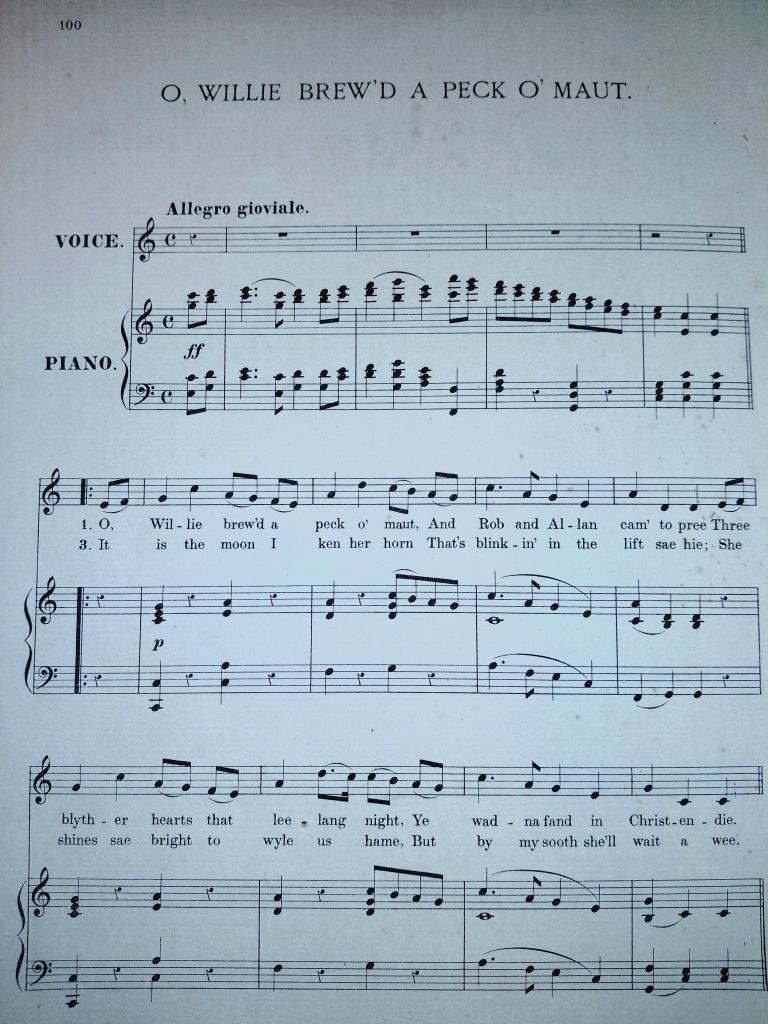
The book is old and battered. However, I like to think that it has enjoyed an active, possibly rather merry life …
* The AI link to an Eastern European website does name the compilation under the later edition’s title, but he would still have been a schoolboy when he compiled the 1891 first edition!

