Know Your Audience (Mass Media) Part 2

Why This Matters

It’s interesting to see how newspaper publishers diversified, producing books and booklets – and even music – for their readership. They advertised other publications within the pages of these booklets. The same practice is of course observed inside and on the back covers of sheet music. Indeed, James S. Kerr sometimes advertised along the bottom of a page of printed music.

In the case of John Leng, it gives a glimpse into the kind of readers they were aiming their publications at, and underlines the importance of music in their lives – specifically Robert Burns’s songs, national songs and dance tunes.


Our Wi-fi was down for 14 hours, and the household was plunged into the depths of despair. (I only slightly exaggerate.) But more to the point, all the detailed text of today’s blog post was trapped on my laptop and couldn’t be transferred to the blog.

(Three adverts in four pages โ€“ and not the last youโ€™ll encounter, for this most popular of magazines!)

‘Life is made lightsome with a song’

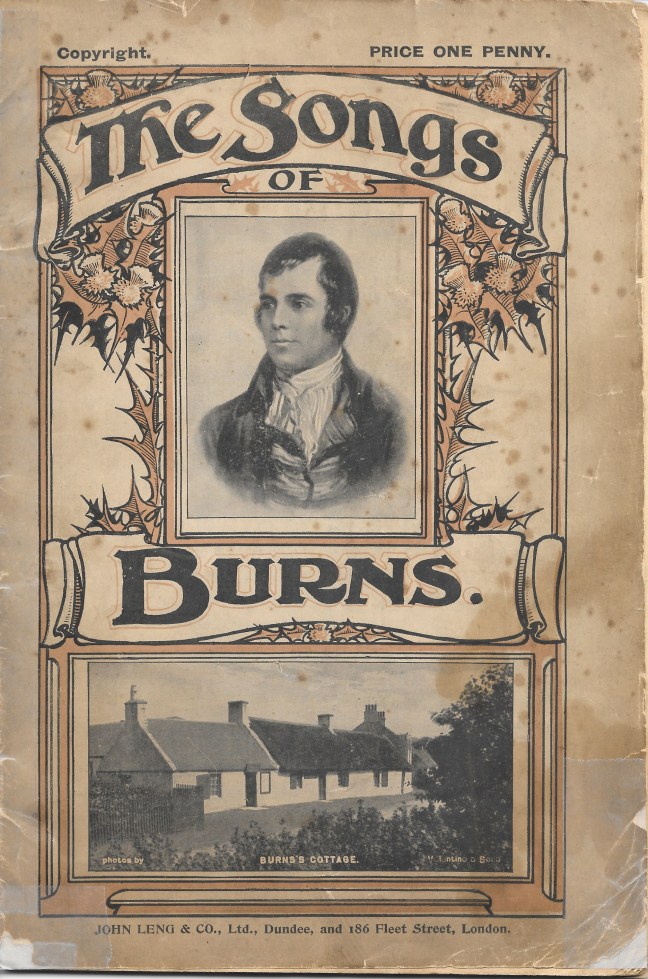
In my earlier post, I promised I’d share details of John Leng & Co.’s advertising strategy, as observed in their booklet, The Songs of Burns – so here we are.

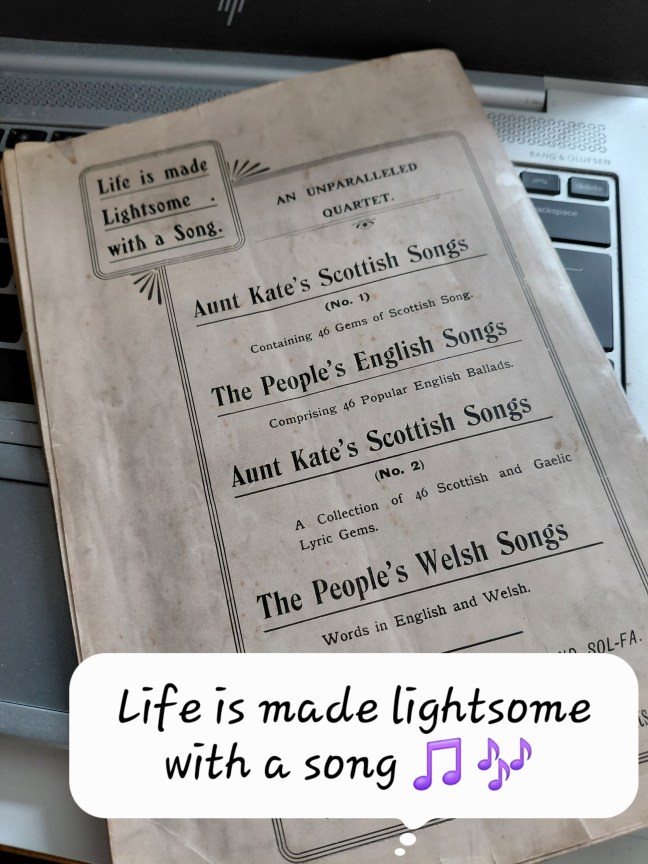
The Songs of Burns is a booklet that I bought purely out of curiosity; I was interested in their support of Scots Song singing through the Dundee Leng Medal prizes, and I wondered if books like this showed another aspect of that interest. I  think the only link is probably that Scottish songs in general, and Burns’ songs in particular, were just  popular all ways up, so this pamphlet wouldn’t have struggled to find purchasers. As the advert on the back cover says, ‘life is made lightsome with a song’.

Tucked in amongst the Burns songs, are the little column adverts and bigger full-page ones, which clearly indicate which publications they were pushing, around January 1905. Many of the adverts are distinctly aimed at women, which is interesting, considering Burns’s songs are of universal appeal.

As I mentioned in Part 1 of this post, much use was made of ‘Aunt Kate’ for good, sensible advice from a trustworthy auntie!

Moreover, I find it interesting that there’s more marketing for the People’s Friend than the People’s Journal. The magazine is still running, whilst the journal ceased in January 1986 – so even the journal had a good long life.

The People’s Penny Burns

Inside cover: Full page advertisement for its earlier companion, The Peopleโ€™s Penny Burns

p.48    Another full page advertisement for The Peopleโ€™s Penny Burns.

The People’s Penny Stories

p.3      Do you like a good novelette? You do. Well, donโ€™t miss The Peopleโ€™s Penny Stories. Every month. One Penny. None so good. 

The question is followed by a firm affirmative answer.  Since my own Peopleโ€™s Friend serial ended up as no.393 in the โ€˜Peopleโ€™s Friend Story Collectionโ€™  back in the 1990s, I am naturally disposed to agree, stressing that this is light fiction, not literature!

p.29    A second advertisement for the Peopleโ€™s Penny Stories series.

Caring

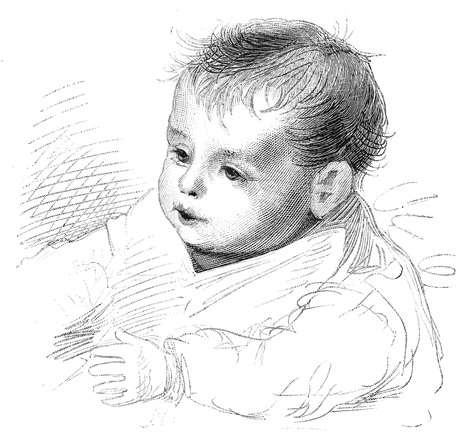
Baby drawing by Mary Mapes Dodge, Wikimedia
Drawing by Mary Mapes Dodge, Wikimedia

p.1      A LOVING MOTHERโ€™S NEGLECT to rear healthy babies is unpardonable. Aunt Kateโ€™s Motherโ€™s Guide contains much useful information, and anyone who follows its advice will have healthy families. Sold by all Newsagents; Price ONE PENNY. 

Taking an indisputably moral tone, the assurance that โ€˜anyone who follows its adviceโ€™ will flourish would probably flout advertising standards today, since some problems simply cannot be put right merely by following sound advice!

p.15    Have you a home pet? If so, and you would like to make the most of it, for its own sake and your own, invest a penny in Aunt Kateโ€™s Canaries and Home Pets. Also uniform in size, style, and price, The Peopleโ€™s Dog Book.

Clothing the Family

p.5      Aunt Kateโ€™s Knitting and Crochet Book contains over 170 Patterns. Price One Penny.  (Believe me, this was an absolute bargain!)

p.30    Young Mothers will find the Peopleโ€™s Friend Paper Patterns invaluable.  Complete Layette Sets at low prices.  Babyโ€™s First Garments, Shortening Clothes, Outdoor Things, Christening Robes, Sleeping and Day Gowns, Newest Bonnets, Hats and Bibs for Young Children of all ages. For styles for spring, summer, autumn and winter, see Peopleโ€™s Friend Fashion Pages. 

(Get the paper patterns, or look in โ€“ where else, but the Peopleโ€™s Friend?  It has to be said that nowadays, the Friend is unashamedly aimed at grandmothers rather than young mums.)

p.41    Make your own Clothes.  Full directions how to cut dresses and other garments in AUNT KATEโ€™S DRESS-MAKING BOOK. Price one penny; sold everywhere.

Feeding the Family

p.9      Aunt Kateโ€™s Cookery Book is the best pennyworth in the world. If you have not a copy get one.

Entertainment

p.11    โ€˜AUNT KATEโ€™S SCOTTISH SONGSโ€™ Nos.1 and 2, and the โ€˜PEOPLEโ€™S ENGLISH SONGSโ€™ Contain the Cream of our National Minstrelsy. Each comprises nearly half a hundred Songs โ€“ Words and Music. The Price of Each is One Penny.

And they soon appeared, together with Welsh songs, in two hardbacked collections. These song books are advertised again on the back cover, see below.

This was, of course, the age of Tonic Sol-Fa, and many schools taught it, so there was a good chance that at least some of the readers of these books could work out a tune from Sol-Fa.  The piano accompaniment, however, required someone who could read music.  These accompaniments are simple and functional, rather than artistic, but theyโ€™re certainly usable. The arranger was a local Dundee music teacher who also wrote for John Leng & Co. Ltd.

Back cover: Life is made Lightsome with a Song: an unparalleled Quartet … โ€˜Music in each case in staff and sol-fa. One penny each. Sold by all newsagents.โ€™

This is a whole page advert for the books in the smaller  column advert on p.11.

  • Aunt Kateโ€™s Scottish Songs No.1: 46 โ€˜gems of Scottish Songโ€™
  • The Peopleโ€™s English Songs: 46 โ€˜popular English balladsโ€™
  • Aunt Kateโ€™s Scottish Songs No.2: 46 Scottish and Gaelic โ€˜lyric gemsโ€™
  • The Peopleโ€™s Welsh Songs: Words in English and Welsh

Inside back cover โ€“ advertisement for โ€˜Simply Indispensible! Four Valuable Books [one penny each]:-

  • Conjuring and Parlour Magic Book: Aunt Kateโ€™s Parlour Magic Book
  • Parlour Games for Everybody: a Companion to Aunt Kateโ€™s Conjuring and Parlour Magic
  • The Peopleโ€™s Fortune Teller
  • Aunt Kateโ€™s Dance Music โ€˜contains music for no fewer than twenty-six popular dancesโ€™ (there’s a little more about this book in another blog, Unsung Histories, Sept 2021, by Katie Howson.)

The People’s Friend

p.14    WHY NOT JOIN A CLUB? The Helperโ€™s Club, conducted by Janette in the โ€œPeopleโ€™s Friendโ€, is a National Bureau for the exchange of opinions, advice, and experiences among women of all classes.

p.16    Everyone praises the wholesome tone that characterizes every page of THE PEOPLEโ€™S FRIEND.

p.17    A FRIEND INDEED is just what the Peopleโ€™s Friend has all along proved itself to be. No one who has ever known this โ€œFriendโ€ has turned his or her back upon it.  It contains something for everybody.  Ask your Newsagent to introduce you to the โ€œFriendโ€; it will cost you a Penny, but youโ€™ll find it worth the money over and over again.

p.25    Tribute to the PEOPLEโ€™S FRIEND [โ€ฆ] A miscellany which finds its way into many homes where good reading is courted. It has been a real influence in Scottish life, brightening it, and that must be a chief joy to Sir John Leng. โ€“ Daily Chronicle, London. 

p.35    Quoting Mr T. P. Connor speaking highly of the Peopleโ€™s Friend and Peopleโ€™s Journal, we find another mention of the Friend and a second of the Journal.

p.47    Space at the bottom of the Table of Contents โ€“ filled with a larger advertisement for The Peopleโ€™s Friend, quoting press opinions.

Men’s Stuff?

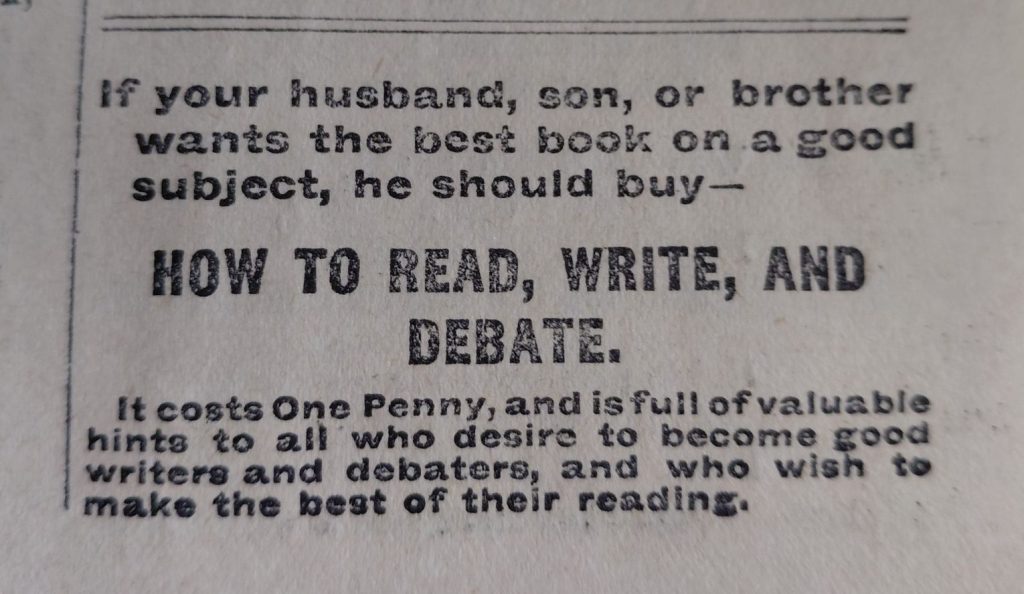
p.21    If your husband, son or brother wants the best book on a good subject, he should buy โ€“ HOW TO READ, WRITE, AND DEBATE. It costs One Penny, and is full of valuable hints to all who desire to become good writers and debaters, and who wish to make the best of their reading.

The People’s Journal

p.23    POINTS about the PEOPLEโ€™S JOURNAL. 10,000 Newsagents sell it.  1,250,000 People read it.  A weekโ€™s issue weighs 20 tons.  It is the Peopleโ€™s Family Newspaper. Sold everywhere, price one penny. 
Know Your Audience (Mass Media) Part 1

Why This Matters

The advertisements in this little poetry booklet would be called ‘paratext’ by book historians. Paratext is anything around the text that forms the main body of a book. So the title page, index, contents pages, a preface or introduction – or advertisements for other publications – all count as paratext. It tells us more about the motivation of a publisher, what else they were publishing around the same time, and what they thought their readers would be interested in.


This was how John Leng & Co., of Dundee and Fleet Street, London, advertised their new booklet in  The Forfar Herald on Friday 20 January 1905:-

“THE SONGS OF Burns.โ€”Messrs John Leng & Co., Ltd., have in their latest penny booklet, entitled The Songs of Burns, published what should be specially attractive to many at this time of the year, in view of the approaching anniversary of Burns’ birthday. Most of the well-known songs are included, and an alphabetical table of contents is also printed. It is a good pennyworth.”

That one penny (one-twelfth of todayโ€™s modern 5p and equating to about 55p using the Bank of Englandโ€™s Inflation Calculator), was certainly affordable!  The Songs of Burns was sensibly and conveniently published just before Burnsโ€™ Day โ€“ 48 pages including an index and a full page advertisement for another of their publications. 

Itโ€™s just a book of verses โ€“ no music.  It was intended to be a companion to an earlier collection, The Peopleโ€™s Penny Burns (โ€˜a splendid selection from the poems of Scotlandโ€™s national bardโ€™), the same size and price.

No surprises as to the contents, then, but what caught my eye was actually the column advertisements. The publishers wasted no opportunity to advertise other publications that the reader might find interesting! Skimming through them enables us to profile the readership very clearly: largely women, concerned with feeding, clothing and amusing their families, and looking after the household pets.  ‘Aunt Kate’ was the branding John Leng used for many such publications – a homely and mature voice that readers could trust.

Meanwhile, women are advised that their menfolk should buy a booklet on effective reading, writing and debating. Of all the advertisements in this particular booklet, that’s the only ad for a title specifically aimed at men:-

How to read, write, and debate …

We have no wi-fi today, so I’m going to stop here for now.  When I  return,  we’ll have a paratextual wander through the 48 pages of John Leng’s The Songs of Burns, and I’ll show you how Leng did their advertising!

(Contextual note: If you’re not well up on newspaper publishing history, I should explain that D C Thomson later acquired John Leng & Co. Ltd, so there’s a direct lineage to today’s The People’s Friend, Sunday Post and Scots Magazine. The People’sFriend goes back a very long way.) 

Burns Night? Morning Too

I didn’t take organ music with me today. The church got ‘Green grow the rashes, O’ (I’d transcribed that from a recording); and the rest from memory:- ‘Afton Water’; ‘My luve is like a red, red rose’; ‘When you and I were young’; ‘Ae fond kiss’; and ‘Comin’ thro’ the rye’.

Well, it’s Burns Night! 

Friends of Wighton – A Celebration of Burns

The Wighton Collection's logo - various musical instruments

Burns Night is on Sunday 25 January 2026

This Saturday, 24 January, is virtually Burns’ Night, so what better afternoon to have A Celebration of  Burns at the Central Library of Dundee? I understand we were fully booked, but those lucky enough to have obtained a ticket had a great afternoon. Click on the link (as long as it’s still there) to see the line-up.

And I finished up  the event with a singalong of three favourite songs by Robert Burns – not bad for a girl from Norfolk! If I play, and everyone else sings, my English accent is well-concealed …

But what are the three songs?

Green Grow the Rashes, O.

Burnsโ€™ version of this pre-existing song appeared in the Scots Musical Museum song collection in the late 18th century. It was included in several school song books in the 20th century, and remains popular to this day.


CHORUS: Green grow the rashes, O; Green grow the rashes, O;
The sweetest hours that e’er I spend, Are spent amang the lasses, O.

1. There’s nought but care on ev’ry han’, In ev’ry hour that passes, O:
What signifies the life o’ man,  An’ ’twere na for the lasses, O.
Green โ€ฆ

2. The war’ly race may riches chase, – An’ riches still may fly them, O;
An’ tho’ at last they catch them fast, Their hearts can ne’er enjoy them, O.
Green โ€ฆ

3. Gie me a cannie hour at e’en, My arms about my dearie, O;
An’ war’ly cares, an’ war’ly men, May a’ gae tapsalteerie, O!
Green โ€ฆ

4. For you sae douce, ye sneer at this; Ye’re nought but senseless asses, O:
The wisest man the warl’ e’er saw, He dearly lov’d the lasses, O.
Green โ€ฆ

5. Auld Nature swears, the lovely dears Her noblest work she classes, O:
Her prentice han’ she try’d on man, An’ then she made the lasses, O.
Green โ€ฆ

Cominโ€™ Throโ€™ the Rye

There was a very famous soprano called Flora Woodman (1896-1981), who was born in London of Scottish parents. For some years, this was practically her signature tune โ€“ she sang it a couple of hundred times.

But why? I discovered that there had been a novel called Cominโ€™ throโ€™ the Rye, written by novelist Helen Mather back in 1875. The heroine sings this song as she walks through a rye-field; thatโ€™s the only connection with the song.

But the story became a silent movie in autumn 1916 โ€“ months after Flora started singing it. The film was so popular that the film producer remade it in 1923. Flora was still singing the song โ€“ probably because the film had popularised it – but the film went out of fashion when the first talkie, The Jazz Singer, came out in 1927, and Flora began to sing the song less often.
As for the words โ€“ the clean words – you wonโ€™t be surprised to learn that even this version didnโ€™t make it into any school books of Scottish songs!

Cominโ€™ throโ€™ the rye

1. Gin a body meet a body Comin’ thro’ the rye, Gin a body kiss a body, Need a body cry?

Chorus: Ilka lassie has her laddie, Nane, they say, hae I, Yet a’ the lads they smile at me, When comin’ thro’ the rye.

    2. Gin a body meet a body Comin’ frae the town, Gin a body kiss a body, Need a body frown?ย  Chorus

      3. Gin a body meet a body, Comin’ frae the well,ย  Gin a body kiss a body, Need a body tell? Chorus

        ย 4. ‘Mang the train there is a swain I dearly lo’e myself, But what his name or whaur his hame, I dinna care to tell. Chorus

          Auld Lang Syne

          Our last song needed no introduction!

           1. Should auld acquaintance be forgot, And never brought to mind?  Should auld acquaintance be forgot, And the days oโ€™ auld lang syne?

          Chorus: For auld lang syne, my dear, For auld lang syne,  Weโ€™ll takโ€™ a cup oโ€™ kindness yet, For auld lang syne.

          2. And hereโ€™s a hand, my trusty fiere, And gieโ€™s a hand oโ€™ thine;ย  And weโ€™ll takโ€™ a right guid willie-waught For the days oโ€™ auld lang syne.  Chorus.

            Burns’ Songs – for his Centenary

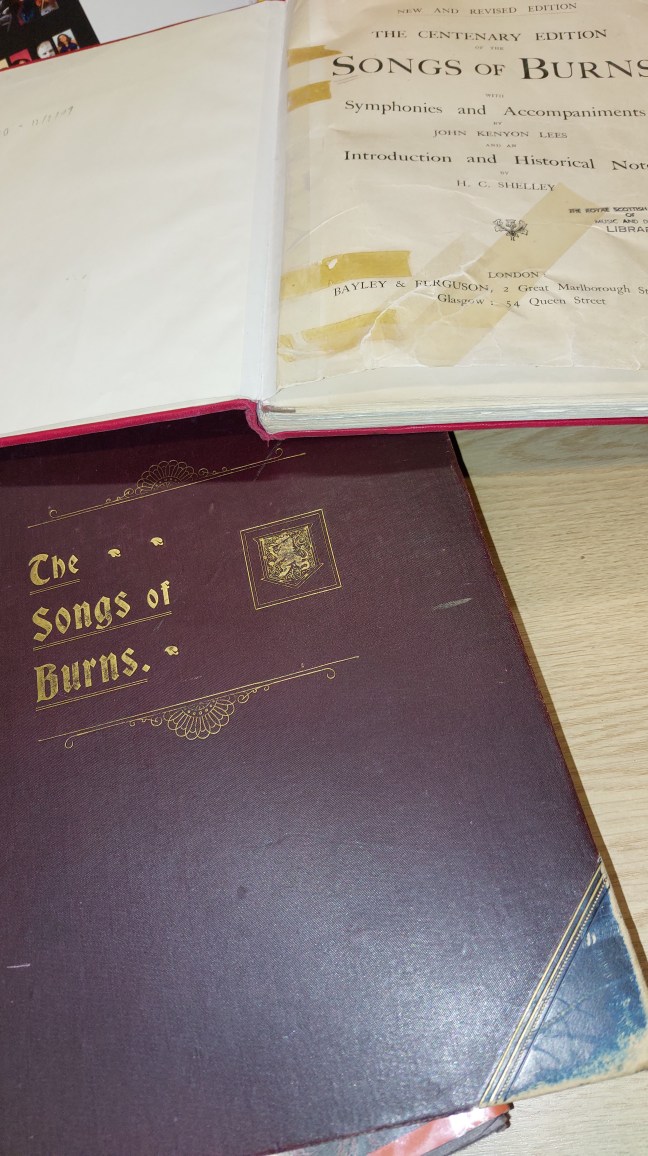
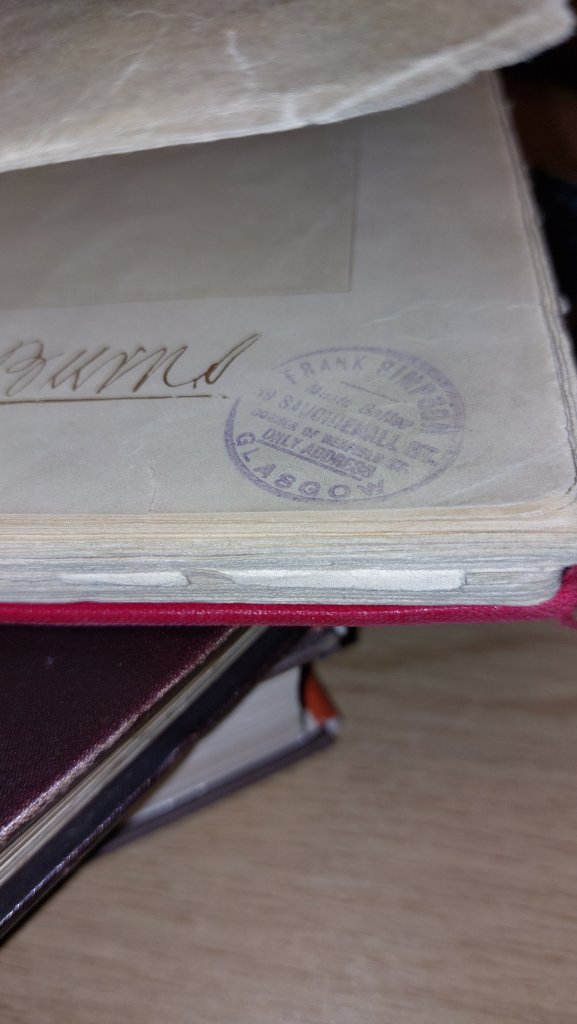
            You can imagine the enthusiasm with which publishers rushed to produce centenary editions of Robert Burns’s songs in 1896. We have a Bayley & Ferguson ‘new and revised’ centenary edition in the Royal Conservatoire of Scotland library: well-used over the years, bearing the scars of untold tussles, its paper almost skin-soft through repeated borrowing. This one was published in Glasgow and London. I wasn’t at all surprised to see vendor Frank Simpson’s stamp on it – the Sauchiehall Street shop was there for many years, where the now defunct BHS store later stood. I can’t imagine how many of our old scores came from there!

            Today, I needed to compare it with a more lavish bound presentation copy, which we acquired as a donation. The imprint likewise had Bayley and Ferguson’s name, but in larger print above it, it had Hedderwick, of Citizen Buildings in St Vincent Street. Both firms gave Glasgow addresses, and no mention of London. I suspect it was the earlier of the two, since I found 1896 newspaper adverts for this one. Hedderwick was a long established firm. And Bayley and Ferguson did publish music on behalf of other firms, groups or individuals.

            It’ll have to go into the special collection – it’s so heavy that I can’t imagine anyone wanting to borrow it.

            Plain or fancy, I imagine this title was a bestseller for several decades. I’ll finish cataloguing it tomorrow.

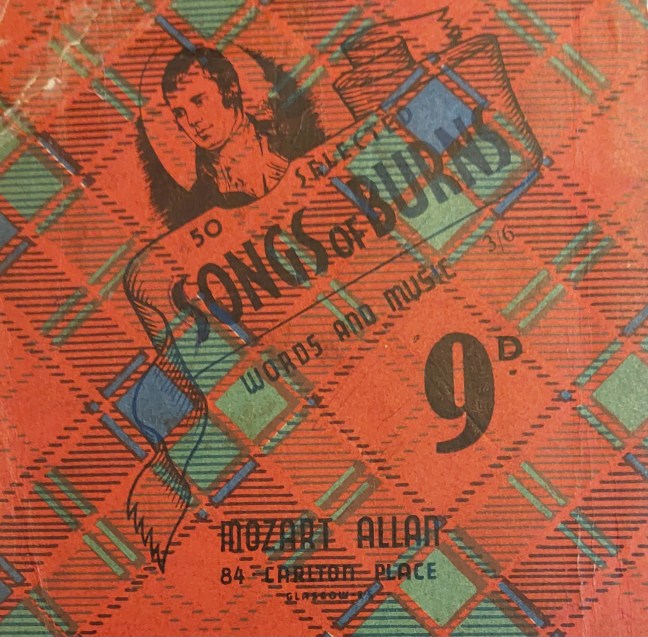
            Now – have we got the Mozart Allan centenary Burns edition … ? Of course we have!