

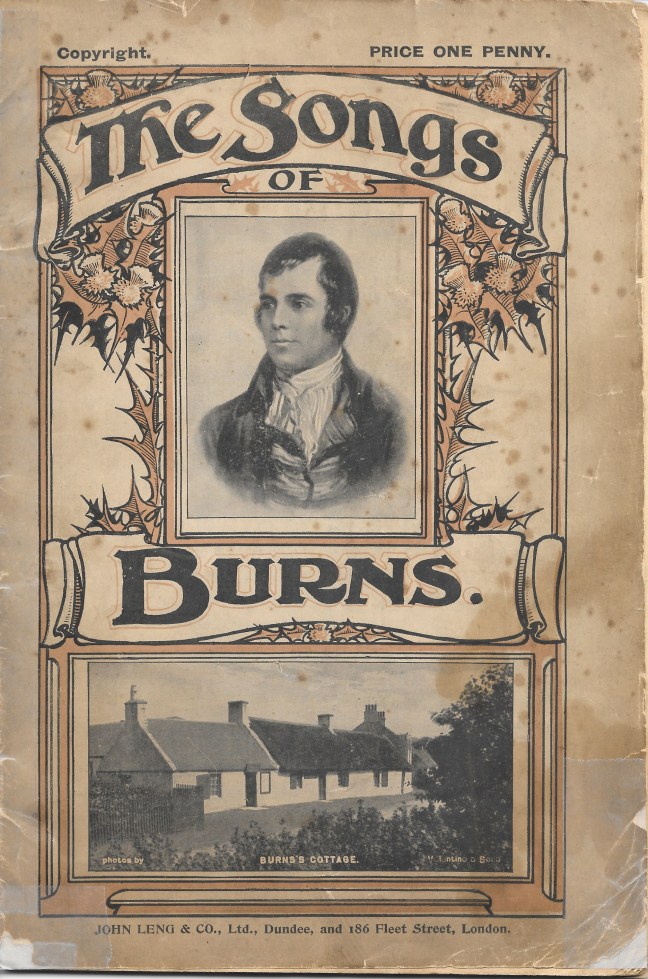
Why This Matters
The advertisements in this little poetry booklet would be called ‘paratext’ by book historians. Paratext is anything around the text that forms the main body of a book. So the title page, index, contents pages, a preface or introduction – or advertisements for other publications – all count as paratext. It tells us more about the motivation of a publisher, what else they were publishing around the same time, and what they thought their readers would be interested in.
This was how John Leng & Co., of Dundee and Fleet Street, London, advertised their new booklet in The Forfar Herald on Friday 20 January 1905:-
“THE SONGS OF Burns.—Messrs John Leng & Co., Ltd., have in their latest penny booklet, entitled The Songs of Burns, published what should be specially attractive to many at this time of the year, in view of the approaching anniversary of Burns’ birthday. Most of the well-known songs are included, and an alphabetical table of contents is also printed. It is a good pennyworth.”
That one penny (one-twelfth of today’s modern 5p and equating to about 55p using the Bank of England’s Inflation Calculator), was certainly affordable! The Songs of Burns was sensibly and conveniently published just before Burns’ Day – 48 pages including an index and a full page advertisement for another of their publications.
It’s just a book of verses – no music. It was intended to be a companion to an earlier collection, The People’s Penny Burns (‘a splendid selection from the poems of Scotland’s national bard’), the same size and price.
No surprises as to the contents, then, but what caught my eye was actually the column advertisements. The publishers wasted no opportunity to advertise other publications that the reader might find interesting! Skimming through them enables us to profile the readership very clearly: largely women, concerned with feeding, clothing and amusing their families, and looking after the household pets. ‘Aunt Kate’ was the branding John Leng used for many such publications – a homely and mature voice that readers could trust.
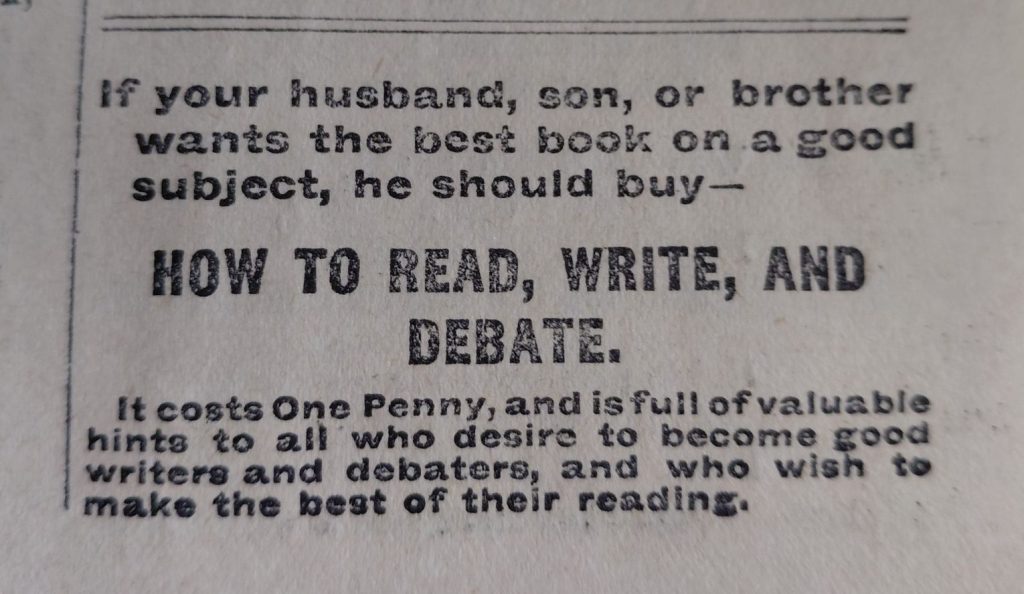
Meanwhile, women are advised that their menfolk should buy a booklet on effective reading, writing and debating. Of all the advertisements in this particular booklet, that’s the only ad for a title specifically aimed at men:-
We have no wi-fi today, so I’m going to stop here for now. When I return, we’ll have a paratextual wander through the 48 pages of John Leng’s The Songs of Burns, and I’ll show you how Leng did their advertising!
(Contextual note: If you’re not well up on newspaper publishing history, I should explain that D C Thomson later acquired John Leng & Co. Ltd, so there’s a direct lineage to today’s The People’s Friend, Sunday Post and Scots Magazine. The People’sFriend goes back a very long way.)

