Top companies your searchers work at

Clip of the LinkedIn section listing the top companies my searches work at

Linked in won’t tell me much, without my paying for Premium membership, which I’m not going to do. Still they’ll tell me the top three companies my searchers work at. Frankly, I’m surprised by their names. I’m particularly surprised that IQVIA (a real company) has looked me up again, considering I have spoken to a real, live person – well, I assume she was real and live – to point out that I am absolutely not who they are looking for. So, why have they looked me up again? Didn’t they remove me from their list of hopefuls, as I rather strongly suggested?

This is Who I am Not

I am not, never have been, never will be a medic of any description. Do they really think that just because I have a PhD and am a post doctoral research fellow, I must therefore be a medical researcher?

I was not a straight-A-in-every-subject all-rounder: I have one narrowly-passed O-Level in Physical Chemistry. That’s is my sole scientific credential. The other ten O-Levels, and all subsequent qualifications, are non-scientific.

This is Who I am

I work in a Conservatoire! (To anyone in the USA, it would be called a conservatory.) I’m a musicologist, and my historical research crosses over into social history.

Anyway, to make things easier for them, I have improved my profile. Before tonight, perhaps it was a little ambiguous – to headhunters not familiar with what a Conservatoire is all about:-

Post Doctoral Research Fellow at Royal Conservatoire of Scotland. Athenaeum Award for Leng Medal Memories research project.

And now?

This is What I do

Post Doctoral Research Fellow at Royal Conservatoire of Scotland. Athenaeum Award for Leng Medal Memories research project into a Dundee Scots Song Competition 🎵.

  • I haven’t said I’m ‘Open to’ work of any kind, because I’m semi-retired, live in Glasgow with an elderly spouse, and could only possibly entertain part-time research which did not entail relocation.
  • I don’t wish to Enhance my profile using AI.
  • I shall, however, Add a section to help clarify that medical research is really, truly not my forte! I’ve linked to my publications list, and featured the paper I’m giving at the Royal Academy of Music’s September conference, Women and Musical Histories, 1789-1914:- ‘The Trumpet Major’s ‘Poetess’ Widow; the Scottish Shipping Magnate’s Daughter and the Retired Barrister: The Importance of Parental Support to Musically Gifted Girls in the Late Victorian and Edwardian Eras’.

Having written my conference paper and devised a PowerPoint, it’ll be back to transcribing oral history interviews on Thursday. The kind of thing you’d expect a musicologist/social historian to be doing, in fact!

And it Goes on

A week later – now we have pharmaceutical companies and animal health experts looking me up. What do I have to do …. ?!
38 Years in Glasgow

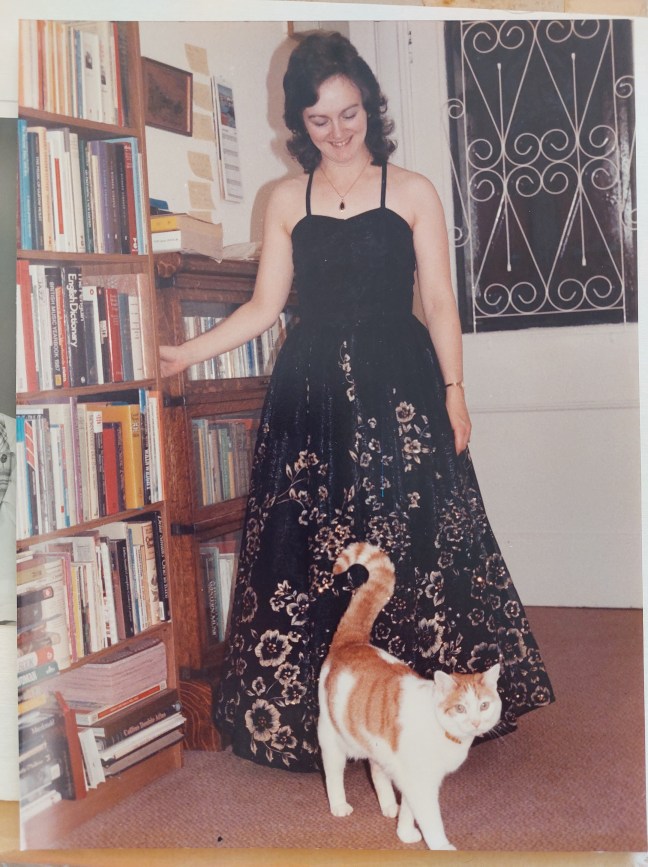
Me in self-made evening dress, with Fergie the cat, in our Springburn flat

38 years ago today, we (my husband and I, and the cat) moved from North Shields on Tyneside, to Springburn in Glasgow. I swear the vet hadn’t given Fergie a strong enough sedative for his journey, because he yowled every time we slowed down. Nonetheless, he staggered drunkenly from his travelling crate when we reached our new home.

I had a couple of music degrees, a librarianship qualification, and was a chartered librarian. I’d abandoned a PhD (on mediaeval English cantus firmus treatment in the Eton Choirbook, don’t you know?) a couple of years earlier – and I knew NOTHING about Scottish music. Research fellowships weren’t even on my horizon. I had only ever published small things in my capacity as a music librarian.

Where did the time go?!

We now have three adult sons and no cat. I completed another PhD and a teaching certificate, and gained Fellowship of CILIP. (I relinquished membership when I left the library.) I know ‘a bit’ about Scottish music, have published quite a lot, and added other fellowships to my CV.

No-one ever said, ‘You’ll live to regret abandoning doctoral studies …’

If you’d told the 1988 version of myself what I’d achieve in all those librarianly years, I doubt she’d have believed you. I really just wanted to make it up to myself for not completing the first doctorate.

It all started when we set off from North Shields, behind the removal van.

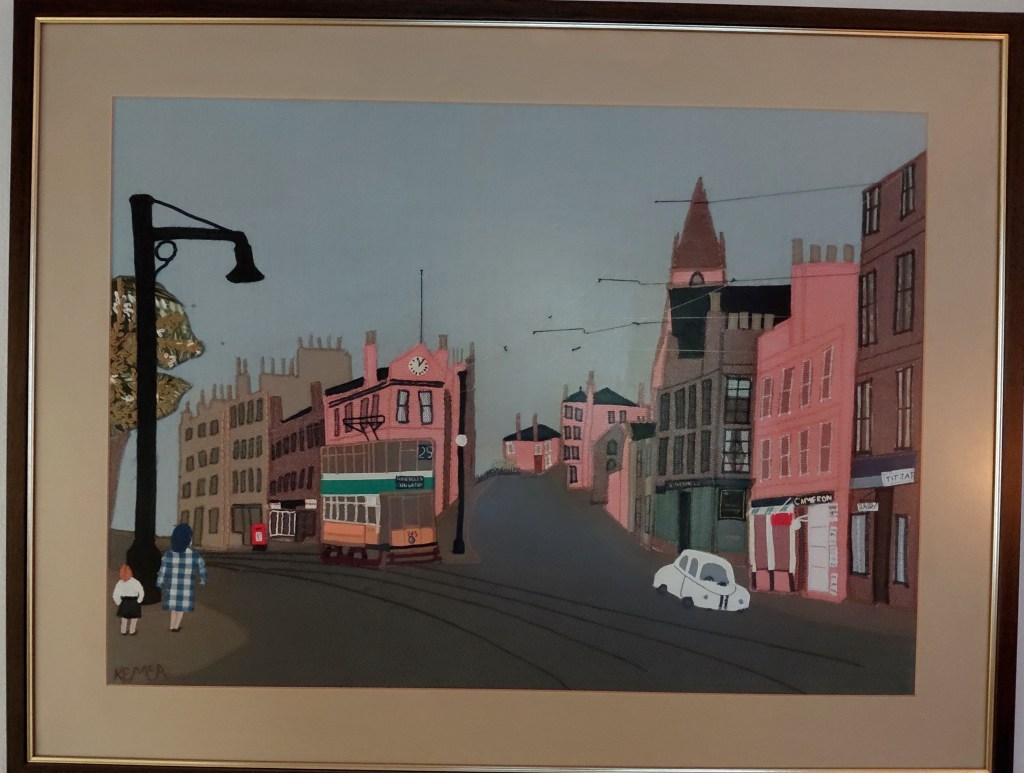
A fabric collage interpretation showing a Springburn street junction with tenements, a tram and a white car. Two people in bottom left corner - it was too fiddly to add the many people in the original photo!
Our first tenement flat – the pink sandstone block, centre back (collage ‘interpretation’ of a vintage black and white photo)

A Teenager! (Should I Bake a Cake?)

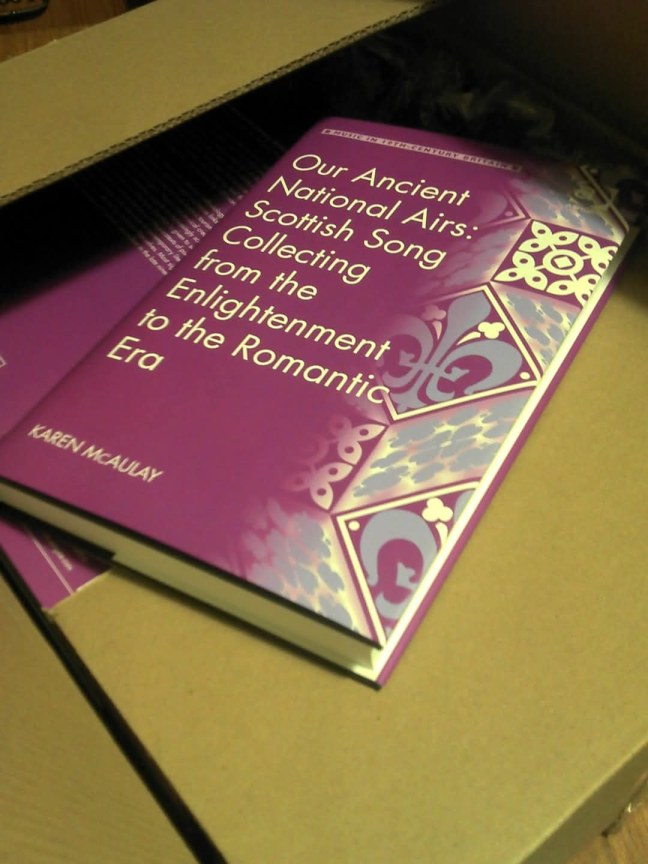
Facebook has just reminded me that it’s thirteen years since the book launch of my first monograph. Surely I should celebrate somehow? Should I bake it a cake? (Any excuse for a cake!)

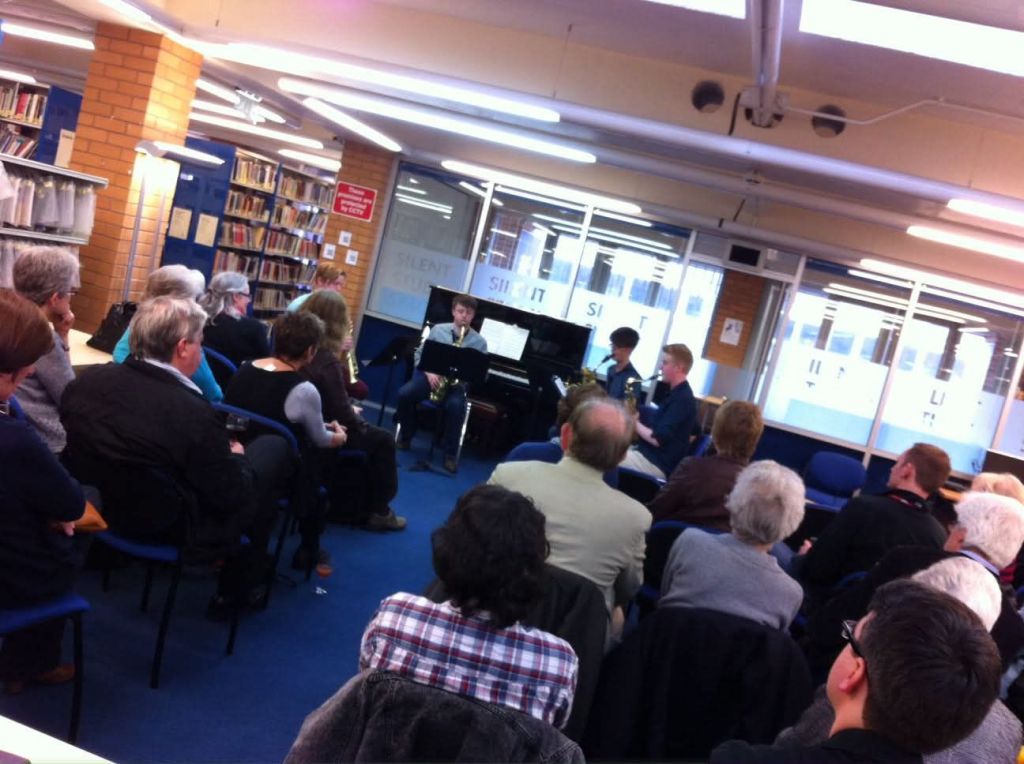
Book launch in the Whittaker Library, 13 years ago

Saxophones, Singing and Harp Strings

The launch had a saxophone ensemble playing arrangements of songs that Alexander Campbell had collected for his two Albyn’s Anthology volumes (1816, 1818). Robyn Stapleton sang with a piano trio.  And my friend clarsach player Karen Marshalsay played a tune she had written for me.  It was a great celebration, and another milestone for me, the woman who never submitted her first doctoral thesis in the mid 1980s, but had completed another one a quarter of a century later.

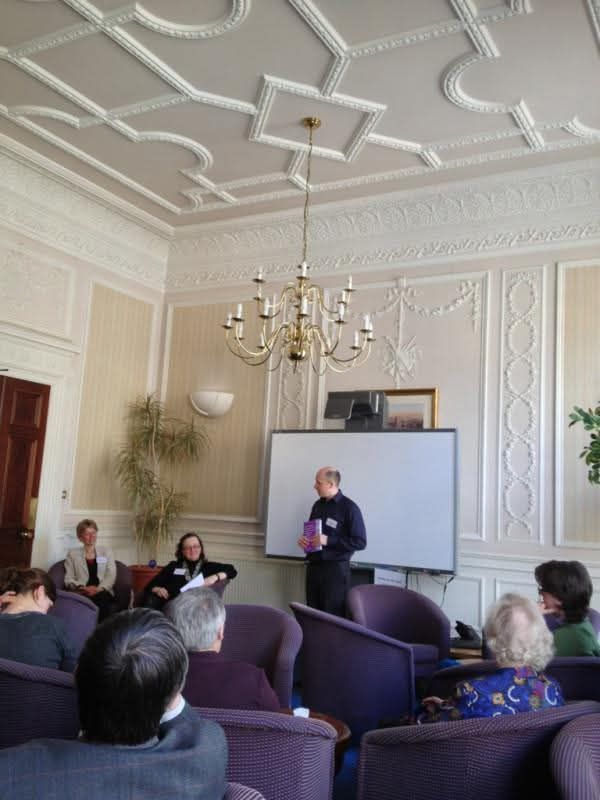
We had another no less triumphant, but smaller scholarly launch at the 2013 Musica Scotica conference.

I remain totally convinced that my second research career has been better in every respect than the first abortive attempt. Different subject.  A different environment.  Much more impact. And, with no offence to anyone working on mediaeval music, significantly more useful in the librarianship career I had dedicated myself to. The Royal Conservatoire of Scotland does offer a traditional music degree, so historical Scottish song collections are of some interest, whilst I suspect fewer of our undergraduates would have been excited by cantus firmus treatment in 15th century polyphony!

My research changed me, and changed my subsequent career. So yes, I do need to celebrate Our Ancient National Airs‘ thirteenth birthday.

Before I get started on the first chapter of my next, third book.

Good News! Article now Published in RMA Research Chronicle, and an [unrelated] Book Chapter Pending

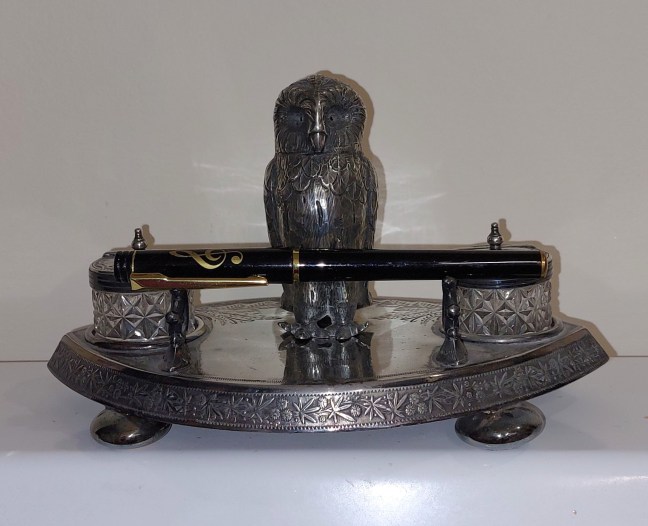
Silver Victorian pen and ink stand

A couple of weeks ago, I mentioned that my RMA Research Chronicle article was now available online as open access. Today, it’s actually in the published issue. Receiving this email is a great start to the day:-

“your article, ‘Women Pursuing Musical Careers: Finding Opportunities in Late Nineteenth- and Early Twentieth-Century Scottish Music Publishing Circles’, has now been published in Royal Musical Association Research Chronicle! You can view your article at https://doi.org/10.1017/rrc.2025.10009

Citation Details

Writing about Tourism

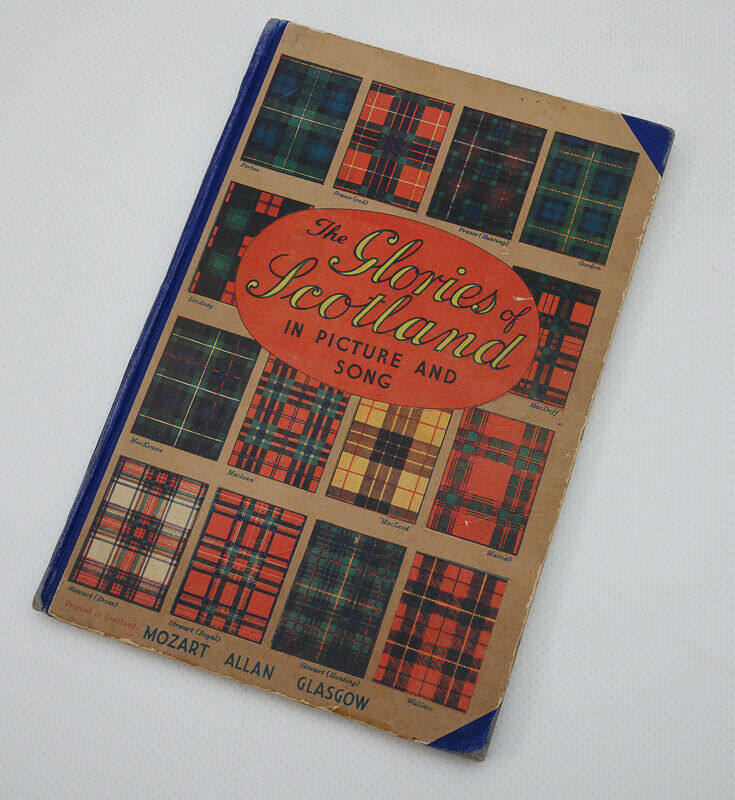
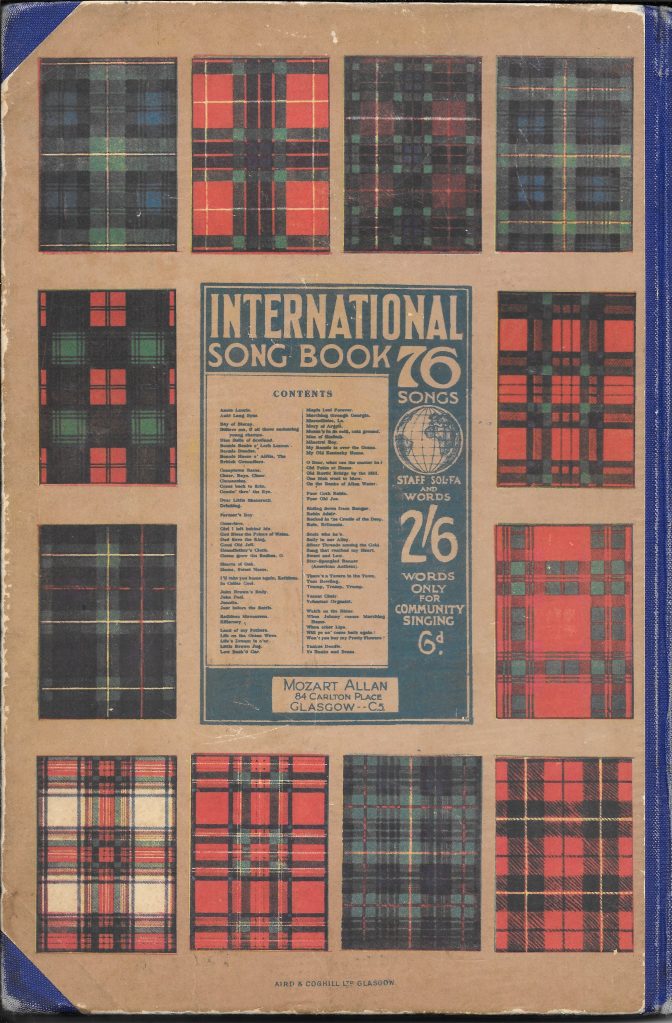
What’s this?, I hear you ask. Why would a musicologist write about tourism? Well, it’s like this: one of the song book titles that I explored in last year’s monograph, The Glories of Scotland, really deserved more space than I could give it in a monograph devoted to a nation’s music publishing. However, the opportunity came up to contribute a chapter to a Peter Lang Publication, Print and Tourism: Travel-Related Publications from the Sixteenth to the Twentieth Century, edited by Catherine Armstrong and Elaine Jackson.

Today, I received the final proofs, which means that the book itself can’t be very far away. I really enjoyed writing this chapter – you could say that it’s decidedly more about publishing history, and tourism, than conventional musicology – and I really look forward to it actually being published.

My chapter (19 pages):-

‘The Glories of Scotland in Picture and Song’: Jumping on the Festival of Britain Bandwagon?’

Jobs for Girls and Boys in the 1950s

Yes, I’m afraid I have been distracted in my archival search for the editor of some teaching materials.  I identified a run of box files for the right years, but it turns out not to be from the editorial team. The sales department was obviously crucial, once the books were ready to market and sell, but if my present quarry had only had any evident input into one solitary published title, then frankly those boxes probably don’t concern me in my present research.

Nonetheless, I inspected four boxes fairly closely, before deciding to stop looking at the boxes from 1953. 

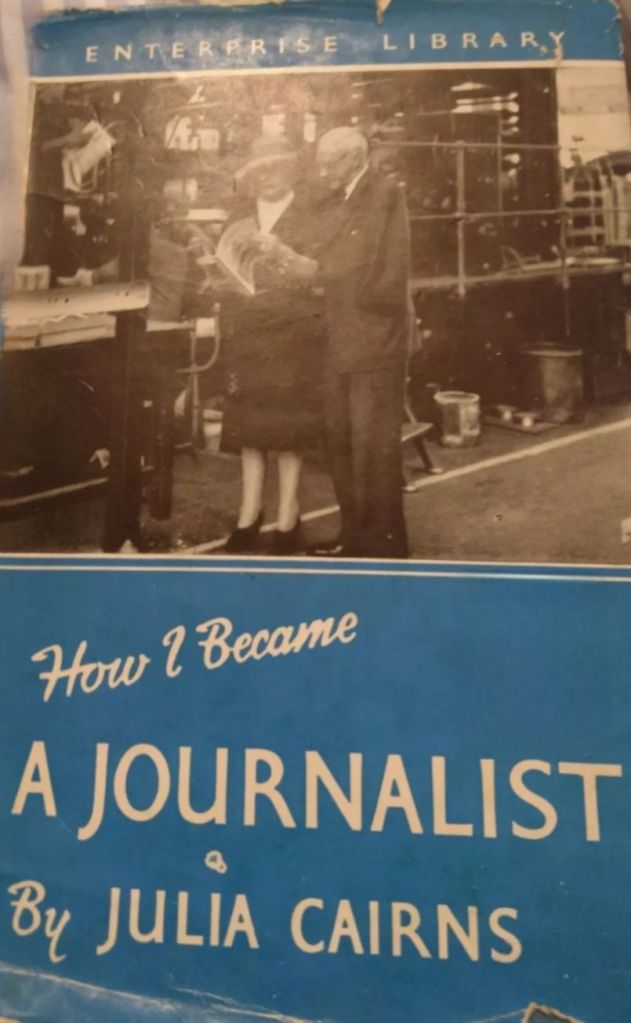
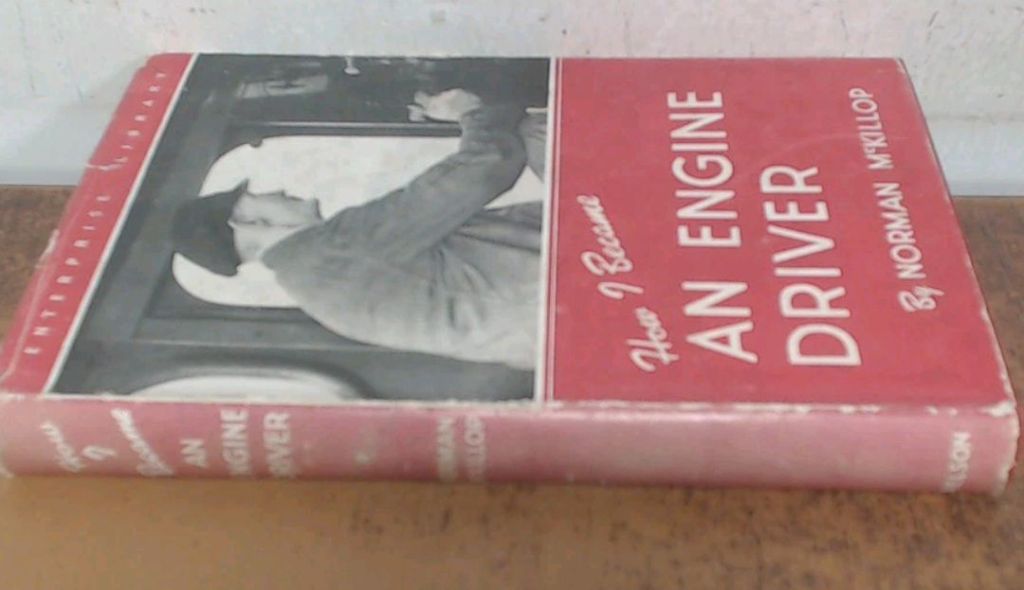
In passing, in the ‘Nelson Juniors’ series, I  encountered some careers-related books from the 1950s. The choices – apart from that of journalist – are rather stereotyped! On the other hand, the girls seem to have more choices … curious, that! Maybe they meant to publish more titles, before the series rolled to a halt with the ‘engine driver’ in 1960.

Found on eBay!
Yes, also on eBay

How I became a … (by women authors)

  • Ballet dancer
  • Fashion model
  • Journalist
  • Librarian
  • Nursing Sister
  • Air Stewardess

How I became a … (by male authors)

  • Cricketer
  • Detective
  • Engine Driver
Also on eBay!

The first and last of these seem to have attracted some interest! The ballet book was reviewed in an American dance magazine – Dancing Star, by the editor of a British magazine called Ballet Today. The Ballet Annual wanted to review it. (A lot of announcements were sent to relevant organisations and individuals.) Moreover, The Psychologist Magazine wanted to review both the ballet book and How I became a Nursing Sister. (Nursing, I can understand. But reviewing a children’s book about the career of ballet dancer? Was it to gain insight into a young ballerina’s mind …?)

And even if nowadays, it looks pretty mundane, Meccano Magazine and The Model Engineer both requested review copies of How I became an Engine Driver.  The Stephenson Locomotive Society were also sent a review copy, along with 2750: Legend of a Locomotive, and they promised to publish a review in the Society’s Journal. Indeed, Thomas Nelson sent a presentation copy of the book to the Lord Reay Maharashtra Industrial Museum in Bombay in response to a request for books for the museum library being set up there – just that one book!

Image by Alana Jordan from Pixabay

Volte Face: Never Think You Can’t Change Direction

We drove south last week. No, I drove us south. I missed one turning and mistook another. I’ll never hear the end of it, and I never want to see Pontefract again.  (It did give a certain person the opportunity to deride my own lack of any sense of direction, and proudly show off their own.)

As for me? I am so accustomed to getting it wrong that I just regard it as part of the journey. I get there in the end.  If this sounds like a metaphor for your own career path,  then read on. You’re in good company.

I found a photo last week that revealed my career has been a bit like that, too.  I’ve told my story often enough, so I’ll keep it brief today.

So Young!!
  • Aspiring to a research career, I completed a research Masters then switched topic for a PhD. First mistake.
  • Took fright at the thought of trying to become an academic, and trained as a librarian – without finishing the PhD. Second (big, big) mistake.
  • First (temporary) post in academic library.
  • 2nd post in public library (who says you can’t change sector? Anyway, I needed a permanent job) – and got Chartered.
  • 3rd post in academic library (another switch, see?). This was where I wanted to be: an academic music librarian. The closest (I imagined) I’d get to being a scholar librarian.
  • Boredom set in. I wasn’t very happy. Here’s where the LinkedIn career coaches say you should walk away. Listen, a breadwinner can’t just walk away! Hang in there. Plan, prepare.
  • Mid-career PhD done, whilst working full-time with dependents. Did folk think me crazy? Assuredly!
  • Partial research secondment.
  • Retire from library, hang onto the research – no longer a secondment but a new part-time position. Onwards and upwards.

I look at that old news clipping (why did Mum keep it? I thought she found my latter research career an embarrassment! All those letters after my name – so immodest) – and I wonder what 22-year old me would have said if she knew how my zigzag career would pan out?

  • Then, not many people did Masters’ degrees. Now, a lot of people do. 
  • Mediaeval plainsong? Completely unrelated to anything I’ve done since 1984! No use in the library.
  • Fifteenth-century English polyphony? Ditto. Although I do feel a bit guilty that I baled out before it was done.

Don’t Look Back

Admittedly, I do wonder what I’d have done if I’d finished the first PhD, and found work as an academic. But there’s absolutely no point in playing “What if?”.  We take the decisions that feel right at the time.

I wouldn’t dare to suggest that I had the model career.  I didn’t aim high enough, lacking self-confidence to a chronic degree; got stuck where I was (see above); and had one helluva struggle rectifying the  situation. Quite a ride! But I did demonstrate both flexibility and determination. I did get what I really wanted all along – eventually.

It all just goes to show that there’s more than one way to get there – if that’s where you want to go. And a few false turns aren’t the end of the road.

How Can I be a Fellow? Let me Count the Ways

Elizabeth Barrett Browning would probably kill me for misappropriating her memorable poetical line! However, I’m only now realising the very many different ways in which one can achieve Fellowship.

A Disappointing Start

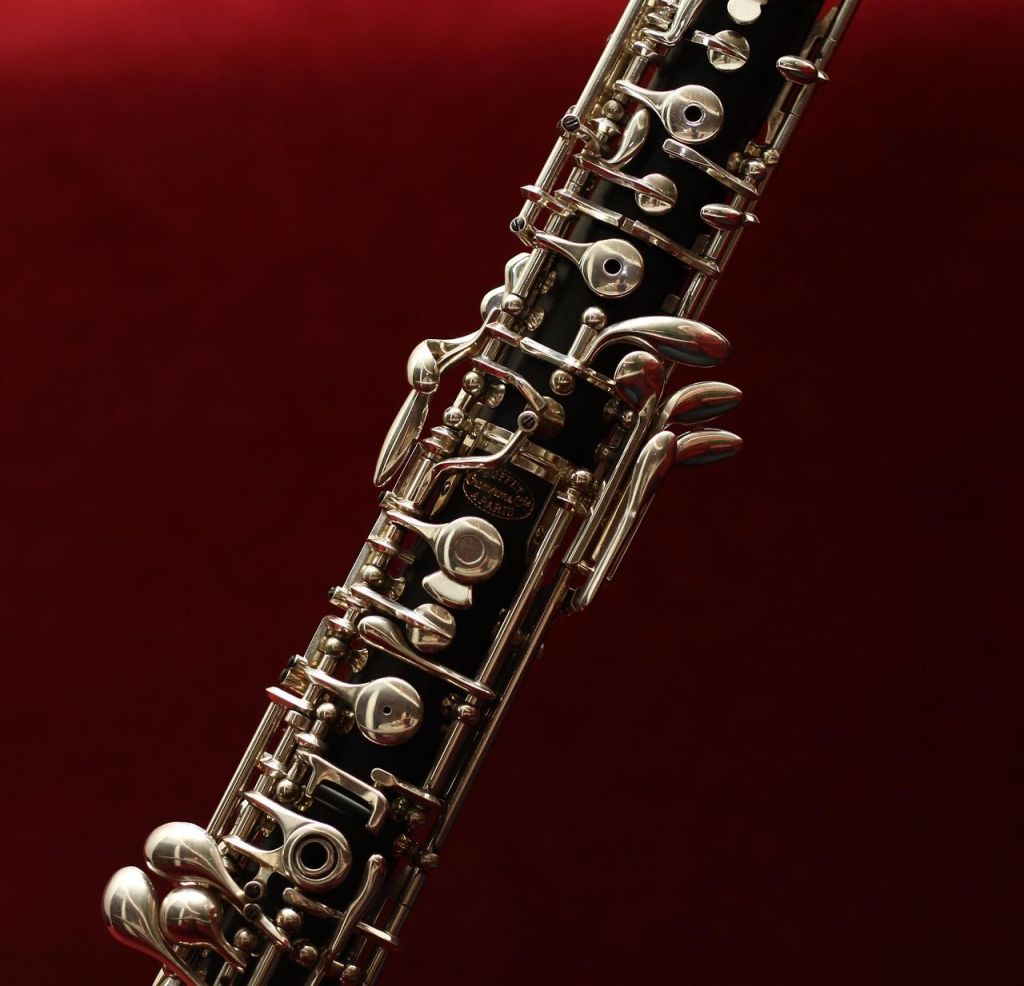
Many years ago, I tried to achieve a Fellowship of Trinity College London, in oboe performance. I’m afraid I didn’t succeed, remaining a Licentiate to this day – but I no longer call myself an oboist in any case; I haven’t played for years.  To think that at one point, I couldn’t imagine myself not playing it!

An Early Dalliance

Professional

I was more successful in librarianship.  I attained Fellowship of CILIP (the Chartered Institute of Library and Information Professionals) in 2010, only relinquishing it (my decision) when I stopped being a librarian.  I was also made a Fellow of IAML(UK & Irl) as I approached the end of my career in music librarianship.  (My official role was Performing Arts Librarian, but I was, essentially, a music librarian.)

Research

A couple of years ago, I enjoyed a Ketelbey Fellowship semester in the School of History at the University of St Andrews, and I’m currently a Fellow at IASH, University of Edinburgh.

I’m continuing my research activities as a postdoctoral research fellow at the Royal Conservatoire of Scotland  – that’s my permanent part-time role.  Would I cause confusion by mentioning that I was also awarded Fellowship of the Royal Conservatoire of Scotland in Autumn 2024? 

And Today … FRHistS

I was delighted to learn that I’ve just been elected a Fellow of the Royal Historical Society.  This is a worldwide organisation with a long and distinguished history, so Fellowship really is an honour.  I’m one of 78 new Fellows this summer. Since I’ve taken the greatest interest and pleasure in historical research in the latter part of my career – as evidenced by my publications record  –  this news is a source of quiet satisfaction. 

The Plan is Working

I read some advice the other day (you’ll have seen it often enough):-

If you aren’t happy where you are working, then leave.

There’s another adage, which is similar on the face of it, which goes like this:-

If you keep on doing what you’ve always done, you’ll get what you’ve always got.

I know there’s value in the first suggestion,  but it isn’t always possible, is it? You may be well aware that you’ve probably been in the same job too long, but personal circumstances mean you simply can’t leave. Or your role is so specialised that you would have to relocate, which might not be an option.

This is why I prefer the second adage. Sometimes you have to take a long view, and your Plan B might involve changing direction whilst sitting tight.  Get ready for a new role, adjust your mindset accordingly, but accept that it’ll be a while before you make the move.

Alt-Ac-tually

I feel for people at the start of an academic career, with the struggle to get one foot on the ladder.  Do you actively want an Alt-Ac career, or do you feel you have no choice?

I wanted to be an academic music librarian. That became my career, but later I regretted not having finished my first PhD and given academia a fair shot.

My Plan B began with getting a PhD.  Afterwards,  I was very fortunate to get partial secondment as a researcher for more than a decade, whilst remaining in librarianship for the bulk of my week.

Adjust Mindset

It’s not just a question of having the right qualifications.  You need to ensure that you believe in yourself as a scholar, and that others see you as a serious academic.

  • Write the articles;
  • Publish the book (if appropriate) or chapters,
  • Attend conferences (partial attendance isn’t ideal  but it’s better than non-attendance, if cost or time are problematical);
  • Give talks, whether scholarly or as  public engagement;
  • Seek opportunities for career development.  (I did a part-time PGCert a couple of years after the part-time PhD).
  • DO NOT, repeat DO NOT, write yourself out of a career option because you believe yourself incapable of it. (Aged 21, I believed I would never be able to stand in front of a class of students. And on what did I base that assumption? I’d just taught English to assorted European students for about a month.  I did it. I planned lessons, and stood there, and did it. So who said I couldn’t?!  And it gets worse.  There weren’t many women doing music PhDs when I was 21.  Guys told me it was incredibly hard to break into academia – and I just took their word for it.  How naive WAS I?!)
  • Look instead for opportunities to practise the  areas you feel need improvement.  You may need to think laterally.  Music librarians seldom teach music history, but they do deliver research skills training. Lots of it.

Today

Fast-forward to now. I left Glasgow at 7 am today, in subzero temperatures. Edinburgh is bright, clear and breathtakingly … well, breathtakingly cold as well as beautiful! A freezing cold early start might not sound like a luxury to the average retired librarian.  I’ve never wanted to be conventional, though.

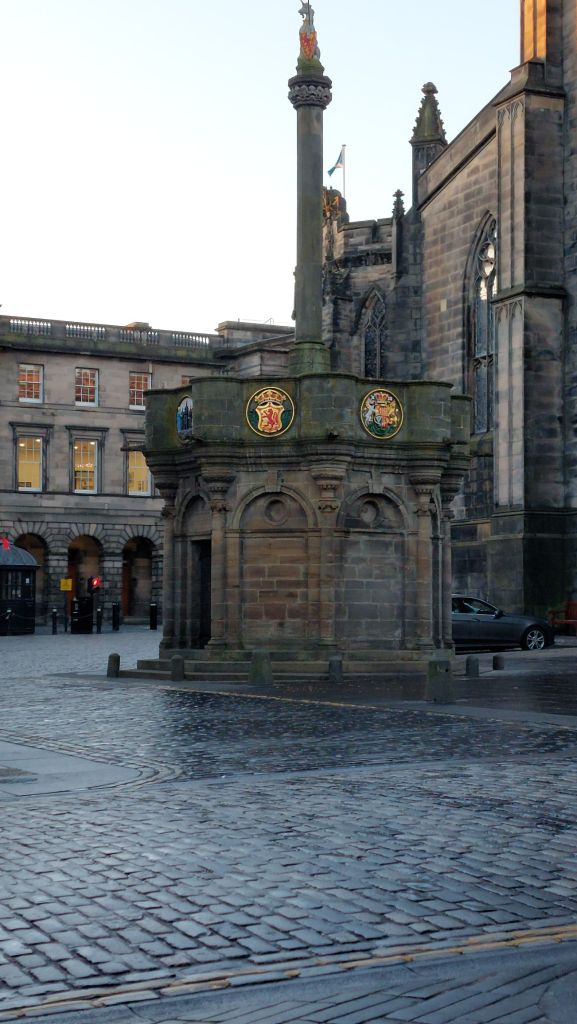
The Mercat Cross, Edinburgh

This is the first week in my IASH Heritage Collections fellowship.  For the first time in my career, I’m NOT juggling librarianship and research.  I’m part of a vibrant community of practice, and I have both the  University Library and the National Library of Scotland just down the road. Thus, today, I saw a set of four Scottish song books that are remarkably hard to find as a set. (Three cheers for legal deposit!) 

And last night, the year got off to an even better start, with an article being accepted.  Just a few minor tweaks to do, which won’t be difficult.

It feels to me as though my long-term plan might be working out quite well!

Annual Review of 2024

Probably the most eventful year I’ve ever reported, 2024 saw plenty of action. However, I’d like to add a few words of explanation before I go any further. Firstly, everyone’s different and everyone’s circumstances are different. (You know the old saying about how you have to ‘walk a mile in someone’s shoes’ before you understand their experiences and challenges?) I’ve spent far too long on introspection, measuring myself unfavourably against high-achievers. It gets you nowhere, apart from feeling inadequate. You will know what is possible in your own situation; please don’t feel I’ve set myself up as an example. I’ve done it my way.

If you’re on the tenure track hamster wheel elsewhere in the world, you may read this and wonder at how little I’ve achieved. On the other hand, if you’re not employed as an academic, you might be surprised at how much. If you’re fully retired, you may think I’ve lost my marbles, but if you’re semi-retired, you might understand! Similarly, everyone’s personal circumstances at home are different too.

For full disclosure, my research career has been what you’d now call alt-ac (alternative academic); I have had 10½ paid hours a week on research for over a decade, but my main career has been in music librarianship.  (I’ve never been a full-time academic,  and my outputs were achieved in less than one third of my working week.)  As you’ll see, I recently gave a keynote about being ‘alt-ac’, and I’d certainly be open to further bookings of this kind, if your institution or network was interested. (I’m in the UK.)

Highlights

  • I had successful eye surgery in February. 
  • I retired from librarianship at the end of June.
  • I was promoted to part-time postdoctoral research fellow in July (10½ hours a week).
  • I’ve had the opportunity to do some teaching cover.
  • My second monograph was published. (It has a 2025 imprint, but actually came out in autumn 2024.)
  • I was elected a Fellow of IAML (UK & Ireland) in the spring, and of the Royal Conservatoire of Scotland in November.
  • I was keynote speaker for the ECRN Alt-Ac Showcase at the University of Birmingham.
  • I successfully applied for a research fellowship at IASH (the Institute for Advanced Study in the Humanities) at the University of Edinburgh, which I shall be taking up between January and June 2025.
  • I received the Mervyn Heard Award from the Magic Lantern Society in December, for research into Bayley and Ferguson’s service of song  publications.

Four fellowships of various kinds is quite an impressive number, however you look at it, so I must remind myself of this before I start beating myself up about my relatively modest upward progress!

Publications

  • A Social History of Amateur Music-Making and Scottish National Identity: Scotland’s Printed Music, 1880-1951 (Routledge, 2025)
  • Book Review: Gun Sireadh, Gun Irraidh: The Tolmie Collection (Folk Music Journal Vol.12 no.5, pp.127-9; my review of a new edition of the Tolmie Collection, a significant Gaelic song anthology, here re-edited by Kenna Campbell and Ainsley Hamill)
  • [Article withdrawn due to pressures of time, but published on this blog: ‘The Exhilaration and Exasperation of Hybridity: Third-Space Professionalism in the Library’]
  • 2 accepted chapters pending publication.
  • 2 articles recently submitted, pending peer review. [February 2025 update: one got through peer review, has been revised, edited and I’ve approved the proofs. The other got through peer review and now awaits the revisions. Nonetheless, satisfactory progress!]

Speaker

  • Exchange Talk, Royal Conservatoire of Scotland, Jan 2024, ‘From Magic Lantern to Microphone: the Scottish Music Publishers & Pedagogues inspiring Hearts & Minds through Song’
  • NAG (National Acquisitions Group) Talk, April 2024, ‘Redressing the Balance: Getting Historically Under-Represented Composers and Contemporary Environmental Concerns into Library Stock’
  • Print Networks, conference held at University of Newcastle, July 2024, ‘‘Music for All’: the Rise and Fall of Scottish Music Publishing, 1880-1964’
  • Exchange Talk, Royal Conservatoire of Scotland, Nov 2024, ‘The Glory of Scotland’ (it’s the title of a Scottish song book published for the 1951 Festival of Britain)
  • Keynote for ECRN Alt-Ac Showcase at the University of Birmingham, Nov 2024, ‘My Alt-Ac Life’

Other Activities

  • BBC Scotland: ‘Good Morning Scotland’ interview
  • Book launch
  • Fellowships of IAML(UK) and RCS
  • Mervyn Peak Award, Magic Lantern Society
  • New job title: Post Doctoral Research Fellow
  • Peer reviews for AHRC and a scholarly journal
  • Providing teaching cover
  • Successful application: Heritage Collections Research Fellowship, IASH (Institute for Advanced Studies in the Humanities at the University of Edinburgh), for Jan-June 2025.
Edinburgh University Library from The Meadows (Wikipedia image)

Forward Planning

My IASH Fellowship will allow me the opportunity to explore the former Edinburgh publisher, Thomas Nelson’s archives, to find out more about their publishing in the music field. There wasn’t a great amount, but I aim to explore correspondence and find out how it fits into the wider range of their activities. I’ll be spending more of my time on research than I ever have since 1982!

Meanwhile, I’ve been working on an article for a history publication; I want to get that finished in the near future, so that I can turn my attention to another article on a different topic. What I do after that will probably depend on how the IASH Fellowship research goes, and what interesting possibilities reveal themselves to me. There’s bound to be enough for an article. But could I expand it to something book-length? I’ll have to wait and see!

ECRN Alt-Ac Showcase: Keynote Speaker

A first for me, today: I was the keynote speaker for an Early Career Research Network event jointly organised with CALt-Ac at the University of Birmingham.  That’s the College of Arts and Law’s network for people with ‘alternative academic’ roles, rather like mine when I was in the library 3.5 days a week, and seconded to research for 1.5.  Not a full-time academic,  in other words.

Yes, yes, you’re correct in pointing out that I’m not exactly ‘early-career’ myself!  I was invited to share my own ‘Alt-Ac’ story, since it transpires that I have actually been an Alt-Ac since before the term was devised.

Everyone was very kind and appreciative; it’s been a lovely day.  I heard interesting and informative contributions, and chatted to a number of people. There was a mix of subject-related presentations, and others which, as I did, shared their own way of making the alt-ac existence work for them.

The ‘Queen of Alt-Ac’ (not my words) declares herself happy (if abashed by the epithet), and is now being conveyed back to Glasgow in her carriage, Avanti West Coast.

My next post will share a summary of my talk. Are you ready …?!