The Excitement of a Good Spreadsheet!

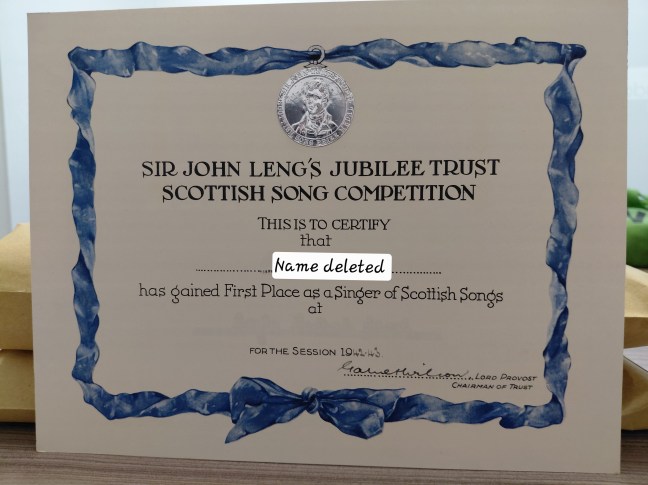
A Leng Medal Certificate

It’s fair enough to say that I find spreadsheets endlessly fascinating, although I don’t use them for number-crunching. However, they’re invaluable for comparing data. In fact, I discovered this before I even knew the word, ‘spreadsheet’, since I did some repertoire comparison for my Masters research degree on mediaeval English plainsong uses at the University of Exeter in 1979-80. It was a 60K-word Masters thesis – I’d intended to continue it to doctoral level, but decided instead to write it up as a Masters then changed subject for the PhD.  (And that became my first doctoral attempt, the one that never got finished.)
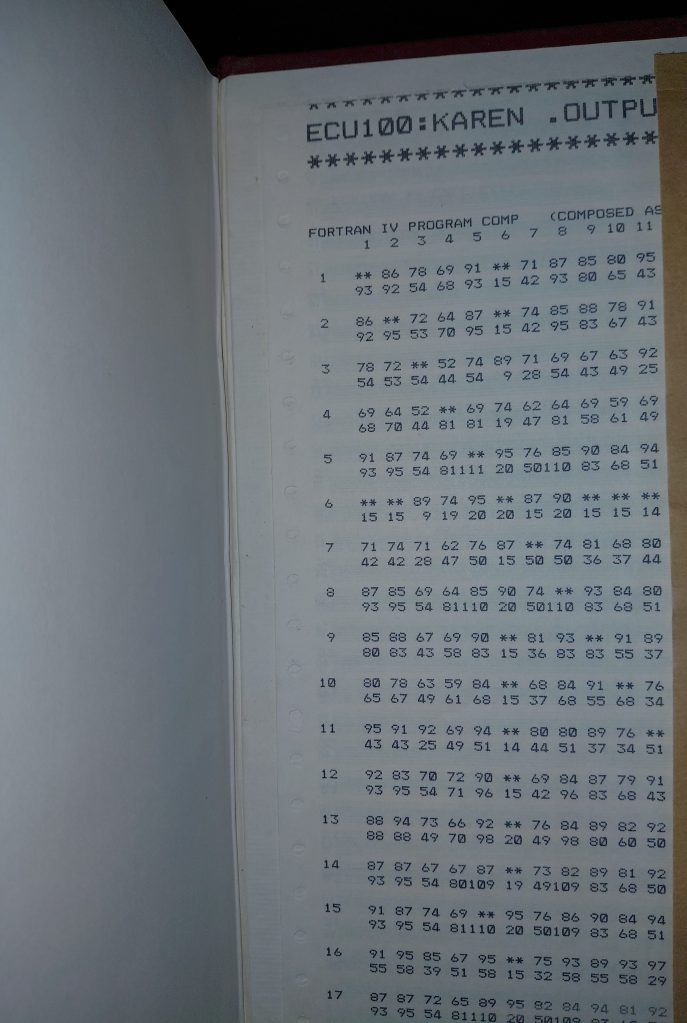
Page of Fortran data printout
Computer printout from my Masters thesis, 1980

This was before the era of personal computers. My data was tabulated manually on a very long roll of kitchen shelf-lining paper, which opened out the full length of the Music departmental library in ‘Knightley’ on Streatham Drive. I compared post-Pentecostal Alleluias and sequences from various English liturgical manuscripts, along with pieces of plainsong from an Augustinian burial rite, now in Shrewsbury public school library. That’s nearly as much as you need to know about my Masters!
Just a Roll of Paper!

Computer Science? Yes, Indeed!

However, one other interesting fact is that I was the first music postgrad to involve the Computer Science department in my repertoire analysis. I filled in cards – or forms, can’t remember which – which were input by the computer scientists to arrive at statistics as to how much different categories of plainsong correlated in terms of repertoire, across different monastic orders and geographic locations.

If you were interested in that Master’s research, this is how you’d find it in Jisc Library Hub Discover; it hasn’t been digitized, to the best of my knowledge:-

  • Karen Elisabeth Manley, English mediaeval liturgies and their plainsong. Exeter, 1980.

The Magical Microsoft Excel

Since my second incarnation as a musicologist in the present century, I’m sure you can imagine how exciting it has been to be able to compare repertoires of Scottish song in a variety of different contexts. But this time I can save my spreadsheets safely – they’re much more portable and more readily manipulable.

In the context of my Leng Medal research, my ‘cup truly overfloweth’ this week, since I’ve seen lists of songs sung, enabling me to see how tastes have changed over the past sixty or so years. I’ve been comparing what was sung, against a few different song books available at particular times. Obviously, I can’t compare ALL the songs against ALL the song books that exist – I would surely go insane! Indeed, I couldn’t even capture ALL the data for every single year over that period – I simply didn’t have time. But carefully judged snapshots are certainly giving me food for thought. I’ve had endless fun today, producing charts and tables to examine the data in different ways.

The Most Popular Songs sung by Leng Gold Medal Finalists

Oh, did you think I was going to tell you which they were? Sorry, not at the moment – I need to keep specifics for when I write my research up later!  It’s certainly interesting, though.

I only picked nine different years for close examination.   Suffice to say, they have given me plenty of hard data to set my oral history interviews in context.

And not a roll of shelf-lining paper in sight nowadays!


My Leng Medal Memories research is funded by an Athenaeum Award from the Royal Conservatoire of Scotland.

Diversity in the Concert Programme

Below, you’ll find a blog post that I have just written for the Whittaker Library blog. In my library career, I haven’t changed the world, but I have bought and catalogued quite a lot of music.ย  (Why be modest? Mountains of it!) In the past five years, I’ve focused particularly on equality and diversity – I put a huge amount of effort into it, and I hope it has made a difference to our users.ย  Perhaps one day, there will be an event to raise awareness of all this music.ย  I tried, but I have done all I can.ย  I wish it had been more, and I wish it could have ended more triumphantly.

In an era that’s all about impact and engagement, it can be an up-hill struggle for a librarian to make a significant difference, and even harder to blow one’s own trumpet metaphorically when surrounded by genuine stars in the making, deservedly blowing their own actual trumpets!

Whilst repertoire lists might not seem the most exciting topic in the world, if theyโ€™re important to recitalists and other people planning concert programmes, then theyโ€™re important to us. We would like to remind everyone that the Whittaker Library does have a lot of music by women and/or BIPOC composers. Weโ€™ve committed a fair chunk [โ€ฆ]

Diversity in the Concert Programme

Diversifying Your Repertoire: Music by BIPOC Composers

At the Whittaker Library, we use the Portal (a bit like Moodle, it’s a kind of intranet for material shared within the institution) for useful information to help our students and colleagues.

A while ago, I compiled lists of music by women composers, subdivided into categories, such as music for children, music for tuba, music for mixed chamber ensemble – but until now, I hadn’t done much in the way of subdividing the lists of music by BIPOC composers. So, I have been working on it.  Despite having acquired quite a lot of music, I have discovered that the commonest instruments have by far and away the most music. Poor tuba player, if you want to diversify your programme with music by people of other ethnicities.

Some university libraries have put in a lot of effort helping students find this kind of thing – especially in Canada and the USA – and there are some useful databases to help – but I have still been struggling to find materials for some of the more minority instruments. Not a great deal for piccolo, tuba, accordion – or bagpipes! (Well,  there might not be as much pipe music over there – we started the piping tradition here in Scotland. However,  there are plenty of non-Scottish pipe bands. Some international pipers must also compose!)

If you play tuba, trombone, piccolo, oboe, saxophone – you get the picture – and your repertoire includes a fabulous piece of music by a BIPOC composer, PLEASE do recommend your library to get that piece in stock so that other musicians can also find it! It won’t be up to me to continue ordering music at RCS after the end of June – and that’s a strange feeling – but I can, right now, highlight the fact that libraries need to pay attention to the repertoire they buy.

If you’re a librarian – by all means, keep the standard repertoire up to date. Buy what your patrons need and ask for. But if you have a chance to do stock development, please keep the BIPOC composers in mind. They are, after all, the global majority! And I’m ashamed to say, we don’t know enough about them, though I can, hand on heart, say that I’ve been making a determined effort to find out.

I had hoped to do one last workshop about all the exciting new repertoire in the library, before I retired. Sadly, this isn’t going to happen. Never mind – maybe one day, someone will find this blog post and feel inspired to explore it all for themselves.

Image by congerdesign from Pixabay