


No disrespect to my day-job, but years of cataloguing have trained me to tolerate repetitive tasks to a very high degree! Cataloguing can be repetitive and, I’m afraid, monotonous. However, in terms of endurance training, this background stands me in good stead. I just keep on going, like the Duracell bunny in the battery ads!
My innocent vacation amusement this week has been the rather slow-moving exercise of comparing one database with another. Why would anyone spend hours, days, starting to go through a list that amounts to some 2000 pieces of music? Ah, for a very good reason. This is the list of Edinburgh University Library’s Reid Hall Cupboard collection, and I’m finding out how much legal deposit music was actually retained. First, I compared it with the entire registered output of 1810 as listed in Kassler. Very little was there. Then with the registered output for 1818, the last year listed there. Possibly one match. Then I compared the Reid Cupboard contents with the material listed by the Advocates in 1830 – twelve years after the period itemised in Kassler. Very little correlation there, either.
A Significant Sample: 68 Hits
However, at different periods, copyright music WAS selectively retained at the University of Edinburgh. I concluded that there was nothing for it but to go through that a significant sample of that spreadsheet, just to begin with. Some music is continental (mainly French or German) in origin, and some is in manuscript; these categories don’t form part of my investigation. The problem is that no single approach can be taken to the whole corpus. We’re not comparing like with like, and different listings cover different periods, apart from any other considerations:-
- There is the option of checking Kassler’s listing (if Copac indicates that the piece
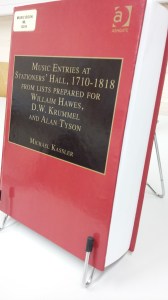 was published before 1819); checking Kassler in digital format is generally easier than in the paper edition, because one can check by title in the e-book. The physical book has various indices, but there’s no alphabetical title listing, and only the composers’ names are listed, not their works.
 - The Advocates 1830 lists merely cover February to March of one year. Even if much of this material turns up in the Victorian catalogue at NLS, it’s not a huge sampling.
- It’s marginally quicker checking the EUL Reid cupboard material against the St Andrews copyright music spreadsheet (which did arrive by the legal deposit route) than it is checking against Copac, but it has to be said that checking Copac is the more thorough way. Having said that, we can’t be totally certain that the Copac-listed material was registered at Stationers’ Hall if it postdates 1818, short of actually checking the Stationers’ Hall records. An item appearing in the British Library, and one or more of the other copyright libraries, was probably accessioned under legal deposit, but not categorically so. And not everything that should have been registered and legally deposited, actually was.
- The St Andrews collection is only catalogued online for material dating from 1801 onwards, and of course, will not include items that were discarded rather than being bound in the big composite volumes.
After several lengthy sessions checking and cross-referring, I had nearly finished composers beginning with “G”!
Thursday – the brightness of a [rainy] new dawn …
Faced with a very large collection of Haydn publications, I concluded that although the most comprehensive approach would be a complete comparision of the EUL Reid Hall cupboard contents with Kassler, St Andrew’s online copyright collection, and items listed in Copac, maybe this isn’t necessary immediately. Instead, a few broad statistics give us an overview of what’s there.
- Comparing Kassler’s listing for 1810 with the Reid Hall cupboard: a maximum of 9 matches, and possibly only 7.
- Comparing Kassler’s listing for 1818 with the Reid Hall cupboard: possibly one match. It’s a very popular Irish selection, so it could have arrived by other routes than legal deposit, eg by donation.
- Comparing the Advocates’ lists of February and March 1830 with the Reid Hall cupboard: only three matches, which are European editions.
- Comparing an initial sample of 68 Reid Hall cupboard items matched either with the St Andrews copyright collection or Copac: obviously, percentages could only be calcuated if the entire list was compared; they’d be meaningless with a small sample. Nonetheless, we can observe that in Edinburgh, items seem to have been retained very intermittently between 1770 and 1811; there’s no real pattern. Between 1812 and 1821, noticeably more material was retained, although nothing like the St Andrews collection. After that it appears to be even more intermittent than in the earlier period.
 Karen McAulay, Musicologist