

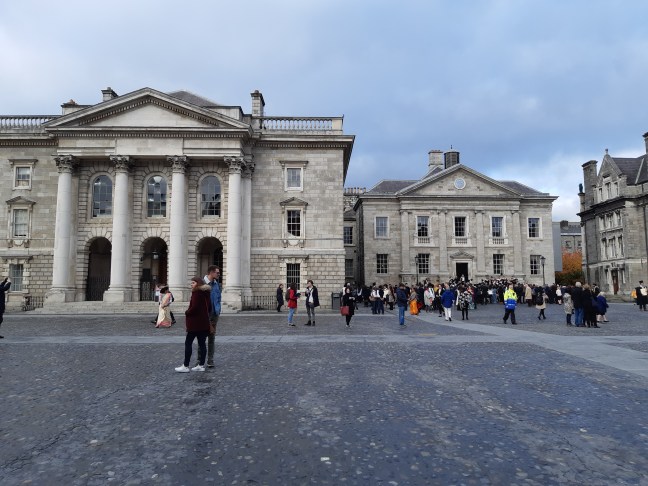
Trinity College was the legal deposit library that did, initially keep legal deposit music (in the attic), but then by 1817, they had instructed their London agent not to collect sheet music, school books or novels. It seems virtually no music was retained before the 1850s, when they started keeping it again.
A full century later, in 1917, it’s minuted that “All the unsorted music which was filed in the West Attic … was sorted by the librarian.” Well, if the word “filed” slightly gladdened your heart, you’re about to be rudely disappointed! The minutes go on to record that,
“Several sacks filled with separate band parts and music-hall rubbish were sent to the wastepaper merchant.”
It went away in bin-bags! Nowadays, I suppose it would have gone in the shredder. (Let’s face it, loose band parts can be a bit of a pain, and who knows what state the music-hall material might have been in. Maybe the librarian saw no use for it, back in 1917.) The good news is that “Full scores were put in Dr Todd’s cabinet in the Librarian’s Room.” Ah, so it didn’t all get chucked out!
Notwithstanding the disappointment about the sacks of rubbish, I enjoyed a fruitful conversation with my “opposite number” at Trinity, had an atmospheric stroll through the galleries of the old library, perused the old minute books, and looked at a handful of surviving music textbooks and minstrelsy verses – not musical scores, certainly, but I was looking for ownership marks and library property stamps, and I did find those! Trinity has a whole run of The Harmonicon, a music magazine which was extremely popular at St Andrews – and I’m happy to say that Motherwell’s Minstrelsy is there in the 1827 edition, which has a bunch of tunes at the end.

 Karen McAulay, Musicologist