

Relax, dear reader – this is not an incursion into my working research existence. I haven’t broken my resolution to take a well-earned holiday. Well, not exactly!
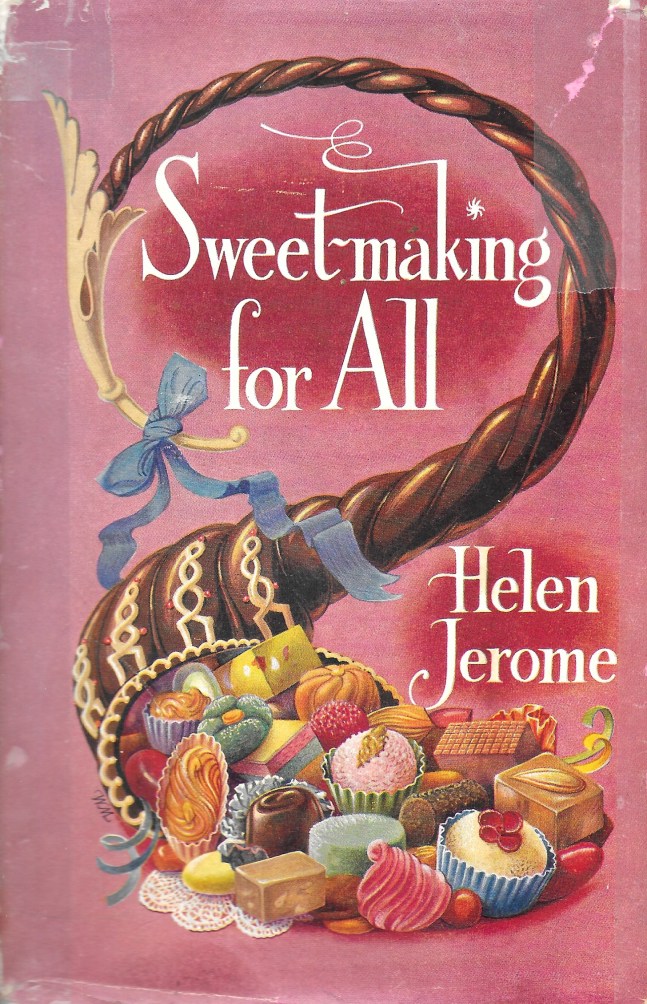
Going through the Thomas Nelson correspondence a few weeks ago, I came across a post-war letter celebrating the fact that sugar rationing was finally over, in which one editor suggested to another that now would be a good time to reissue Helen Jerome’s sweet-making book.
Now for a bit of history! It had first been published in 1924. In 1931, the author proposed another book, this time about baking cakes. The publishers declined it, since they felt the sweet-making one hadn’t sold very well.
Notwithstanding these observations, they revised the sweet-making book in 1936, and reprinted it in June 1939 (still pre-war). This publisher very much had their finger on the pulse, and books for adults quite often tapped into contemporary issues. So, right now they guessed – probably accurately – that people would enjoy making confectionery again after the years of privation. I obtained a revised edition with a foreword dated Spring 1954:-
FOREWORD TO THE REVISED EDITION. The effect of sweet and sugar rationing appears only to have increased the amount of sweets eaten in Great Britain, establishing us as one of the largest sweet-eating countries in the world. There is now much added interest in the actual making of sweets at home – whether as a skilled hobby … a family venture for special occasions, or as an experiment embarked upon by teenagers …
I’ll be honest – I bought this book intending to make some confectionery which I could photograph and write about. Now I’m on holiday, I imagined myself lovingly creating something delicious to intrigue and delight the family. However, I’ve looked through at the required equipment, the fancy syrups, and high boiling temperatures, and I have taken fright. It’s not going to happen! The first three chapters are terrifying enough: Utensils Required for Sweet-making; Materials Required for Sweet-making and Hints on their Preparation; and Sugar Boiling, Sugar Syrups, Spun Sugar, and Crystallisation.

I have a stove. And a sugar thermometer (unused). I don’t have a slab, be it marble, slate or heavy wood (‘covered with a sheet of enamelled iron’) or a ‘heavy white enamelled tray known as a “butcher’s tray”‘. Nor do I have a nylon or hair sieve, candy bars (not the edible variety – these are ‘a set of four steel bars cut from 1/2 in. cube steel, and 12-18 in. long, which help to obtain and professional finish’ and ‘can be obtained from a builder’s merchant’.) I’m mystified by sweet rings or cream rings, a caramel marker, a sugar scraper, a candy hook or a starch tray … need I continue? There are three more pages of equipment requirements.
As you can see, getting set up could be quite expensive! Not only are some of the above items going to be hard to source, but I had a bit of a problem establishing what, precisely, a gill measurement is. My first Google search did not go well …

If at first you don’t succeed – try, try, try again:-

Anyway, let’s look at the ingredients:- Loaf sugar, granulated sugar, demerara sugar, castor sugar, icing sugar, Raw West Indian or ‘soft’ sugar. Treacle, honey, glucose, cream of tartar, butter … so far, so good. But don’t get complacent. After various nuts and dried fruit, we find we need plain cooking chocolate (yes) and covering chocolate (what?), cocoa butter, various flavourings, gum arabic, gelatine, confectioners’ starch. Maple sugar, maple syrup, molasses, marshmallow cream … and then we get on to various techniques that you use to transform these ingredients into other more complex substances.
After all this, there are ten chapters devoted to different kinds of sweets, followed by advice about packaging them.
- Fondants
- Marzipan (you make this from scratch – don’t imagine you can buy a packet from Sainsbury’s!)
- Toffees
- Caramels
- Candies and Fudges
- Nougats
- Chocolates
- Jelly Sweets and ‘Delights’
- Unboiled Bon-Bons
- Miscellaneous Recipes
Now I’m feeling hungry, and my mouth is watering, but I am not equipped to start my confectionery journey. Not only that, but my ceramic hob is my pride and joy (or a ridiculous obsession, to quote my nearest and dearest), and I live in fear of pots boiling over at the best of times. Can I risk spilling boiling syrup on it? I cannot.
I take my hat off to the author, with her First-Class Diplomas, London and Paris (Cordon Bleu), who was a former staff Teacher of Cookery at the Polytechnic, Regent Street, London W1. I envy the skilled hobbyists capable of mastering ‘difficult processes’ (see? she admits they’re hard!). And I’m in awe of ‘teenagers who want to make their own “tuck”‘. I can well imagine their collective excitement at being able to buy all these sweet ingredients to create the treats they had missed out on for so long, and I hope many tasty confections were made by the purchasers of this book.
Next time I’m passing a shop, I’ll get some Fry’s Turkish Delight, and be grateful that I can!
 Karen McAulay, Musicologist