Countdowns!

You know the story of the shoemaker and the elves? He goes to bed, exhausted, and wakes to find the little elves have done all his outstanding work? Oh, I wish!

Technically, my book is meant to be finished by the end of July. I’ve written quite a bit of the last chapter, but it goes without saying that that’s not the end of the process!

  • Writing the conclusion;
  • Tidying the introduction;
  • Checking the whole thing – for content, and also against the style guide;
  • Converting footnotes to endnotes;
  • Sorting the bibliography…

I’m also handling the comms for an international congress – it begins on 31 July.

Of course, there’s also the day-job to be done! And domesticated things don’t just stop. Garden hedges grow regardless of everything. Aargh!

And I have a whole magazine issue to proofread ASAP. (This task was accepted on my behalf – literally nothing to do with me!)

Daily Countdown

Now, the book deadline has been engraved on my brain for a long time. I’ve also known the congress date quite a long time. But believe it or not, it’s only just dawned on me that both dates coincide, and that therefore 38 days’ countdown for one thing would be 38 days for the other. Strange how the realisation suddenly makes it all the more stressful! All I can do is keep doing what I can. A colleague asked me the other day, what were my plans for this summer … ?

‘Finish a book’, I whispered. One way or another!

Alas, I don’t feel indomitable today. More like, a bit hopeless, faced with the mountain in front of me.

On Either Side of the Divide: Classical v Trad

Fence with road on one side.

Just a quick reflection, today.

Working on my final chapter, I encountered a composer about whom I knew comparatively little. However, when I discovered he was friendly with one of Scotland’s significant 20th century poets; that the two of them had corresponded extensively; and that the composer set lyrics written by the poet, I thought I ought to know more about both men. I consulted the Oxford Dictionary of Biography. On Amazon, I ordered a poem considered one of the poet’s greatest works. At work, I borrowed a score and a textbook. I also sent out an email, basically asking (in more scholarly terms), ‘is this composer any good?’ (And ‘would you put his songs in your music case, if you were filling it with your favourite repertoire?’)

The outcome was very interesting. I was directed to a singing tutor and a student who had worked on this repertoire. Both sang the composer’s praises – indeed they were enthusiastically generous in their praise.

I also had a response from a traditional music expert: their assessment was quite the reverse. Indeed, it reminded me of what happens when I introduce the songs of Marjory Kennedy Fraser to traditional music students. Looks mingling caution, boredom and blank incomprehension, steal over faces that were only minutes before quite animated and interested.

I’m a musicologist from the classical music tradition, working with supposedly ‘traditional’ folk song collections. Well, commercial collections of ‘traditional’ national songs. I really am stuck in the middle! It’s an interesting place to be.

Why study history?

There are lots of arguments on social media about why we should, or should not study history. I freely admit – I think we should! I really liked a blogpost by someone whom I follow on twitter, George Harris (@HistoryLecturer):-

What is the Point of Studying History?

History Lecturer, Wednesday, 5 June 2013

I’ll be adding this link to my Zotero bibliography, ready to fire at anyone who dares suggest that studying history is not worthwhile!!!

The Gentle Art of Bibliography: a Footnote

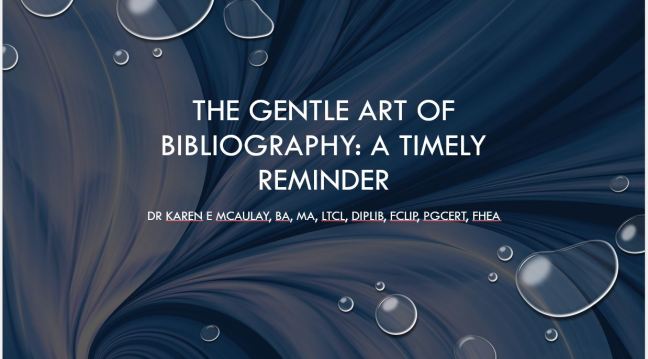
Title slide for my talk, The Gentle Art of Bibliography. No image, just an abstracct grey background.

My talk for the Scottish Graduate School of Arts and Humanities was incredibly well-attended. It was lovely to be able to talk about one of my specialisms to people who were genuinely interested. My thanks to you for attending, if you were one of those people! At least one individual had just started their bibliography, so hopefully I was able to share some useful tips.

I’ve uploaded my PowerPoint and text to my Conservatoire Pure account – our institutional repository – please click here.

If anyone tried to sign up, but experienced a problem getting into the meeting, please contact me via the SGSAH Summer School organisers.

Thank you Karen for a fantastic talk

😊
An attendee

It was such an excellent and helpful session!

Another attendee

Chat GPT (part 3) I asked it to define ‘Scottish’ music!

I think you know my main thoughts about what counts as ‘Scottish’ – I posted about it only last week. However, having just played ‘Highland Cathedral’ as a crowd-pleaser at church this morning, I wondered what Chat GPT thought about that kind of thing. I always feel a bit guilty in two ways: purists quite rightly say it’s not by a Scottish composer, but there I am playing it all the same – whilst people who just like the music don’t want to feel they’re being put down by being ‘educated’ about the fact that it isn’t actually Scottish at all.

Here was my question:- “I’d like to write about the different ways a piece of music can be considered Scottish”

Chat Open AI responded accordingly. This is the link to their answer:- Scottish music explained.

It’s really not a bad response. But of course, I forgot to ask about ‘Highland Cathedral’, which as we all know is not remotely Scottish in origin – it’s just called a Scottish piece and is often played on bagpipes! So I tried again.

My next question:- “Why do some people say that the musical composition, ‘Highland Cathedral’, is not really Scottish?”

I can’t share the same link again, so I’ll show you what Chat Open AI actually said:-

The musical composition “Highland Cathedral” is often associated with Scotland due to its name and the use of bagpipes, which are strongly linked to Scottish music and culture. However, it is true that some people argue that “Highland Cathedral” is not genuinely Scottish in origin.

The composition was actually created by two German musicians, Ulrich Roever and Michael Korb, in the 1980s. It gained popularity as a bagpipe tune and has been performed by various Scottish pipe bands and military bands. The melody and arrangement evoke a sense of Scottish musical traditions and are often heard at Scottish-themed events, including Highland games and military ceremonies.

Critics argue that because the composers are German and the composition was not created within the traditional Scottish musical framework, it does not qualify as an authentic Scottish piece. They contend that “Highland Cathedral” lacks the historical and cultural context typically associated with traditional Scottish music, which often has deep roots in Scottish folklore and history.

However, it’s important to note that the concept of musical authenticity can be subjective, and the definition of what constitutes “Scottish” music may vary among individuals. While “Highland Cathedral” may not have originated from traditional Scottish sources, it has undoubtedly become strongly associated with Scottish culture and is beloved by many as a representation of Scottish musical identity.

Ultimately, whether or not “Highland Cathedral” is considered genuinely Scottish is a matter of personal interpretation and cultural context.

At this point, I’m quite impressed! My essential argument, that Scottishness is a subjective concept, is right there. And it even named the composers – not bad, Chat Open AI!

Another researcher threw out a challenge: Why do some people say that the musical composition “Farewell to Stromness”, is not really Scottish? Now, this is a classical piece by Peter Maxwell Davies. (I played it as a voluntary before the service at church, as it happened!) I was curious to see what Chat Open AI would say. It didn’t exactly muddle things, but there was really no need to talk about traditional music, because this is not traditional!

The musical composition “Farewell to Stromness” is a piece written by the British composer Peter Maxwell Davies. It is part of a larger work called “The Yellow Cake Revue,” which Davies composed in 1980 as a protest against uranium mining in Orkney, Scotland.

While “Farewell to Stromness” was inspired by the Scottish town of Stromness and its local music traditions, some people argue that it is not a traditional Scottish composition. The main reason for this view is that the piece does not adhere to the typical structure and style of Scottish folk music. Traditional Scottish music often features specific rhythmic patterns, melodic ornaments, and instrumental arrangements that are characteristic of the genre.

“Farewell to Stromness,” on the other hand, is a contemporary classical composition that incorporates elements of folk music. It is written for solo piano and has a more modern harmonic language and structure. The piece is often performed by classical pianists and is appreciated for its lyrical and reflective qualities.

While it may not fit the mold of traditional Scottish music, “Farewell to Stromness” is still associated with Scotland due to its thematic connection to the town of Stromness. It is important to note that music, like any art form, evolves and takes on new forms over time. The composition represents a creative interpretation and expression of the composer’s feelings and ideas, which is a common practice in music composition.

Well, I argued back just a little: This music is a classical piece, not a traditional folk tune. It is not a traditional tune from any country!

Chat GPT is so polite in its debates, as you can see:-

You are correct, “Farewell to Stromness” is a classical composition and not a traditional folk tune from any country. I apologize if my previous response was not clear on that point.

As I mentioned earlier, the piece was written by the British composer Peter Maxwell Davies as part of a larger work called “The Yellow Cake Revue.” It was composed in a contemporary classical style and is typically performed by classical pianists.

While the composition was inspired by the town of Stromness in Scotland, it does not adhere to the traditional structures and characteristics of Scottish folk music. It is a unique creation by the composer, and its style falls within the realm of contemporary classical music rather than traditional folk music.

Thank you for pointing out the distinction, and I apologize for any confusion caused by my previous response.

I don’t know if my correction would be incorporated into a subsequent answer, though, since Chat GPT is experimental and based on a snapshot of the internet at a certain point in time. Still, it’s an interesting thing to play with!

Image by Nikolaus Bader from Pixabay

Define ‘Scottish’ without a Scotch Snap (human asking human!)

OK. We’re thinking about ‘classical’ music. 🎶

Art music, if you like.

If you’re a serious classical composer, wanting to convey your Scottish identity – but also aspiring to avoid clichés – how do you do it?

  • No ‘Scotch snaps’
  • No ‘modes’, flat sevenths, or gapped scales
  • No Scottish song or fiddle melodies
  • No titles derived from Robert Burns or Walter Scott’s literary output
  • Oh, okay, you can have a clarsach, fiddle, whistle or pipes if you absolutely insist!

Why am I asking you this riddle?

I read in an old newspaper that a certain composer had truly captured ‘Scottishness’ in his music. I didn’t know the piece they were referring to. Did he evoke Scotland in his soundscape? How?

We say that Sibelius’s music evokes Finland. To be truthful, many of us have probably just accepted that it’s a ‘Finnish sound’, making us think of steep valleys, tall pines, and vast echoing lakes. Fair enough. We’ve heard something, and learnt to associate it with a set of visual images.

So what would evoke Scotland? Can we look at some Romantic-era tone-poems and point to elements that sound Scottish, or could only be Scottish?

What are your thoughts about this 🤔

SGSAH Summer School: The Gentle Art of Bibliography

An entirely new venture for me: I’ve offered to give a talk at the Scottish Graduate School for Arts and Humanities Summer School later this month – next week, to be precise! It’s a summer school for all Arts and Humanities doctoral researchers in Scotland. When the opportunity came up to participate, I initially wondered if I had any expertise that I could share, leaving aside my own niche research interests. But then it occurred to me that people seem to enjoy my talks and writing about the process of research, as much as my talks about the research itself, so the obvious thing was to talk about one of my favourite things – bibliography. A lot of people have signed up – I’m so pleased.

Today felt like a good day to get it written, powerpoint and all.

The Gentle Art of Bibliography: a Timely Reminder (Quick Talk)

I might share the talk later, after it has actually taken place. For now, here’s a taster for any Scottish postgraduate researcher deciding which talks to attend!

“Have you ever forgotten where you read something useful?  You know the scenario – whilst you’re searching for something, whether on the web, in the library or in a database, you flick past something that’s perhaps only of tangential interest, only to realise later that it was more significant than you thought.  Or you’re just killing time, so you’re not in full scholar-mode, and you find something interesting that is so relevant that you just know you’ll be able to find it again? But you can’t. 

Isn’t it an awful feeling?”

When I submitted my proposal for this talk, I had to describe the learning outcomes. Here’s what I’m aiming to do:-

Learning Outcomes:- By the end of this session, participants will have a greater understanding of the options available to them, in terms of building, maintaining and deploying a bibliography in scholarly writing. By the end of this session, participants will also understand the importance of starting to build one’s bibliography at the earliest opportunity.

Full Programme of the Summer School here

Flower Pots! How to Brighten a Music Librarian’s Day

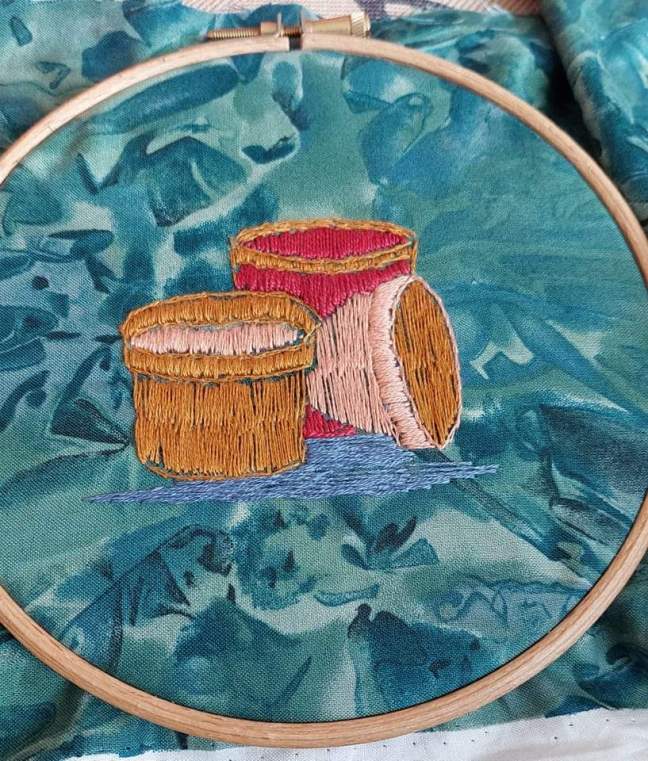
Embroidered picture of flower pots

I’ve mentioned before how, for the past four or five years, I’ve particularly focused on getting more music by women and composers of colour into the Whittaker Library. By the time I reach retirement age, there will be a good, up-to-date selection of such works for students to choose from. (I’ve also mentioned my rationale for this activity – if we introduce this music to today’s students, then whether they go out and perform it, or teach it, or combine these with other activities, there’s hope that they’ll pass on a wider, more receptive approach to repertoire-building to the students that follow on behind them.

Today, I was invited to attend a recital by one of our students. Two of the pieces were pieces by women composers, that their teacher had recommended us to acquire. It was a great recital – innovative, exciting and impressive. One particular piece involved a percussionist playing a counterpart on – wait for it – an assortment of carefully-chosen, differently pitched flower pots. You didn’t think flower pots were pitched? No, they aren’t deliberately tuned, but they can be chosen for the sound they make when you hit them! I bet you none of the audience had ever heard flower pots in a recital before, but it was great. Another piece had been written with piano accompaniment, but this time it was played on accordion. (From a personal point of view, this was of considerable interest. I got an accordion a few months before the pandemic, and a concertina a few weeks before. I get a lot of enjoyment out of my beginner’s attempts with two inexpensive instruments. But to sit and hear a truly excellent instrument in expert hands – and a “button box”, too; completely baffling to me! – well, that was something else. If you think accordions are just about ceilidhs and the good old days of Jimmy Shand, then believe me, you’ve missed so much.)

I and my colleagues even got a mention in the programme “credits”, for having obtained the music. It makes all the difference to feel that we were part of the programme-planning in our own small way. Sometimes, in a performing institution, it’s easy to feel that our hidden-away, behind-the-scenes work is really very insignificant and unnoticed. Obviously, we research and source the materials, catalogue and index them, then sit back and wait to see what happens. Our job is effectively done, one score or resource at a time, and the performers then go off and do the hard work, putting together a balanced programme and practising hard. We don’t always get to hear the results, though, which is why this morning’s recital was so lovely.

I have already expressed my opinion on – and weariness of – repetitive cataloguing. Processing CD after CD, all in the same genre and series, is mind-numbing. The mental exercise in cataloguing and indexing fresh, contemporary sheet music is definitely more enjoyable! Nothing can be ‘discovered’ in a library unless it has first been carefully catalogued, indexed and assigned the correct place on the shelves.

Seeing and hearing the results reminds me of the importance of music librarianship. A timely reminder!

35 years in one post

I omitted to note that this week is my 35 year anniversary of being in the same library post at RCS. Having said that, I have …

  • Had 3 children (minimum maternity leave each time) and seen them grow up.
  • Done a self-funded PhD in my spare time; also gained Fellowship of CILIP and Advance HE. Nearly forgot – I did a PGCert too. My commitment to CPD is, I suggest, exemplary!
  • Published a book;
  • Written a number of articles and papers etc;
  • Nearly finished the second book;
  • Am looking forward to a part-time visiting fellowship in my part-time research secondment.

I just haven’t managed a promotion 😕. Still, apart from that big fail (a single, male former colleague once said that anyone who didn’t move on and up was not a success), at least I have some other successes to my name!

Has anyone said that to you? How did you respond?

Chat GPT (Part 2) Fake News? It found me a Music Publisher that I haven’t heard of!

It’s intriguing – I couldn’t resist investigating it! Has Chat GPT led me up the garden path again? This time, my younger son is inclined to believe me rather than the AI. “Mum, you’ve researched the subject FAR MORE than Chat GPT has!” But the worrying thing is, that it looks so convincing. Anyone just hastily asking a question, and not having my level of knowledge, would completely believe what they were being told.

Music Sellers in the Paisley Post Office Directory for 1904-1905

The question that I asked Chat GPT, after it named the Reid Brothers

All of the information I’m about to reproduce here, comes from Chat GPT. I am not going to modify it at all. But before you read it, let me share a few truths with you! I will then annotate Chat GPT in square brackets.

  • This music publisher is unlisted in the Scottish Book Trade Index – but would have been too modern for that database. If it existed at all.
  • The Jisc Library Hub Discover database doesn’t have any music published by this firm.
  • They aren’t mentioned in the local press when they were starting trading.
  • They aren’t listed in the Paisley Post Office Directory for 1904-1905.
  • Chat GPT didn’t give me an actual address in Paisley.
  • I did find an Andrew Reid with those dates in a genealogy site – in Aberdeenshire, not Paisley, and nothing to do with music.
  • And there was a James Milton Reid in Kentucky with the dates for Chat GPT’s James Reid!

Here goes, courtesy of Chat GPT. It had already alluded to them briefly, so I threw out a challenge:-

ME “Tell me more about Andrew and James Reid, the Reid Brothers.”

ChatGPT:-

“Andrew and James Reid, known as the Reid Brothers, were Scottish music publishers who made significant contributions to the music industry in the early twentieth century. Here are some details about them:

  1. Background and Early Career [unverified]: Andrew Reid (1870-1944) and James Reid (1872-1956) were born in Paisley, Scotland. They came from a musical family, with their father being a music teacher. Both brothers developed a deep passion for music from a young age.
  2. Formation of Reid Brothers [no music shop traced, though a friend did trace a grocery shop]: In 1902, Andrew and James Reid established their music publishing business, known as the Reid Brothers, in Paisley. They started with a modest shop selling sheet music and musical instruments. Over time, their business expanded and became well-respected in the industry.
  3. Wide Range of Publications [untraced]: The Reid Brothers published a diverse range of music, including Scottish songs, instrumental compositions, dance music, and educational materials. They had a particular focus on Scottish music, contributing to the preservation and promotion of traditional Scottish tunes.
  4. Collections and Songbooks [untraced]: One of the notable contributions of the Reid Brothers was the publication of various songbooks and collections. They released compilations of Scottish songs, often accompanied by sheet music and lyrics. These collections played an important role in preserving traditional Scottish music and making it accessible to a wider audience. [I have never come across compilations ‘accompanied by sheet music and lyrics’. Lyrics are IN the compilations or IN sheet music of single songs. Lyrics are not provided to ‘accompany’ a compilation or a single song, which makes them sound like a separate entity…]
  5. Collaborations with Composers and Songwriters [untraced – this all looks like wishful thinking!]: The Reid Brothers worked closely with Scottish composers and songwriters, publishing their works and providing them with a platform for their music. They actively sought out new talent and supported local musicians, contributing to the vibrant music scene in Scotland.
  6. Music Shop and Instrument Sales [untraced, see above]: In addition to their publishing activities, the Reid Brothers operated a music shop in Paisley. The shop offered a wide range of musical instruments, sheet music, and accessories, catering to the needs of local musicians and enthusiasts.
  7. Influence and Legacy [untraced and probably again wishful thinking!]: The Reid Brothers played a significant role in promoting Scottish music and supporting local musicians during their time. Their publications and contributions helped preserve traditional Scottish tunes and fostered a sense of pride in Scottish cultural heritage. Their music shop and publishing business remained active for several decades.

The Reid Brothers’ dedication to music publishing [really?] and their efforts to promote Scottish music contributed to the rich tapestry of Scottish musical heritage. They played a vital role in preserving and disseminating traditional Scottish tunes, leaving behind a lasting legacy in the music industry.”

Now, it looks convincing, doesn’t it. Can ANYONE verify it, though?!

It was pointed out to me that I have just given the text credence by posting it. Hopefully the observations in square brackets will help cast doubt on the original!!