

Remember, my project into Stationers’ Hall copyright music included the erstwhile library of Sion College?
Anything surviving in that library went to Lambeth Palace, which now has a splendid new library building. Well, I have just seen this advert for a cataloguer posted. Knowing how little music is there, it’s a job for a rare books cataloguer really, but I can’t NOT share details, since I feel a tenuous connection with the library through our research project! AND if you scroll down, there’s another digital job, too …
Here goes – and good luck! :-
Project Cataloguer (Sion College Library) Lambeth Palace Library
Fixed term (two years) £26,954 p.a. rising to £28,983 p.a. after probation
Lambeth Palace Library, founded in 1610, is the historic library and record office of the Archbishop of Canterbury. Following the merger with the Church of England Record Centre in 2020 it is now the principal repository for the archives not only of the Archbishop of Canterbury but also of the National Church Institutions in London.
We are looking for a new team member to support the vision and mission of the Library by describing, developing, interpreting and promoting the Library’s collections for the benefit of readers, particularly the pre-1850 printed collections of Sion College Library (founded 1629).
Using your previous experience of cataloguing printed material and your understanding of cataloguing standards, you will create high-quality catalogue records for early printed books and other printed material, to agreed targets and standards.
Engaging with our readers and researchers, you will promote the use of the collections, answering enquiries and participating in outreach and engagement activities to support the Library’s vision to be accessible to all.
This post is offered on a fixed term contract expected to last for two years. Interviews are expected to be held on Tuesday 31st August 2021.For further details and to apply, please visit: https://pathways.churchofengland.org/…/project…. Informal enquiries may be made to archives@churchofengland.org.
Digital Officer, Lambeth Palace Library. Secondment/fixed-term contract until August 2022
Salary: £26,954 rising to £28,983 per year after probation (pro rata)
This is an excellent opportunity to join Lambeth Palace Library, the National Library and Archive of the Church of England. The post is offered on a secondment/fixed-term contract expected to last until the beginning of August 2022.
You will provide copies of manuscript, archive and printed materials in digital formats for users of the Library and for outreach and preservation purposes and administer the service on a day-to-day basis, keeping accurate records of orders and payments. You will also maintain the digital image bank, storing new images with standard metadata according to agreed procedures.
To be successful, you will need ability and experience in digital photography as well as strong customer service and IT skills. We’re also looking for someone who is able to prioritise, and work accurately and methodically, handling material with due care for preservation and security.
This is a part-time role, working 21 hours per week.
To arrange an informal discussion about the role, please contact krzysztof.adamiec@churchofengland.org
Interviews will be held the week commencing 6th September 2021. For further details and to apply, please visit: https://pathways.churchofengland.org/job/pathways/2579/digital-officer

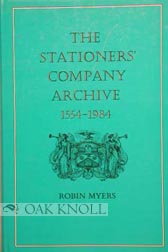 By and large, this book is aimed at book and publishing historians – it enumerates the contents of the Stationers’ Company Archive from 1554-1984, at Stationers’ Hall. The compiler, Robin Myers, was for a long time Honorary Archivist there. (She has the status of Liveryman at the Stationers’ Company.)
