

It’s some months now since we agreed at our workshop that it might be possible to make a comparison across libraries of a small sample of the legal deposit music acquired during the Georgian era. A spreadsheet was shared and duly returned, or completed by me to the best of my ability where available data was more sketchy, and this month I’ve been pondering which data “slices” might be most amenable to comparison.
Here are the facts: a couple of libraries have identifiable runs of legal deposit music from that era. Other libraries may have recognisable sequences, or scattered volumes containing legal deposit music, or volumes which were collated later along with other material NOT acquired by legal deposit. The bindings, too, may be done to a house style, or may be so different that it’s clear the volumes arrived via a different route.
And then there are the catalogues. Same problem. The Universities of St Andrews and Aberdeen have their sequences of volumes, so the shelf-marks should be easy to recognise in the catalogues, too. This may be the case in Glasgow and Oxford too, but it might not be as clear-cut as it is in St Andrews and Aberdeen. Interrogating the catalogues for music from particular years will yield items that were NOT acquired by legal deposit as well as items that were. And it’s even more complicated in some of the other libraries! The vaster the collections, the trickier it gets. There’s one more problem, too. It’s not all catalogued online. Where an online catalogue can be interrogated by date, a paper one cannot!

And then we have the problem that Kassler’s Music Entries at Stationers’ Hall 1710-1818 not only ends at 1818 – in other words, eighteen years before the Library Deposit Act in 1836 – but the last eighteen years of his index are listed as an appendix, and have a different history to the rest of the book: this appendix covers ‘Music entries from 1811 to 1818 in the William Hawes Manuscript’, which is an extract copied from the Stationers Hall registers. It doesn’t give as much detail (notably, no publisher, not as much title information – and no library locations are given) but it does at least mean that we have a list of some kind up to 1818.
After that? We’re on our own! Adam Matthew Digital has produced an online database providing digital images of the Stationers’ Hall registers, so it might be that we’d have to arrange for someone to transcribe the entries for the last eighteen years of the era that we’re interested in.
- The first question is, do any of the Georgian legal deposit libraries subscribe to the Literary Print Culture database?
- And the next is, can we find grant funding to make transcription a real possibility?!
Anyway, I’m wondering about not one but two data-slices, firstly at the tail-end of Kassler’s index – which would still mean we lacked some of the Stationers’ Hall data, but would include the most library stock – and then, perhaps later on, to consider the five or six years prior to the Copyright Rescinding Act. This would allow us to make comparisons between what was published, by whom, and whether different kinds of material were by now being kept.
Before any kind of listing could be made, we have to decide what style of bibliography we’re aspiring to. Do we want it online? Do we want short-titles or full descriptive bibliography? What skills do we require in a research assistant for this kind of task? Certainly, we need an understanding of music AND of what cataloguing or bibliography-making entails.
We’ll all need to mull over these problems before we can make any positive plans of action!

 In the past month, I’ve been to Edinburgh, Cambridge and Oxford in connection with the Claimed From Stationers’ Hall research network. I’ve chatted with Almut Boehme in the National Library of Scotland, Elizabeth Lawrence and Jenny Nex at the University of Edinburgh, Margaret Jones and Jill Whitelock in Cambridge, and Martin Holmes and Giles Bergel in Oxford. We’ve talked about how different libraries stored and curated their legal deposit collections, attitudes towards music and cataloguing, and the influence of the British Museum’s mid-nineteenth century cataloguing rules. Several libraries began by categorising their music as instrumental or vocal – so to anyone wondering why our library does it that way – well, we’re following the Library of Congress, and they seem to have followed the British Museum too!
 and the lists of music – lists that came from Stationers’ Hall at regular intervals, and lists that were made of material as it was accessioned. Serendipity is a wonderful thing – Margaret looked out scores corresponding to material in the lists, and came up with a bound collection of various national songbooks – always a popular genre – not to mention an English opera that might have made no ripples in nearly two centuries, but certainly raised a few smiles in that meeting room in February 2018!
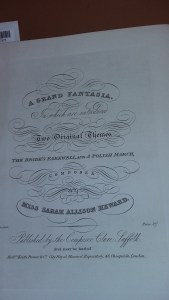 Meanwhile, Martin’s selection of scores included a composition by a young English woman whom I’d never heard of before – Sarah Allison Heward – and a network member in Germany has since unearthed a whole wealth of information about her and her musical family. Watch this space – there’s a blogpost coming up!
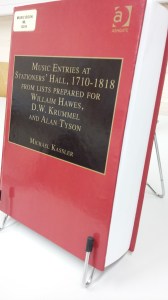 was published before 1819); checking Kassler in digital format is generally easier than in the paper edition, because one can check by title in the e-book. The physical book has various indices, but there’s no alphabetical title listing, and only the composers’ names are listed, not their works.
 So what did I do yesterday? I networked! Potential networkers can be found in a wide variety of places – not just academic departments or university libraries. We need people with technical skills every bit as much as we do researchers and librarians.
 Karen McAulay, Musicologist