Moving with the Times: from Silent Movies to (oh, Gosh!) British Pathe Shorts

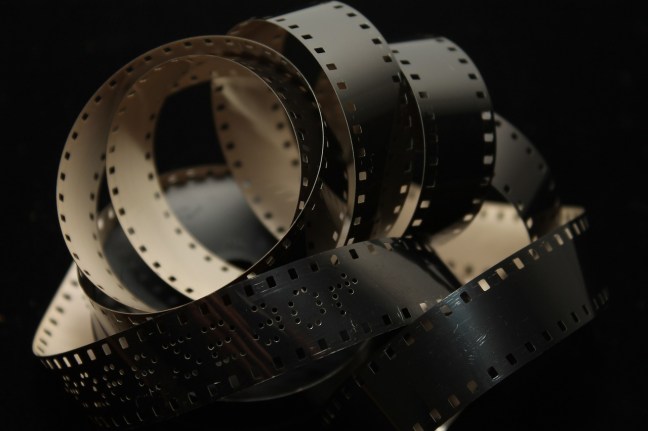
A tangle of movie film roll

You can tell I’ve spent too long in the late nineteenth century – in the research sense, that is.  Dizzy with excitement at the thought of seeing a silent movie – yes, it might actually come to pass, albeit not for a few months – I was almost deliriously pleased to discover that one of my research interests made British Pathe ‘shorts’ during the Second World War.  My aim is to contrast two singing careers, started only a decade apart – and here’s the first contrast. One began their career during the First World War and the silent movie era. The other made British Pathe shorts during the Second.

We think we’re so advanced, with our internet and our AI, electric cars and digital sound … but anyone born in the late nineteenth or early twentieth century might have been amazed by their own advances in technology.  A fin-de-siecle child treated to a magic lantern show, might have sung along to hymn or Scottish song texts projected on a magic lantern screen, the singing led by whichever grown-up had been co-opted in to help. When silent film came along, any music would be provided by a cinema pianist or a small ‘orchestra’ – possibly no more than a piano trio. What you heard would partly depend on who was playing and the bundle of music they’d brought with them.

But when the children became adults, they would would find themselves listening to the wireless or going out to ‘talking’ movies.  Watching, in adulthood, a short film performance by a contemporary star vocalist would have been unimaginable a decade earlier.

However, I must still cool my heels as I wait to see if (and when) the silent movie that I need to see, can be converted into a modern format.  Meanwhile, I’m trapped in the nineteenth century with the printed novel that gave rise to the movie.  As I read, I wonder how they managed to condense the story into a couple of hours, and then convey the whole plot by wordless gestures. 

I can’t wait to see.

Accessing Silent Films

Lucerna: a Magic Lantern Database

LUCERNA is an online resource on the magic lantern, an early slide projector invented in the 17th century.

‘For more than 350 years the magic lantern has represented and fed into every aspect of human life and every part of the world. It is still used today, both in its original form and through direct descendants like the modern data projector.

LUCERNA includes details of slide sets, slide images, readings and other texts related to slide sets, lantern hardware, people and organisations involved in lantern history, and much more.’

(Introduction to the Lucerna database)

Cover Image from Pixabay
The Height of Madness? Top F in Donizetti’s ‘Mad Scene’

Donizetti – Ardon gl’incensi

I’m a little bit obsessed by this aria. It’s one of the arias in the so-called ‘Mad Scene’ in Donizetti’s Lucia di Lammermoor. It was the popular showpiece of a soprano whom I’m currently researching, and she performed it numerous times within just a few years, in the late 1920s. She never sang it in an operatic context, just in concerts, and she didn’t record it – but several women did. I wanted to know what it was like, and why she might have been drawn to it. I was keen to hear an earlier recording, to get chronologically closer to ‘my’ singer. This one goes too far the other way, dating from 1907 – it’s Luisa Tetrazzini on a Gramophone recording:-

The aria has been analysed and written about. There’s much about female madness and female agency. (The heroine has been deceived into marrying someone else, to keep her from marrying the man whom she wants to marry, and of course the ‘jilted’ lover is furious that she appears to have done the dirty on him. So, realising she’s been tricked, she murders her new, unwanted spouse. Then goes downstairs and tells the guests …)

It’s based on Sir Walter Scott’s The Bride of Lammermoor. I got very excited about this, thinking that ‘my’ soprano must have been drawn to it for its Scottish content. However, so many people were singing it, that I am forced, pragmatically, to conclude that she probably just thought it was a great showpiece aria which would suit her high soprano coloratura voice. Moreover, when the opera was premiered in the UK in 1838, there were comments that it couldn’t be much less ‘Scottish’, with just a couple of characters in Scottish costume and nothing more to hint at the origin of the story.

Oh, all right! You’d like to hear it in a better recording than the 1907 one? No offence to Tetrazzini, it’s not her fault that recording techniques were quite primitive in 1907! Here you are, have a listen to Joan Sutherland in 1959. No-one would blame you if you played this several times over – I think it’s fantastic!

The question of glass harmonica or flute as obbligato instrument is another entirely. Donizetti’s glass harmonicist walked out, so he used a flautist – as in the Sutherland recording. There’s a very nice recording of Jessica Pratt singing it with glass harmonica, which is a longer version than in the Sutherland performance:-

I’m not going to delve any further into the history of the aria. It’s fascinating, but not really part of my research!

Now, what do I do with these observations? Ah, well, I have a piece of writing to do. I do tend to sweep the net wide when I’m researching a topic, because it helps me to see the central subject in context. Whether I start writing this side of Christmas is another question entirely. It may turn out to be the writing blitz that tends to overcome me somewhere between the fourth and twelfth days of Christmas!

Buja, Maureen, ‘Who’s the Maddest of them All? Lucia di Lammermoor’, Interlude, April 2nd, 2023. https://interlude.hk/whos-the-maddest-of-them-all-best-performances-donizetti-lucia-di-lammermoor/

Metropolitan Opera, ‘Madly in love’

https://www.metopera.org/discover/education/educator-guides/lucia-di-lammermoor/madly-in-love/

Parker, Roger, ‘Lucia di Lammermoor’s mad tragedy in Donizetti’s mad life’, The Guardian, Jan 28th, 2010. https://www.theguardian.com/music/2010/jan/28/lucia-di-lammermoor-donizetti

Smart, Mary Ann, ‘The Silencing of Lucia’, Cambridge Opera Journal, Vol. 4, No. 2 (Jul., 1992), pp. 119-141

Main image from Pixabay

Ancient and Modern, Near and Far

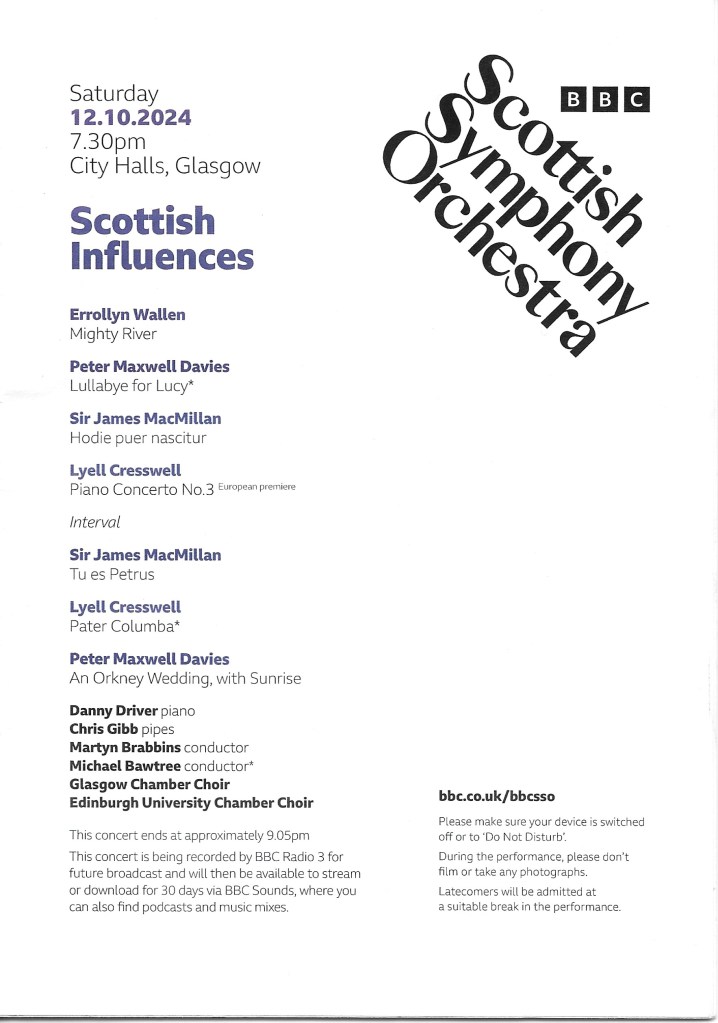
Glasgow City Halls stage set for BBC Radio 3 concert

By way of a change, I took myself to the BBC Scottish Symphony Orchestra’s concert in Glasgow City Halls last night. Conducted by Martyn Brabbins and Michael Bawtree, the programme was entitled Scottish Influences, with music by Errollyn Wallen, Master of the King’s Music; Sir James MacMillan; and the late Peter Maxwell Davies and Lyell Cresswell. I anticipated seeing a few faces that I recognised – and I did – and I was particularly looking forward to hearing Wallen’s Mighty River and Maxwell Davies’ An Orkney Wedding, with Sunrise.

It was a truly great night. Wallen’s piece very much suggested a wide, flowing river, and incorporated two spirituals and a hymn, ‘Deep River’, ‘Go down, Moses’, and ‘Amazing Grace’. Davies’ piece – which I only encountered for the first time a few weeks ago on Radio 3, whilst driving – evoked uninhibited Scottish celilidh dancing, along with a waiter delivering a tray with whisky and glasses to the principal violinist and conductor at an appropriate point – and a fully kilted piper striding the length of the auditorium. (Yes, Chris Gibb is one of our RCS alumni. I was proud!) Michael Bawtree conducted gorgeous choral pieces performed by students from Glasgow and Edinburgh. New Zealander Lyell Cresswell’s PianoConcerto no.3, was premiered in Europe last night by pianist Danny Driver.

I couldn’t help smiling at the thought that yesterday afternoon, I was listening to Scottish country dance music recorded a century ago, whilst only a few hours later, I was sitting listening to Scottish-influenced music with the two living composers literally sitting within ten feet of me. Yesterday afternoon, I was remembering the story of the dance pianist who played with a tea-cup of whisky teetering on the edge of her grand piano, whilst last night the ‘whisky-drinking’ (was it real?!) took place right before my eyes. Indeed, my recent research of Scottish printed music has revealed a healthy export trade of Scottish song and dance music to Australia and New Zealand – whilst the late Lyell Cresswell reversed the process by bringing himself to Scotland, where he made his home in Edinburgh.

The good news is, last night’s concert will eventually be broadcast and will then be available to stream or download for 30 days via BBC Sounds. I’d certainly recommend listening.