Dr Karen McAulay explores the history of Scottish music collecting, publishing and national identity from the 18th to 20th centuries. Research Fellow at Royal Conservatoire of Scotland, author of two Routledge monographs.
Our bibliography was only updated at the end of August, but a mere five weeks later, there were a number more useful publications waiting to be added, including some references gleaned from a couple of exciting articles by Nancy Mace. So, a new edition of the bibliography has been uploaded …
Notwithstanding this, please check what’s there already, and do let me know if you’ve written about any aspect of historical music copyright, music library history, or music publishing history that might be pertinent to our field of study! We’d really like to add details to our listing.
It’s some months now since we agreed at our workshop that it might be possible to make a comparison across libraries of a small sample of the legal deposit music acquired during the Georgian era. A spreadsheet was shared and duly returned, or completed by me to the best of my ability where available data was more sketchy, and this month I’ve been pondering which data “slices” might be most amenable to comparison.
Here are the facts: a couple of libraries have identifiable runs of legal deposit music from that era. Other libraries may have recognisable sequences, or scattered volumes containing legal deposit music, or volumes which were collated later along with other material NOT acquired by legal deposit. The bindings, too, may be done to a house style, or may be so different that it’s clear the volumes arrived via a different route.
And then there are the catalogues. Same problem. The Universities of St Andrews and Aberdeen have their sequences of volumes, so the shelf-marks should be easy to recognise in the catalogues, too. This may be the case in Glasgow and Oxford too, but it might not be as clear-cut as it is in St Andrews and Aberdeen. Interrogating the catalogues for music from particular years will yield items that were NOT acquired by legal deposit as well as items that were. And it’s even more complicated in some of the other libraries! The vaster the collections, the trickier it gets. There’s one more problem, too. It’s not all catalogued online. Where an online catalogue can be interrogated by date, a paper one cannot!
Batt-printed porcelain contemporary with the copyright music era
And then we have the problem that Kassler’s Music Entries at Stationers’ Hall 1710-1818 not only ends at 1818 – in other words, eighteen years before the Library Deposit Act in 1836 – but the last eighteen years of his index are listed as an appendix, and have a different history to the rest of the book: this appendix covers ‘Music entries from 1811 to 1818 in the William Hawes Manuscript’, which is an extract copied from the Stationers Hall registers. It doesn’t give as much detail (notably, no publisher, not as much title information – and no library locations are given) but it does at least mean that we have a list of some kind up to 1818.
After that? We’re on our own! Adam Matthew Digital has produced an online database providing digital images of the Stationers’ Hall registers, so it might be that we’d have to arrange for someone to transcribe the entries for the last eighteen years of the era that we’re interested in.
The first question is, do any of the Georgian legal deposit libraries subscribe to the Literary Print Culturedatabase?
And the next is, can we find grant funding to make transcription a real possibility?!
Anyway, I’m wondering about not one but two data-slices, firstly at the tail-end of Kassler’s index – which would still mean we lacked some of the Stationers’ Hall data, but would include the most library stock – and then, perhaps later on, to consider the five or six years prior to the Copyright Rescinding Act. This would allow us to make comparisons between what was published, by whom, and whether different kinds of material were by now being kept.
Before any kind of listing could be made, we have to decide what style of bibliography we’re aspiring to. Do we want it online? Do we want short-titles or full descriptive bibliography? What skills do we require in a research assistant for this kind of task? Certainly, we need an understanding of music AND of what cataloguing or bibliography-making entails.
We’ll all need to mull over these problems before we can make any positive plans of action!
I gave a paper at the RMA Conference yesterday afternoon (Friday 14 September 2018).
Abstract:
From 1710 to 1836, British copyright legislation required legal deposit of all publications to nine, and latterly eleven libraries. For music, the system worked – to a greater or lesser extent – for the last half-century of this period. However, the libraries were not always appreciative of the flood of sheet music that came their way; its survival and documentation in modern times is varied, to say the least.
After an initial study of the University of St Andrews’ Copyright Music Collection, the present author was awarded AHRC networking funding to extend the investigation to the late-Georgian music surviving UK-wide.
This paper will explore some of the interesting patterns of survival that emerge, from the borrowing habits of middle-class music-lovers in St Andrews, to the 1830 lists of the Edinburgh Advocates and the lists of rejected music at Oxbridge.
It will also describe the challenges of exploiting modern networking capabilities to achieve maximum traction, not to mention impact, and – at the end of the project’s funding period – will summarise what has been achieved, and what future directions the research might take.
Just thought I’d remind you that we have an extensive bibliography pertaining to the history of music legal deposit and copyright in the UK (and further afield, in a few instances). Do take a look – if you have written on the subject but I haven’t picked up the citation, please do forward it! Similarly, if you have colleagues whose work ought to be included in this listing, it would be great if you could let me know. I’d hate for anyone to be missed out! Very many thanks.
Yesterday, I was at the Wighton Centre in Dundee, where I’m honorary librarian of the Friends of Wighton – it’s a charity set up to look after and augment the Wighton Collection, a renowned collection of historical music which has been housed in Dundee public library since the 19th century.
Today, we were launching the Jimmy Shand Collection, which is 23 antiquarian volumes that were bought at auction from the estate of the late Scottish dance-band musician. There were local dignitaries, and Mr and Mrs Jimmy Shand Jnr were also with us.
The Friends of Wighton support music classes in traditional instruments, and some of the musicians played for the launch today. I’m sure Andrew Wighton and his widow would have been pleased that his original epic collection is still been drawn upon for repertoire, and has now had these expertly-conserved scores – once owned by Jimmy Shand – added to it. Jimmy Shand Jnr. made a brief speech in which it was clear that the family are delighted to see their Dad’s music beautifully restored and made available to the local community – and much of it has also been digitized to further its reach.From my point of view, I spend my working week surrounded by conservatoire musicians who play at a very high level, and I enjoy the contrast of seeing other talented musicians out in the community, sharing their skills with people who perhaps haven’t the same musical background, but are still clearly getting personal pleasure from learning to play traditional tunes in the company of other like-minded folk. You could say it’s music for everyone, and not just for the gifted individuals who will set the world alight in their future careers. That’s exactly how it should be.My involvement with the Wighton Collection goes back a number of years now, though I’ve only been Hon. Librarian for a comparatively short time. It’s not directly related to my Claimed From Stationers’ Hall research, but I certainly do draw on knowledge and experienced gained in that respect, so there’s a kind of sideways, indirect link.
And a wee postscript! I was back in Dundee this morning to talk to a TV reporter about the Wighton Collection and the Shand volumes. I don’t think there’ll be anything to see for a while, so I’ll update you when it does!
The latest Claimed From Stationers’ Hall Newsletter is live! Read it here.
For your convenience (and the benefit of my Researchfish entries), there’s now a page with links to all Newsletters. You’ll find it here– or from the Menu bar on the homepage of this website.
One of those chains of enquiry where one thing leads to another! Should I need to know later, here’s the Oxford Music Online entry for the choral society for which Husk was librarian:- Sacred Harmonic Society | Grove Music
Husk was the Librarian of the Sacred Harmonic Society, and corresponded with William Chappell. Having heard of him through researcher Alice Little, I looked him up in Oxford Music Online, just in case I needed to know about him later:-
Not so long ago, I encountered a Georgian picture of a cutter (sailing boat) in a music book that once belonged to Jimmy Shand, and today’s find was just as unexpected. This book belonged to a woman – there’s no way of telling if it was she, or someone else, that drew a series of fashionable women in Victorian bustles and frills! No, this has nothing to do with music, but I thought you might like to see the drawings all the same! They’re in a copy of William Chappell’s A Collection of National English Airs belonging to the Whittaker Library at the Royal Conservatoire of Scotland.
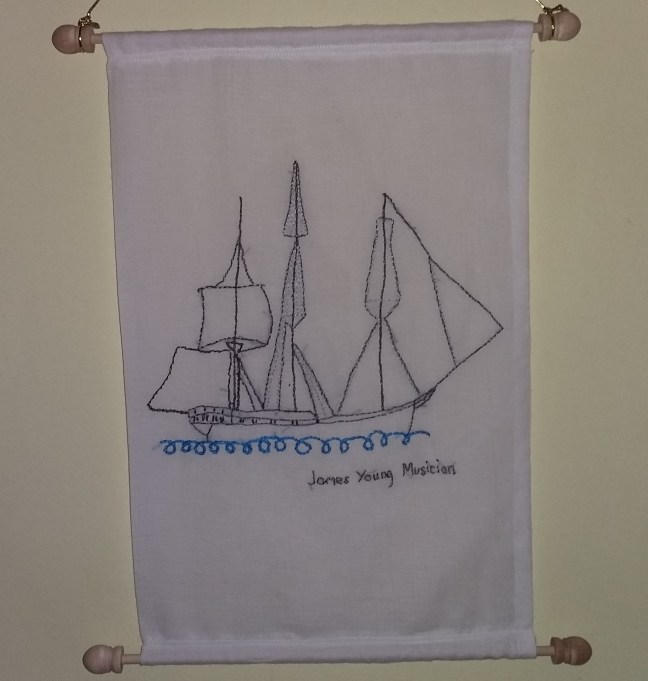
And here’s the Georgian cutter from the Jimmy Shand collection in Dundee Central Library. It was rather indistinct, but I’ve since interpreted it in my own, 21st century way:-
An unfinished drawing from a book which belonged to musician James Young.
I was at Edinburgh University Library yesterday – I’m trying to work out which bound volumes might contain music that arrived through the legal deposit route. I was looking at one particular volume, and came to a batch of pieces all by the same Edinburgh-based composer. I looked him up – and found he spent some time in Italy in his youth, under the direction of a particular teacher.
Then I remembered that I’d encountered some music BY that teacher, in a different volume. And then – exploring the University Library catalogue – I found more by the Edinburgh composer AND more by the Italian musician. Is it remotely possible that the individual who arranged for that legal deposit volume to be bound, also knew the Edinburgh musician? It was some decades before music would have an official, recognised place in the University curriculum, but obviously some music was being collected.
Equally, might the music by the Italian – in another volume, not necessarily legal deposit, and in other volumes definitely not so – have come to Edinburgh in some way connected with his British pupil?
You might argue that this doesn’t have much to do with legal deposit. In one sense, that’s true. But if we’re thinking about what the University decided to keep, out of the legal deposit material that they received, then this is – if nothing else – quite interesting, surely?
As to the identity of these guys – well, let me enjoy the mystery a bit longer, once I’ve worked out if there’s any more to be discovered!


 Dear friends and fellow network members,
 Yesterday, I was at the Wighton Centre in Dundee, where I’m honorary librarian of the
 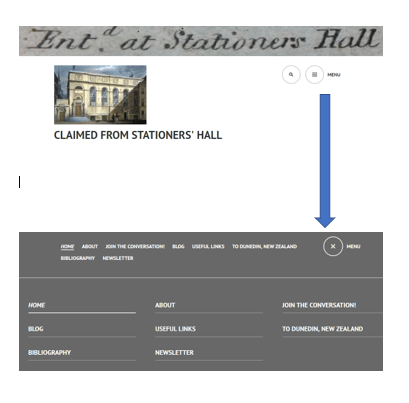 For your convenience (and the benefit of my Researchfish entries), there’s now a page with links to all Newsletters. You’ll find it


 Karen McAulay, Musicologist