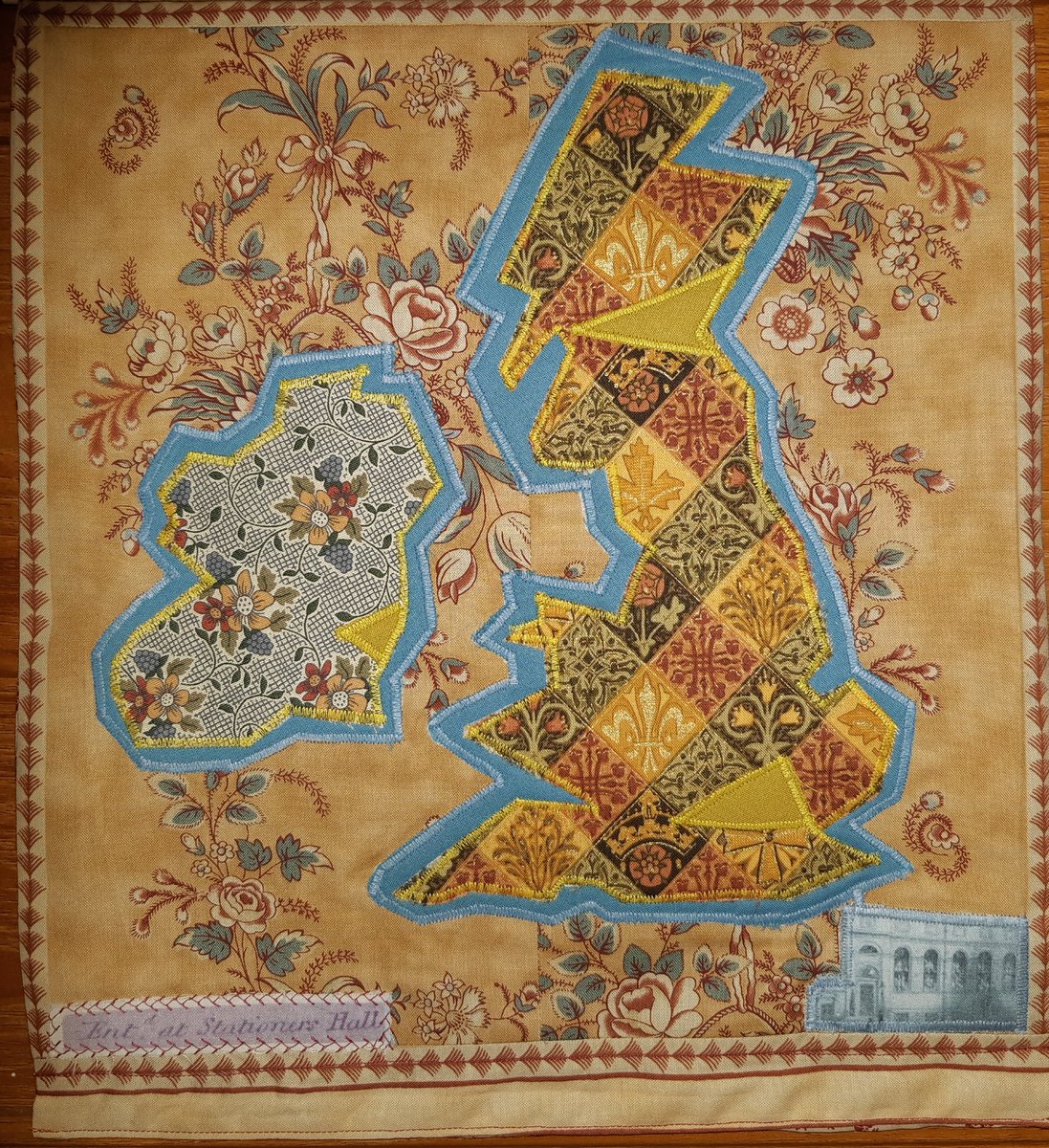
This isn’t about mathematical golden triangles!
The other day, I decided to make a map of the UK’s Georgian legal deposit library locations. Yes, I know – it’s a strange way to interpret a serious research project, but I wanted an illustration that would have impact for an audience, not all of whom may know as much about legal deposit as I now do! So, first I thought about making a patchwork map, but after experimenting with lines on a map, I concluded that it would be such a weird piece of patchwork that maybe I needed to come up with a Plan B.
A collage map seemed more feasible, and I thought I’d mark out where the legal deposit libraries were by linking them together and then appliqueing the shape that resulted. And there they were – a triangle in England (London-Oxford-Cambridge) and a triangle in Scotland (Glasgow-Aberdeen-Edinburgh, with St Andrews sitting on the line between Aberdeen and Edinburgh). Finally, there were the new arrivals of two legal deposit libraries in Dublin from 1801 onwards (Trinity College and Kings’ Inns) – I couldn’t force them into a triangle, but I gave them one anyway. So there it was – the three triangles formed another triangle, and I had my graphic illustration.
But why the big gap in the middle with no legal deposit libraries? Ah, that’s probably because there weren’t any university libraries old enough to be considered when legal deposit was established at the beginning of the 18th century! As a graduate of Durham myself, I thought it was a shame that we missed out on this privilege, but the fact is that although Durham Hall became Durham College back in 1286, it was actually founded by the University of Oxford, eventually becoming Trinity College, Oxford in 1555. The University of Durham and University College weren’t founded until 1832, and the Royal Charter was granted to the University by King William IV in 1837. (All dates from the University website.) By the time Durham had its university, widespread legal deposit was about to be curtailed, and the Library Deposit Act had already been enacted a year before its Royal Charter was granted. “Too late”, as a Scottish friend put it succinctly! (Similarly, the Victoria University of Manchester was formed as a medical school in 1824, but did not become a university until even later, in 1851.)
So, the harsh facts are that there weren’t any old-established universities between the southern golden triangle and the Scottish one, at the time the legislation was enacted! And that’s why the legal deposit libraries were scattered around the UK and Ireland as they were.




 Karen McAulay, Musicologist