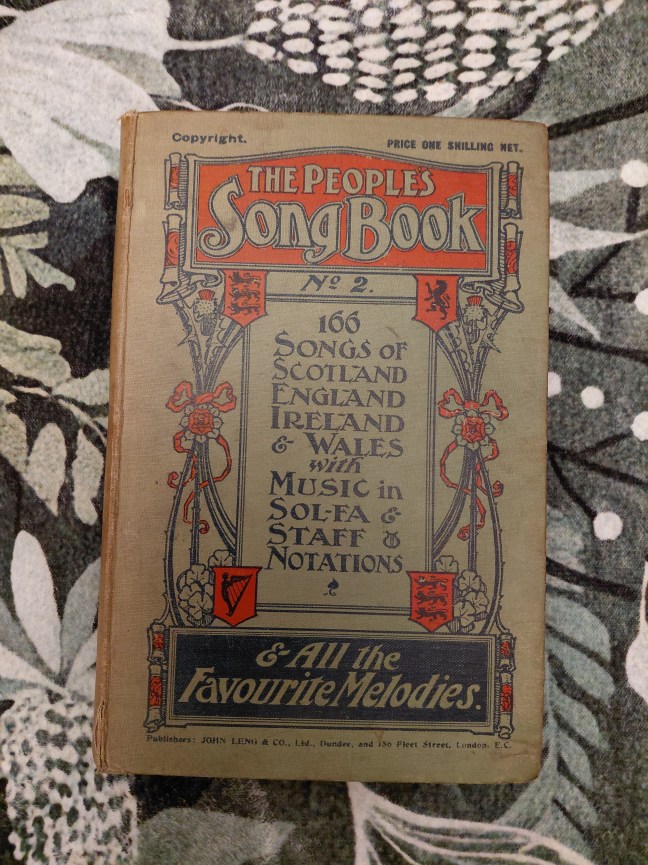
The People’s Song Book No.2 (published by John Leng)

It stands to reason. If I’m researching the John Leng Scots Song competitions, then I might also be interested in this firm’s publications. Not, of course, that there’s any direct link between Leng’s trust fund and the firm’s later publications.  They published general material, magazines and newspapers, and only a handful of music titles.  However, this means that what music they did publish would be of a kind suited to the mass market. 
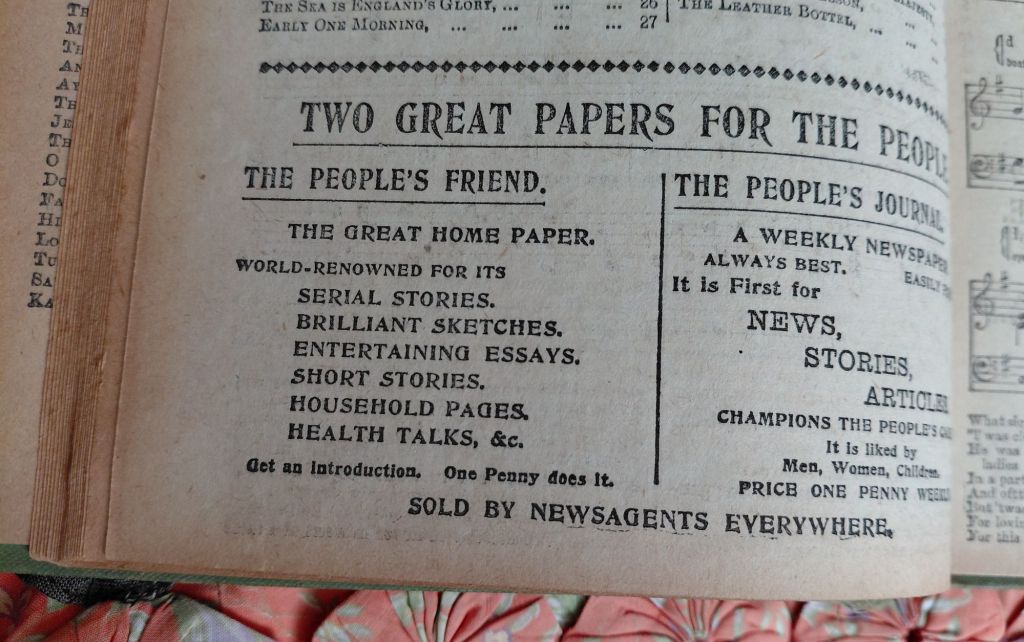
‘For the people’

Is it any surprise that, amongst the ‘Aunt Kate’s’ housekeeping and embroidery books, there might also be dance music and national songs? Which of course indicates their recognition of how popular national songs actually were.
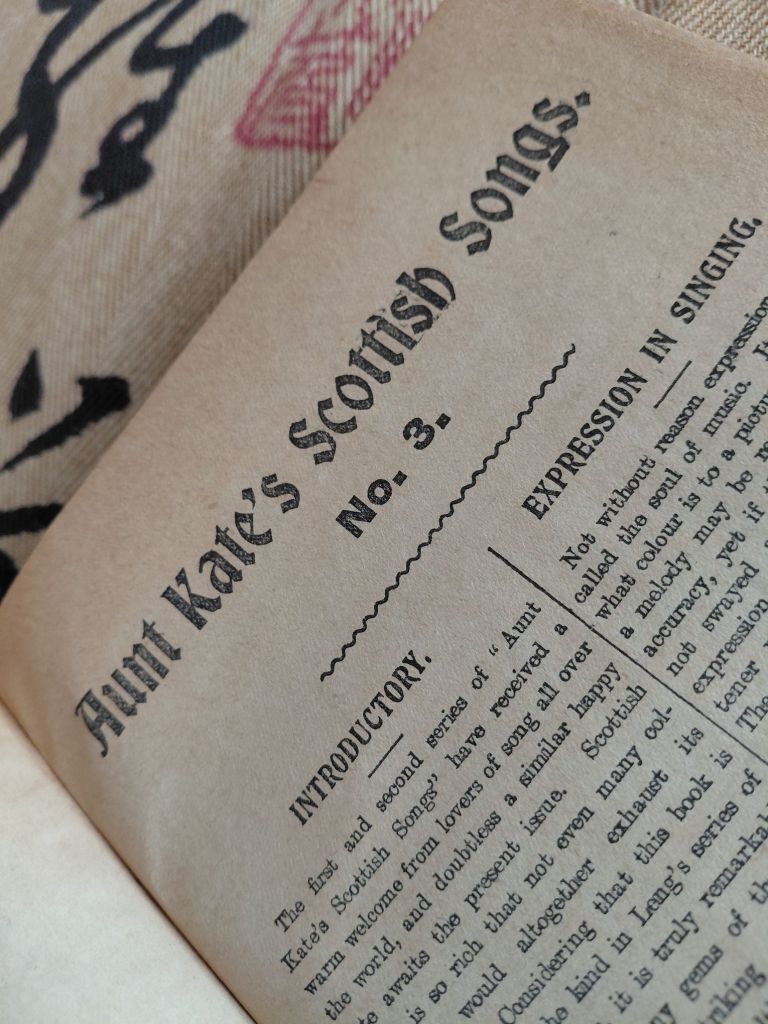
The mythical ‘Aunt Kate’ enjoyed a song!

This week, I bought the second volume of The People’s Song Book, published in 1915. It’s quite an attractive little book, containing 32 Scottish, 33 English, 35 Irish and 34 Welsh songs.

There’s also a section with 32 of the now distasteful genre of ‘minstrel’ songs at the back – blackface minstrelsy, not the homegrown wandering minstrel variety. They are described more insultingly than that, as was the unfortunate custom of that era.

Curiously, these are indicated as a third series of English songs, lower down the page.  (The second series appeared after the Scottish songs.  Remember, this was the second book, so the ‘first series’ of English songs is presumably there.)

Today, we recognise the English and American origins of the minstrelsy repertoire, but I doubt the compilers were hinting at that.  I have written at some length about such songs in my recent monograph – what’s in the present book is no different to those in the collections I’ve already examined.

Notwithstanding this – because we have to recognise that the book is a product of its age, whatever our more informed modern opinion – it would be a strange scholar that acquired book 2, but wasn’t curious about book 1, so I’m excited now to be repatriating the first volume from Virginia.  Perhaps some expat took it with them in their trunk, or had it sent to them as a keepsake?  And now it’s coming home – it feels appropriate.
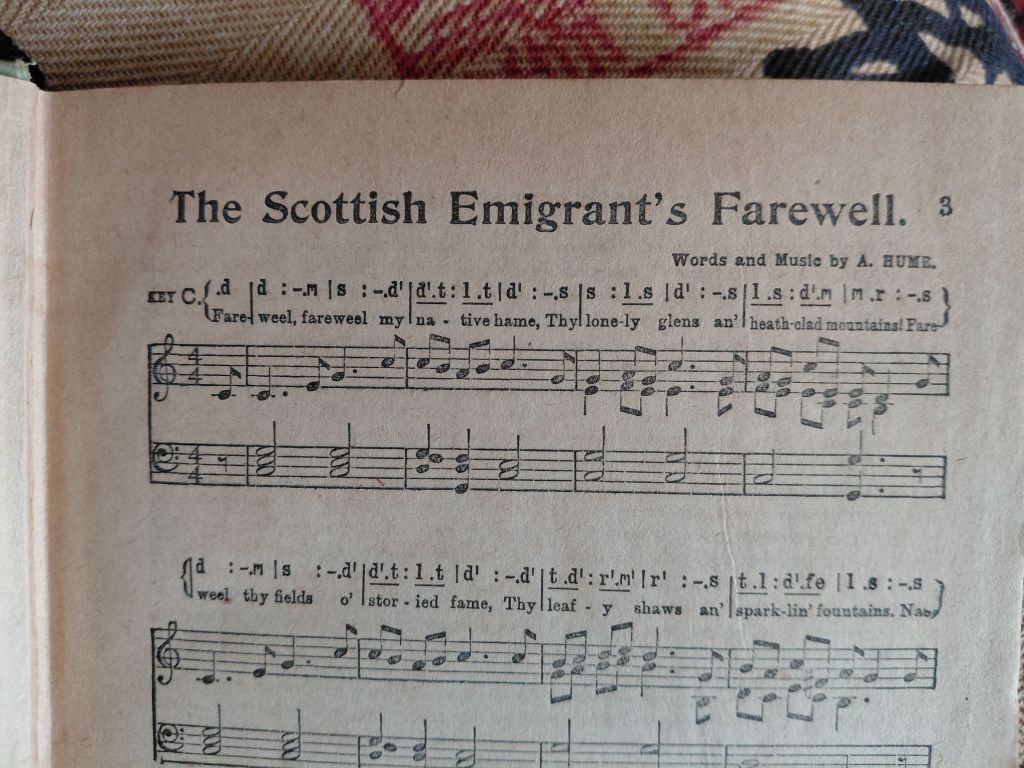
First song in the 2nd book – emigration!

The funny thing about Virginia  – on a completely unrelated note – is that, a quarter of a century ago, I attended a librarianship interview in Richmond. I didn’t succeed  – but I did start my doctoral studies at home in Glasgow, a year or two later.  None of what I’ve subsequently done, would have been done at all, if I’d become yet another emigrant like those of a century before.

And now a little national song book is making its way home to me.  I’ll be sure to make it welcome!

And More?

Book 1 may answer an intriguing question that arose yesterday. I’m impatient!

Shhh! What Granny Didn’t Want Them to Know

The closed lock of an old suitcase

Tracking Irish Emigrants from Cork to USA and London

My third audio book just came up as a new publication when I logged onto Audible. Its title appealed to me. Additionally, since my own [in-the-pipeline] monograph touches upon emigration in the nineteenth and early twentieth centuries, then if Clair Wills’ book touched upon that, I was definitely interested.

Clair Wills, Missing Persons, or, My Grandmother’s Secrets (Penguin Audible, 2024)

The book describes the author’s extensive efforts to find out more about illegitimate births in her own Irish family; the adults involved, and the secrecy surrounding what had happened. The scandal of the Irish mother-and-baby homes during the twentieth century is naturally a significant focus, but the author also examines the part of the Irish Catholic Church; the local authorities; adoption; single mothers; questions of respectability and inheritance; of shame; of emigration (to America, and to England); of stigma and suicide; along with changing attitudes towards the end of the twentieth century. Since I’m neither Irish nor Roman Catholic, I was sure it would be informative – and it was.

It’s a moving, and multi-faceted narrative. Just when I was beginning to ask myself, ‘So, if the mother-and-baby homes were a twentieth century scandal, what happened before that?’, Wills explains how things gradually changed from the second half of the nineteenth century into the early twentieth, along with the political changes. The unbearable tragedies for the mothers and babies were too many to enumerate, but we’re reminded that the outcome for a young Irishman fleeing to life as an itinerant labourer in England was hardly what any young adult man would have hoped for, either.

Did any of this have any bearing on my own research? Not really, except to provide me with some statistics about emigration from Ireland that were far higher than I had imagined – and I already knew they were high. Moreover, my own musicological research really only requires me to say, ‘There was a lot of emigration from the Highlands and Ireland, usually for work.’ After all, I write about national songbooks, and their appeal to emigrants. If I was going to give more detail, I could, I suppose, add, ‘and sometimes, especially in Ireland, to make a fresh start where an illegitimate pregnancy made it expedient for either party.’ But to be honest, songs about missing your homeland – or even your sweetheart back in the old country – aren’t likely to go into specifics about babies born in inconvenient circumstances.

However, reading Audible books during a period of forced inactivity, doesn’t mean they have to be connected with research. It’s an unaccustomed luxury to listen to books for hours on end, and I’d recommend this one. I have six more titles lined up, but I don’t think I’ll start them today. I like to let the memory of one sink in, before beginning another.