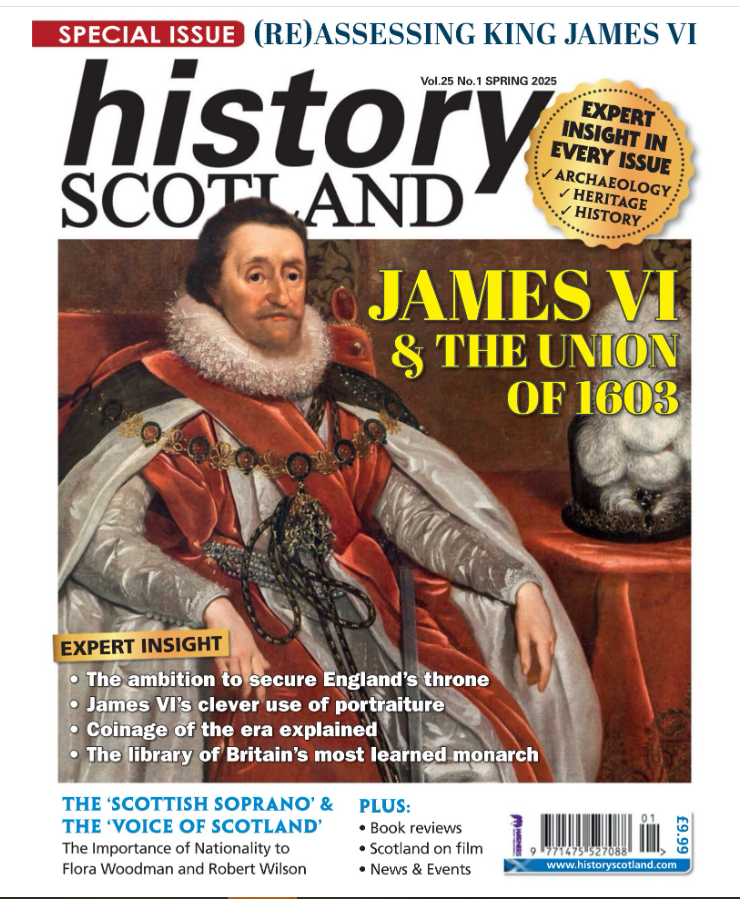
Now published in History Scotland, Spring 2025: The ‘Scottish Soprano’ and the ‘Voice of Scotland’

The Scottish Clans Association of London badge, on background of Mackinnon tartan

Sadly, this is the last issue of History Scotland, but I’m very pleased to have an article published there. I have really enjoyed writing this, and I think my idea of comparing two very different Scottish singers has actually come together rather well.  I wanted to write about Robert Wilson, but I didn’t want to go over the same ground that has already been covered.  I also wanted to write about Flora Woodman – but would anyone remember her? Then came the inspiration: what if I wrote about them both, two almost contemporary but very different celebrities, and then I could compare them.  This hadn’t been done before! And it worked  – the piece almost wrote itself.

Karen E McAulay, ‘The ‘Scottish Soprano’ and the ‘Voice of Scotland’: the Importance of Nationality to Flora Woodman and Robert Wilson’, History Scotland Vol.25 no.1 (Spring 2025), 74-81

If your public library has e-magazines, you’ll be able to read it online. Glasgow Life certainly has it!

Flora Woodman – photo and compliments, 25th October 1924

A Thought-Provoking History Scotland Webinar

Leisure and Pleasure – Everyday life in Second World War Scotland

I don’t often sign up to webinars, but something so closely aligned to my own current research was irresistible.

The History Scotland webinar series is promoted by the History Department at the University of Dundee. The guest speaker today was Dr Michelle Moffat of Manchester Metropolitan University.

And what did I learn? Leisure pursuits didn’t stop in wartime, especially going to the cinema.  This is worth knowing.  (However,  I must be careful not to assume things were exactly the same everywhere.  It makes me wonder about central London, for example, where people might have felt more threatened. )

There was also interesting detail about rationing and food shortages, and discussion about how much people in Scotland felt the war was ‘their’ war. (I suspect anyone who had relatives fighting overseas would  very much have felt indirectly part of it.)

And a reminder about the Mass Observation Archive.  I had forgotten about this, but it’s a crucial resource – I’m going to check it out with some questions that I hope it might help with!