


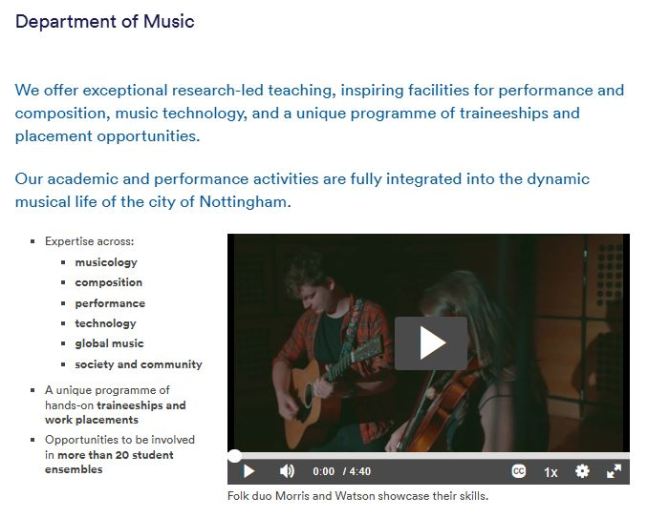
The screenshot below, is of the University of Nottingham Music Department homepage. A flourishing department, which sadly hit the news for all the wrong reasons a couple of days ago.
BBC News:- University to suspend music and language courses
Music graduates and linguists across the UK (and beyond) will have been aghast to learn that the University of Nottingham is suspending its Music and Modern Languages degree courses. Allowing present students to complete their courses, that is, but not taking any new entrants.
Now, I’m not a Nottingham graduate – I’ve no connection with the University at all (apart from having declined a graduate library traineeship back in 1982, for reasons entirely unconnected with Nottingham University Library). Nonetheless, I know, after my own academic music-related career, that the department has an excellent name. I also know – since I have a BA (Hons), MA and PhD in Music – the value of a music degree.
The decision to suspend teaching music seems to me to be a very retrograde step. It is true that students can still be offered the chance to sing in choirs, play in orchestras and so on, but recreational music, at however high a level, is hardly the same as academic study. To suggest that ‘they can still make music’, puts me in mind of 1920s and 1930s pedagogy, where music was often considered a ‘practical’ subject like sewing, art or woodwork, rather than an academic discipline. Don’t get me wrong – I am certainly not denigrating these subjects. Indeed, if I’m not studying or making music, I can usually be found with a needle and thread. I am a creative individual. However, I wish to make the point that even ‘practical’ creative subjects can be studied in a scholarly sense.
So, since I’m now semi-retired, what can I do to help? Arguably, not a lot, but I can use my voice to make a bit more noise. Let me outline what I studied in my own music degrees, decades ago; and then I’ll share how the knowledge I gained has been put to use in my subsequent career. Nottingham’s Music Department homepage offers expertise across: musicology, performance, composition, technology, global music and society and community – a similar, but updated list of what I studied in Durham, Exeter and Glasgow.
My Own Undergraduate Music Experience
- Score-reading
- Harmony & counterpoint
- Aural training
- Music history (musicology)
- Music analysis
- Ethnomusicology (not global; I studied Javanese Gamelan music)
- Electronic Music
- Composition
- Writing about music
- Acoustics
My own Masters and PhD Music Journey
- Music history (musicology)
- Analysis
- Cultural and social history
- Writing about music
I studied librarianship after my first, unfinished PhD, spending my career as a music librarian, but I returned to research mid-career and thereafter combined librarianship and research. I didn’t become a teacher, which was one of the traditional destinations for music graduates; neither could I find a way into arts administration. So, music librarianship seemed a sensible choice. I worked briefly in the public library sector, and then in academic librarianship. But ask around, and you’ll find music graduates in all sorts of careers.
What did I gain from my music degrees? Well, as a music librarian with appropriate academic music qualifications, I was very much a subject specialist, and was appreciated as such. Simply being in a choir or student orchestra, without the academic study, wouldn’t have made me as knowledgeable.
The Value of Knowing Your Subject: the Evidence
- Many thanks for all your efforts in finding all this music!
- I showed the class the print-out from this CD record sleeve, which was very relevant
- Thanks very much for your enlightening and entertaining contribution yesterday.
- A very thorough and impressive piece of research
- Thanks! HOW do you do it? I can hardly contain my exuberance. When I’m running the planet, you’ll get the money your worth and 3 extra vacation days. Promise!
- Just wanted to thank you so v much for all your help yesterday. It was a great help to come in and find all the music ready
- Thanks for your efforts – they are very much appreciated.
- [they said] the Library was a great resource: [they had] come in to find four fairly obscure things and we had (and helped find!) all four.
- Will mention your wonderful help in the programme notes! 🙂
- This very useful, thank you!
And as an organist and choir director? I use my skills on a weekly basis: arranging music; transposing it; writing it; choral training; and planning/developing repertoire.
Lastly, as a music postdoctoral fellow? Enough said. I wouldn’t be researching at a postdoctoral level if I hadn’t studied it at university first. My research has often focused on the region where I live, but also on music in education and society.
It seems to me a crying shame to cut music degrees, denying students future opportunities, and (presumably) cutting staff with immeasurable expertise in their subject. The city of Nottingham, too, will lose out from the expertise that is lost to the region.
Modern languages are every bit as important. How can you have a university that doesn’t teach modern languages? You want translators? Teachers? People who can conduct business, or write books, or manuals, in a language other than English? Or careers where language graduates bring their own aptitudes? (A friend of mine went into computing, because their linguistic skills apparently made them eminently suitable for that path.) So you need modern language graduates!
My late music-teaching, comprehensive school head of modern languages father will be turning in his grave!
Take Action
Change.org Stop the suspension of undergraduate music courses at The University of Nottingham
Change.org Stop the removal of Modern Languages courses at the University of Nottingham!
Image by David Reed from Pixabay
 Karen McAulay, Musicologist