Dr Karen McAulay explores the history of Scottish music collecting, publishing and national identity from the 18th to 20th centuries. Research Fellow at Royal Conservatoire of Scotland, author of two Routledge monographs.
You turn up to start a new university course, all ready to elevate your ukulele* performance to the highest possible level … and suddenly, you’re being told about referencing and citation, catalogue searching and note-taking, and you have a written assignment which terrifies the life out of you? How have things got so serious, so soon?
As you’ll have been told, it is very important that whoever marks your essay can see where you drew your information from. When you studied maths at school, your teachers probably told you to ‘show your workings’ (or some similar expression), right? Referencing is pretty much the same idea – they need to know how you arrived at your final argument, and which authorities informed your thinking. Referencing (some people call it citation) is how you show your workings in academia.
You’ll also have been told about the Turnitin software which can determine whether your submission is likely to be all your own work, or cut and pasted from various other sources without acknowledgement. Academic honesty is all-important. Using other folks’ work is not acceptable – and using AI such at Chat GPT is equally frowned upon.
‘Chat GPT can’t do referencing’
(said a colleague from another institution, in discussion)
Is this correct? In the spirit of scientific discovery, we decided to put this to the test. We wrote an ‘essay’ (well, a couple of paragraphs) containing some genuine references, but also some downright lies about pizza and curry! then asked Chat GPT to write a piece of prose with a bibliography.
Chat GP entered into the spirit of the thing, and made up some titles in line with the nonsense we’d written!
Well, this wouldn’t be much good in an essay, would it? Made up titles? No publisher details? No, thanks. Perhaps, we thought, we had been wrong to TELL Chat GPT we were only playing with it.
Removing the dates, we left incomplete references. Chat GPT completed every reference with ‘(year of publication and the title are not provided).’ That wasn’t much use either.
How could we get Chat GPT to produce a Harvard reference? Indeed, any decent reference?
We tried a third time. This time, we left the imaginary essay out of it, and just gave Chat GPT five authors’ names and the years of their genuine publications.
Chat GPT was stumped! However, it was scrupulously polite in admitting it:-
‘I apologize, but I couldn’t find specific references or sources for the provided citations. It’s possible that these references do not exist or that they are not widely known in the academic or literary world. If you have any other questions or need assistance with different topics, please feel free to ask.’
Chat GPT, 16 October 2023
So, it’s true. You can’t get Chat GPT to write a Harvard reference! It might be tempting to try to use technology to help write your essay, but you’re seriously better off doing the work – and the referencing – yourself! You learn, your tutor sees that you’ve done the work, and everyone is happy. (NB The library can help you find resources to get your referencing right. It sounds complicated, but it’s really quite easy to get the hang of it. Look for the Ask a Librarianlink on the catalogue home-page.)
I finished the Conclusion of my second monograph today! I really should have celebrated this, but – well, it was lunchtime and I checked my emails, and … shall we say that I forgot about celebrating by the time I’d finished answering the email?
Never mind. I’ll celebrate tomorrow instead. Before I start the revision process. This evening, I read through all my publisher’s guidelines. I read about endnotes (bye-bye, beloved footnotes. You’re no longer the flavour of the month). I read about chapter abstracts, and formatting, and a whole lot of other stuff. Saved it all in a folder, and reached for my MHRA Guidelines. This is where I remembered that it could take quite a while!
The good thing, I suppose, is that my cataloguing background makes me quite attuned to the fine detail required in formatting references and so on, and pretty well prepared for the routine-ness of it all. I’m more concerned about ensuring everything’s consistent between chapters, and – the worst bit – tightening up the prose. I need to jettison quite a few words, to get within the word-limit.
What a blessing that I’ve got two weeks’ holiday coming up. No proper vacation for me, this time. But I do look forward to getting the manuscript submitted later this year!
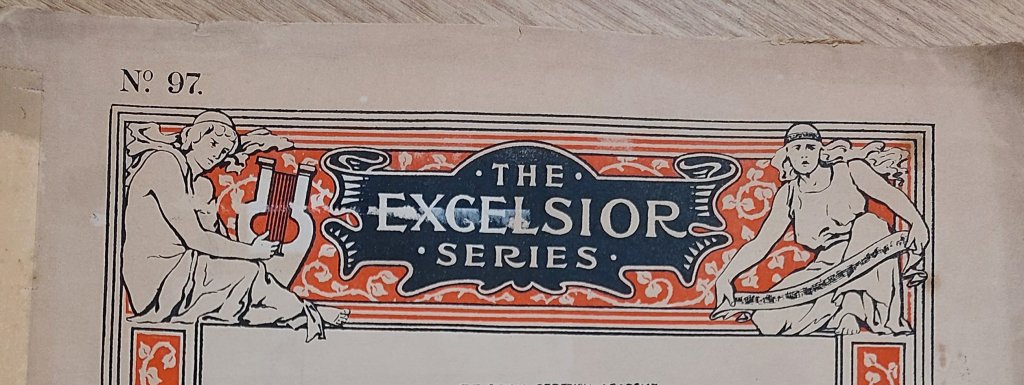
Bayley & Ferguson’s Excelsior series, another iteration
My talk for the Scottish Graduate School of Arts and Humanities was incredibly well-attended. It was lovely to be able to talk about one of my specialisms to people who were genuinely interested. My thanks to you for attending, if you were one of those people! At least one individual had just started their bibliography, so hopefully I was able to share some useful tips.
I’ve uploaded my PowerPoint and text to my Conservatoire Pure account – our institutional repository – please click here.
If anyone tried to sign up, but experienced a problem getting into the meeting, please contact me via the SGSAH Summer School organisers.



 Karen McAulay, Musicologist