


Thomas Nelson’s four-book set was for classroom use. Offering a mixture of history and theory (music-reading and tune-building), it even suggested pupils might plan a folk music concert.
In this exciting, modern world, children were reminded that their parents’ music lessons consisted only of singing, whereas now they might also learn instruments like the recorder, and perhaps collect interesting clippings from the Radio Times. (It sounds like another world, doesn’t it?)
Meanwhile, diving straight into the history, children were immediately introduced to the concept of folk music.

This is an English book, but I only recognised two of the three songs from my own school days. ‘The Carrion Crow’ wasn’t one I knew.
I’m delighted to find that kids were also introduced to the role of a song collector. Although I have to say that the child in the foreground on the right looks bored and unimpressed by the proceedings, in the illustration! Still, Nelson’s editors presumably commissioned the illustration rather than use a stock image, so they’re due some credit.

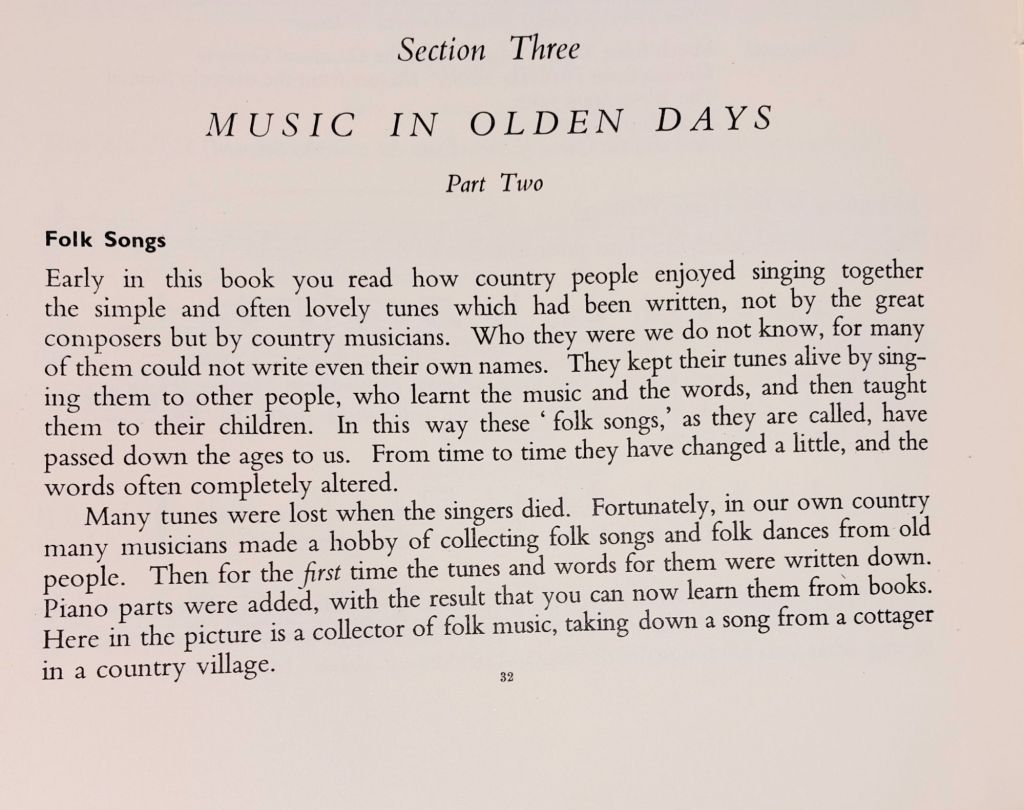
They’re still holding onto the idea that folk music came from country folk. I wonder if pupils ever asked what city folk sang?!
Of course, it wasn’t all folk music. Kids were also introduced to the likes of Brahms, Handel and Purcell. Today, I imagine only examination classes would have textbooks introducing the classical greats. On the other hand, more time is probably spent on world music, and efforts are made to consider music by women and people of underrepresented communities. Times have moved on!
Nonetheless, it’s interesting to see how much knowledge children would have acquired in general classroom music lessons, and to compare it with modern times.
Even the books are brighter and more appealing today, I must admit!
 Karen McAulay, Musicologist