Dr Karen McAulay explores the history of Scottish music collecting, publishing and national identity from the 18th to 20th centuries. Research Fellow at Royal Conservatoire of Scotland, author of two Routledge monographs.
There was a time long ago, whilst I was doing a postgraduate librarianship diploma in Aberystwyth, when we all had to go on a week’s study tour. I went to Sheffield, staying with friends, and visiting various libraries with my classmates.
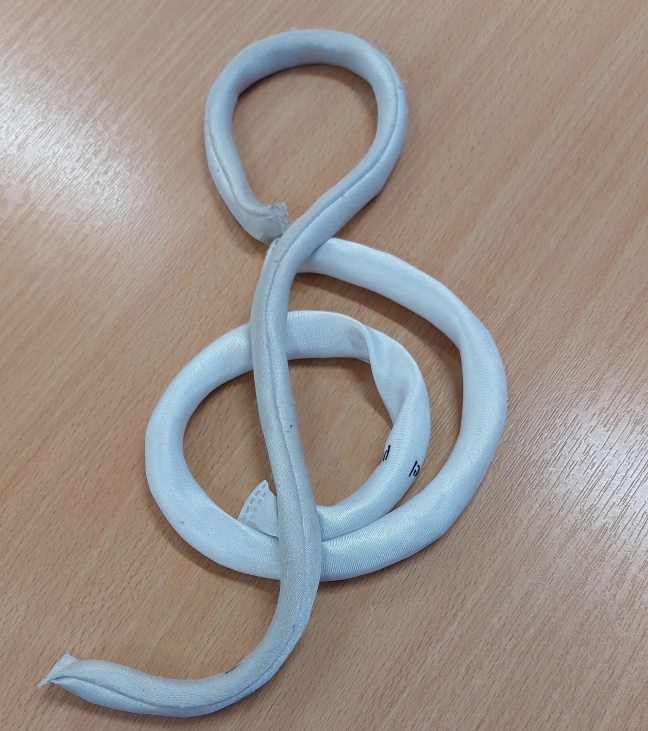
A visit to some archives enchanted me. I can’t remember if they were regional archives or university ones, but those heavy bindings, scrolls, and all the modern accoutrements of white tapes, book cushions and weighted ‘snakes’ – not to mention the questions of conservation and restoration – certainly seemed irresistible in that moment. I would love to have known that conservation was in itself a career. I didn’t know.
On the other hand, I was forced to acknowledge that more legal conveyancing and inheritance documents survive than mediaeval music manuscripts. And some materials looked unmistakably grubby when they reached the archive. Besides, I was already on track for librarianship rather than archives.
Dusty Old Deans
I was half-amused, half-annoyed by a pearl of parental wisdom:-
You don’t want to be an archivist, dear. All you’ll meet is Dusty Old Deans.
Admittedly, I had not so long before been researching mediaeval music and visiting cathedral libraries. I hadn’t encountered a Dean, dusty or otherwise, whom I hadn’t found charming.
So many archives, so little time!
Anyway, I had no reason to visit archives for a couple of decades, until I recommenced researching. I’m no longer a mediaevalist. But Victorian and early 20th century archival materials have turned out to hold their own appeal. Archival correspondence is intriguing, even when it’s conveniently in legible typescript. The biggest attraction of retirement from librarianship is the opportunity of far more research, and hopefully many more hours in archives.
I wonder if there’s anywhere I could learn to do conservation …. ?
Well, this has been an interesting weekend. It has encompassed both the sublime (filling in a Fellowship application) and the ridiculous. Completing an application turned out to have been exactly the right thing to have done, in the circumstances, because it put the unrelated storm-in-a-teacup properly into perspective. It even banished a migraine – quite remarkable! The expression, ‘Focus on the positive’ has a lot to be said for it.
Not, I hasten to add, that I have submitted the application yet – but at least I’ve written what needs writing. I am NOT planning on turning to daytime TV in my 66th year – I can’t think of anything worse. So, plainly I need engrossing things to do, once I’ve had the dreaded birthday.
When it comes to filling in online forms, the best thing is to print them out for easy reference, and then to draft answers to the various questions.
Headings
That way, you can write under headings reflecting the different parts of each question; ensure nothing gets omitted; AND keep count of how many words you have used. I’m getting quite good at condensing down sentences and simplifying wording where my first response would have been just too wordy.
So, I’ve made up a title for my proposed project (I did that when I woke at 5.40 am and couldn’t get back to sleep!);
Composed a 50-word summary (that fitted the time between getting ready for church and actually setting off);
and answered all the questions, in between cooking Sunday dinner, eating it, and supper-time.
However, there’s another question I must ask myself: as well as writing under all the headings that the form requires, I also need to ensure I’ve showcased anything that I feel relevant. That’s a task for Monday night!
I feel as though I’ve had a busy day, but I’m happy with what I’ve achieved.
Reaching the end of my recent cataloguing project – the gift of a number of books of old Scottish music – I must confess I left what looked like the most miscellaneous, worn, unbound pieces until last. Late on Friday afternoon, I had observed that one such piece had a pencil note at the head – ‘Music for The Gentle Shepherd, Foulis edition, 1788’. Now, this is a famous ballad opera by Allan Ramsay. It was so popular that my colleague Brianna Robertson-Kirkland writes that there were 86 editions of TheGentle Shepherd, 66 of them the ballad opera. Initially, the songs only indicated the name of the tune to use, and different editions have more or less songs. The 1788 edition contains a full vocal score of the songs, and that’s what we’ve got. My guess is that the last owner bought the 18 pages which someone had previously separated from the back of the larger original volume.
I haven’t made a study of it myself, but I do recognise the opera and its songs as very significant in the history of Scottish music – and this edition has particular importance. So, if this gathering of pages was so important, it would benefit from a decent catalogue entry.
The pages are numbered 1-18. With no title-page, still less a cover, to give me further clues, it wasn’t a task for 4.30 on a Friday afternoon, but it very definitely was one for a Monday morning.
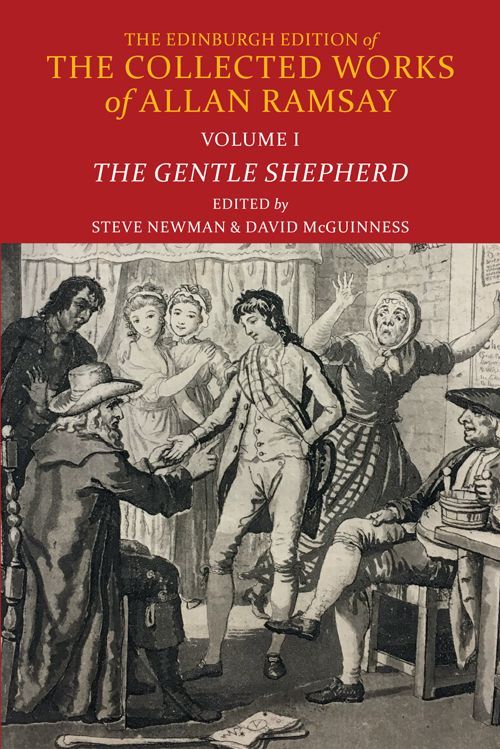
A bit of digging around soon found me another library’s catalogue record of Ramsay’s ballad opera in that very edition – a particularly significant edition, because it’s the most lavish, quite apart from having the complete vocal score section. RCS lecturer Brianna Robertson-Kirkland has researched the work in detail and written an article about it, which is on one of her class reading-lists. Dr David McGuinness, with whom I worked on the HMS.Scot AHRC-funded project a few years ago, has also recently published a book about it, with Steve Newman.
The new Edinburgh Edition of The Gentle Shepherd
But the catalogue record didn’t exactly fit my purpose, because what I had in my hand was the appendix at the end of the book, containing all the songs. We didn’t have the text of the ballad opera at all.
No problem – I downloaded the catalogue record and adapted it to reflect what we did have. I made sure the words ‘Scottish songs’ appeared in the catalogue record, and I indexed every one of those songs. The appendix is only eighteen pages long – it wasn’t that arduous a task. I’m really happy that we’ve been given this, because – even though it’s fragile and will have to be handled with extreme care – it means the students will now be able to see the music that Brianna has written about, and lectures about. (It still needs a nice stout card folder, and a secure storage space – but they’ll be sorted out soon.)
Informed Cataloguing
There’s one strange thing, though. It appears no other cataloguer has catalogued each song in The Gentle Shepherd – not in Jisc Library Hub, at any rate. Well, although we at RCS might not have the whole magnificent text, a title page or a cover, we HAVE now got a catalogue record which indexes all the songs. Hooray!
Contents:-
The wawking of the fauld (1st line: My Peggy is a young thing)
Fy gar rub her o’er wi’ strae (1st line: Dear Roger, if your Jenny geck)
Polwart on the Green (1st line: The dorty will repent)
O dear mother, what shall I do (1st line; O dear Peggy, love’s beguiling)
How can I be sad on my wedding day (1st line: How shall I be sad when a husband I hae?)
Nansy’s to the green-wood gane (1st line: I yield, dear lassie)
Cauld kail in Aberdeen (1st Line : Cauld be the rebels cast)
Mucking o’ Geordie’s byre (1st line: The laird, wha in riches)
Carle, an’ the king come (1st line: Peggy, now the king’s come)
The yellow-hair’d laddie (1st line: When first my dear ladie gade to the green hill)
Kirk wad let me be (1st line: Duty, and part of reason)
Woe’s my heart that we shou’d sunder (1st line: Speak on, speak thus)
Tweed Side (1st line: When hope was quite sunk in despair)
Bush aboon Traquair (1st line: At setting day and rising morn)
The bonny grey-ey’d morn
Corn-Riggs (1st line: My Patie is a lover gay)
I struggled to explain to my family just how gratifying I find this. But I think it’s really important not only that Brianna’s students can see which songs are in Foulis’s edition of The Gentle Shepherd, but also, anyone looking for one of those song titles will be able to see that it was one of the songs used in the famous ballad opera.
The Gentle Shepherd / Allan Ramsay ; edited by Steve Newman, David McGuinness.
As a matter of interest, we do also have some items going back to the era when Cedric Thorpe Davie put on a performance of the opera. Anyone checking our catalogue will spot those too!
The Gentle Shepherd: a pastoral comedy / by Allan Ramsay ; abridged and adapted for performance at Edinburgh International Festival by Robert Kemp [bound photocopy, 47 p.]
I accepted a generous donation of old books to the Library a couple of weeks ago. This presented me, personally, with a bit of a problem because our offices, furniture and contents are being moved around, and I had proudly emptied most of my shelves in readiness. There will be fewer shelves in the other office. And now I had two shelves full of old Scottish music – right up my street – which needed cataloguing.
Most vital priority – get them done before I retire from the Library.
Almost as vital – to get them done before the move on Thursday next week!
Of course, the lovely thing is that they’re books I’ve encountered in various research contexts … the PhD; the Bass Culture project (https://HMS.Scot); the book chapter on subscriptions; and my own forthcoming monograph.
I catalogued like crazy on Thursday and Friday. I’ve catalogued Sammelbande (personal bound volumes) of songs, piano music and fiddle tunes. I’ve shown colleagues books signed by George Thomson. I’ve indexed Gow’s strathspeys and reels. And yesterday I blogged about James Davie and his Caledonian Repository.
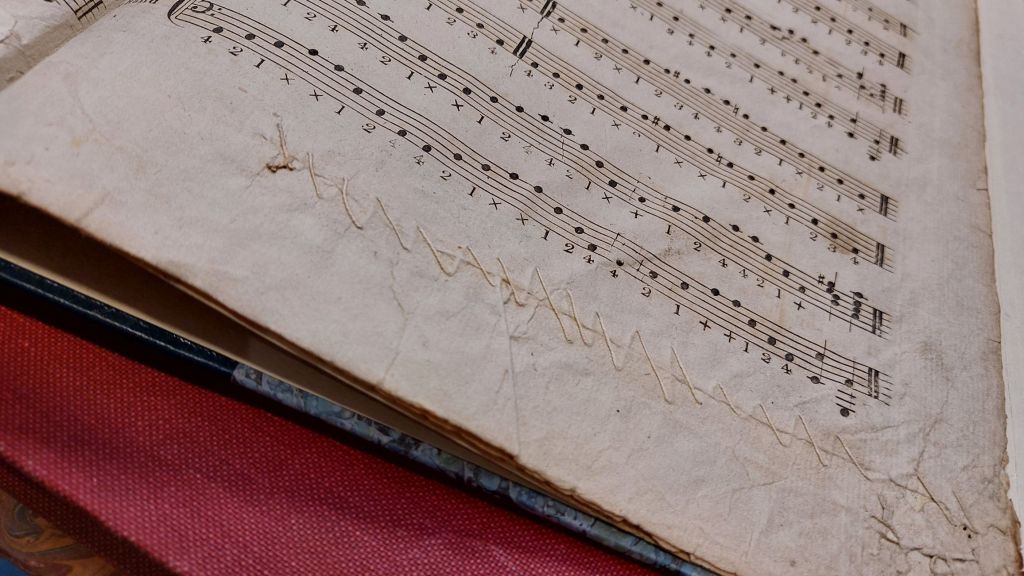
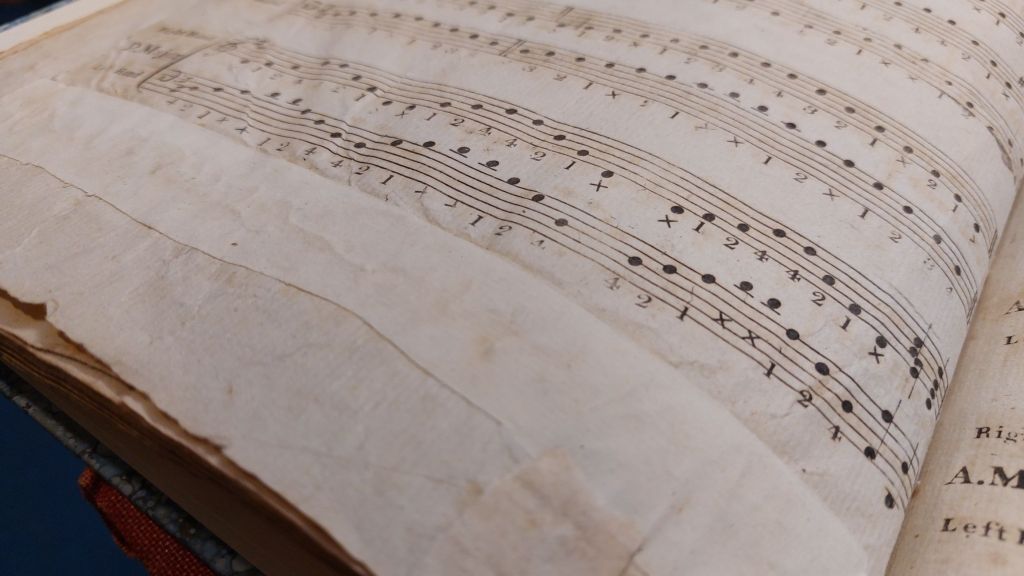
But I’ve also just enjoyed handling the music, because sometimes one finds some endearingly human evidence of the scores being used, even to the point of needing mending. It’s quite touching to ponder how much a piece had been used, before it actually needed stitching – here, along a line where the edge of the printer’s block had originally left a dent in the paper:-
Stitched on one side, pasted on the other!
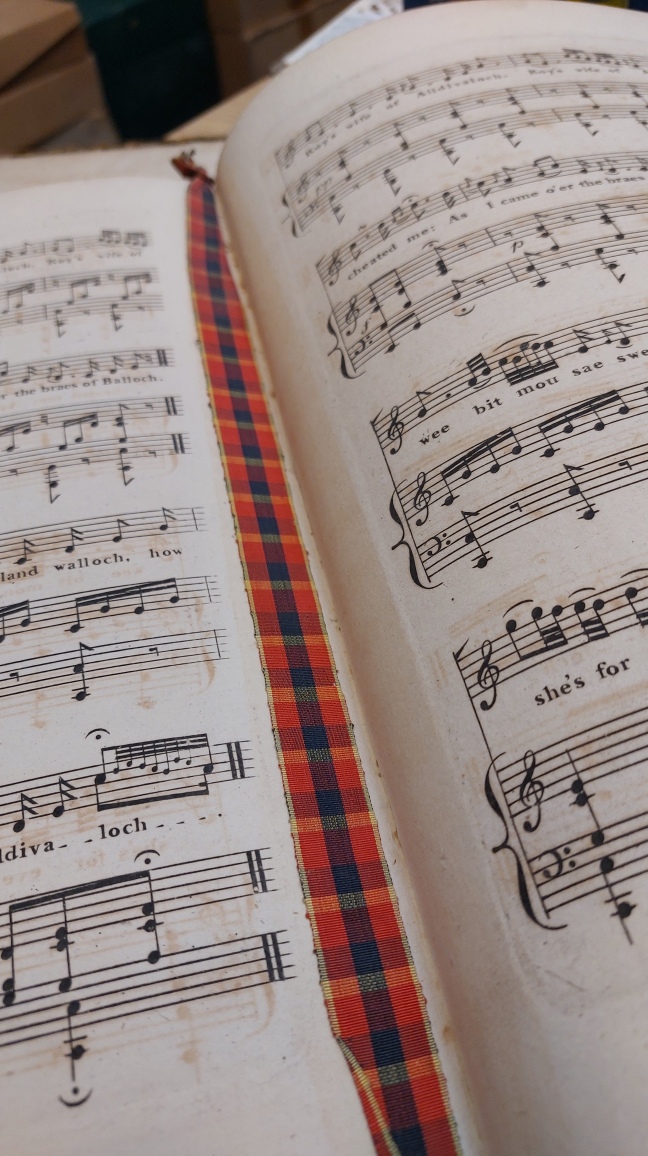
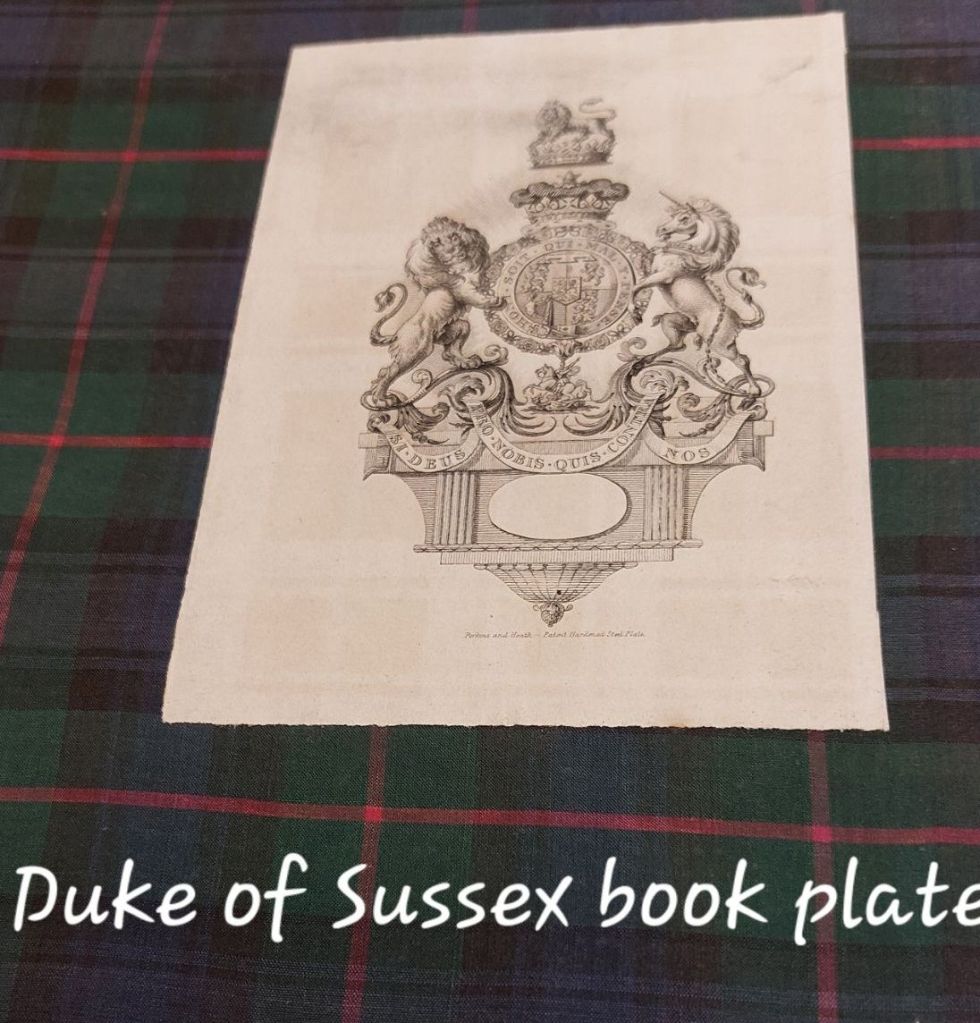
I’ve smiled at Georgian ladies’ stitched repairs to much-loved pieces, noticed with amusement a handful of early Mozart Allan books (yes, including some strathspeys and reels) in a fin-de-siecle Sammelband which had seen better days; spotted piano fingerings pencilled in; and best of all, found a tartan ribbon in a volume dedicated to the Duke of Sussex – his personal copy, which was first sold out of the family’s possession in 1844. His library was dispersed after he died in straitened financial circumstances:-
Nine Scots Songs and three Duetts, newly arranged with a harp or piano forte accompaniment / by P. Anthony Corri
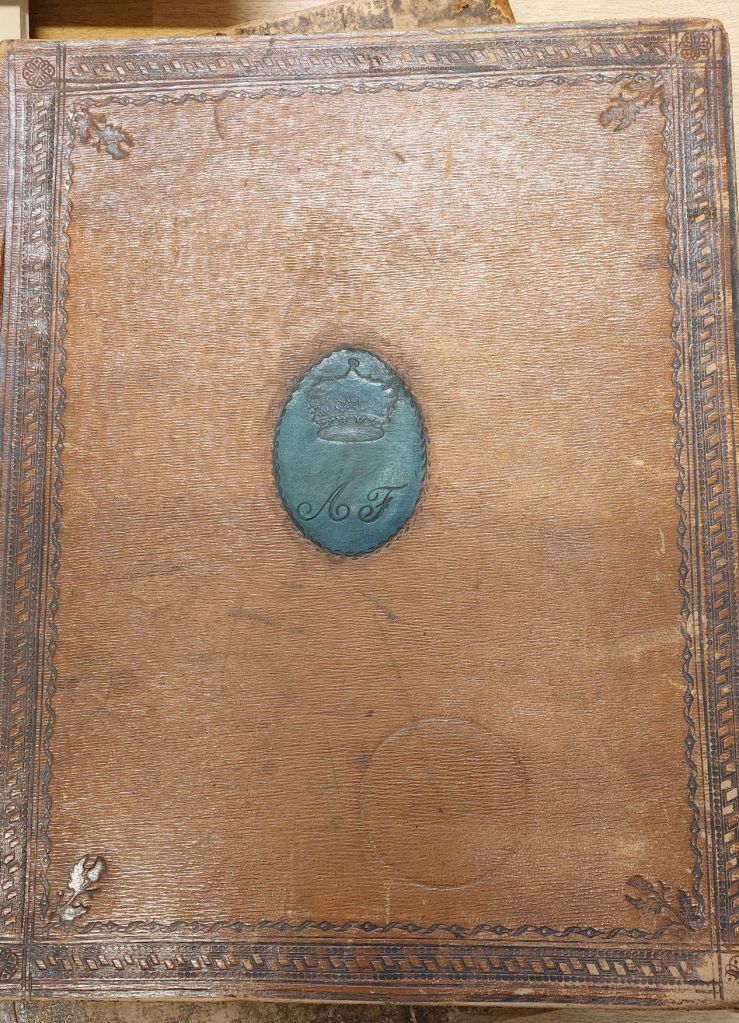
This book has the Duke’s family crest on a label pasted inside, and the outer cover is embossed with ‘A F’ (Augustus Frederick), reflecting the monogram on the title page.
The Duke of Sussex’s mongramAugustus Frederick, Duke of Sussex (1773-1843)
The tartan endpapers and tartan ribbon between pp.30-31 are a perfect illustration of what I have written about in a chapter on tartanry in my forthcoming monograph. Everyone – whether nobility or commoner – liked a bit of tartan on or inside their Scottish song books, and here, someone even found a bit of tartan ribbon to use as a bookmark.
I have just a few of those books left to catalogue now. There’s an intriguing one without a cover or title page, waiting for 9 am on Monday …! Hopefully, I’ll end up with an empty bookcase again.
To be fair, David Baptie spoke highly of the Aberdonian James Davie, an early to mid 19th Century Scottish song enthusiast. He was a friend of the Dundonian song collector James Wighton.
However, correspondence between the two men reveals him writing sour objections to other contemporaries’ activities and opinions. I quoted some of his grumblings in my first book, Our Ancient National. Airs. I formed the impression that he was decidedly irritable in his old age!
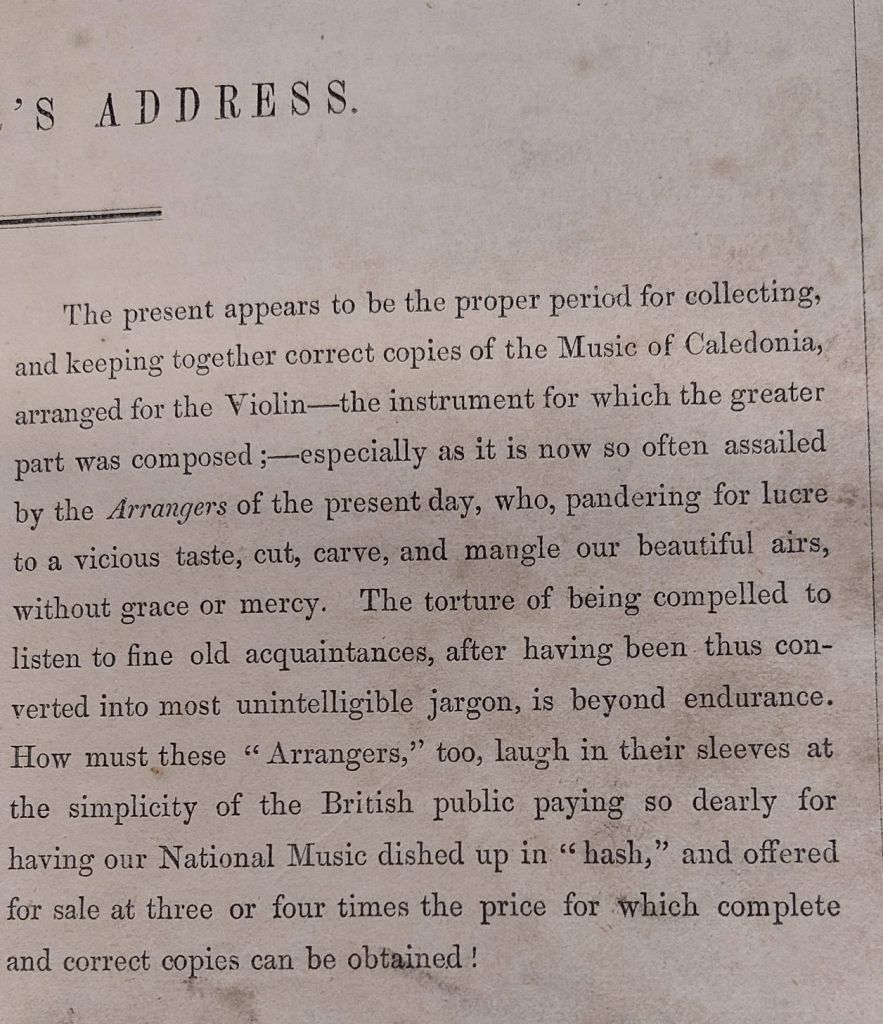
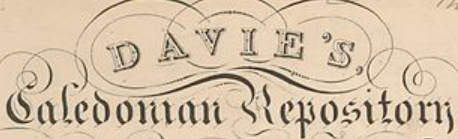
Here he is, in characteristic tone at the start of his CaledonianRepository:-
Arrangers? Pshaw!
Notwithstanding this, I was excited to accession several books of this Caledonian Repository to the library, since they’re quite rare. The books are tatty and fragile, but a tangible link with the past – they’re about 200 years old.
The Repository is in two series. We have three books from the first and two from the second. Grateful that the tune contents pages were there, I sorted out which pages belonged where, then catalogued them. Oh, my fingers flew. But the last one that I managed to catalogue before 5 pm yesterday, simply didn’t want to play fair. The catalogue entry was done. But, without going into details, it wasn’t displaying properly.
I went home, had tea, opened the laptop and recatalogued that piece using the info I’d already entered.
No luck.
I removed the identifying sequential number and tried again.
Still no luck.
Maybe ‘something’ magical would happen to it overnight? It was too much to hope! Mr Davie, irascible as ever, did NOT want that book to appear properly in our catalogue.
Finally, my line-manager suggested trying to give it a different barcode. I have absolutely no idea why the system didn’t like the one I’d assigned it, but I did as suggested, and hey presto, we have Davie’s Caledonian Repository, Series 2, Book 2, properly catalogued and accessible.
So that left me with Series 2, Book 1 to do this morning. That book has all its pages, but the page numbering is, shall we say, a little quixotic. Mr Davie has had the last laugh there.
Nonetheless, we do now have all five items in the Whittaker Library catalogue. I like to think Davie would be a little bit pleased!
MOT cancelled on April Fool’s Day; it really was …
I took myself off on a library visit, looking for a peaceful, fruitful day. (Yes, yes, I know – I’m a librarian, and I already work in a library 3.5 days a week. However, researching in a different library is an entirely different experience.)
It was peaceful, though I could have done without the six miles’ walking in the rain! But –
I found nothing related to my research question!
The trouble was, I had to read a lot of stuff, to eliminate it. Having researched music for so long, however, I was enchanted to read about paper pulp, factories, shipping and personnel in Nairobi, Cape Town, India, Toronto … yes, it was 1946-7, and the links were strong.
Then there were paper and bookbinding cloth shortages. Lots of allusions to both.
But was it a wasted journey? On the face of it, I made no progress, but – as you see – I gathered contextual information. From now on, I won’t be parroting those facts, but alluding to situations I’ve witnessed through perusal of correspondence. That does count for something. And I learned a handful of names that I might one day encounter in a musical context.
Oh, and apart from getting drookit (drenched) and walking six miles (thanks, Fitbit), I did get my peaceful day in a library.
Am I a listophile? I started the list to end all lists, on Saturday evening. (Yes, I know. Sad, isn’t it? It’s surely better than the Saturday night trips to the laundry in my student days, though.) I’m going through my book manuscript, tracking EVERY sheet music title that I’ve mentioned.
I should already have them in my epic Zotero bibliography, but for this exercise, I’m also checking off which chapters they appear in. It could be handy when I’m indexing the book in due course. Not only that – if I encounter any date discrepancies, at least I will have the chance to put them right.
But have I created a Monster?
This, dear reader, truly is turning out to be a mega-list. I’m approaching the end of my trawl through Chapter 3 now, and the list is already quite lengthy. On the other hand, since I am likely to be the most knowledgeable authority about publications and publication dates for these particular Scottish publishers, there surely must be some value in this.
And – there are just a few ‘lost books’ amongst them. What could be nicer but more tantalising for a librarian/musicologist/book historian?
It has been a fortnight of revisions. I had a minor tweak to do to my book manuscript, but that was done pretty much in the twinkling of an eye. So far, so good. I zipped it all up in another zip-file, and off it went.
I’m also revising a paper that I’m giving to a professional organisation at the end of April. Most of it is fine, but I have an extra bit I need to add since I last gave the talk to a different group.
But then, yesterday I decided to do some revision to a lecture that I’m scheduled to give to our own students in a month’s time. I’ve given it annually for several years, and each time it gets a little brush-and-polish to reflect any additional thoughts I’ve had on the topic.
This time – and I don’t know why I thought of it – it underwent a slightly more detailed overhaul. Partly, this is because of the work done on my book since this time last year. In March last year, I was still completing the manuscript for the first draft. Now, it’s with the editors, so my thoughts have had time to settle. But actually, it’s quite interesting to stand back and look at this particular lecture, since it draws on my research over two decades, albeit in a pretty superficial way. (Well, how much can be said in an hour?!)
Writing Under Headings
As I read the lecture through for the umpteenth time today, I realised that there were bits of rearrangement to do. I remembered my PhD supervisor’s advice: write headings, then ensure you write to those headings. Today, I retrospectively added some headings and – miraculously – any passages that were slightly out of order pretty much jumped out and slapped me in the face. It definitely improves the clarity of one’s writing.
The controversies around Marjory Kennedy-Fraser’s achievements are clearer with some of the life history pruned out, and her friend Professor Blackie is introduced in a more organised way.
Ironically, my listeners won’t even know what’s changed (and they won’t see those new headings!), but I’ll know it’s more polished, and that’s the main thing.
It’s hard to believe now, just how much more women composers were discriminated against in the past. Today, they’re still struggling for equal recognition, but not as much as when Boosey said he would only publish ‘little songs’ by a woman. It’s not as though there’s a feminine style of composition. We don’t arrange our crotchets and quavers, chords and rhythms in a uniquely feminine way.
I concede that a composer might say their piece was inspired by some aspect of being a woman. Life experiences can inspire any composer. Yet, there are as many experiences as there are people on earth. I don’t think a woman’s music is inherently distinctive, any more than her trumpet playing or any other art-form would be.
Why must we stereotype people? On the face of it, I’m a very conventional, married librarian and mother of three. I look boringly conventional, I freely admit it. Yet I am also the breadwinner, and did a PhD at the second attempt, working full-time throughout. I’ve carved a parallel career as a scholar. Is that conventional? Does it fit the stereotype of a boringly conventional information worker?
Dancing to my own tune
And I’m about to retire from librarianship – but not from research. I’m not going to fit any stereotype of a pensioner, either. (Daytime TV and bingo sessions have absolutely no appeal for me – I might explode if anyone tries to categorise me into those particular boxes!) I have a second monograph and two book chapters to see published before or as I move on with my research plans.