the Scottish Music Publishers and Pedagogues inspiring Hearts and Minds through Song’
You just have to get to St Andrews!
Thursday at 5.30 pm
https://x.com/ISHRStAndrews/status/1726346251262722510?t=Pcj4iHBLW-ABj4-jzAECvw&s=09


Dr Karen McAulay explores the history of Scottish music collecting, publishing and national identity from the 18th to 20th centuries. Research Fellow at Royal Conservatoire of Scotland, author of two Routledge monographs.

the Scottish Music Publishers and Pedagogues inspiring Hearts and Minds through Song’
You just have to get to St Andrews!
Thursday at 5.30 pm
https://x.com/ISHRStAndrews/status/1726346251262722510?t=Pcj4iHBLW-ABj4-jzAECvw&s=09

It occurred to me that many folk with a recently finished PhD or some other significant piece of research, must wonder whether to publish it as a book. Now my second monograph has moved to the revision stage, I thought I’d share a few thoughts on the process.
Everyone will arrive at this point with different prior experiences. In my case, I’ve written in a variety of formats and contexts. All writing experience is useful, even if you have to adopt different styles and protocols.
So, here I am, revising the draft of my second monograph. And it’s different. It’s like swimming – eventually you take off your armbands, do a few lengths of the pool, and at some point, head for the sea. I can’t talk about writing a non-academic book, but I can certainly outline what’s likely to happen with a scholarly one.
And then – if it hasn’t happened already – someone utters the dreaded words,
“And what’s your next book going to be about … ?”
Unknown, interested well-wisher

Choosing more diverse repertoire is challenging for instrumentalists and singers. For four or more years, I’ve been working hard on increasing our stock in this area – music by women, music by BIPOC composers, and, of course, music by women who are BIPOC composers – and I’ve compiled some helpful lists of music in stock at the Royal Conservatoire of Scotland’s Whittaker Library. They’re posted on the library WhittakerLive blog.
I intend this to be my legacy when I retire from the Library in July 2024.
Image by Gerd Altmann from Pixabay

The Fellow had a migraine yesterday.
Caffeine, carbs, codeine and a lunchtime walk restored me to near normality, so I did some reading in preparation for the book revisions, and continued the task today. But migraines are very draining, so I’m tired!

I have taken annual leave in order to spend my Thursday afternoons researching, to maximise the time I have in St Andrews. So I settled down to do what needs doing, but STILL I received emailed queries. I spent as little time as I could, but readers shouldn’t be kept waiting. Anyway, back to the research ….
Having a finite amount of time certainly concentrates the mind. Is this relevant? Useful? How does it help the argument?
It pays to get an oversight of a book’s chapter structure, and to make use of the index. If something is in digital format, searching for keywords certainly gives an indication as to whether it’s worth spending time on.

Next week, I’m giving another talk, this time to the Institute of Scottish Historical Research. It’s all written, so I just need to read the whole thing out loud to myself between now and then, to ensure there are no tongue-twisters to trip me up!

And after carrying far too much to last week’s talk, be assured that I won’t make the same mistake again! My props will be no larger than will fit in a pocket.
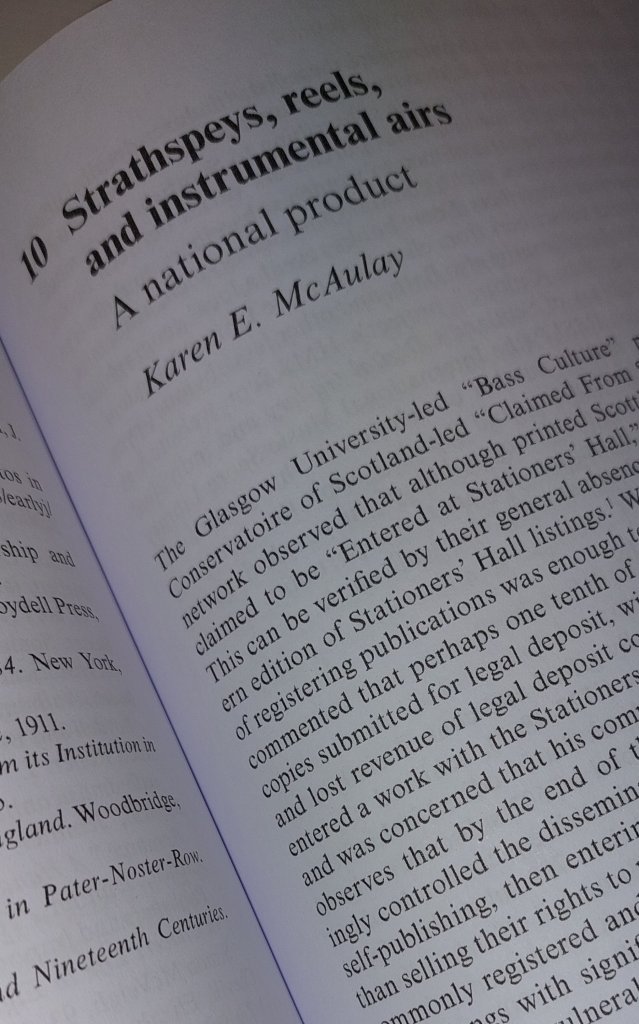
Music by subscription : composers and their networks in the British music-publishing trade, 1676-1820 / edited by Simon D.I. Fleming, Martin Perkins. (Routledge, 2022)
I wrote a chapter for this book, which came out in 2022. I wonder if anyone has read RCS’s e-book version? The hardback itself seems to have sat on the shelf unnoticed for a whole year ….
‘Strathspeys, reels, and instrumental airs: a national product’ (pp.177-197)

It wasn’t until I needed to draw up a list that I realised just how much I’ve focused on British women in music in my research over the past five or six years! Quite a bit, it appears.
‘Mrs Bertram’s Music Borrowing: Reading Between the Lines’, 18 Sept 2017, Guest blogpost: EAERN (Eighteenth-Century Arts Education Research Network) https://eaern.wordpress.com/2017/09/18/mrs-bertrams-music-borrowing-readingbetween-the-lines/
‘My love to war is going’: Women and Song in the Napoleonic Era’, jointly authored with Brianna Robertson-Kirkland, Trafalgar Chronicle, New Series 3 (2018), 202-212.
‘A labour of love for Miss Lambert’, Nov 20, 2019, Personal blogpost: https://karenmcaulaymusicologist.blog/2019/11/20/a-labour-of-love-for-miss-lambert/
‘The sound of forgotten music: Karen McAulay uncovers some of the great female composers who have been lost from history’, in The People’s Friend, Special Edition, 11 Sep 2020, 2 p. Dundee : D C Thomson.
‘A Music Library for St Andrews: use of the University’s Copyright Music Collections, 1801-1849’, in Journal of the Edinburgh Bibliographical Society no.15 (2020), 13-33.
‘An Extensive Musical Library’: Mrs Clarinda Webster, LRAM, Brio vol.59 no.1 (2022), 29-42
‘Representation of Women Composers in the Whittaker Library’, Journal of Perspectives in Applied Academic Practice. Vol. 11 No. 1 (2023): Special Issue on Breaking the Gender Bias in Academia and Academic Practice, pp.21-26. (Paper given at the International Women’s Day Conference hosted by the University of the Highlands and Islands, 2022.) DOI: https://doi.org/10.56433/jpaap.v11i1.533
Newsletter article, ‘‘Our Heroine is Dead’: Miss Margaret Wallace Thomson, Paisley Organist (1853-1896)’, The Glasgow Diapason, March 2023, 10-15. (You can find this article in full on this blog)
FORTHCOMING: Article in History Today – due Dec 2023 [Marjory Kennedy-Fraser and Annie Gray, fin-de-siecle performers]

One day, when I’ve retired from librarianship, all that will be left to show for my 36 years here will be the books and music on the shelves – and their catalogue records. Naturally, I made sure RCS has a copy of Mozart Allan and Jack Fletcher’s The Glories of Scotland in Picture and Song. Click on the title to see how I’ve catalogued it!
I think you’ll agree I’ve managed to insert enough hints as to why I think it’s significant. There’s a book chapter coming out in an essay collection from the Centre for Printing History and Culture at Birmingham City University, so there will be more to read in due course.

The Fellow sits outside Cromars fish and chip shop, and cogitates. The chips – which were too hot to handle five minutes ago – have magically cooled to the ‘am I still enjoying these?’ stage, but I have achieved my aim: a short walk by the sea, and chips outdoors for lunch. Now I have to go back to my desk and face The Fear.
Writing a book? You take a deep breath, and start. One chapter at a time, head down and just keep going.
You get it as good as you can, submit it, and wait for the feedback. Not so different from writing an academic assignment, really.
The report comes back. Taking a deep breath, you read it. Then again, carefully. In my case, it was kind and eminently reasonable. After a bit of thought, you respond.
But now for the scary bit! The revision. At this point, you have to address the gentle suggestions for improvements. Not only are you reaching into the recesses of your brain to produce new sparkling prose to align with someone else’s carefully considered suggestions, but there’s another deadline.
I’ve booked some scattered annual leave (so as not to cause too much inconvenience) and mapped out my time.
The Fellow has a busy couple of months ahead, disregarding the festive season!

I attended a lunchtime concert, gave a talk, and heard a doctoral presentation. Surprisingly – or maybe not – I’m knackered!

I have a bone to pick with Mozart Allan. I brought a backpack full of his publications with me. If anyone has seen a small, middle-aged woman with a heavy backpack, staggering around St Andrews, the lady is not a tramp! It just renders me incapable of going up or down stairs at anything faster than snail’s pace.
I really HAD to bring Morven with me, but I was starting to regret my decision before I’d even reached St Catherine’s Lodge yesterday morning! Much as I love my travelling companions, I’ll be glad to put them safely back on my shelf at home, where they can talk about the exciting time they had being the centre of everyone’s attention.

I would still have preferred a couple more hours’ sleep yesterday morning, but I sat down to revise my paper in the afternoon, and found my early morning brain had done me a favour: moving a couple of chunks of text didn’t involve much rewriting, and I think it makes a more interesting narrative.
My weekend working pattern is a bit disjointed – anyone running a household will understand – but that’s just my reality. Revise a bit of writing – start cooking dinner – a bit more revision. And so on. I tell myself that my subconscious mind is still working on it. (So, when I was carving the roast …? No, I don’t believe it was working at all!)

I also timed my paper. I think I must still read a bit too fast, though, although I do try to pace it. I don’t gabble. Maybe I should try again tonight, as slowly as I can manage. How do other folk get themselves to slow down? Any special strategies, tips or hints?
Here are suggestions from friends and colleagues. I’ve been practising with the first two already:-
I woke early again this morning, but thankfully my wakeful brain wasn’t in editorial mode today…

